Why we're building the Laabh app on Compose Multiplatform
One Kotlin codebase for Android and iOS: why it suits an investing app, what stays native, and the trade-offs we are accepting.
Summarize this article with AI





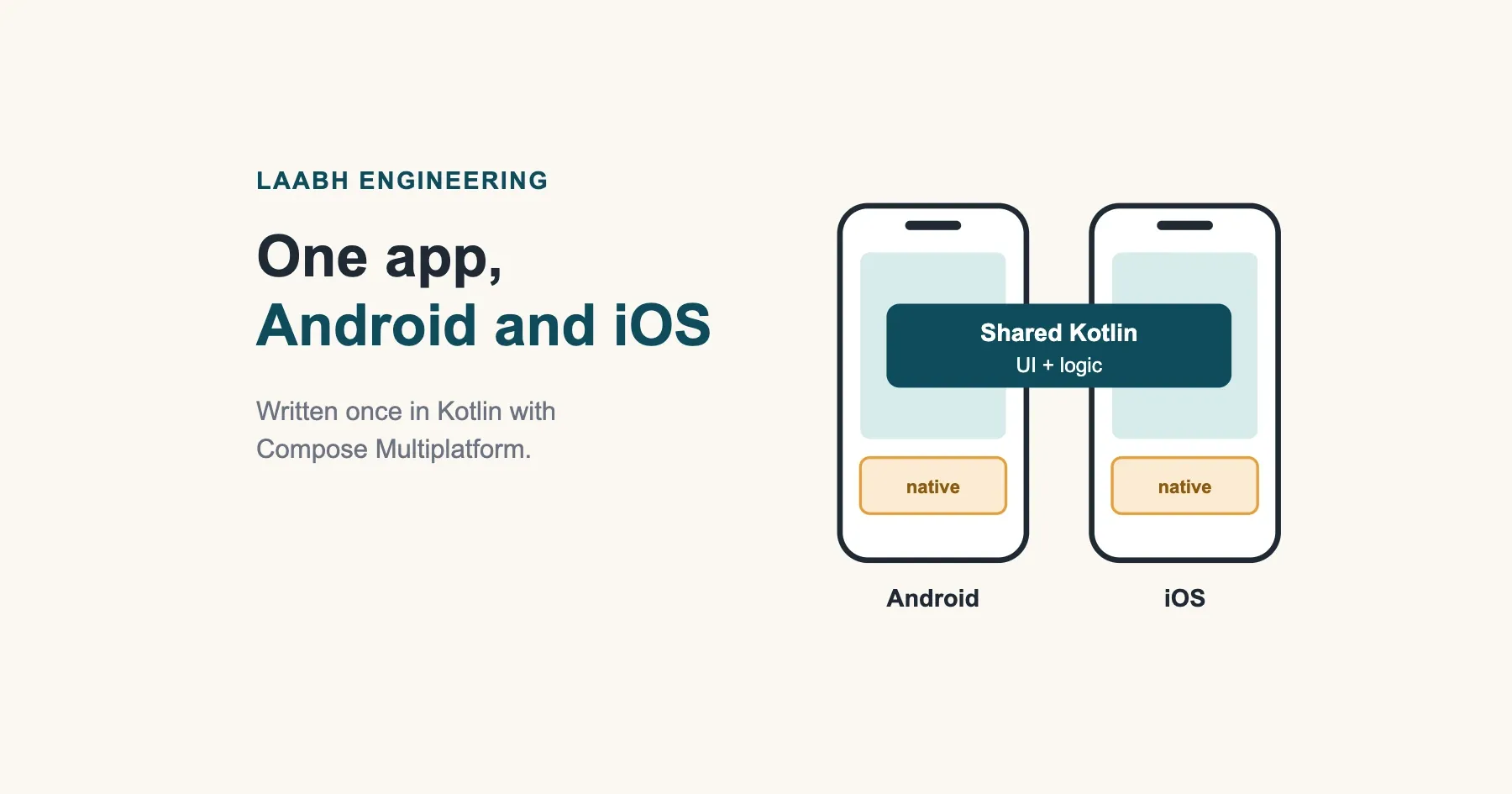
Laabh is building one investing app for stocks, F&O and mutual funds, starting with mutual funds. We are writing it once, in Kotlin, with Compose Multiplatform, and shipping the same app to Android and iOS. That makes Laabh one of India's first investing apps built entirely on Compose Multiplatform.
This post explains what that means, why it suits an investing app in particular, and what we are giving up to do it.
What Compose Multiplatform is
Compose Multiplatform is a UI framework from JetBrains, the company behind Kotlin. It is built on Jetpack Compose, the toolkit Google recommends for Android UI, and extends it to iOS, desktop and the web.
- Shared UI: screens, components and navigation are written once and drawn natively on each platform.
- Shared logic: Kotlin Multiplatform lets the same business rules, networking and data code run on Android and iOS. Google has officially supported Kotlin Multiplatform for sharing code between Android and iOS since 2024.
- Stable on iOS: JetBrains declared Compose Multiplatform for iOS stable and production-ready in May 2025, with version 1.8.0.
Why it suits an investing app
In most apps, a small difference between the Android and iOS versions is a cosmetic bug. In an investing app it can mean an order behaves differently depending on which phone you hold. Writing it once removes a whole class of those problems.
- One order pad. The rules that check an order before it leaves your phone (quantity, price bands, order type, the mutual fund cut-off time) live in one place, so they behave the same everywhere.
- One set of numbers. Returns, NAVs, P&L and charges are calculated and formatted by the same code, so two phones never show two answers.
- One wording for what matters. Risk disclosures, confirmations and error messages come from the same source, so nothing gets lost in a second translation.
- Fixes ship together. A bug fixed once is fixed on Android and iOS in the same release, instead of two teams fixing it on two timelines.
What stays native
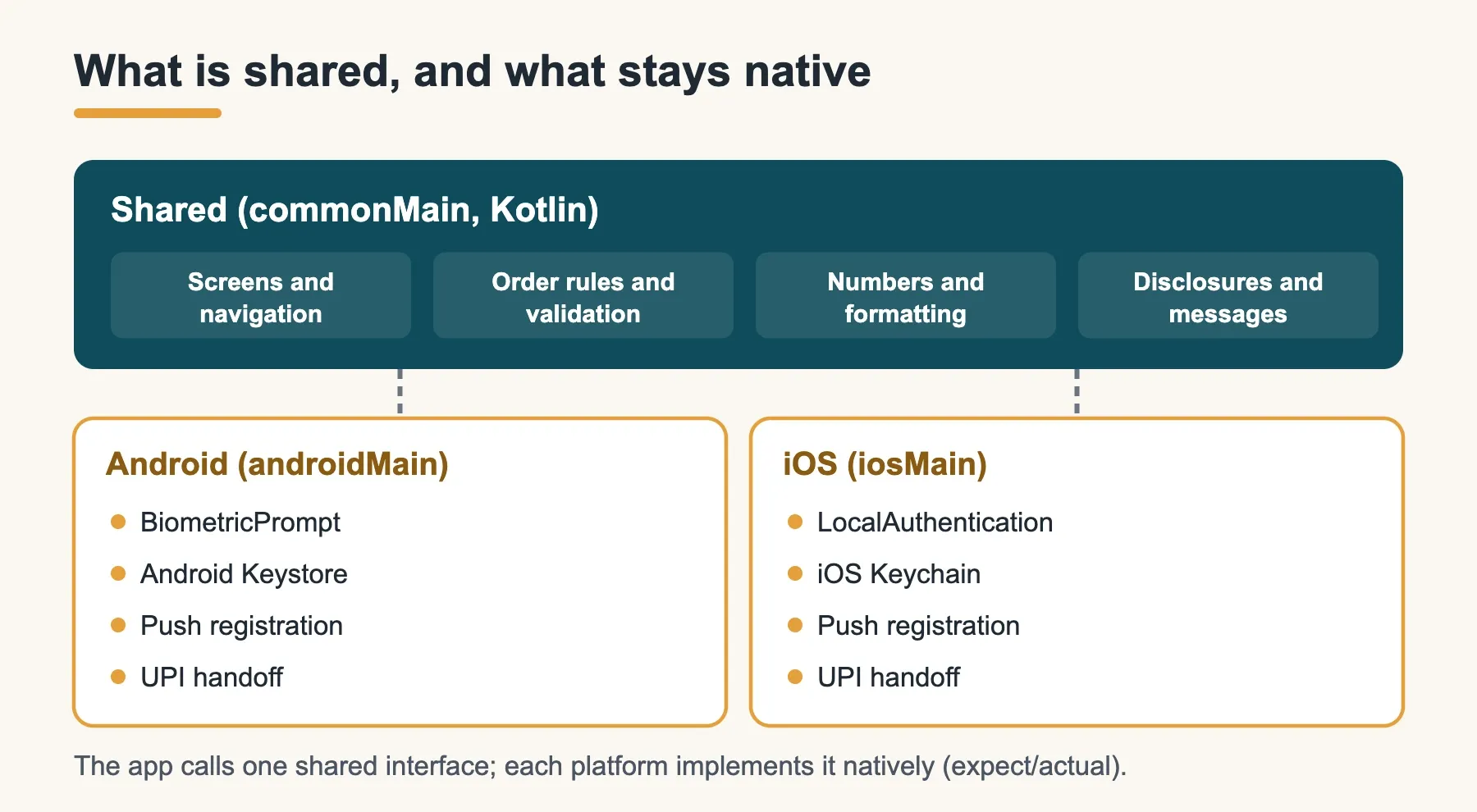
Not everything should be shared. Where the platforms differ in ways that matter for security or feel, we keep native code behind a small shared interface, using Kotlin's expect/actual mechanism:
- Biometric unlock: BiometricPrompt on Android, LocalAuthentication on iOS
- Secure storage for keys and tokens: Android Keystore and the iOS Keychain
- Push notification registration
- Handing off to UPI and banking apps for payments
// commonMain: the app only sees this
expect class BiometricGate {
    suspend fun authenticate(reason: String): Boolean
}

// androidMain: implemented with BiometricPrompt
// iosMain: implemented with LAContext (LocalAuthentication)
The trade-offs we are accepting
- iOS feel needs care. Compose draws its own UI on iOS, so details iPhone users notice, like scrolling, text selection and keyboard behaviour, need testing on real devices, not just simulators.
- A larger iOS app. The rendering engine ships inside the app, so the iOS download is bigger than a fully native app's would be.
- A younger ecosystem. There are fewer ready-made libraries and fewer engineers with production experience than for native iOS or Android, so we build more ourselves and hire people who want to learn it.
We think one app that behaves the same on every phone is worth these costs, and we will write about what we learn as we go.
What comes next
Mutual funds come first. Stocks and F&O follow on the same codebase. In later posts we will cover how prices stream into the app, how an order travels from your tap to the exchange, and how we test one app on two platforms.