To spread their money
One fund holds dozens of companies, so a single company having a bad year hurts less.
A mutual fund pools money from many investors into one portfolio, run by a fund manager. Learn how funds work, how a SIP works and what to check before you invest.
A mutual fund collects money from many investors and puts it into a mix of shares, bonds or both. A professional fund manager decides what to buy and sell.
You get units for your money. The price of one unit is the NAV, worked out once every working day. Funds are run by an asset management company and regulated by SEBI.
A fund’s value still moves with the market, up and down.
One fund holds dozens of companies, so a single company having a bad year hurts less.
A fund manager picks and tracks the investments, within rules set out in the scheme documents.
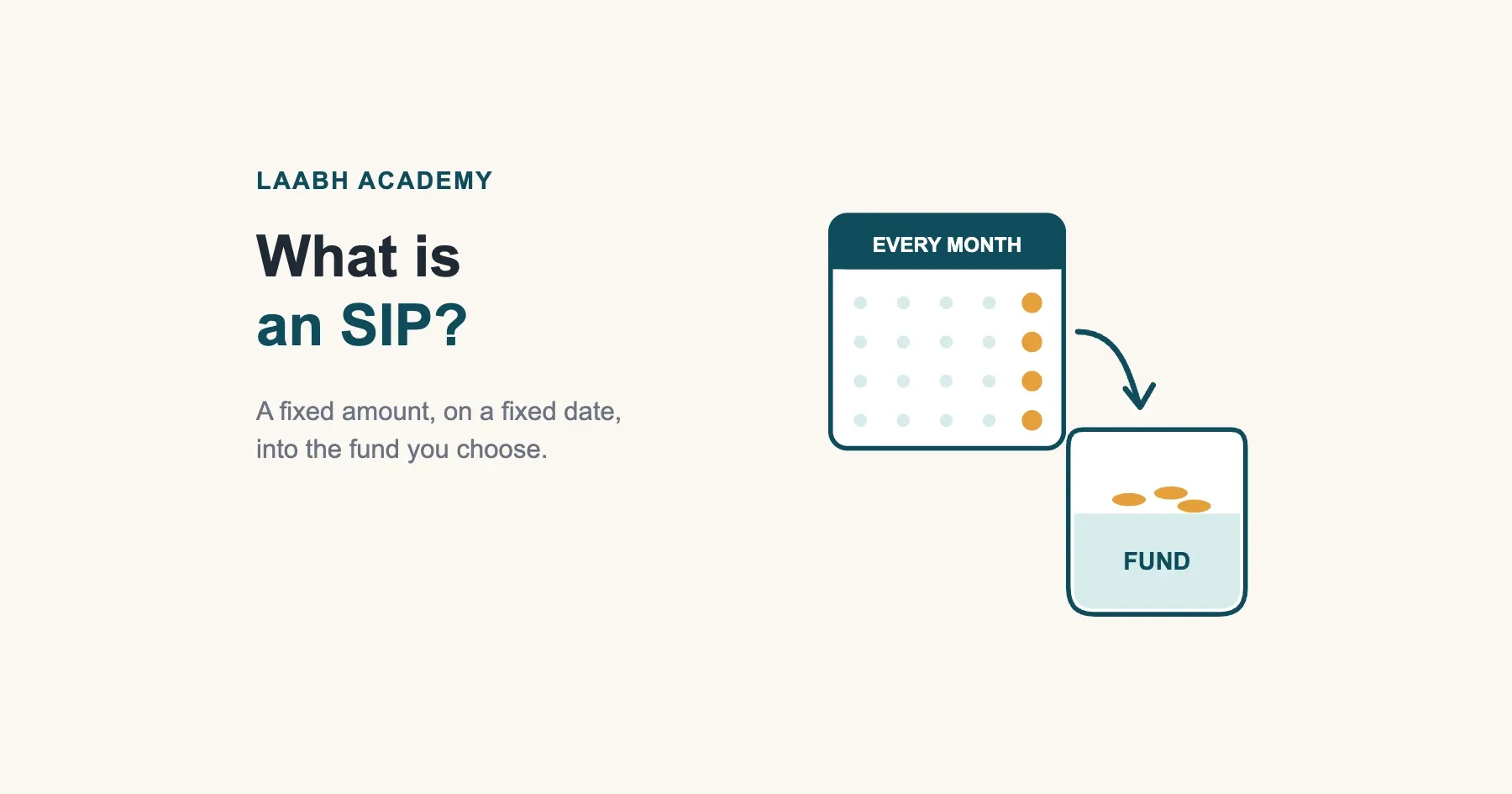
A SIP invests a fixed amount every month, often from ₹100 to ₹1,000, so the habit does the work.
Whether you invest once or every month, your money goes through the same five stages.
Pick the fund, then the Direct plan, with no commission.
A one-time amount, or a SIP on a date you choose.
Your amount ÷ that day’s NAV = the units you own.
It rises or falls with what the fund holds.
Sell some or all units; the money reaches your bank.
Both buy units of the same fund. The difference is when your money goes in, and at what NAV.
Other ways to invest in the market, each with its own risks and costs.
A basket of shares, gold or bonds that trades on the exchange like a single stock, usually at a lower yearly cost than an active fund.
What is an ETF?Buy shares of individual companies yourself. You choose every company, and you carry all of the research and the risk.
What is a stock?An SIP invests a fixed amount in a mutual fund scheme at regular intervals. See how ₹2,500 a month becomes units, and why value can still fall.
Read more →KYC, choosing a fund, picking an amount and date, nominating, and setting up the auto-debit. What happens at each step, and how long your first SIP really takes.
Read more →Exit load in mutual funds explained: how it's charged on each SIP instalment, a ₹ date table, and SEBI's 3% cap under the 2026 Regulations.
Read more →Buy a gold ETF like a share: demat, iNAV vs price, bid-ask, limit orders, costs and 2026 tax rules, with a hypothetical ₹25,000 example.
Read more →What each holds, how each can fall, and what the same ₹2 lakh leaves you after tax at 11 months, 3 years and 7 years.
Read more →How LTCG tax harvesting works for a SIP investor: which units FIFO sells, the ₹1.25 lakh yearly limit, the costs, and when to skip it.
Read more →A mutual fund pools money from lots of people, and a professional manager invests it in shares, bonds or both. You get units in proportion to what you put in, so you own a slice of the whole basket.
NAV (net asset value) is the price of one unit. It is the value of everything the fund holds, minus costs, divided by the number of units, and is worked out every working day.
Many funds accept SIPs from ₹100 to ₹1,000 a month. The fund page shows the exact minimum for SIPs and one-time investments.
An SIP invests a fixed amount at regular intervals, weekly or monthly, so you buy at many different NAVs. A one-time investment puts it all in at once, at one NAV. Either way, you're buying units of the same fund.
A flexi cap fund keeps at least 65% in Indian shares, and the fund manager can move freely between large, mid-size and small companies. Some can also hold a slice in overseas shares.
A Direct plan is bought straight from the fund with no distributor commission, so its yearly cost is lower. A Regular plan includes that commission. Laabh offers Direct plans only.
Yes, for open-ended funds. The money usually reaches your bank within three working days. An exit load may apply if you redeem early, and ELSS tax-saving funds have a three-year lock-in.
Mutual funds are regulated by SEBI, but they aren’t risk-free. Their value moves with the market, and equity funds can fall sharply. Every fund shows its risk on a riskometer.
Gains are taxed when you redeem, and the rate depends on the fund type and how long you held the units. Rules change often, so confirm for your filing year.
Compare Direct plans by category, cost and risk. Reading a fund page is free.
Data: Parag Parikh Flexi Cap Fund is a scheme of PPFAS Mutual Fund. The figures in the app screen shown are samples, not its actual NAV, returns or holdings. App screens are illustrations. Naming the fund is not a recommendation to invest in it.
Mutual fund investments are subject to market risks, read all scheme related documents carefully. Past performance does not indicate or guarantee future returns. This page is for information only and is not investment advice. Tax rules change; confirm for your filing year.
Laabh is a brand of Kautilya Capital Technologies Private Limited (CIN U62099KA2026PTC224259). Investing through Laabh is not available yet; registration details for broking and mutual fund distribution will be shown here when it opens.