F&O margin and lot size, explained through what you can lose
F&O margin is a deposit, not a loss cap. See how lot size sets contract value, why futures can lose more than margin, and what SEBI's study found.
Summarize this article with AI





The short version
- Margin is a deposit collected upfront (SPAN plus extreme loss margin for futures and option sellers; the full premium for option buyers). It is not a cap on your loss.
- The lot size times the price gives the contract value, and the contract value decides how much each point of movement costs.
- SEBI's October 2024 framework requires index derivative contracts to be valued at ₹15 lakh to ₹20 lakh at review, which is why lot sizes are revised.
- Option buyers can lose up to the full premium; futures traders and option sellers can lose more than their margin.
- A margin shortfall you can't meet can lead to your position being closed, and you remain liable for the loss.
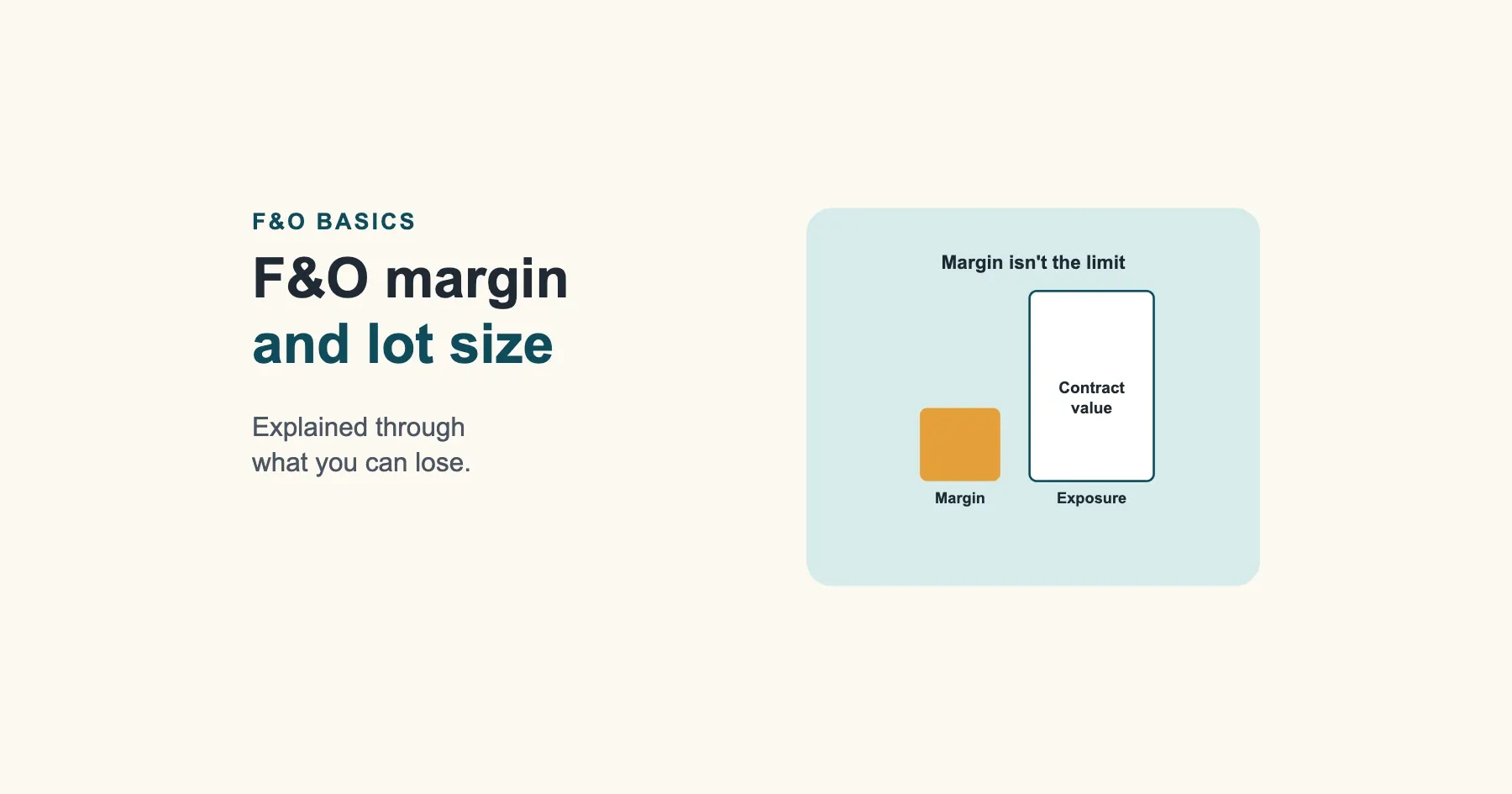
In F&O, margin is the deposit your broker collects before you take a position. It is not the most you can lose. A lot fixes how many units one contract covers, so every point the price moves changes your profit or loss by the full lot. Futures traders and option sellers can lose more than their margin.
A common first question about F&O margin and lot size is "how much capital do I need?" This guide starts with a different question: if the price moves against you, how much can you lose, and where does that number come from? The short answer is that the contract value sets the loss. The margin only sets the deposit you put up.
What is margin in F&O, and is it the most I can lose?
Margin is a security deposit, not a price you pay. When you buy or sell a futures contract, or sell an option, you do not pay the full contract value. The broker blocks a slice of it as margin, and the clearing corporation holds that slice as a cushion against losses.
NSE's guidelines on margin collection say trading members must collect SPAN margin and extreme loss margin from clients upfront in the F&O segment. SPAN margin is worked out from the risk of the whole position, by testing how much it could lose across a range of price and volatility scenarios. Extreme loss margin (brokers often show it as exposure margin) is an extra layer for moves beyond those scenarios.
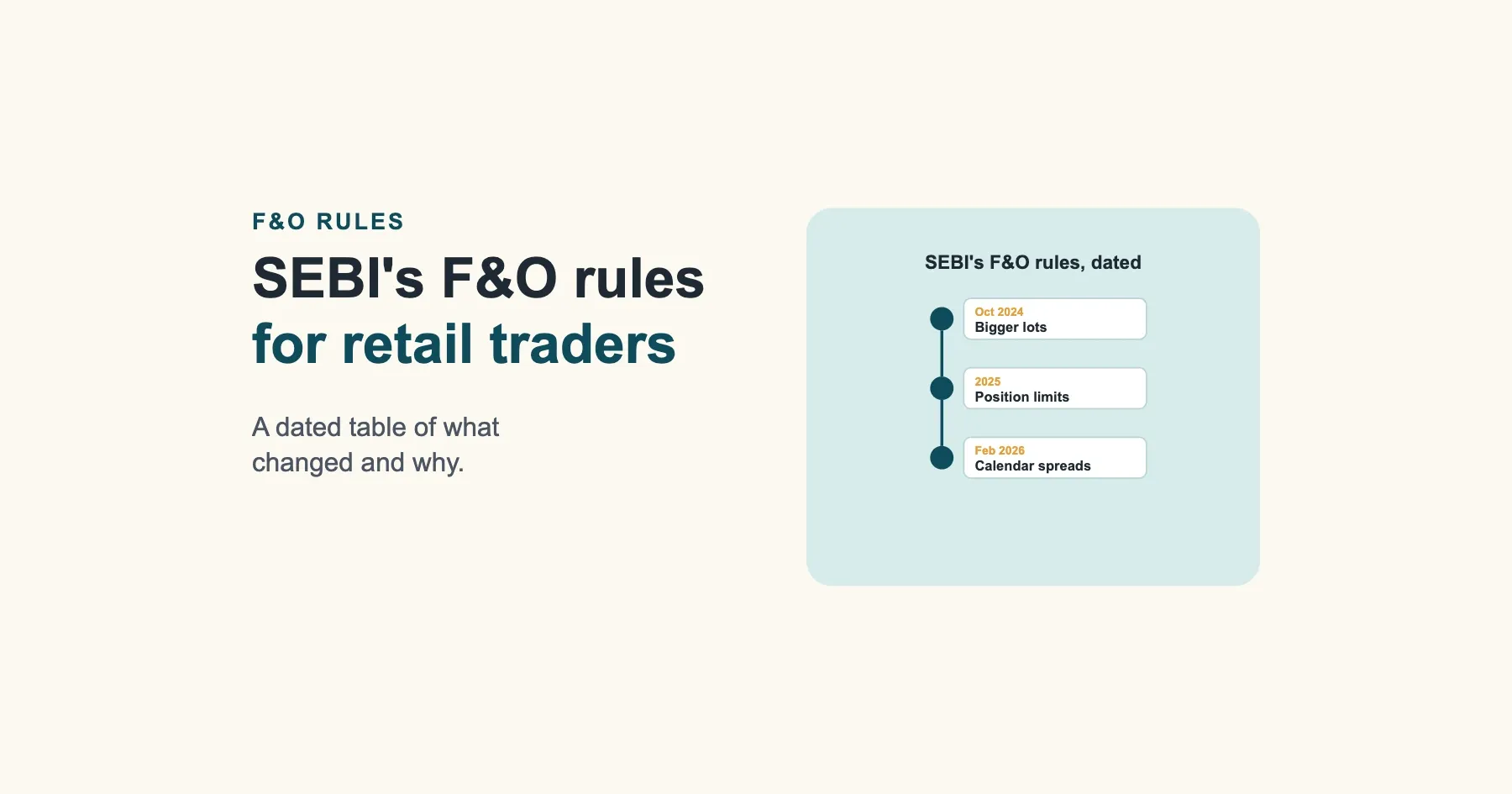
Option buyers work differently. Under SEBI's circular of 1 October 2024, brokers must collect the full option premium upfront from option buyers, effective 1 February 2025.
So is margin the most you can lose? No. Margin is sized to cover what the clearing system expects a position might lose over a short period. Your actual loss depends on how far the price moves, multiplied by the lot. If the move is larger than the margin assumed, the loss is larger than the margin.
What is a lot size, and why did index lot sizes change?
A lot is the fixed number of units in one F&O contract. You can trade one lot, two lots or more, but not half a lot. Multiply the lot size by the price and you get the contract value, which is the size of the exposure you actually carry.
Lot sizes are set by the exchanges, inside a framework SEBI defines. In its 1 October 2024 circular on strengthening the equity index derivatives framework, SEBI said an index derivative contract must have a value of not less than ₹15 lakh when introduced, and the lot size must be fixed so that the contract value on the day of review is within ₹15 lakh to ₹20 lakh. This applied to new index derivative contracts introduced after 20 November 2024.
That is why index lot sizes change from time to time. As an index rises or falls, the exchange reviews the lot so the contract value stays in that band, and announces revisions through circulars. Current lot sizes aren't listed here because they change; check the latest exchange circular for any contract. The full dated list of changes is in SEBI's F&O rules for retail traders.
Why can I lose more than my margin in futures or when selling options?
Because the loss is calculated on the contract value, while the margin is only a slice of it. Here is a hypothetical example to show the mechanics.
Hypothetical example (not a real contract, lot or margin rate; charges excluded):
- One futures lot of 50 units at an index level of 32,000 gives a contract value of ₹16,00,000.
- At an assumed margin of 12%, the deposit is ₹1,92,000.
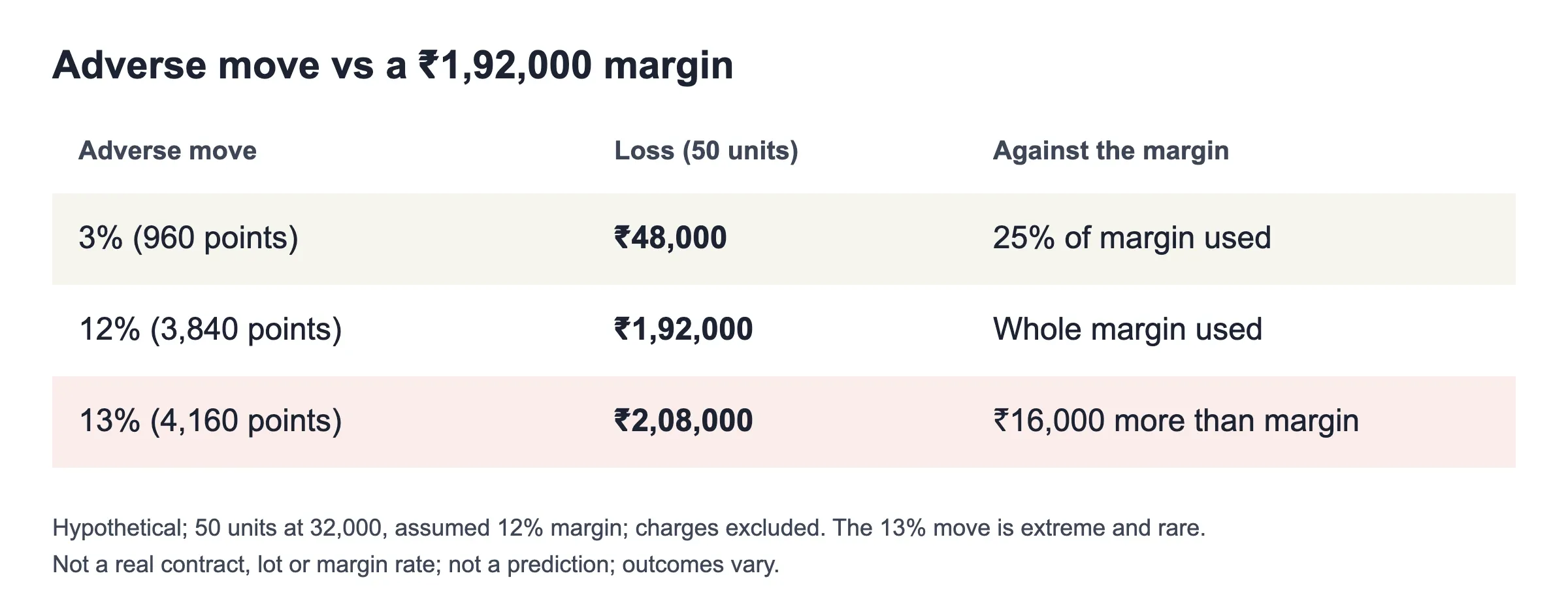
- A 3% adverse move is 960 points. Across 50 units, that loses ₹48,000, a quarter of the margin.
- A 12% adverse move is 3,840 points, which loses ₹1,92,000: the whole margin.
- A 13% adverse move (4,160 points; an extreme, rare move used only to show the mechanics) loses ₹2,08,000, which is ₹16,000 more than the margin.
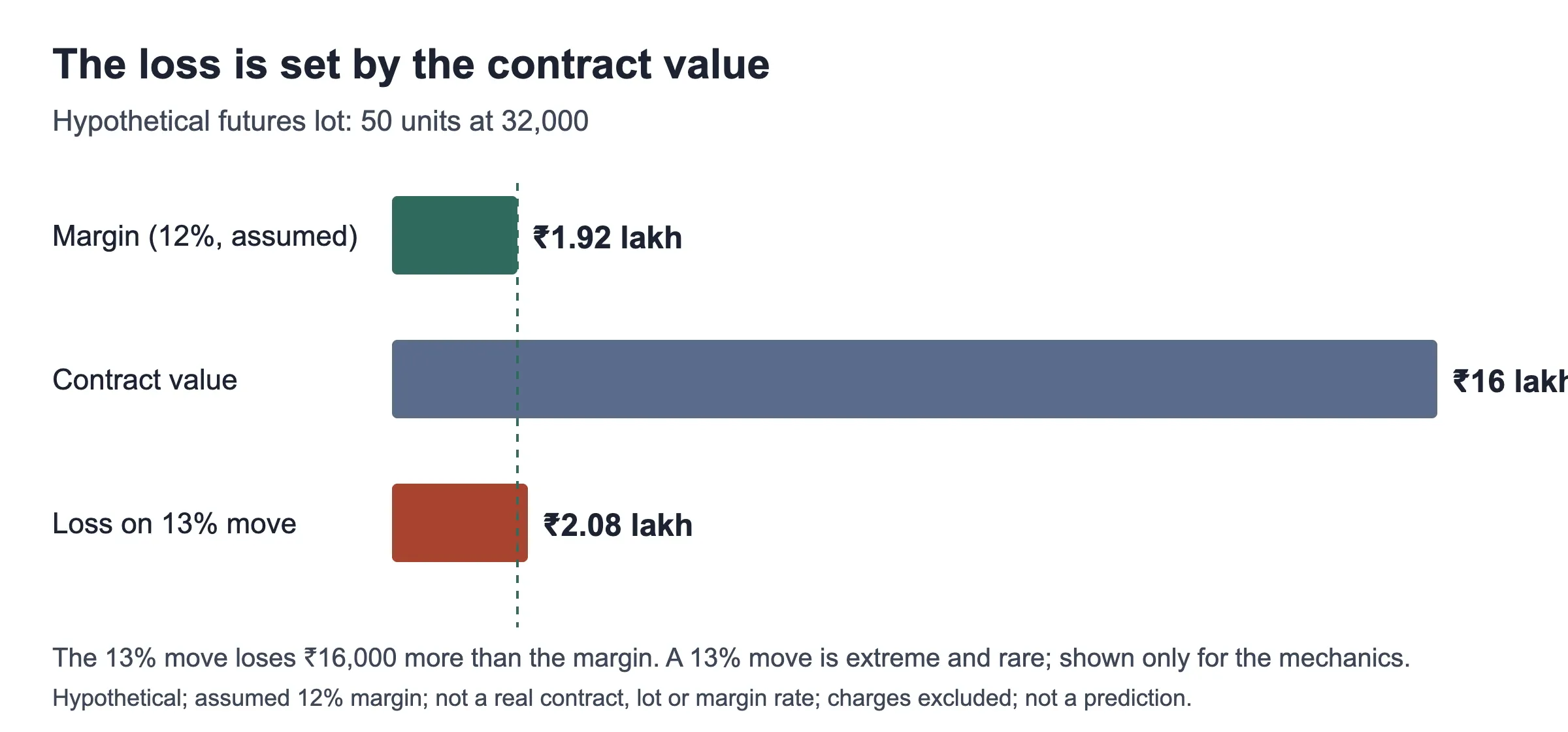
All figures are hypothetical, at an assumed 12% margin rate. This is an illustration, not a promise or a prediction; outcomes vary, and real margins, lots and charges differ.
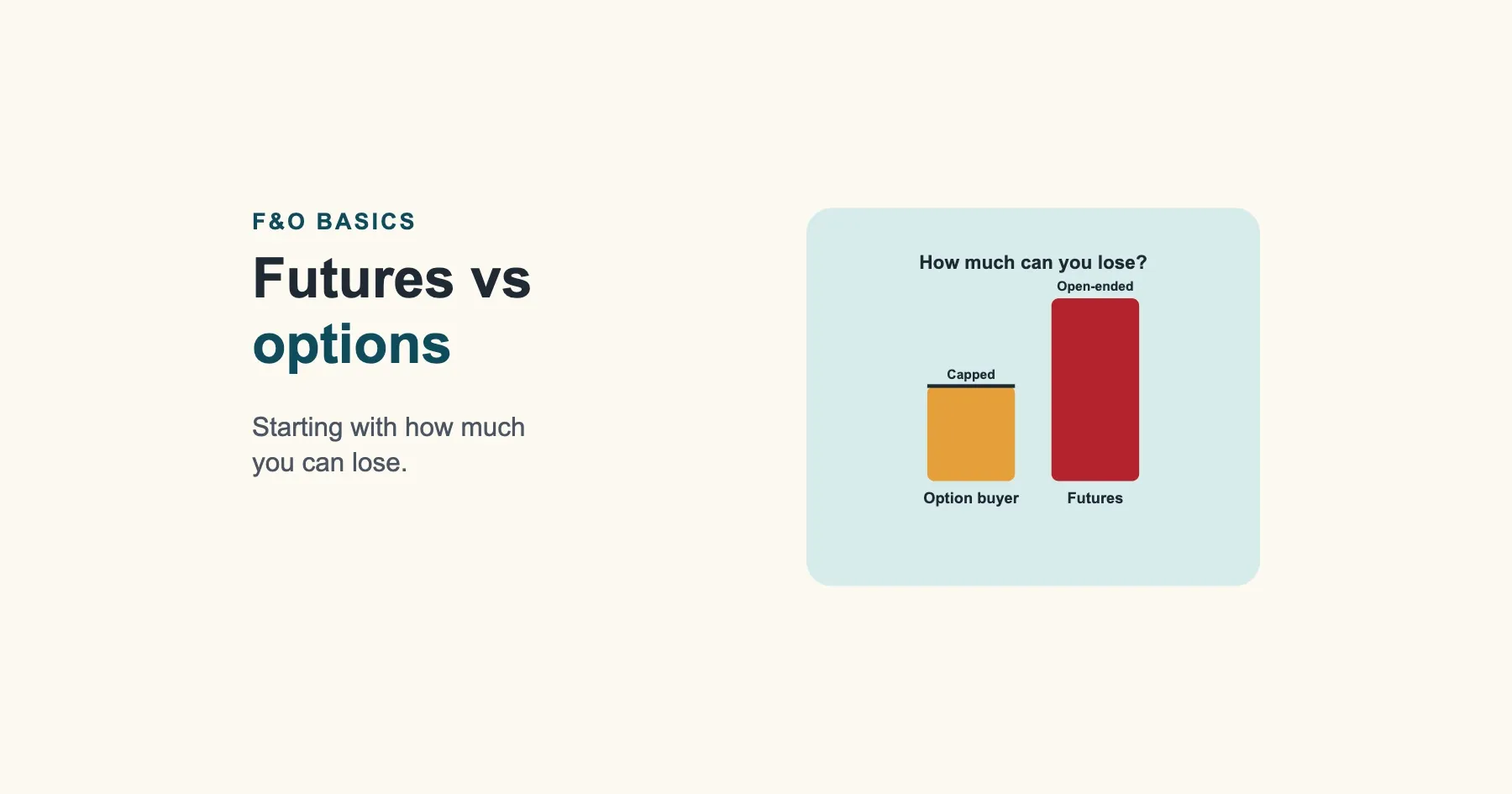
Who can lose what depends on which side you take:
| Position | What you put up | How far the loss can go |
|---|---|---|
| Option buyer | The premium, paid upfront | Limited to the premium paid |
| Option seller | Margin | Can exceed the premium received and the margin |
| Futures (buy or sell) | Margin | Can exceed the margin |
An option buyer's maximum loss is the premium paid, which can still be the whole amount. Option sellers and futures traders carry the full exposure of the contract value, so a large enough move can cost more than the margin they put in. The exchanges' risk disclosure documents for derivatives warn that losses can exceed the original margin amount. For a side-by-side of buyer and seller losses, see futures vs options.
What is a margin call or MTM shortfall, and what happens if I can't pay?
Futures positions are marked to market (MTM) every trading day. That means the day's gain or loss is worked out against the day's settlement price and settled in cash. A gain is credited. A loss is debited from your account balance.
If losses eat into your balance so that it falls below the margin needed for the position, you have a margin shortfall. The broker asks you to add funds, which is a margin call.
If you can't add the money in time, the exchange risk disclosure document for derivatives says the broker may close part or all of your position, and you remain liable for any losses from such close-outs. If the loss is larger than the money in your account, you owe the difference. Exact timelines and any charges for a shortfall depend on exchange rules and your broker's terms, so read them before you trade.
What does F&O actually require, and how many traders lose money?
Instead of asking how much money you need to start, it helps to ask three other questions first:
- What is the contract value of one lot? That, not the margin, is your real exposure.
- How far would the price need to move to wipe out the margin? In the hypothetical example above, that is 3,840 points, or 12%.
- Could I pay a margin call or a loss larger than the margin without touching money you need for rent, EMIs or emergencies?
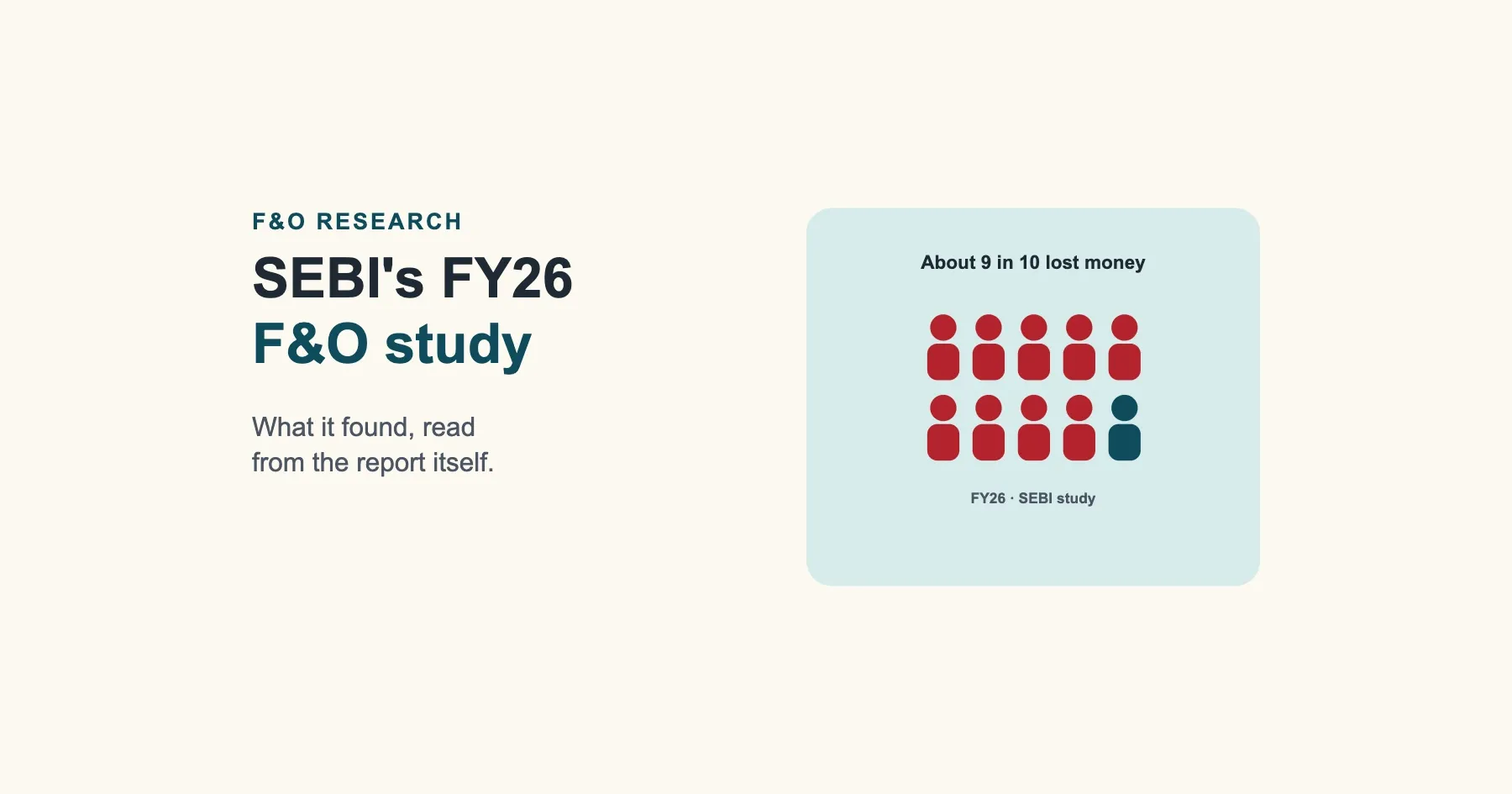
SEBI's own data is a useful check on expectations. Its study, Profitability of Individual Traders in the Equity Derivatives Segment (FY25–FY26), found that:
- 87.7% of individual traders made net losses in FY26, compared with 90.9% in FY25.
- Aggregate net losses of individual traders were about ₹91,685 crore in FY26.
- About 89% of traders under 30 made losses in FY26 (88.55% in SEBI's age table).
SEBI notes that its analysis is descriptive and does not establish causes. Since 1 July 2023, SEBI has also required brokers to show individual F&O traders a risk disclosure on these losses when they log in.
Frequently asked questions
Is margin the maximum I can lose in F&O?
No. Margin is a deposit collected before you take a position. Futures traders and option sellers can lose more than their margin, because the loss is worked out on the full contract value. An option buyer's loss is limited to the premium paid.
What is SPAN margin?
SPAN margin is the main upfront margin in the F&O segment. It is calculated from the risk of the whole position across a range of price and volatility scenarios. NSE's margin guidelines require brokers to collect it, along with extreme loss margin, from clients upfront.
What is peak margin?
Peak margin refers to checking margins through several snapshots taken during the trading day, not only at the end of the day, so the client must have enough margin throughout the day. SEBI phased this in from December 2020, with full application from September 2021. Rules as of 17 November 2026.
Who decides lot sizes in F&O?
The exchanges set and revise lot sizes, within SEBI's framework. Under SEBI's 1 October 2024 circular, index derivative contracts must be worth at least ₹15 lakh when introduced, and lot sizes are fixed so the contract value is within ₹15 lakh to ₹20 lakh on the day of review. Revisions are announced through exchange circulars.
Where can I find the risk disclosure document for F&O?
Exchanges prescribe a risk disclosure document that brokers give clients as part of the account documents for derivatives trading. Separately, since 1 July 2023, SEBI requires brokers to show individual F&O traders a risk disclosure on losses when they log in.
Read next
For the full picture, including what the study did not measure, read what SEBI's FY26 F&O study actually found.
— Laabh