SEBI F&O rules for retail traders in 2026: a dated table of what changed and why
SEBI F&O rules for retail traders, dated: ₹15 lakh contracts, one weekly expiry per exchange, upfront premium, expiry-day margin, and what SEBI found.
Summarize this article with AI





The short version
- The core rules come from SEBI's 1 October 2024 circular, phased in from 20 November 2024 to 1 April 2025.
- New index contracts start at ₹15 lakh, within a ₹15–20 lakh band.
- One weekly-expiry index per exchange; each exchange's equity derivatives expire on Tuesday or Thursday (May 2025 circular).
- Option premium is collected upfront; short options carry 2% extra ELM on expiry day.
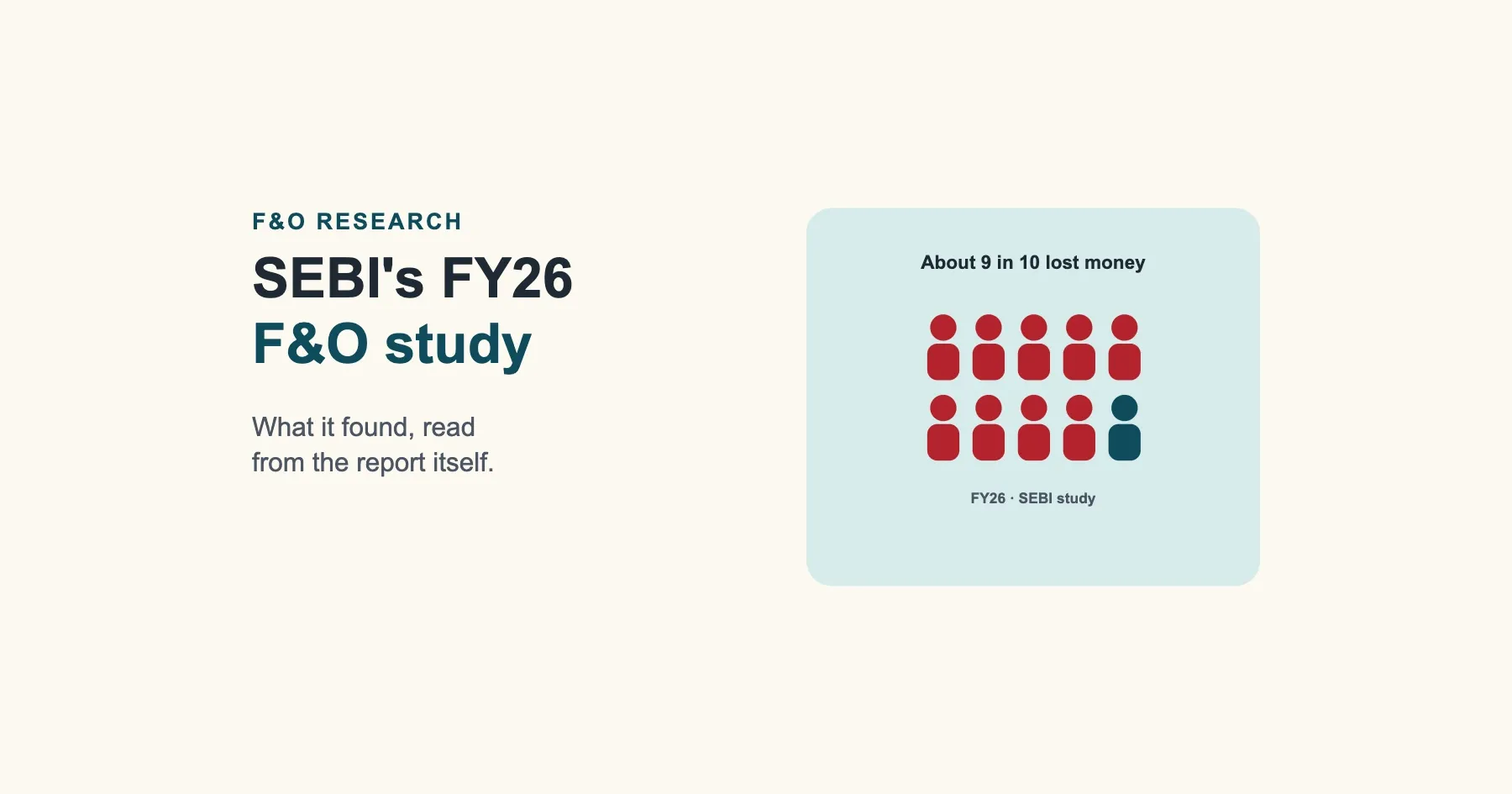
- SEBI's FY26 study: 87.7% of individual traders made net losses; it does not claim the rules caused the decline.
Risk note: SEBI's study on individual traders in equity derivatives found that the share of loss-making individuals fell 3.2 percentage points, to 87.7% in FY26 from 90.9% in FY25. F&O can lead to losses greater than expected and isn't suitable for most beginners. This page is education, not a recommendation to trade.
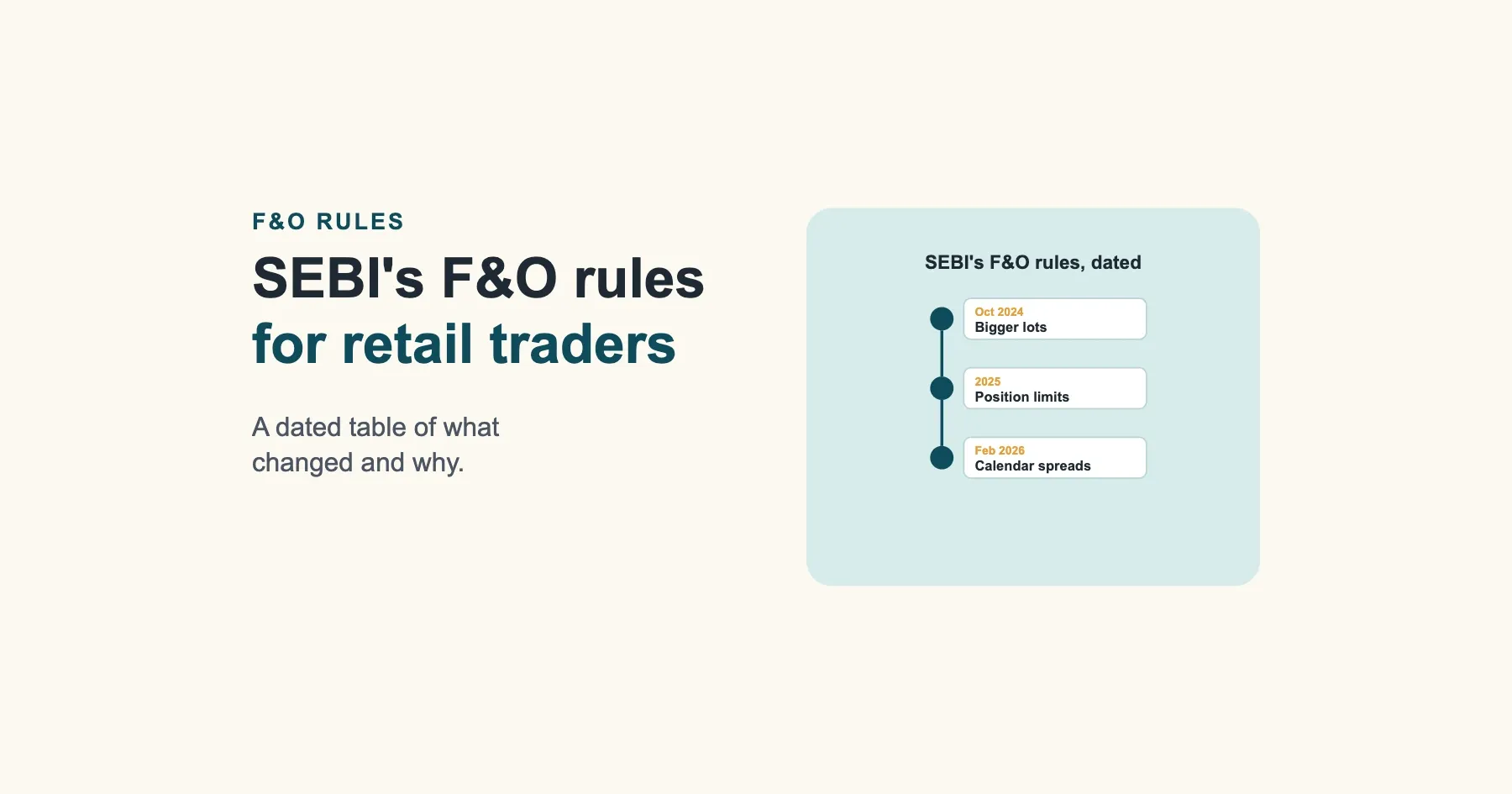
As of 19 November 2026, the core SEBI F&O rules for retail traders still come from one circular: SEBI/HO/MRD/TPD-1/P/CIR/2024/132, dated 1 October 2024. It set a minimum contract value of ₹15 lakh for new index derivatives, allowed weekly expiries on only one benchmark index per exchange, added 2% extra margin on short options on expiry day, made brokers collect option premium upfront, and moved position-limit checks to intraday. A May 2025 circular then fixed each exchange's equity derivatives expiries to a single weekday.
Siddharth, 24, works in Vadodara and has seen friends post screenshots of option trades. Before he opens a trading screen, he wants the actual rules. This page puts each one next to its circular, start date and SEBI's own stated reason.
Why SEBI acted
SEBI's studies of individual traders were the backdrop. Its latest, Profitability of Individual Traders in the Equity Derivatives Segment (FY25–FY26) (August 2026), found most individual traders still made net losses. That report is read closely in what SEBI's FY26 F&O study found.
The 2024 circular states its reasons plainly. On contract size, it cites "the inherent leverage and higher risk in derivatives" and notes market prices had risen about three times since the 2015 revision.
The SEBI F&O rules table (circular of 1 October 2024)
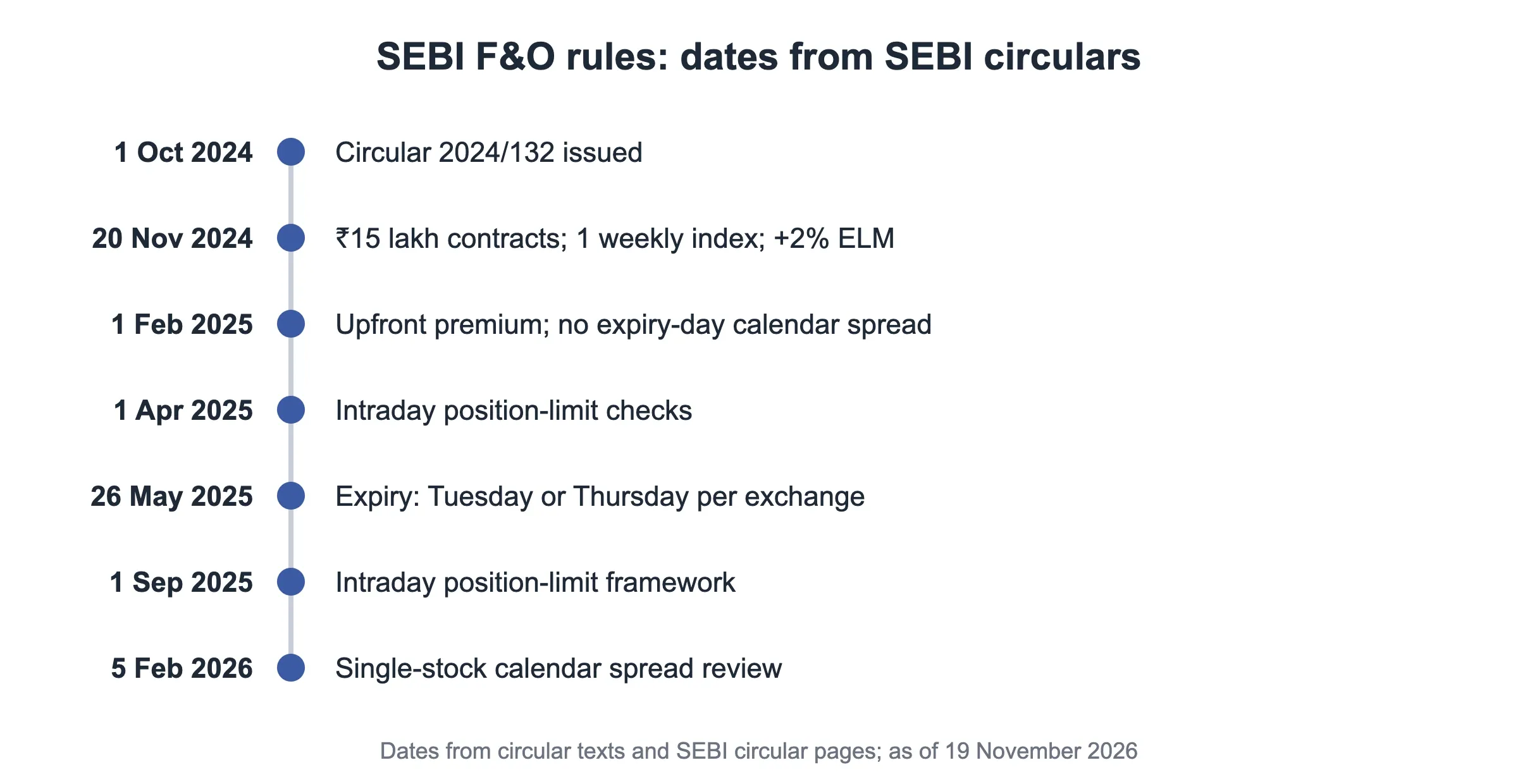
All six measures below come from circular SEBI/HO/MRD/TPD-1/P/CIR/2024/132. The dates are from its implementation table (para 7).
| Rule | What changed | Effective from | SEBI's stated reason |
|---|---|---|---|
| Contract size (para 5.4) | New index derivative contracts must be worth at least ₹15 lakh when introduced; lot size is set so value sits in a ₹15–20 lakh band at review (earlier ₹5–10 lakh) | 20 November 2024 | Inbuilt suitability check, given leverage and risk |
| Weekly expiries (para 5.5) | Each exchange may offer weekly expiry on only one benchmark index | 20 November 2024 | Expiry-day trading largely speculative |
| Extra expiry-day margin (para 5.6) | Additional 2% ELM (extreme loss margin) on short options open at the start of expiry day, or opened that day and expiring that day | 20 November 2024 | "Heightened speculative activity" around expiry |
| Upfront premium (para 5.1) | Brokers must collect the net option premium from buyers upfront, at client level | 1 February 2025 | Avoid "undue intraday leverage to the end-client" |
| Calendar spread (para 5.2) | No calendar spread margin benefit on expiry day for contracts expiring that day | 1 February 2025 | Expiry day "can see significant basis risk" |
| Position limits (para 5.3) | Exchanges monitor index derivative position limits intraday, with at least 4 random snapshots a day | 1 April 2025 | Positions beyond limits could go undetected during the day |
ELM (extreme loss margin) is a buffer collected on top of initial margin to cover rare, extreme moves. A calendar spread is a pair of positions in the same underlying with different expiries; it normally earns lower combined margin, but not for the expiring contract on expiry day.
Later changes: 2025 and 2026
Expiry days (May 2025). SEBI circular SEBI/HO/MRD/MRD-TPD-1/P/CIR/2025/76, dated 26 May 2025, says: "Expiries of all equity derivatives contracts of an exchange will be uniformly limited to either Tuesday or Thursday." Every exchange keeps one weekly benchmark index options contract on its chosen day; other equity derivatives need a minimum tenor of one month and expire in the last week of the month. SEBI's reason: "spacing out of expiry days through the week reduces concentration risk." Exchanges need SEBI's approval before changing a settlement day.
Position limits (September 2025). SEBI issued circular SEBI/HO/MRD/TPD-1/P/CIR/2025/122 on 1 September 2025, titled "Framework for Intraday Position Limits Monitoring for Equity Index Derivatives." It builds on the 2024 snapshot rule; read the circular itself for the current limits and dates.
Single-stock calendar spreads (February 2026). On 5 February 2026, SEBI issued a circular titled "Review of Calendar Spread margin benefit in Single stock derivatives on expiry day" (HO/47/15/11(2)2025-MRD-TPD1/I/4226/2026). Check the circular for its exact terms and start date.
Current lot sizes: where to check
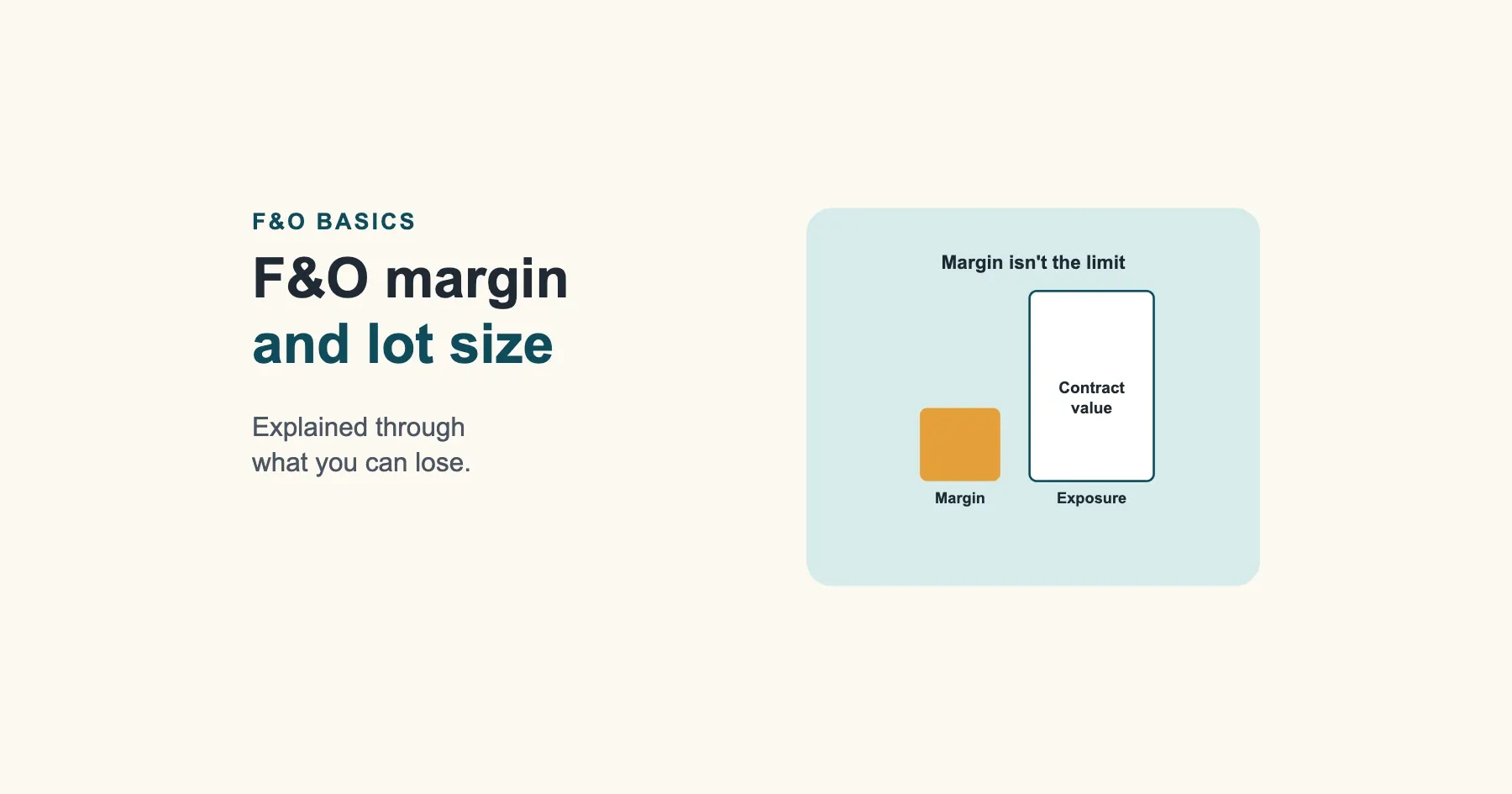
SEBI does not fix a unit count. It sets the value band, and exchanges set lot sizes so contract value stays within ₹15–20 lakh at review, so lot sizes for Nifty 50, Bank Nifty and other indices change when prices move enough. As of 19 November 2026, the reliable source is the latest "revision in market lot" circular on nseindia.com (or bseindia.com for BSE indices); check its date and the expiry from which the new lot applies. How lot size feeds into margin is explained in F&O margin and lot size.
Worked example: what ₹15 lakh contract value means against ₹1.35 lakh
This is hypothetical capital; exposure arithmetic only. It is not a strategy and assumes no return.
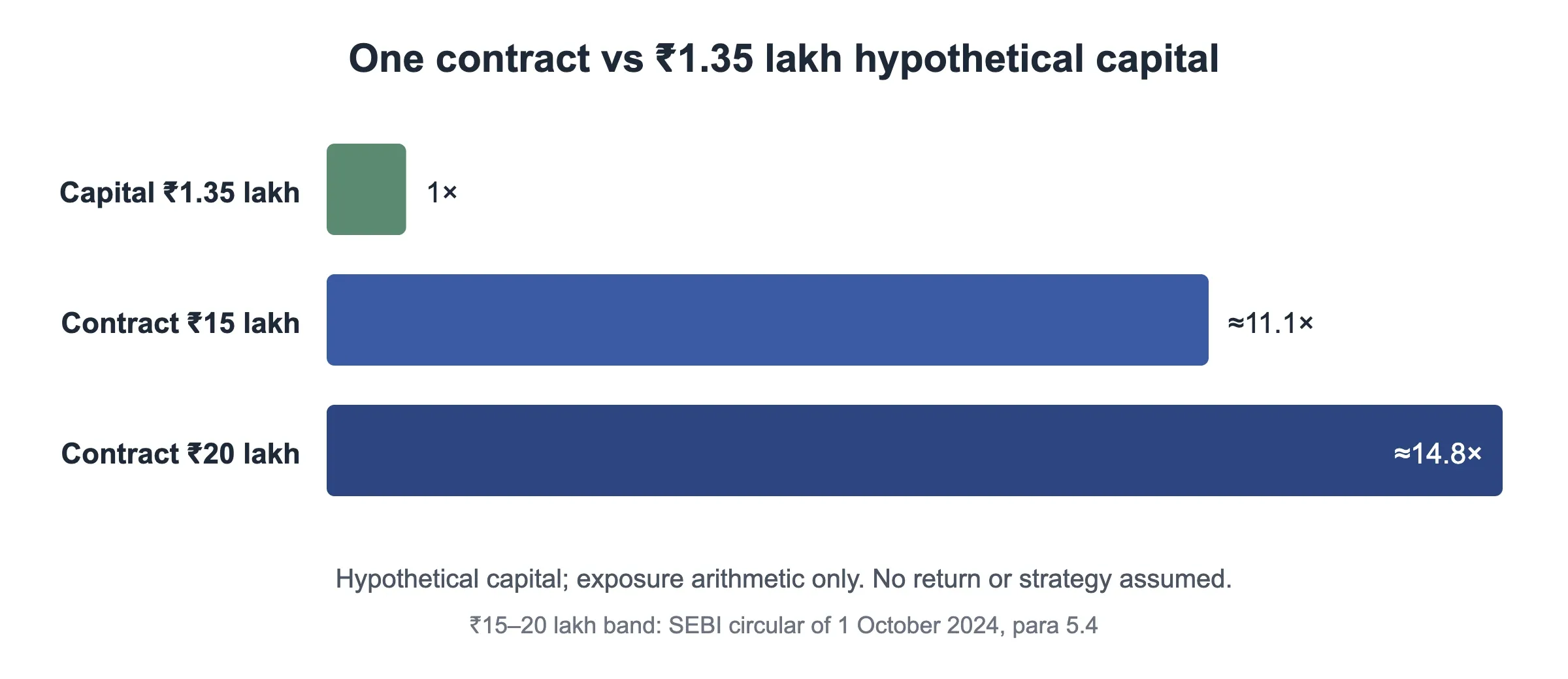
Say Siddharth has ₹1,35,000 he is thinking of using for trading.
- One index derivative contract at the ₹15 lakh minimum contract value controls ₹15,00,000 of the index.
- ₹15,00,000 ÷ ₹1,35,000 ≈ 11.1 times his capital.
- At the top of the ₹15–20 lakh band, ₹20,00,000 ÷ ₹1,35,000 ≈ 14.8 times.
So a 1% index move changes one contract's value by roughly 11% to 15% of his capital, in either direction. Margin for a futures or short option position depends on the exchange's risk calculations on the day; an exchange margin calculator shows the current figure.
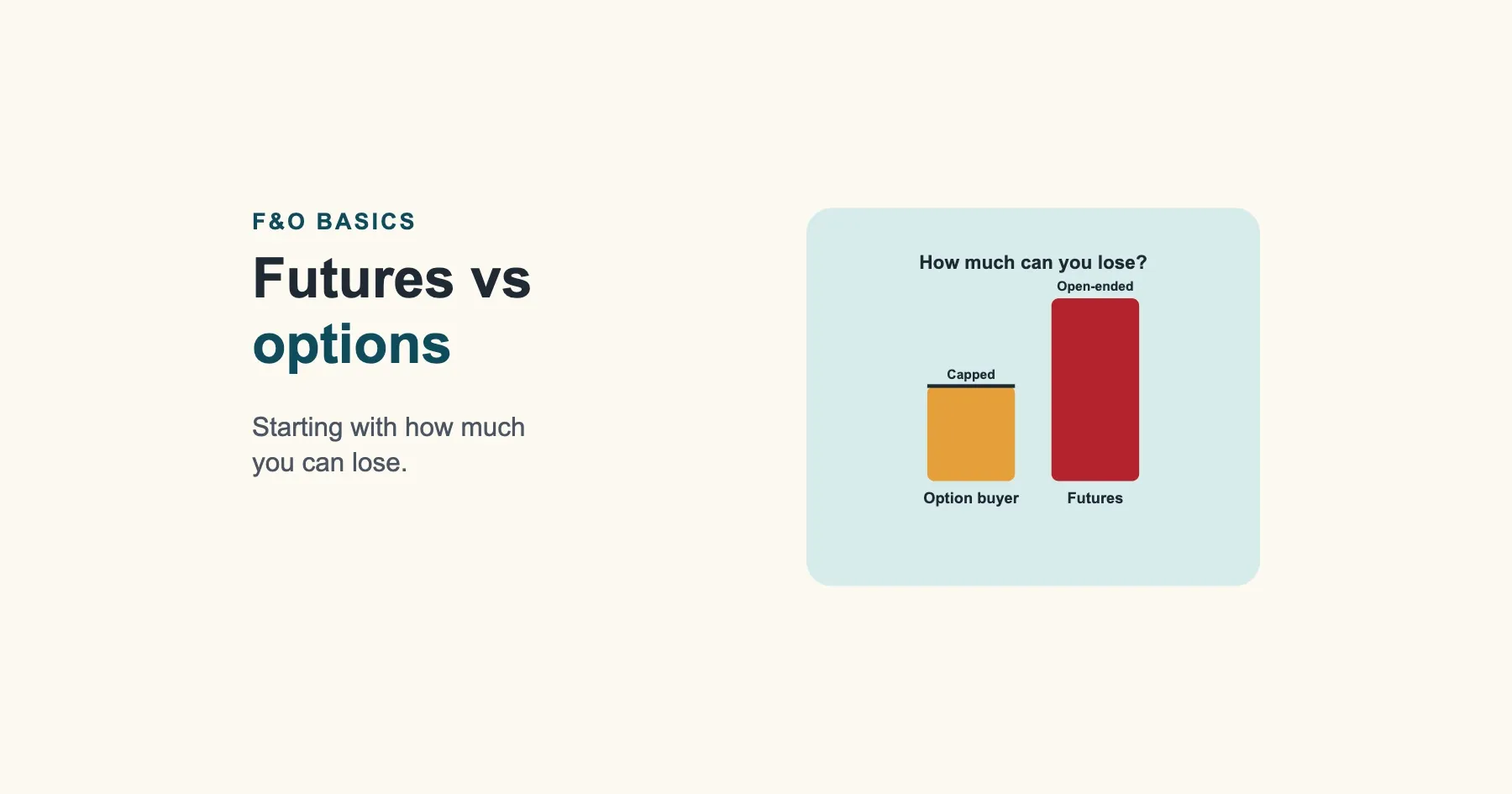
If he buys an option instead, the premium is collected in full upfront (since 1 February 2025), and the whole premium can be lost if the option expires worthless. For comparison, SEBI's FY26 study puts the average loss among loss-makers at ₹1.47 lakh. That is an average, not a forecast for anyone, but it exceeds this hypothetical capital. The difference between buying an option and holding a future is covered in futures vs options.
Have the rules reduced losses?
SEBI's August 2026 report gives numbers but is careful about cause. Its executive summary reports:
- The share of loss-making individuals fell 3.2 percentage points, to 87.7% in FY26 from 90.9% in FY25.
- Aggregate net losses fell about 18%, to ₹91,685 crore in FY26 from a revised ₹1,11,788 crore in FY25.
- Unique individual traders fell from 106.2 lakh in FY25 to 87.5 lakh in FY26, which it calls the first year-on-year decline in the trader base since FY16.
The report adds that its analysis "does not establish a causal relationship" with the November 2024 measures. Fewer people traded and total losses fell, but close to nine in ten individual traders still lost money in FY26.
If you're considering F&O: what the risk note means
The risk note at the top isn't boilerplate. Read it with the rules above:
- Bigger contracts mean bigger swings. A higher minimum contract value raises the amount at stake per trade; it doesn't make a trade safer.
- Upfront premium is spent at entry. An option buyer's full premium leaves the account when the trade is placed.
- Expiry day carries extra margin, because SEBI treats it as the day of heightened speculative activity.
- Lot sizes and expiry days change by exchange circular, so check the date on any number you see.
Frequently asked questions
What are SEBI's new F&O rules I should know before trading options?
As of 19 November 2026, the key rules are a ₹15 lakh minimum contract value, one weekly-expiry index per exchange, upfront collection of option premium, 2% extra ELM on short options on expiry day, no expiry-day calendar spread benefit, and intraday position-limit checks. They come from SEBI's 1 October 2024 circular.
What is the minimum lot size for Nifty and Bank Nifty options now?
SEBI sets a value band, not a unit count: contract value must sit between ₹15 lakh and ₹20 lakh at review. NSE converts that into lot sizes and revises them by circular, so check the latest NSE "revision in market lot" circular and its effective expiry.
Why did SEBI allow weekly expiry on only one index per exchange?
SEBI's 2024 circular says expiry-day trading in index options is largely speculative, with "no discernable benefit towards sustained capital formation." One weekly benchmark per exchange cuts the number of expiry days.
Do I now have to pay the full option premium upfront?
Yes. Since 1 February 2025, brokers must collect the net option premium from buyers upfront, at client level, on top of other margins. SEBI's stated aim is to avoid "undue intraday leverage to the end-client."
Have these rules actually reduced F&O losses for retail traders?
SEBI's August 2026 study found the share of loss-making individuals fell to 87.7% in FY26 from 90.9% in FY25, and aggregate net losses fell 18% to ₹91,685 crore. It also says the analysis does not establish a causal link to the measures.
Read next
Read what SEBI's FY26 F&O study found, from the report itself.
— Laabh