Futures vs options: the difference, starting with how much you can lose
Futures oblige both sides and can lose more than margin; option buyers can lose the whole premium. Max-loss table in ₹ and SEBI's F&O loss data.
Summarize this article with AI





The short version
- Futures oblige both sides; losses are settled daily and can exceed the margin.
- Option buyers can lose the whole premium; option sellers face losses that are not capped.
- The real exposure is the contract value (hypothetically ₹18,75,000 here), not the margin or premium.
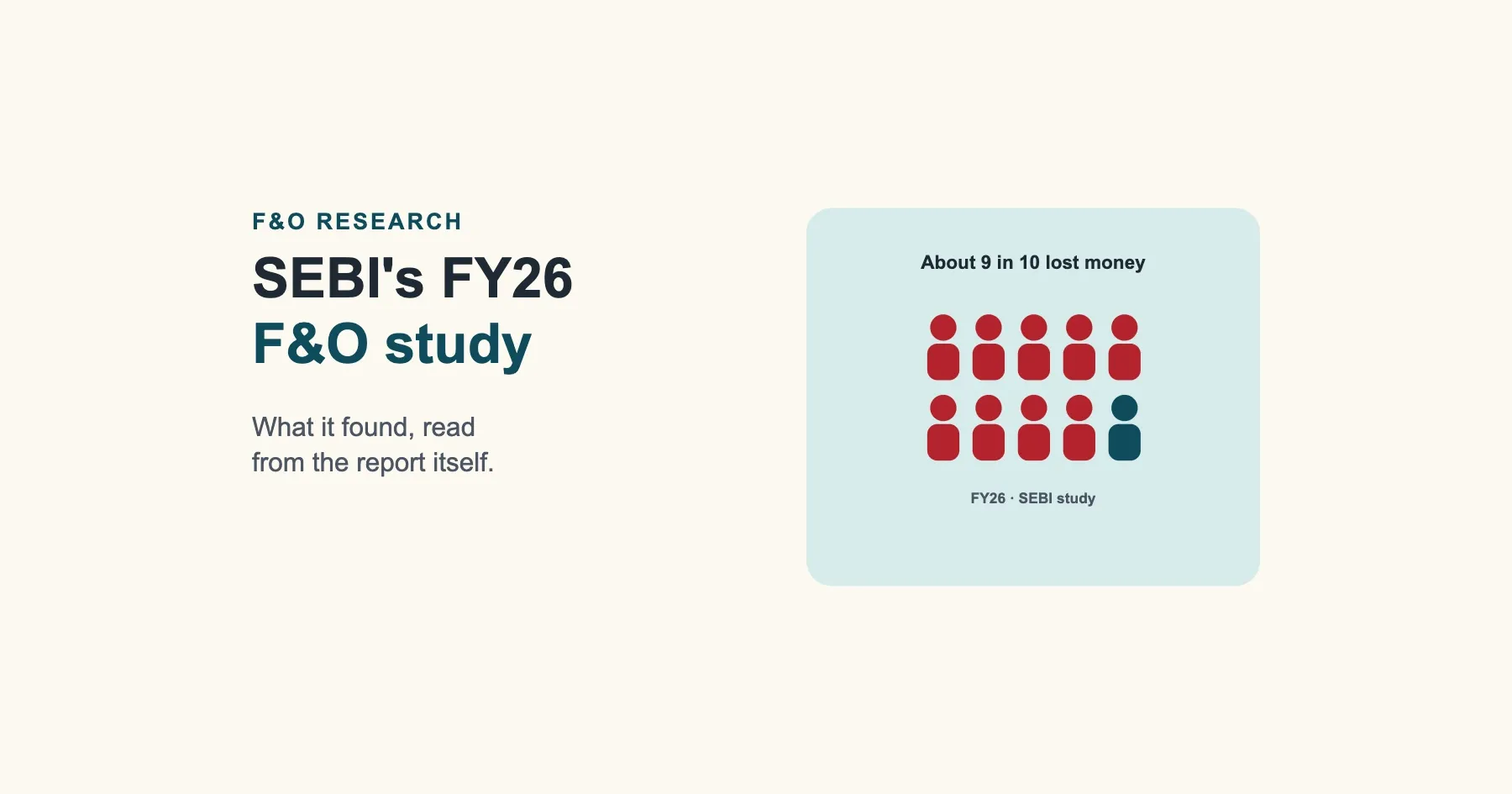
- SEBI found 93% of individual F&O traders made losses over FY22 to FY24, and 87.7% made net losses in FY26.
- Compare F&O by what you can lose, not by what you might make.
A futures contract obliges both sides to buy or sell at a set price on expiry, so losses can exceed your margin. An option gives the buyer a right, not an obligation: the buyer can lose the whole premium, and the seller's loss is not capped. SEBI's study found 87.7% of individual F&O traders made net losses in FY26.
Karthik, 25, in Madurai keeps seeing option-trade screenshots in his feed and wants to understand the products first. This page starts with the futures vs options difference that matters most to a beginner: how much each one can cost you.
What is the difference between futures and options in simple terms?
Both are derivatives: contracts whose value comes from something else, such as an index or a share. Both trade in fixed lots and have an expiry date. The difference is in what each side has to do.
- Futures: an obligation for both sides. The buyer must buy and the seller must sell at the agreed price on expiry. Each posts a margin, a deposit that is a slice of the contract value, and gains and losses are settled daily.
- Options: a right for the buyer, an obligation for the seller. The buyer pays a premium for the right, not the duty, to buy (a call) or sell (a put) at a set price, the strike. The seller receives the premium, must honour the contract, and posts margin.
In short: futures traders carry the full price move; option buyers pay a premium, and option sellers collect it but carry the move.
Which is riskier for a beginner, futures or options?
It depends on your side of the trade, not the product name. Here is one hypothetical index contract from three sides.
Hypothetical example (not a real contract, lot size or margin rate; charges and taxes excluded; not a strategy): an index at 25,000, a lot of 75 units, a call option with an at-the-money strike of 25,000 and a premium of ₹85 per unit.
| Position | What you put up | Hypothetical loss | Is the loss capped? |
|---|---|---|---|
| Futures (buyer or seller) | Margin, here an assumed 12% = ₹2,25,000 | A 2% adverse move (500 points) = ₹37,500 | No. Loss grows with the move and can exceed the margin |
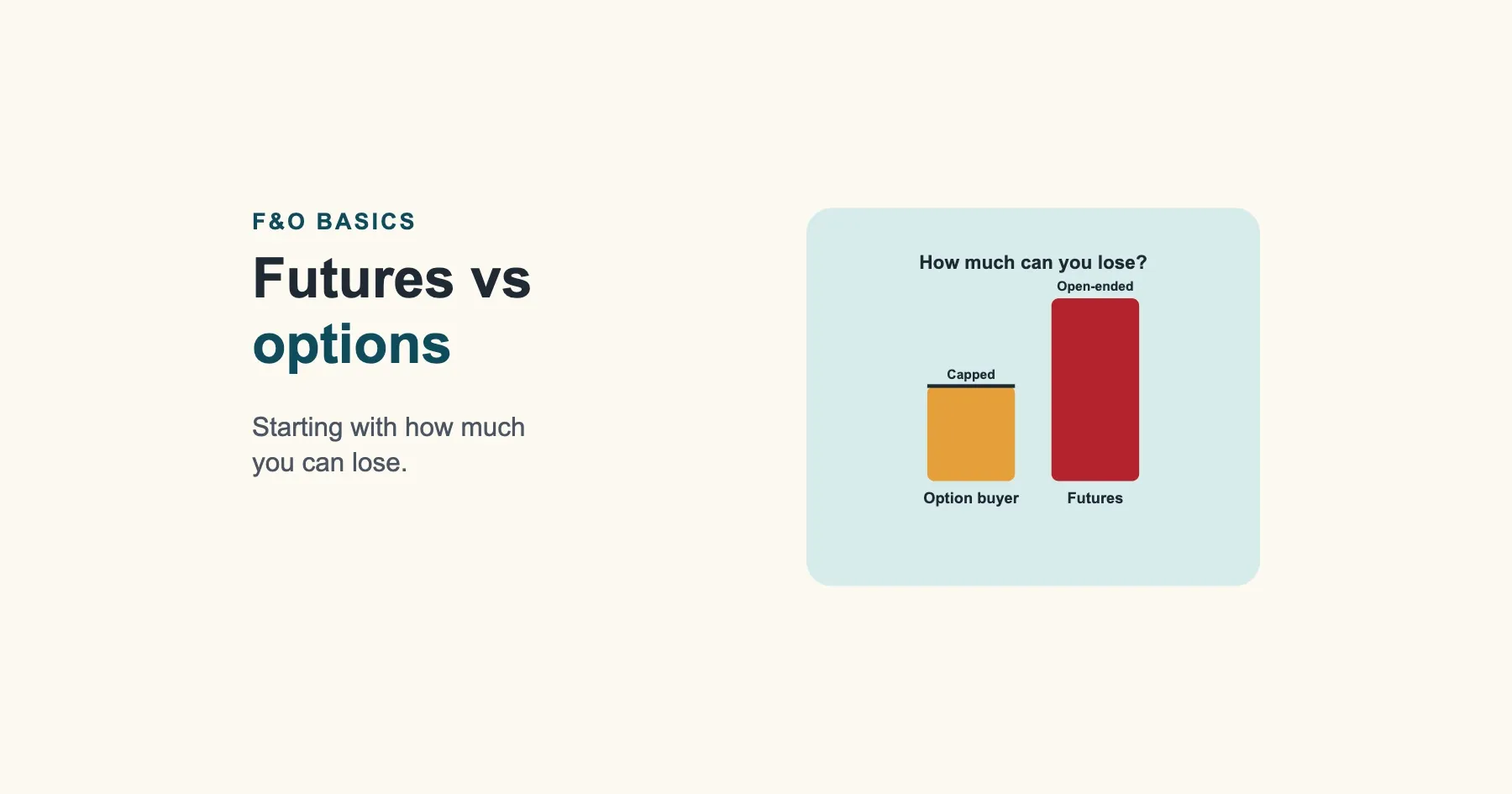
| Option buyer (call) | Premium: ₹85 × 75 = ₹6,375 | Up to ₹6,375, the whole premium, if the index is at or below 25,000 on expiry | Yes, at the premium paid |
| Option seller (call) | Margin; receives ₹6,375 premium | If the index ends 750 points beyond the at-the-money strike at expiry: ₹56,250, or ₹49,875 after the premium received | No. At 1,500 points beyond: ₹1,06,125 net |
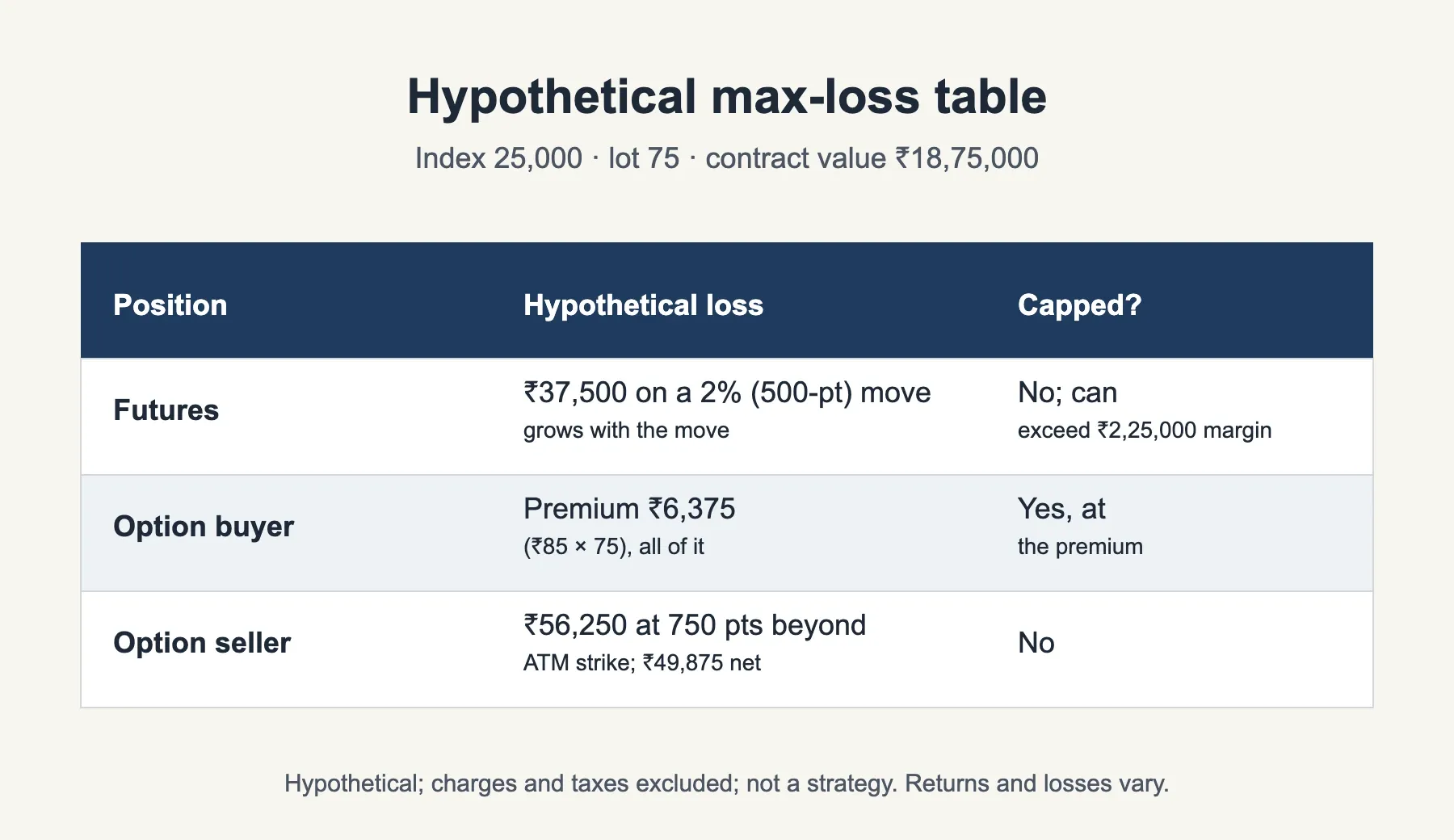
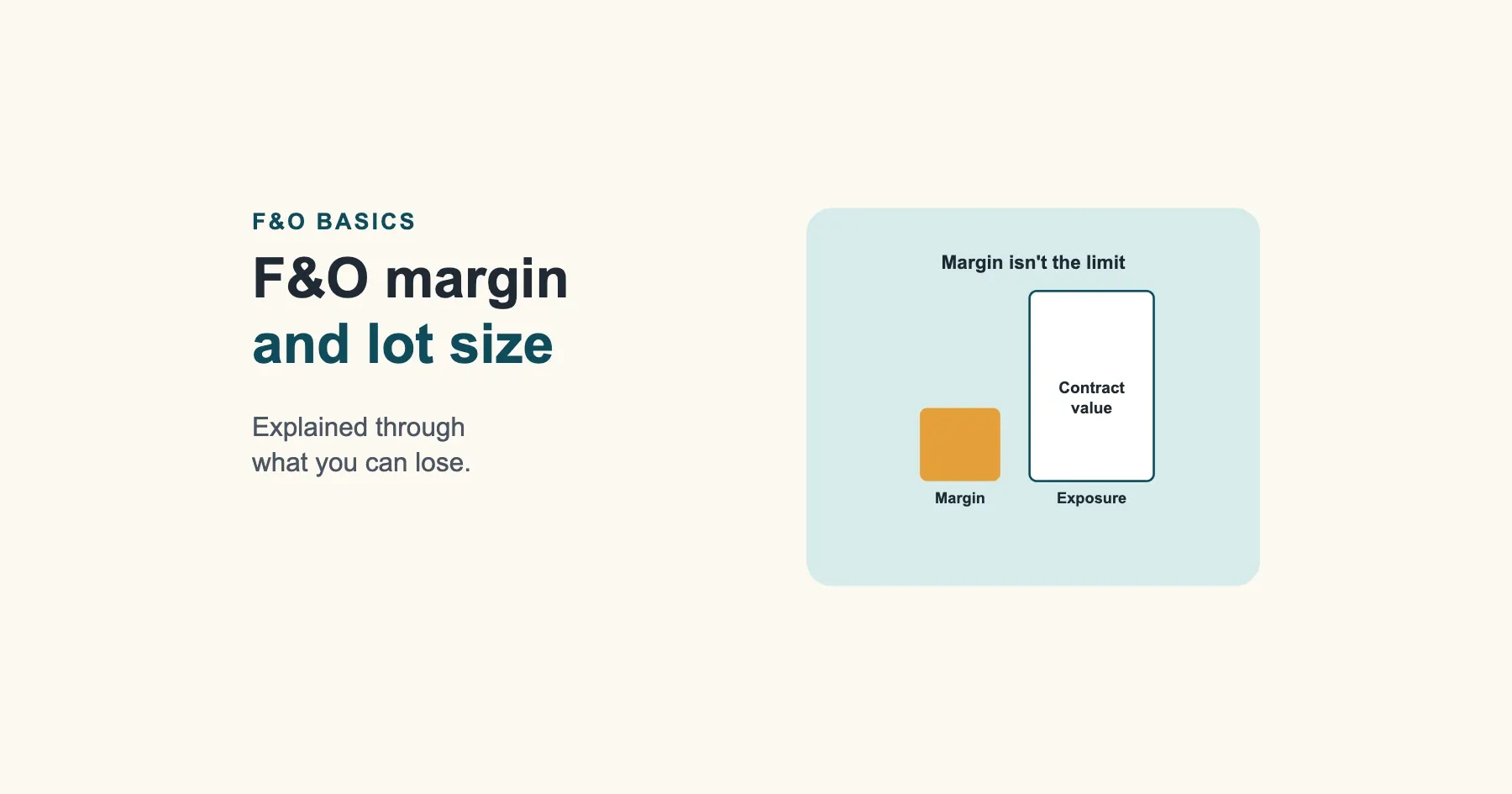
The contract value is 25,000 × 75 = ₹18,75,000. That is the exposure a futures trader or option seller carries, even though only the margin leaves the account at the start.
So the answer is not "futures" or "options". Futures and sold options have losses that are not capped. A bought option's loss is capped, but the cap is the whole premium.
Can I lose more money than I put in when trading futures?
Yes. Your margin is a deposit, not the most you can lose. The exchanges' risk disclosure documents for derivatives warn that losses can exceed the original margin amount.
- Mark-to-market (MTM) every day. At the end of each trading day, the exchange works out your gain or loss against that day's settlement price. In the hypothetical contract, a 300-point fall in one day means ₹22,500 is debited from a futures buyer's account that evening.
- Margin call. If losses pull your balance below the margin the position needs, your broker asks you to add money, often within a short window.
- Square-off. If you cannot add money in time, the broker may close your position at the market price. You are still liable for any loss beyond what was in your account.
In the hypothetical example, a 2% move costs ₹37,500, about one-sixth of the assumed ₹2,25,000 margin. Any adverse move beyond 3,000 points (12%) would take the loss past the entire margin, because the loss is calculated on the full ₹18,75,000, not on the deposit.
Why can an option buyer lose the whole premium?
An option's price has two parts, and both can shrink to zero by expiry.
- Intrinsic value is what the option would be worth if exercised now. A 25,000 call has intrinsic value only when the index is above 25,000.
- Time value is what buyers pay for the chance of a favourable move before expiry. It shrinks as expiry nears (time decay) and is zero on expiry day.
An at-the-money option, where the strike equals the current price, has no intrinsic value. Its whole premium is time value. In the hypothetical example, the call buyer pays ₹6,375. If the index is at or below 25,000 on expiry, the option expires worthless and the full ₹6,375 is gone. Even if the index rises a little, the buyer only gets back the full premium at 25,085 (strike plus premium), before charges.
For the buyer to come out ahead, the price has to move far enough, in the right direction, before time runs out. All three have to hold.
What did SEBI's study find about how many F&O traders lose money?
SEBI has published two large studies of individual traders in the equity derivatives segment.
- Released 23 September 2024 (FY22 to FY24): 93% of individual traders made losses in equity F&O over the three years, and their aggregate losses exceeded ₹1.8 lakh crore (SEBI press release 37/2024).
- Published August 2026 (FY25 to FY26): 87.7% of individual traders made net losses in FY26, compared with 90.9% in FY25. Aggregate net losses were about ₹91,685 crore in FY26. Among traders under 30, about 89% made losses. Transaction costs added roughly ₹25,000 crore a year.
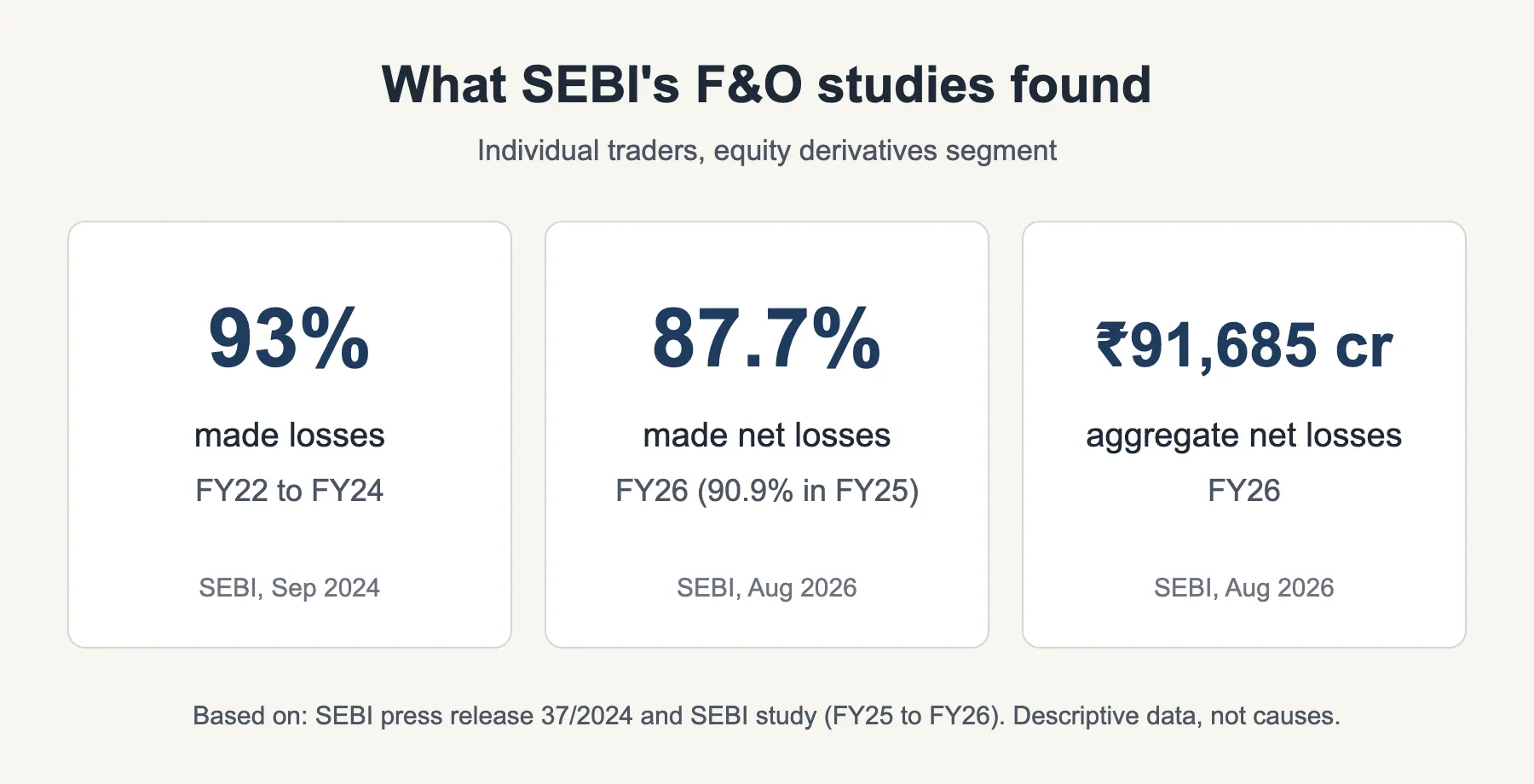
Two cautions. SEBI calls its analysis descriptive: it shows patterns, not causes. And the lower FY26 share came with fewer active traders; SEBI says it "does not necessarily mean trading outcomes have genuinely improved". Method and age tables: what SEBI's FY26 F&O study found.
What rules has SEBI changed for index F&O?
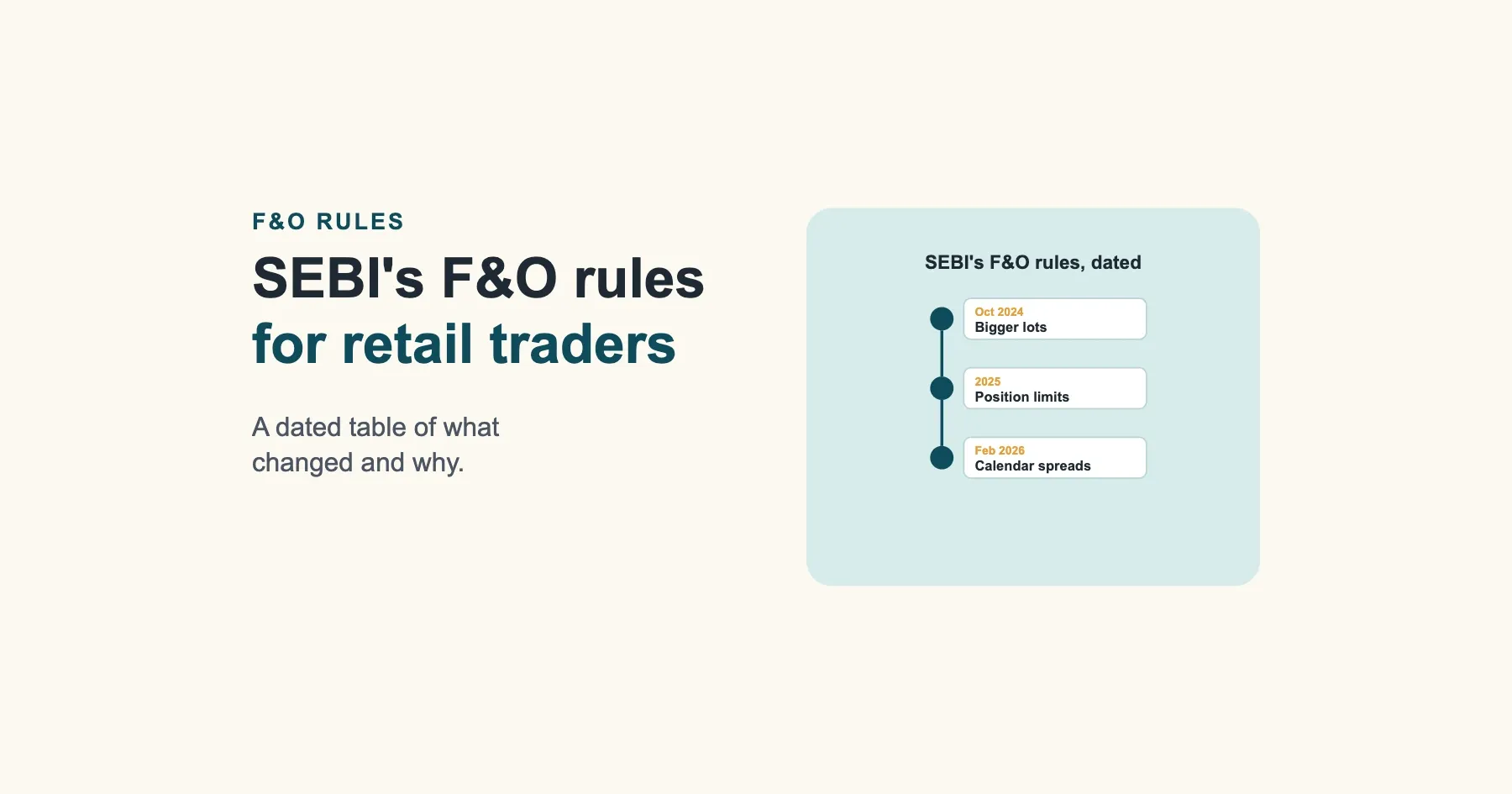
SEBI's circular of 1 October 2024 set three changes that matter here:
- Bigger contracts. New index derivative contracts introduced after 20 November 2024 must be worth at least ₹15 lakh. Exchanges revise lot sizes from time to time, so check the latest exchange circular for any contract's current lot.
- Fewer weekly expiries. From 20 November 2024, each exchange may offer weekly expiry on only one of its benchmark indices.
- Premium upfront. From 1 February 2025, brokers must collect the option premium from buyers upfront.
None of these makes F&O lower-risk for an individual. How lots and margins turn into losses: F&O margin and lot size. For the full dated list, see SEBI's F&O rules for retail traders.
Before anything else: what to learn first
This page does not suggest that F&O suits you. If you are still curious, these steps involve no trade:
- Read the risk disclosure. Since 1 July 2023, SEBI requires brokers to show individual F&O traders a risk disclosure at login.
- Read SEBI's report itself. It is public on sebi.gov.in.
- Check anyone giving you trade ideas. Personalised advice needs SEBI registration; SEBI publishes lists of registered investment advisers and research analysts on sebi.gov.in.
- Understand plain investing first. Owning shares or diversified long-term investments means holding an asset, with no expiry and no margin calls. Many people build long-term wealth without derivatives. How a plain share purchase works: how the stock market works in India.
Frequently asked questions
What are lot size and margin?
A lot is the fixed number of units in one F&O contract; you cannot trade part of a lot. Margin is the deposit your broker collects before you take a futures position or sell an option. It is a slice of the contract value, not the most you can lose.
Is option buying safer because the loss is limited?
The loss is capped at the premium, but that cap can be the whole amount you paid, and time decay works against the buyer until expiry. A capped loss is not the same as a small or unlikely one.
Are F&O gains taxed as business income?
As of 17 November 2026, income from F&O trades on a recognised stock exchange is generally treated as non-speculative business income, not capital gains, and is taxed at your slab rate; losses and turnover have their own reporting rules. Tax rules change; consult a chartered accountant for your situation.
Who can I check advice credentials with?
SEBI publishes lists of registered investment advisers and research analysts on sebi.gov.in.
Read next
Read what SEBI's study found, from the report itself: what SEBI's FY26 F&O study found.
— Laabh