How the stock market works in India: follow one buy order from your phone to your demat
Follow one buy order from your phone to your demat: what SEBI, NSE, BSE, the clearing corporation and NSDL/CDSL each do, and what T+1 means.
Summarize this article with AI





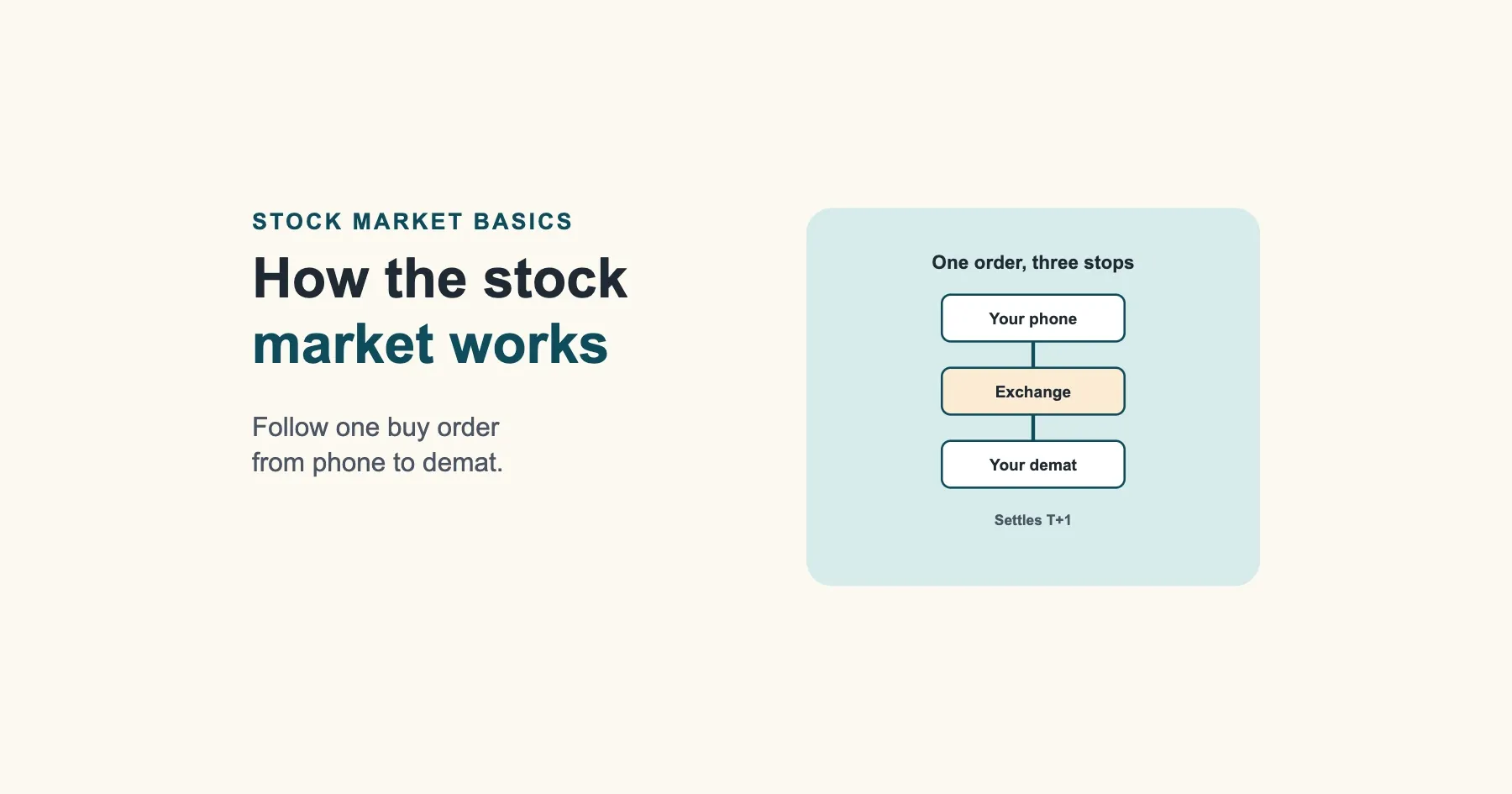
The short version
- A buy order passes through five hands: your broker, the exchange (NSE or BSE), a clearing corporation (NSE Clearing or ICCL), a depository (NSDL or CDSL) and your DP-maintained demat account.
- SEBI regulates the chain but does not trade or hold your shares.
- Under T+1, shares bought on a trading day are settled the next trading day; optional T+0 exists for a limited set of shares.
- SEBI found 87.7% of individual derivatives traders made net losses in FY26; owning shares is a different activity, but it still carries the risk of loss.
In India, you place a buy order through a SEBI-registered stockbroker. The exchange (NSE or BSE) matches it with a seller, a clearing corporation settles the money and shares, and a depository (NSDL or CDSL) credits the shares to your demat account, typically one trading day later under T+1 settlement.
Dev, 24, has been working in Lucknow for a year. Colleagues talk about "the market" as if it were one building. It isn't. When he places his first order, five separate organisations will each do one job. This guide follows one hypothetical order for 12 shares from his phone to his demat account, showing how the stock market works in India and who does what.
How does the stock market actually work in India, step by step?
Primary market. A company issues new shares to raise money, most visibly through an IPO. The money goes to the company (or, in an offer for sale, to the shareholders selling).
Secondary market. Once listed, shares trade between investors on a stock exchange. You buy from another investor, and the company receives nothing from that trade.
Most of what people call "the stock market" is the secondary market. A trade there runs in five steps:
- You place an order with a SEBI-registered stockbroker, usually through an app.
- The broker routes the order to a stock exchange, NSE or BSE.
- The exchange matches your buy order with a sell order at a price both sides accept. That match is the trade.
- A clearing corporation settles the trade: money to the seller's side, shares to the buyer's side.
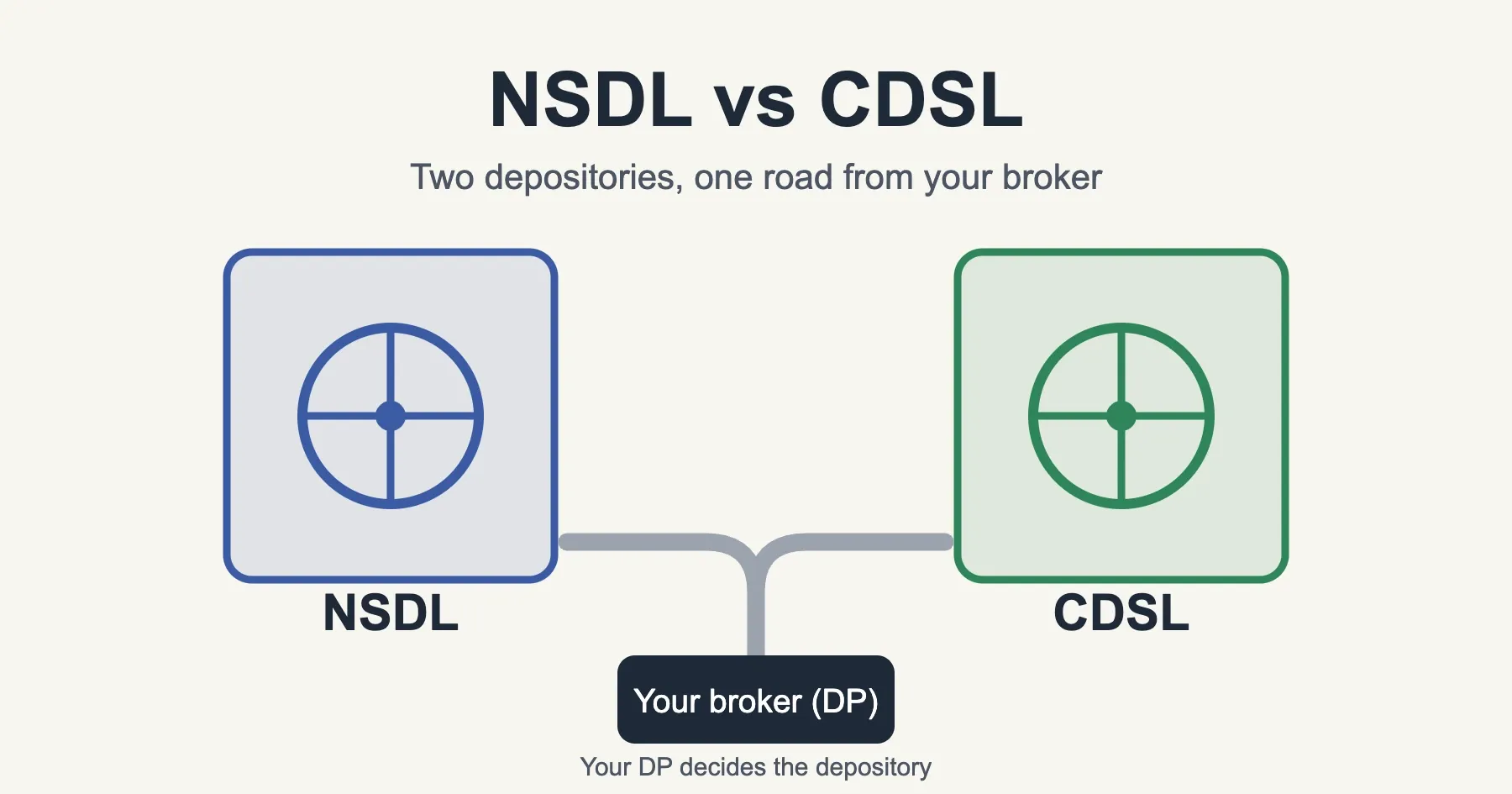
- A depository records ownership. NSDL or CDSL credits the shares to your demat account, which a depository participant (DP) maintains for you.
You never learn who sold you the shares, and neither of you has to trust the other.
Who are SEBI, NSE, BSE, NSDL and CDSL, and what does each one do?
Each actor has one job. Knowing what each one does not do helps when something goes wrong.
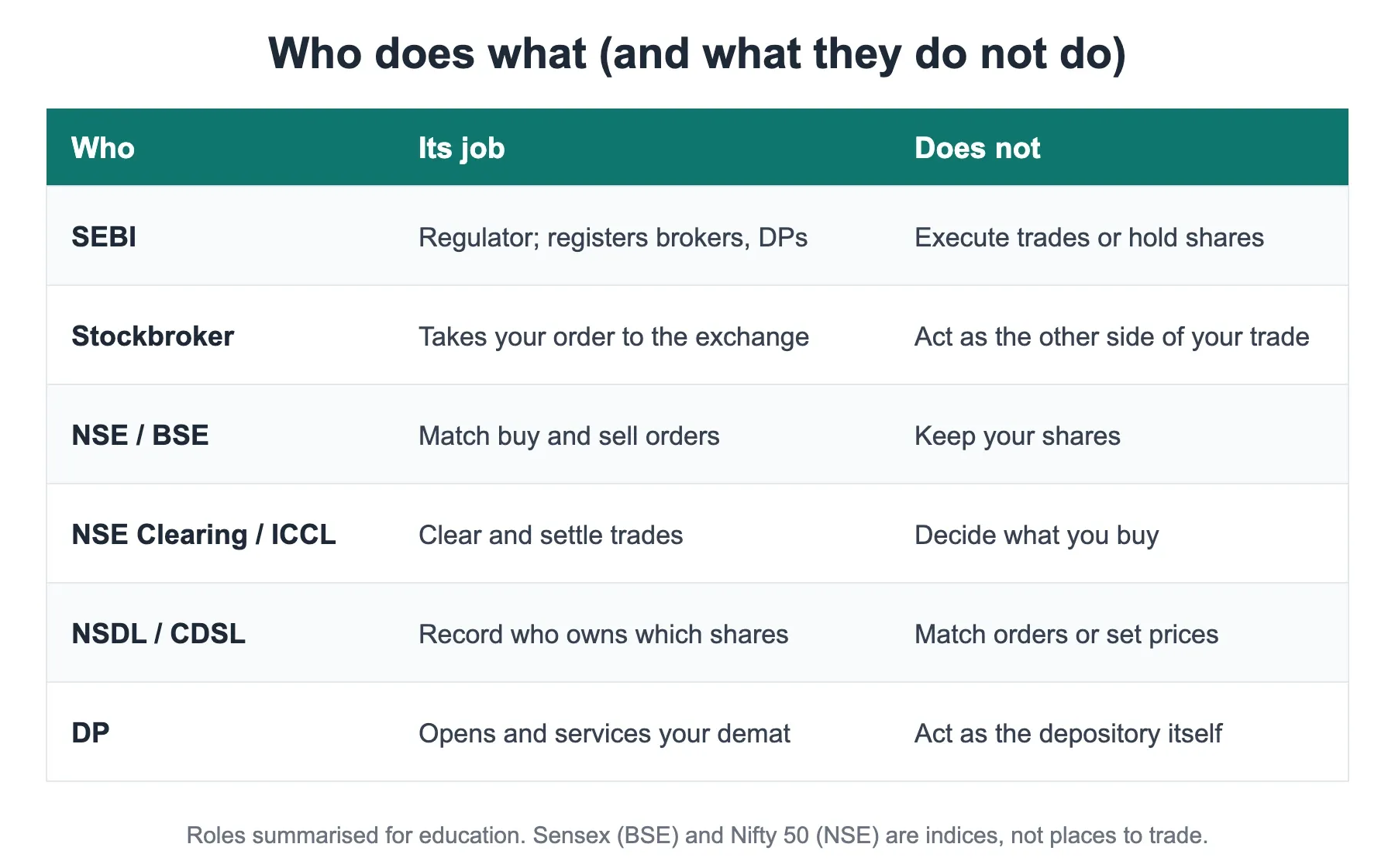
| Who | Its job | What it does not do |
|---|---|---|
| SEBI (Securities and Exchange Board of India) | The regulator. Registers brokers, DPs and advisers, and sets rules for exchanges, clearing corporations and depositories | Does not execute trades or hold your shares or money |
| Stockbroker | Takes your order to the exchange, collects your funds and passes obligations on for settlement | Is not the other side of your trade and does not set the price |
| NSE and BSE (stock exchanges) | Run the order book and match buy and sell orders; list companies | Do not keep your shares; ownership is recorded at a depository |
| NSE Clearing and ICCL (clearing corporations) | Clear and settle trades done on NSE and BSE respectively | Do not decide what or when you buy |
| NSDL and CDSL (depositories) | Hold shares in electronic form and record who owns them | Do not match orders or set prices |
| Depository participant (DP) | Opens and services your demat account on a depository's behalf; many brokers are also DPs | Is not the depository itself |
The Sensex (a BSE index) and the Nifty 50 (an NSE index) are not places. Each tracks a basket of large listed companies and measures how that part of the market moved.
What happens behind the scenes after I click "buy" on a share?
Here is Dev's order, with every number hypothetical: 12 shares at ₹455 each = ₹5,460, before brokerage, charges and taxes. This is not a recommendation, and prices can fall below what you paid.
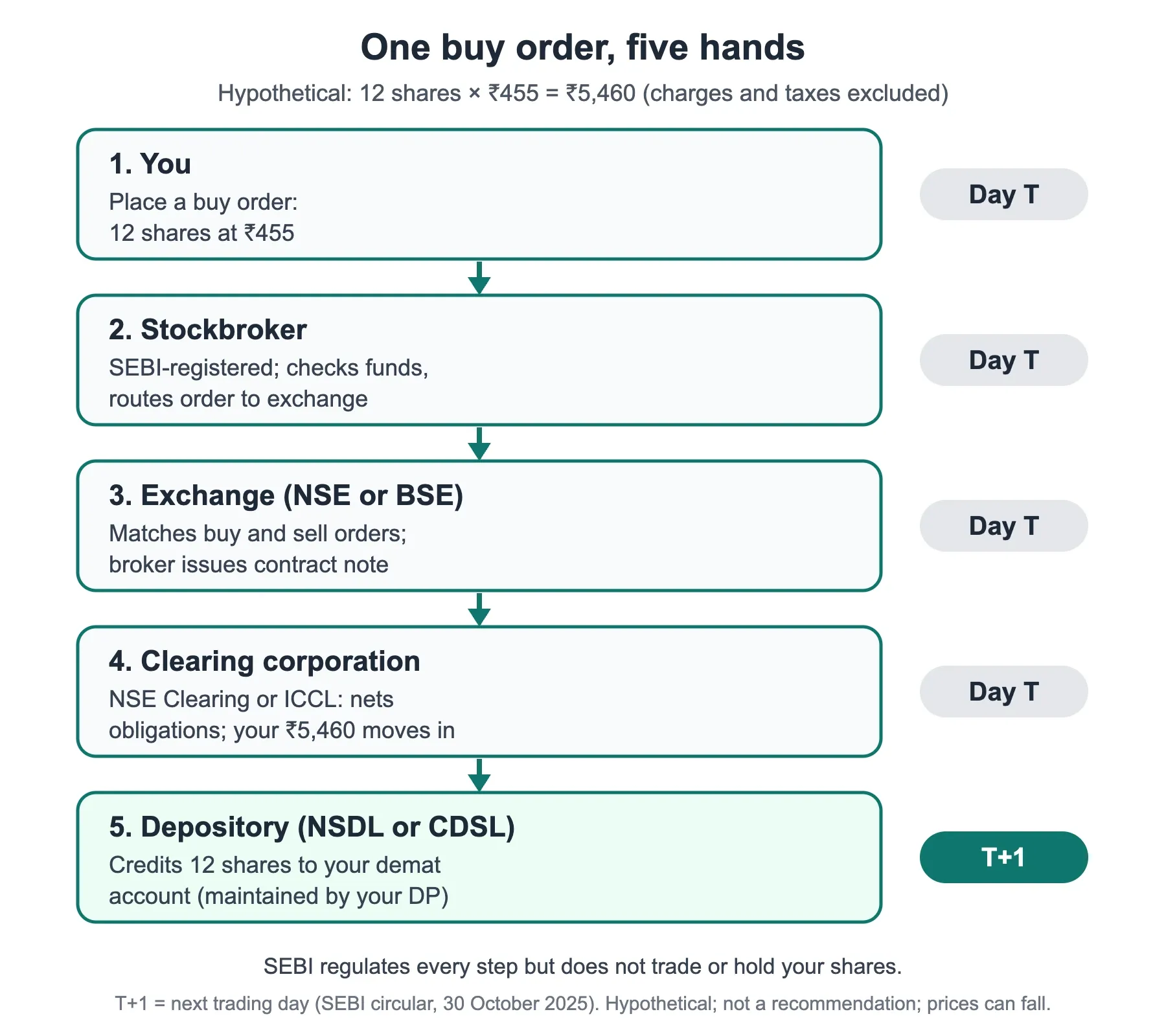
Before the order leaves the app. The broker checks the order is valid and funded. A limit order sets the highest price Dev will pay (₹455 here); a market order takes the best price available.
On the exchange (Day T). The order joins the exchange's electronic order book. When a sell order at ₹455 or lower meets it, the trade is executed, and the broker issues a contract note listing price, quantity and charges. Keep it.
At the clearing corporation (Day T). The clearing corporation works out each broker's net obligation: money owed by buying brokers, shares owed by selling brokers. Dev's ₹5,460 moves via his broker towards it. Because it stands between buyers and sellers for settlement, his trade does not depend on trusting one particular seller.
At the depository (T+1). On settlement day, shares are paid out through the depository system and money to the selling side. The 12 shares are credited to Dev's demat account at NSDL or CDSL.
After that, the market decides. If the price later fell to ₹400 (hypothetical), his 12 shares would be worth ₹4,800, which is ₹660 less than he paid. Hypothetical figures only; not a promise; returns vary.
What is T+1 settlement and when do the shares reach my demat?
"T" is the trade day. T+1 settlement means the trade is settled on the next trading day: the buyer receives the shares and the seller receives the money. As of 17 November 2026, T+1 is the standard settlement cycle for India's equity cash market; a SEBI circular dated 30 October 2025 refers to it as "the existing T+1 settlement cycle". India moved to this cycle from the older T+2 in stages.
Three practical points follow:
- Trading days, not calendar days. Buy on a Friday and T+1 is Monday, if Monday is a trading day; an exchange holiday pushes it later.
- Selling works in reverse. Shares leave your demat, and the sale money settles on T+1 before your broker pays it out.
- Executed is not settled. An order shows as executed on Day T; the shares reach your demat holdings after settlement.
What about same-day settlement? SEBI has introduced an optional T+0 cycle alongside T+1 for a limited list of shares, widening it through a circular dated 10 December 2024. In October 2025, it extended the deadline for qualified stock brokers to build T+0 systems, with further guidance to follow. So as of 17 November 2026, T+1 remains the default for most trades; T+0 is optional and limited.
How is owning shares different from short-term speculation?
Buying a share and holding it means owning a small part of a business. Over time, its price tends to reflect how that business performs and what investors expect of it, though prices can stay far from any estimate of value for long periods. You can lose money, and if a company fails, its shares can lose most or all of their value. Owning shares carries real risk; it is not the same activity as short-term speculation.
Short-term speculation aims to profit from price moves over days, hours or minutes, often with leverage. The clearest public data comes from SEBI's studies of the equity derivatives (futures and options) segment. Its August 2026 study of individual traders found:
- 87.7% of individual traders made net losses in FY26, down from 90.9% in FY25.
- Aggregate net losses of individuals were ₹91,685 crore in FY26, compared with a revised ₹1.12 lakh crore in FY25.
The data measures individuals trading derivatives. It does not measure people who buy and hold shares, and it does not show that holding shares produces gains. It does show that most individuals in that segment lost money in both years studied. The study itself is explained in what SEBI's FY26 F&O study found, and how leverage magnifies losses is in F&O margin and lot size. How futures and options differ, starting with what you can lose: futures vs options.
Three questions help before any first trade: How long can this money stay invested? Could I need it within a year or two? Can I explain what I am buying to someone else?
Frequently asked questions
Do I need a demat account to buy shares?
Yes. Shares you buy on an exchange are credited to a demat account, and you place orders through a trading account with a broker. The two work together but do different jobs.
Can I lose all my money in shares?
Yes, it is possible. If a company runs into serious trouble, its share price can fall close to zero. Spreading money across many companies reduces the impact of any one failure, but it does not remove market risk.
How is an IPO different from buying on the exchange?
In an IPO you apply to buy newly issued shares, and the money goes to the company or the selling shareholders. On the exchange you buy existing shares from another investor. Our guide on how IPO allotment works explains the process.
Is a stock SIP the same as a mutual fund SIP?
No. A stock SIP buys shares of one company at regular intervals through your broker, and you choose the company. A mutual fund SIP buys units of a fund whose manager picks many securities. See our guide on stock SIP vs mutual fund SIP.
What are the Sensex and Nifty 50?
They are indices. The Sensex is a BSE index and the Nifty 50 an NSE index, each tracking a group of large listed companies. They show how that part of the market moved.
Read next
Next, understand where your shares are held: what a demat account is.
— Laabh