Got a bonus to invest? All at once, through an SIP, or an STP: how to choose
No route wins every time. How lump sum, SIP and STP differ for a bonus, what each costs, and why your goal date decides. Hypothetical ₹ example.
Summarize this article with AI





The short version
- No entry route wins every time; pick the one whose catch you can live with.
- All at once: invested sooner; an early fall hits the whole amount.
- Spreading it over a few months: several entry prices; the waiting money is not in the target fund.
- With an STP, check the source fund's exit load and the tax on each transfer.
- For a short goal, the fund category matters more than the route.
No route suits everyone when you decide whether to invest your bonus as a lump sum or through an SIP (Systematic Investment Plan). A lump sum gets all of it invested sooner but exposes all of it to a fall straight away. Spreading it over a few months, through a temporary SIP from your bank account or an STP (Systematic Transfer Plan) from a liquid or debt fund in the same fund house, eases the timing worry, but the waiting money is not yet in the fund you chose. Your goal horizon, and how you would feel about an early dip, decide.
Karthik, 28, is a software tester in Coimbatore. His Diwali bonus has landed, his emergency buffer is in place and he has no costly dues left. He has decided that ₹60,000 of it is for an MBA about six years away, invested in an equity fund. One question is left: all at once, or spread out? And what is the STP a colleague mentioned?
Three ways to put a lump sum into a fund
All at once (lump sum)
A lump sum investment means investing a whole amount in a mutual fund in one go, instead of in instalments. Karthik's ₹60,000 would buy units at one day's NAV (net asset value, the price of one unit), and all of it moves with the market from then on.
Spread out through an SIP
The bonus stays in his bank account, and an SIP moves a fixed amount into the fund each month: say ₹10,000 for six months. This is rupee cost averaging: investing a fixed amount at regular intervals, so you buy more units when prices are lower and fewer when they are higher. It spreads out your purchase price; it does not remove the risk of loss.
Spread out through an STP
AMFI's investor-education site, Mutual Funds Sahi Hai, defines it: "STP is when an investor can transfer money from one Mutual Fund Scheme to another Mutual Fund Scheme of the same Fund House."
The bonus first goes into a source fund, often a liquid or debt fund, and a fixed amount moves each month into the target fund, the equity fund Karthik chose. In short: an SIP moves money from your bank account; an STP moves it from one fund to another in the same fund house.
The STP route has two costs to check.
- Exit load. The source fund may charge one if units are redeemed within a set period. AMFI's page tells investors to check for any exit load in the debt fund where the money is first invested; the SID and KIM give the terms.
- Tax. DSP Mutual Fund's investor-education page says: "An STP transaction is treated like a redemption from the fund you are transferring amounts from". As of 30 October 2026, under section 76 of the Income-tax Act, 2025, gains on units of a specified mutual fund (one investing more than 65% of its proceeds in debt and money market instruments) bought on or after 1 April 2023 are treated as short-term capital gains, whatever the holding period. Liquid funds and most debt funds are likely to fall in that group. Tax rules change; consult a tax professional for your situation.
Lump sum, SIP or STP: the three routes side by side
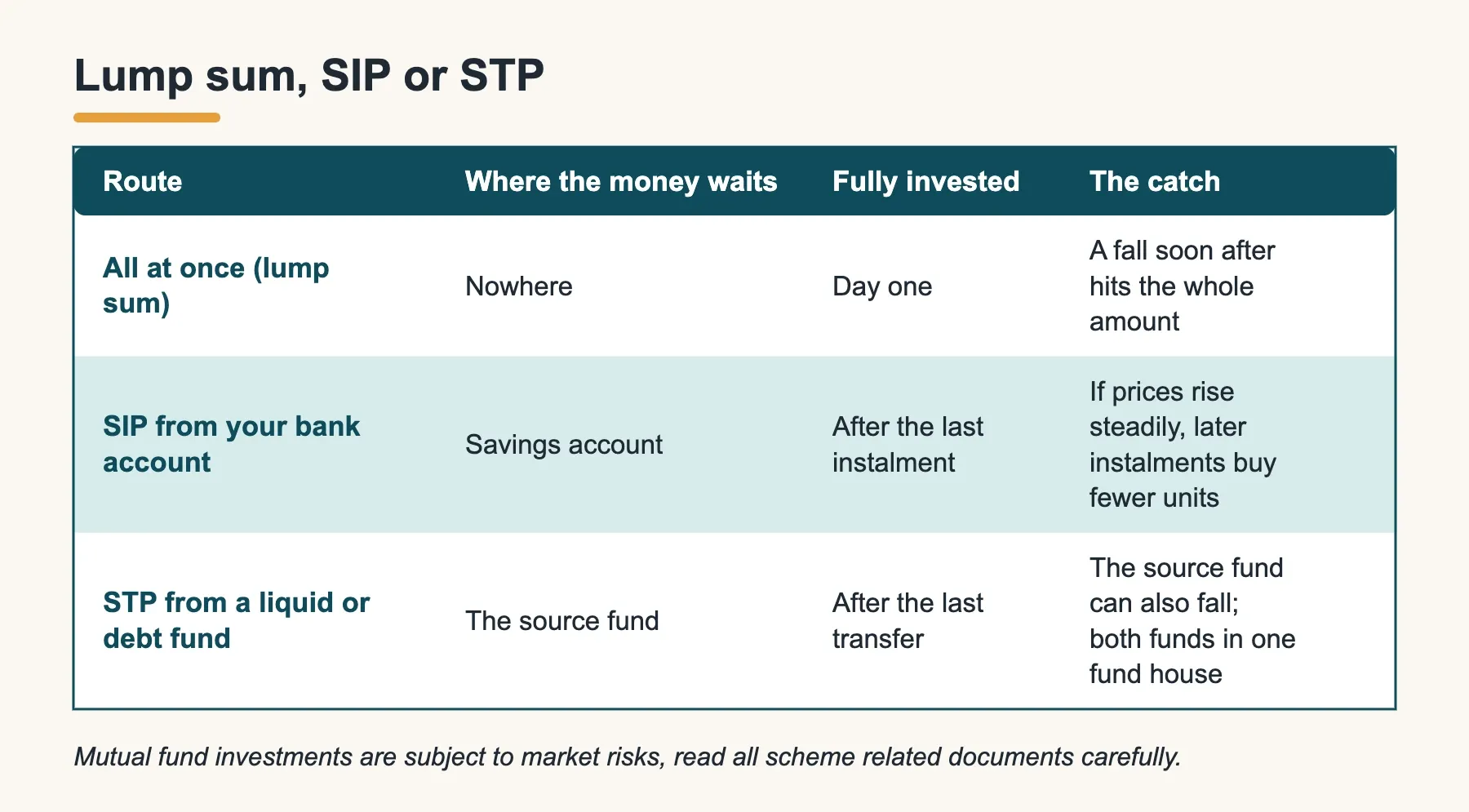
| Route | Where the money waits | When it is fully invested | What it helps with | What it costs | The catch |
|---|---|---|---|---|---|
| All at once (lump sum) | Nowhere | Day one | No money left waiting | Nothing extra | A fall soon after hits the whole amount |
| SIP from your bank account | Savings account | After the last instalment | Buys at several prices, not one | Waiting money earns bank interest, not fund returns; an SIP to track and end | If prices rise steadily, later instalments buy fewer units |
| STP from a liquid or debt fund | The source fund | After the last transfer | The same spreading, with the waiting money in a fund | Possible exit load; each transfer is a redemption, so tax can apply | The source fund can also fall, and both funds must be in one fund house |
What if the market falls right after you invest?
Take a hypothetical case. Karthik invests the full ₹60,000 and, a month later, the fund's NAV is 8% lower. On paper, his ₹60,000 now shows about ₹55,200.
- Goal about six years away: there is time for a recovery, though it is not certain and later falls can happen. Selling now would make the paper loss real.
- Same dip, goal one year away: only 11 months are left, and if no recovery comes in time, the shortfall lands on the goal.
The difference is the time left, not the route. If an early dip would make you stop or sell, spreading the money in may be worth the catch shown in the table. For a running SIP in a falling market, see What happens to your SIP when the market falls (and should you stop it?).
How your goal horizon changes the answer
Goal horizon is the time left until you need the money for a specific goal. The bands below are our interpretation of common investor-education guidance, not a SEBI rule or a fixed count of years.
| Goal horizon | What it means for the route |
|---|---|
| Short (under about 3 years) | The real question is the fund category: an equity fund may not suit this money, however it goes in. |
| Medium (about 3 to 5 years) | Spreading it over a few months can ease a badly timed start, but means less time invested. Weigh both. |
| Long (5 years or more) | A few months matter less over many years; your comfort with an early dip can decide. |
Karthik's goal sits in the long band. The deciding question is personal: would a ₹4,800 paper loss in the first month make him want to sell?
How long to spread it
There is no correct number of months. A June 2025 Value Research article on investing a yearly bonus suggests SIPs over "6 to 12 months". Treat that as one view, and weigh:
- Longer spread: more money waits longer outside the target fund.
- Shorter spread: invested sooner, but averaged over fewer prices.
- Goal date: keep the spread short compared with the time left.
- An end date, so a temporary SIP stops once the bonus is invested.
A hypothetical example: the same ₹60,000, two different markets
- Route A: all ₹60,000 in month 0 (600 units at NAV 100).
- Route B: ₹10,000 a month for six months (months 0 to 5).
Both NAV paths are hypothetical, not a forecast. Value is read at month 6, interest on Route B's waiting money is ignored, and figures are before tax and costs.
- Rising path: NAV 100, 103, 106, 109, 112 and 115 in months 0 to 5; 118 at month 6.
- Dipping path: NAV 100, 95, 90, 88, 92 and 95 in months 0 to 5; 98 at month 6.
| Rising path | Dipping path | |
|---|---|---|
| Route A: value at month 6 | about ₹70,800 | about ₹58,800 |
| Route B: units bought | about 559.4 | about 644 |
| Route B: average cost per unit | about ₹107.26 | about ₹93.17 |
| Route B: value at month 6 | about ₹66,000 | about ₹63,100 |
On the rising path, all at once ended about ₹4,800 ahead: every rupee caught the climb. On the dipping path, spreading it out ended about ₹4,300 ahead, as later instalments bought more units at lower prices, and Route A finished below the ₹60,000 invested.
Neither route won both times, and no one knows which path comes next.
Frequently asked questions
SIP vs lump sum: which makes more sense for a bonus?
Neither wins in every market. A lump sum is invested sooner but takes one day's price on all of it; an SIP over a few months buys at several prices while part of the money waits. For a long goal, your comfort with an early dip can decide; for a short goal, check the fund category first.
Bonus ek saath invest karein ya SIP mein thoda-thoda daalein?
Pehle yeh tay karein ki yeh paisa kab chahiye. Agar goal 5 saal ya usse zyada door hai aur shuru ki girawat dekh kar aap ghabra kar bechenge nahi, toh ek saath invest karna bhi theek ho sakta hai. Early dip ki chinta zyada hai toh kuch mahinon mein SIP ya STP se thoda-thoda daalein, par tab tak baaki paisa fund ke bahar rehta hai. Paisa 3 saal se pehle chahiye toh asli sawaal route nahi, fund category hai.
What is an STP (Systematic Transfer Plan) in mutual funds, and how is it different from an SIP?
An STP moves a fixed amount at regular intervals from one mutual fund scheme to another in the same fund house, often from a liquid or debt fund into an equity fund. An SIP moves money from your bank account into a fund. With an STP, check the source fund's exit load; each transfer is treated as a redemption, so tax can apply.
What if the market falls right after I invest my bonus as a lump sum?
Nothing is sold yet, but the value has fallen; selling then would lock in the loss. With a goal several years away there is time for a recovery, though it is not certain. With a goal a year or so away, the bigger question is whether an equity fund suited that money.
Over how many months should I spread my bonus investment?
There is no correct number. A June 2025 Value Research article suggests "6 to 12 months" for a bonus. A shorter spread invests the money sooner; a longer one leaves more of it waiting. Keep it short compared with the time left to your goal, and set an end date.
What to do next
Write down the goal date for the invested part of your bonus, then use this checklist:
- Is the goal more than about five years away, about three to five, or under three?
- Does the fund category fit those years?
- How would you react to an 8% fall in the first month?
- If you spread it: SIP or STP, over how many months, and with what end date?
- If STP: source fund's exit load, riskometer, SID/KIM and tax checked?
- Revisit each year: the goal date, the amount, and whether the category still fits.
— Laabh



