LTCG Tax Harvesting in Mutual Funds: How Booking ₹1.25 Lakh of Gains a Year Works for a SIP Investor
How LTCG tax harvesting works for a SIP investor: which units FIFO sells, the ₹1.25 lakh yearly limit, the costs, and when to skip it.
Summarize this article with AI






The short version
- LTCG tax harvesting books up to ₹1,25,000 of long-term equity-fund gains a year, then reinvests to reset the cost.
- The limit is yearly and does not carry forward; it is shared with long-term gains on listed shares.
- Redemptions generally follow FIFO, and only units held more than 12 months count as long-term.
- Costs: possible exit load, small STT and stamp duty, and NAV movement while you are out.
- Skip it for locked ELSS units, small gains, or when the year's limit is already used.
Long-term capital gains on equity-oriented mutual fund units are taxed at 12.5% only on the part above ₹1,25,000 in a year. LTCG tax harvesting in mutual funds means redeeming enough long-term units to book gains up to that limit, then reinvesting, so your cost price resets higher. It does not erase tax on future gains; it uses an exemption that would otherwise lapse at the end of the year.
Arjun, 31, in Pune, has run an equity fund SIP for three years. His app shows ₹1,90,000 of unrealised gain. Before he books anything, he needs to know which units would be sold, how much of that gain is long-term, and what the exercise costs. This page works through all three.
What "tax harvesting" means
Tax gain harvesting is booking long-term gains within the yearly exemption and buying back. Tax loss harvesting books a loss to set off against gains; set-off rules are in our guide to how mutual funds are taxed in India. This page covers gain harvesting.
Why it works: the yearly exemption does not carry forward
The Income-tax Act, 2025, in force from 1 April 2026, taxes long-term gains on units of an equity-oriented fund at 12.5% on the amount exceeding ₹1,25,000 (section 198). Under section 112A of the Income-tax Act, 1961, the same rate and limit applied to transfers from 23 July 2024 until 31 March 2026. An equity-oriented fund is, broadly, one that keeps at least 65% in listed domestic equity shares.
The limit is per year. If Arjun books no long-term gain this year, the unused ₹1,25,000 does not roll over. Harvesting puts some gain into a year that would otherwise waste the limit.
Two details matter:
- The ₹1,25,000 is shared. Long-term gains from listed shares and from all your equity-oriented funds count against the same limit for the year.
- Only long-term units count. For an equity fund, units held for more than 12 months are long-term. Gains on younger units are short-term and taxed separately, with no such limit.
Which units you are actually selling
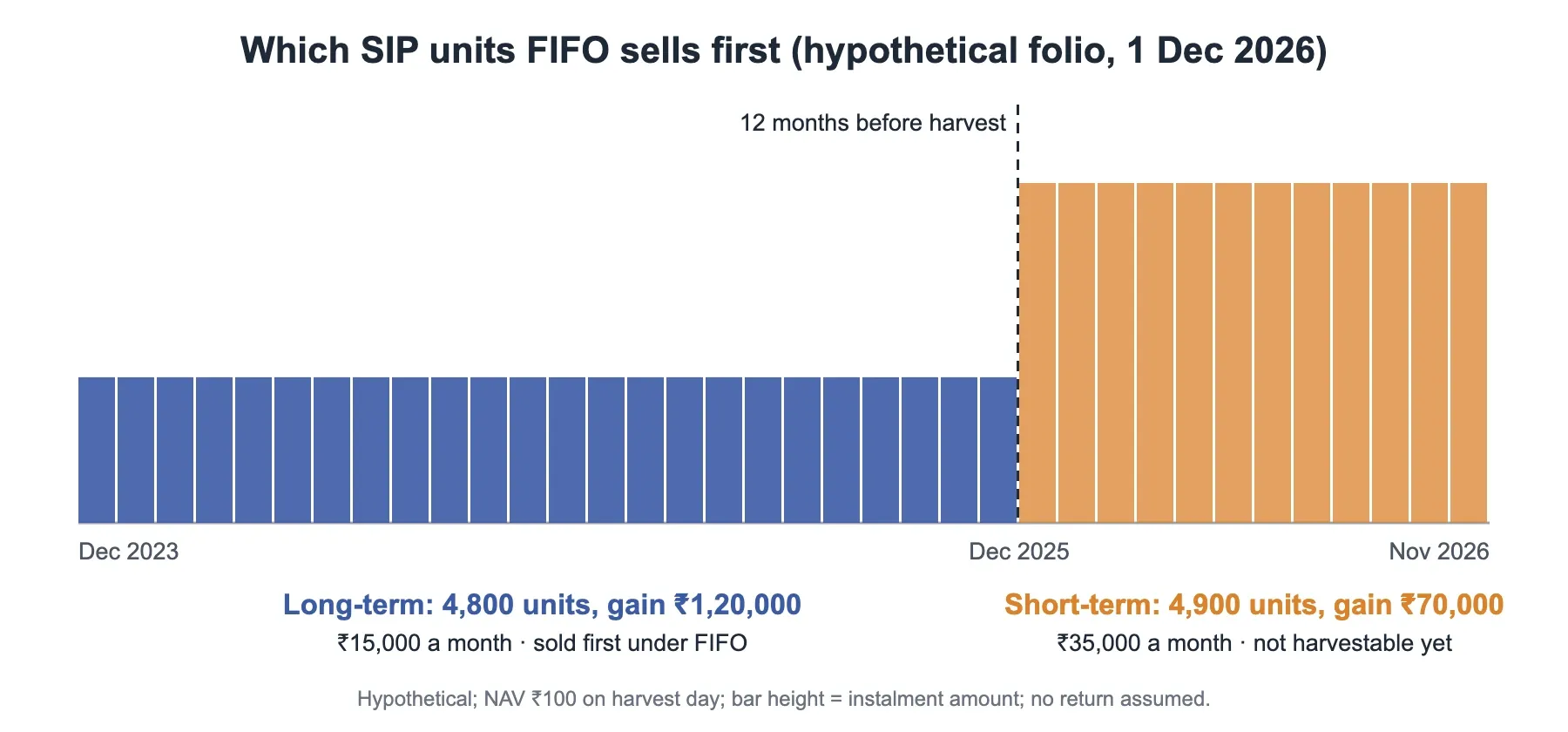
Redemptions are generally matched first in, first out (FIFO): the oldest units leave first. Your capital gains statement shows which lots were matched. Each SIP instalment is its own purchase, with its own date, cost and holding period, so a three-year SIP is a ladder of 36 lots, and only lots older than 12 months are long-term.
FIFO helps a harvester because the long-term lots leave first. The care point is quantity: redeem more units than your long-term lots hold and the excess comes from short-term lots.
Worked example on an SIP folio (hypothetical)
All figures are hypothetical, chosen to show the mechanics; no return is assumed or implied.
Arjun's SIP runs on the 5th of each month: ₹15,000 a month from December 2023, stepped up to ₹35,000 from December 2025. He plans to harvest on 1 December 2026, when the hypothetical NAV is ₹100.
| Instalments | Invested | Units | Average cost (₹/unit) | Value at ₹100 | Gain | Status on 1 Dec 2026 |
|---|---|---|---|---|---|---|
| Dec 2023 to Nov 2024 | ₹1,80,000 | 2,500 | 72.00 | ₹2,50,000 | ₹70,000 | Long-term |
| Dec 2024 to Nov 2025 | ₹1,80,000 | 2,300 | 78.26 | ₹2,30,000 | ₹50,000 | Long-term |
| Dec 2025 to Nov 2026 | ₹4,20,000 | 4,900 | 85.71 | ₹4,90,000 | ₹70,000 | Short-term |
| Total | ₹7,80,000 | 9,700 | ₹9,70,000 | ₹1,90,000 |
Of the ₹1,90,000 gain, ₹1,20,000 sits on long-term units. The ₹70,000 on the newest units cannot be harvested this year.
The harvest. Arjun redeems 4,800 units: exactly the two long-term rows, which FIFO takes first.
- Redemption value: 4,800 × ₹100 = ₹4,80,000
- Cost of those units: ₹3,60,000
- Long-term gain booked: ₹1,20,000, within the ₹1,25,000 limit (assuming no other long-term gains on shares or equity funds this year)
- Tax at 12.5% on this gain: nil, because it does not exceed the limit
The reinvestment. He puts the ₹4,80,000 back into the same fund. Stamp duty of 0.005% on the purchase is ₹24, so ₹4,79,976 buys about 4,799.76 units at ₹100. His cost for those units is now about ₹4,80,000 instead of ₹3,60,000.
What it is worth. When he eventually sells, his taxable gain is ₹1,20,000 lower. If his gains that year would exceed the limit, the tax saved is up to 12.5% × ₹1,20,000 = ₹15,000, less the small transaction costs and any NAV gap. If they would fall within the limit anyway, the saving is smaller or nil.
Step by step: estimate, redeem, reinvest, keep records
- Add up this year's long-term gains so far on shares and equity funds, to see how much of the ₹1,25,000 is left.
- Download a capital gains statement for the folio. It lists lots by date, so you can see which are long-term.
- Work out the units in long-term lots, trimming until the gain fits the remaining limit with a margin for NAV movement.
- Check exit load in the scheme information document (SID); the load period varies by scheme.
- Redeem by units, not by amount, so you control which lots go.
- Reinvest promptly to keep the out-of-market gap short.
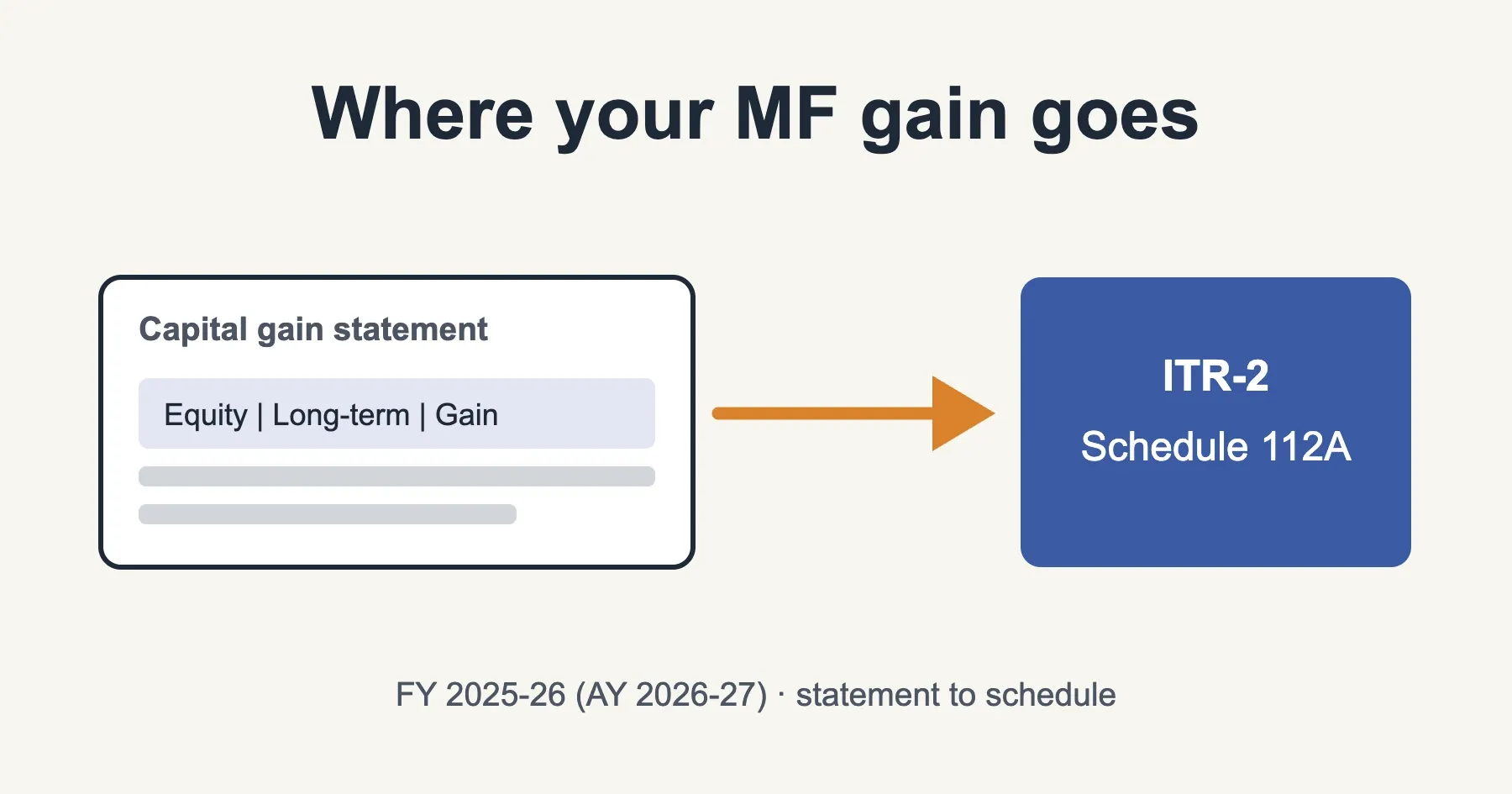
- Keep both statements. The gain is reported in your return even though no tax is due on it; see how to report mutual fund gains in your ITR.
What it costs
| Friction | What happens | In Arjun's hypothetical case |
|---|---|---|
| Exit load | Charged on units redeemed within the scheme's load period | Nil assumed: all redeemed units are over a year old; check your SID |
| STT | 0.001% on redemption of equity-oriented fund units | About ₹5 on ₹4,80,000 |
| Stamp duty | 0.005% on units issued on purchase | ₹24 on ₹4,80,000 |
| Out of the market | NAV can move between your redemption and your reinvestment | A 1% rise means about 4,752 units instead of about 4,800; a 1% fall works the other way |
| New holding period | Repurchased units start a fresh 12-month clock | These units are short-term again until December 2027 |
The NAV gap cuts both ways and cannot be predicted: treat it as a risk, not a budgeted cost.
Five hypothetical years, with and without harvesting
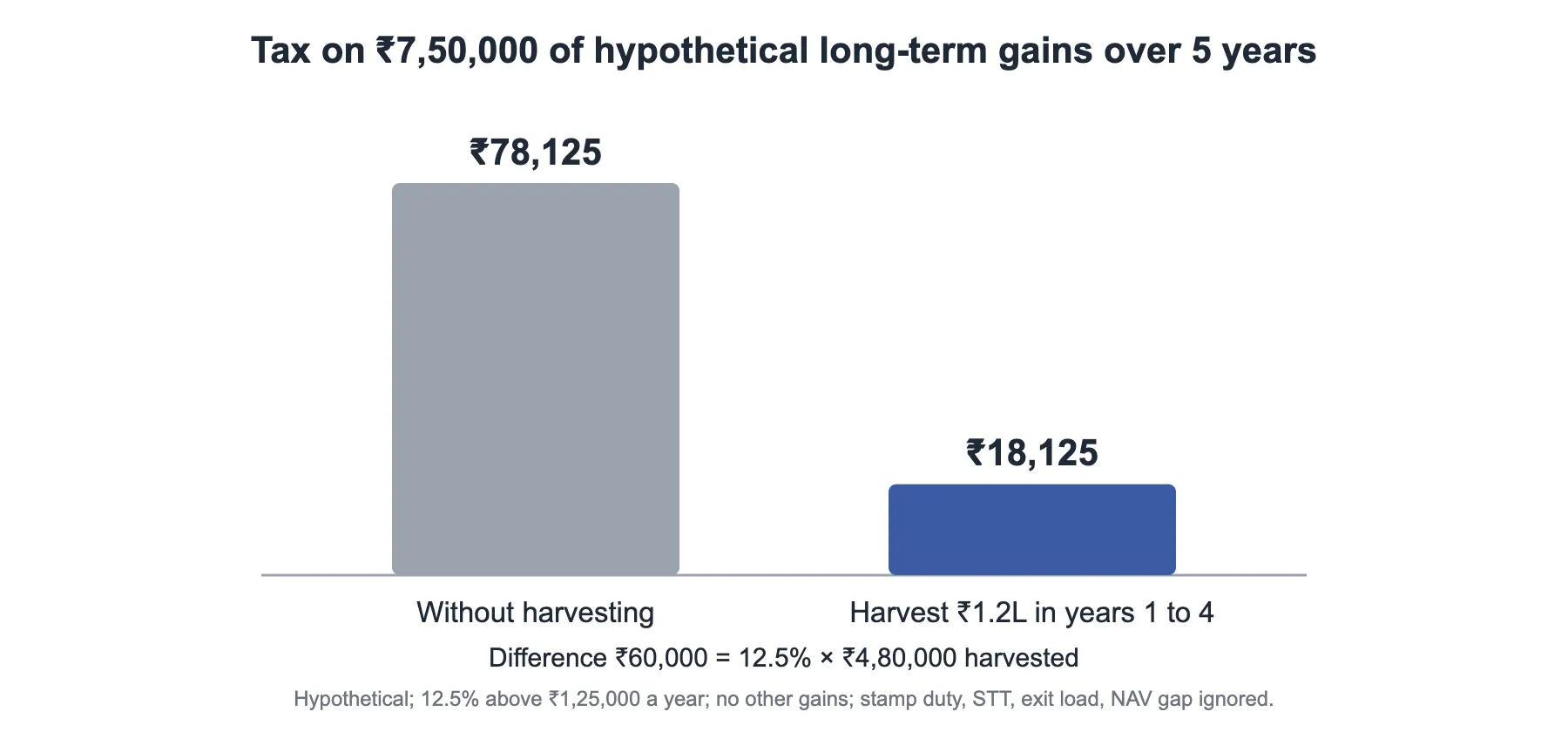
Assume long-term gains of ₹1,20,000, ₹1,35,000, ₹1,50,000, ₹1,65,000 and ₹1,80,000 accrue over five years (₹7,50,000 in all) and everything is sold in year 5. No other gains; frictions ignored.
- Without harvesting: gain in year 5 = ₹7,50,000; tax = 12.5% × (₹7,50,000 − ₹1,25,000) = ₹78,125.
- Harvesting ₹1,20,000 in each of years 1 to 4: ₹4,80,000 booked within the limit; gain left in year 5 = ₹2,70,000; tax = 12.5% × (₹2,70,000 − ₹1,25,000) = ₹18,125.
The ₹60,000 gap is 12.5% of the ₹4,80,000 harvested. Hypothetical, not a projection.
When harvesting isn't worth it
- ELSS units still in lock-in. Each ELSS instalment is locked for three years from its own allotment date, and locked units cannot be redeemed; check the scheme's SID. Reinvesting in ELSS starts a fresh lock-in on the new units. See ELSS lock-in for SIP.
- Small gains. On a gain of a few thousand rupees, 12.5% may not justify the effort and out-of-market risk.
- A goal within a year or two, if that year's gains will stay within the limit anyway.
- The limit is already used by share sales this year.
- Switching schemes to harvest. A switch is a redemption plus a purchase, so it changes what you own: a portfolio decision, not a tax one.
Related: can you withdraw SIP money anytime and what XIRR means in an SIP.
Frequently asked questions
How does LTCG tax harvesting work in mutual funds?
You redeem long-term units of an equity-oriented fund so the gain booked stays within the ₹1,25,000 yearly limit (gains above it are taxed at 12.5%), then reinvest at a higher cost.
Which SIP units get sold first when I redeem?
Generally the oldest, under first in, first out. Each instalment has its own holding period; only those held more than 12 months give long-term gains.
Is tax harvesting legal in India?
It uses an exemption set out in the Income-tax Act; the redemption and the purchase are ordinary transactions, reported in your return. For your situation, consult a tax professional.
Does exit load apply when I harvest?
Only on units still within the scheme's exit load period. The period and rate differ by scheme, so check the SID.
Can I harvest gains in ELSS?
Only on instalments that have completed their three-year lock-in. Reinvesting in ELSS starts a new lock-in for the new units.
Learn more
Save the step-by-step list as a checklist for your next harvest, before 31 March.