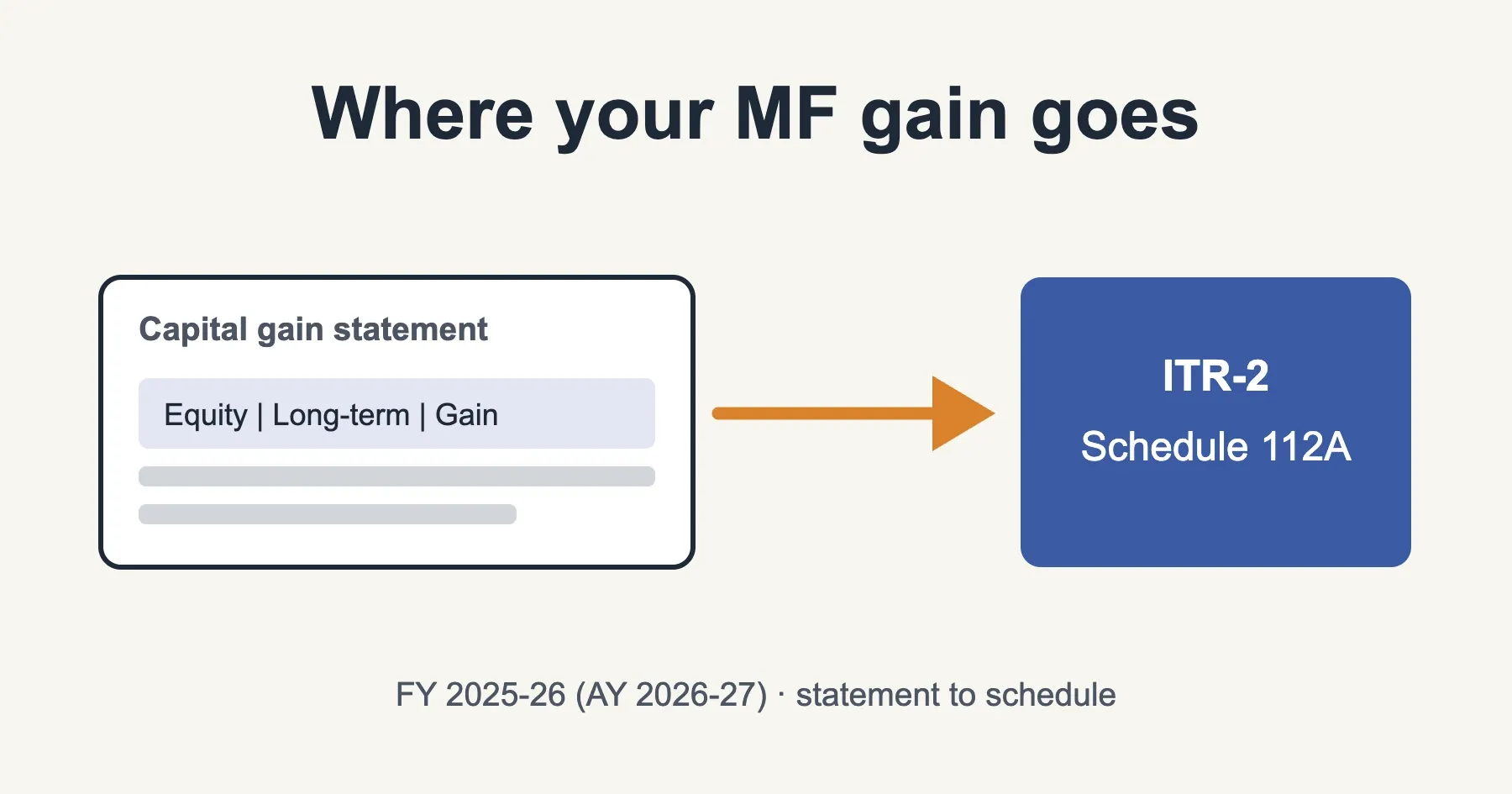
Equity vs Debt Mutual Funds: What Each Holds, How Each Can Fall, and What You Keep After Tax at 1, 3 and 7 Years
What each holds, how each can fall, and what the same ₹2 lakh leaves you after tax at 11 months, 3 years and 7 years.
Summarize this article with AI






The short version
- Equity funds own shares and swing more; debt funds own loans and can still fall on rate rises, defaults or illiquidity.
- SEBI's 26 February 2026 circular defines every category.
- Equity-oriented funds: 20% within 12 months; 12.5% above ₹1.25 lakh a year after.
- Specified mutual fund units bought from 1 April 2023: slab rate at any holding period.
- Hybrids are taxed by where they sit against the 65% lines.
An equity mutual fund mainly owns company shares, so its value can swing widely, especially over short periods. A debt mutual fund owns loans to governments and companies, so it usually moves less but can still fall when interest rates rise or a borrower defaults. Equity fund gains get lower tax rates after 12 months, while gains on debt funds bought from 1 April 2023 are taxed at your slab rate however long you hold them.
Neither type is "safe": both can lose value.
Mihir, 27, in Nagpur, wants a bike in about a year and a flat down payment in seven or more. Instead of asking which type is "better", this page shows what each holds, how each can fall, and what the same ₹2 lakh would leave him after tax at three exit dates.
What each one holds
SEBI's circular "Categorization and Rationalization of Mutual Fund Schemes" (26 February 2026) sets what each label allows.
- Equity funds keep most of their money in shares: a large cap fund at least 80% in large caps, a flexi cap fund at least 65% in equity.
- Debt funds hold debt and money market instruments, and the category tells you how long or how risky those loans can be. A liquid fund holds securities maturing within 91 days; a fund in the 1 to 3 year Macaulay duration category stays in that band; a credit risk fund holds at least 65% in bonds rated AA and below (excluding AA+).
- Hybrid funds mix the two: a conservative hybrid holds 10% to 25% in equity, an aggressive hybrid 65% to 80%.
The full map is in mutual fund categories explained.
How each can lose money
Equity funds fall when share prices fall: a market decline, weak company results, a sector falling out of favour. Diversification spreads company risk but does not stop a fund falling with the whole market.
Debt funds can lose money in three ways:
- Interest-rate risk: when rates rise, existing bond prices fall, more so for longer-duration bonds.
- Credit risk: a borrower can default or be downgraded.
- Liquidity risk: some bonds are hard to sell at a fair price in a stressed market.
Each scheme also shows a riskometer level; see riskometer levels explained. For debt funds alone, see what a debt mutual fund is.
Equity vs debt mutual fund: side-by-side table
| What you compare | Equity fund | Debt fund |
|---|---|---|
| What it holds | Mainly company shares | Bonds, government securities, money market instruments |
| What makes it fall | Market and company news | Rate rises, defaults, illiquid bonds |
| Riskometer | Check the scheme's current level | Check the scheme's current level |
| SEBI category examples | Large Cap, Mid Cap, Flexi Cap, ELSS | Liquid, Money Market, Gilt, Corporate Bond, Credit Risk |
| Tax by holding period | Within 12 months: 20%; after: 12.5% above ₹1.25 lakh a year | Bought from 1 April 2023: slab rate at any holding period |
| Exit load | Scheme-specific; check the SID | Scheme-specific; check the SID |
| Time commonly matched to | Goals several years away | Depends on duration: months for liquid, 1 to 3 years for the 1 to 3 year duration band |
How each is taxed in 2026
Under the Income-tax Act, 2025, in force from 1 April 2026. Rates are before surcharge; 4% health and education cess applies on top. A future Budget could change these rules.
Equity-oriented funds
The tax law's "equity-oriented fund" keeps at least 65% of its money in listed domestic equity shares (section 198(8)). Units held up to 12 months are short-term (section 2(101)).
- Short-term gains: 20% (section 196), where securities transaction tax applies on the sale.
- Long-term gains: 12.5% on gains above ₹1,25,000 in a year (section 198).
Debt funds bought from 1 April 2023
Section 76 calls a fund with more than 65% in debt and money market instruments a "specified mutual fund". Gains on units acquired on or after 1 April 2023 are treated as short-term whatever the holding period, so they are taxed at your slab rate. Older units follow different rules; see how mutual funds are taxed.
Where hybrids fit: the 65% lines
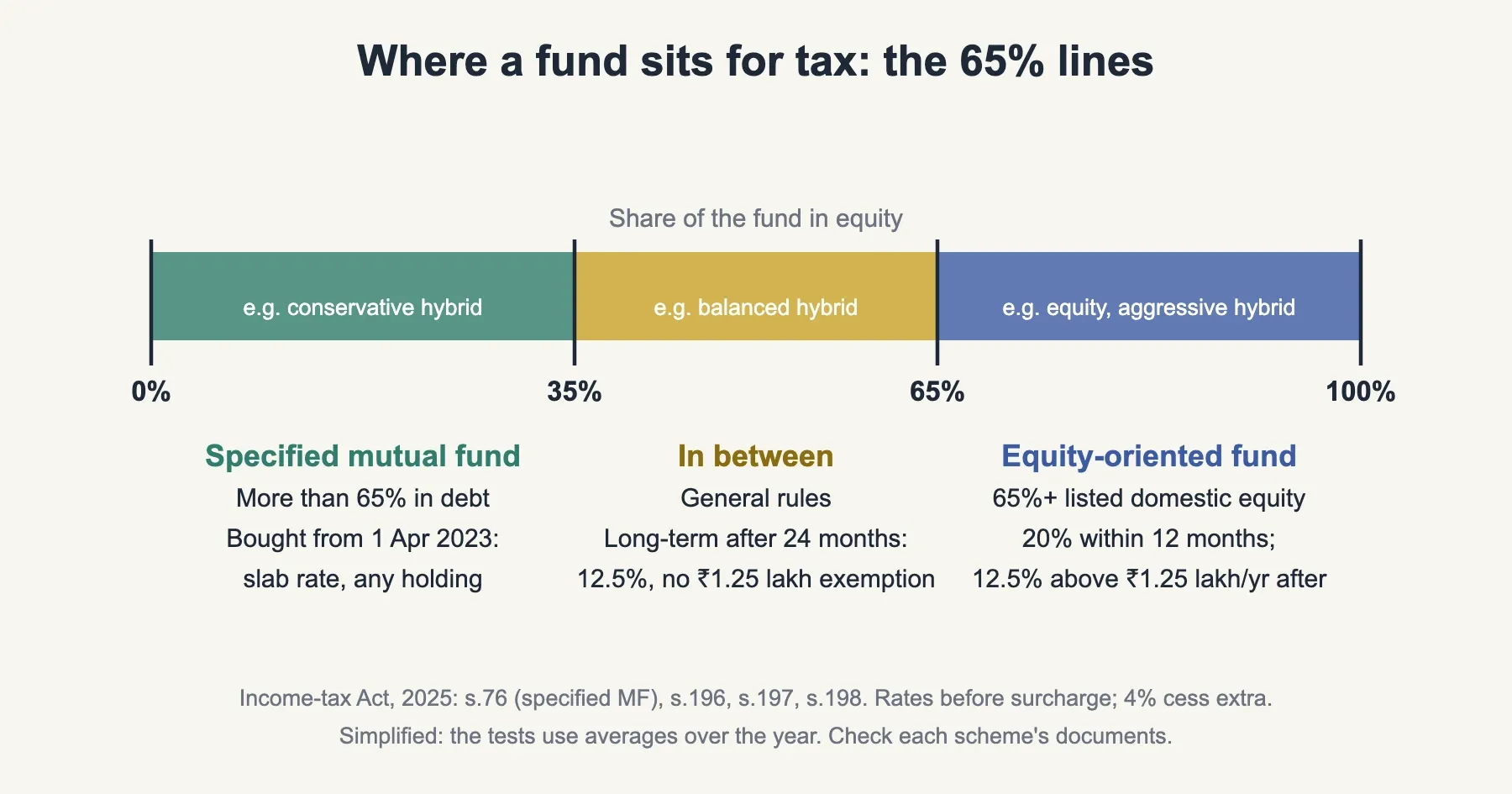
- More than 65% in debt: specified mutual fund, slab rate. A conservative hybrid (75% to 90% debt) would usually sit here.
- 65% or more in listed domestic equity: equity-oriented. An aggressive hybrid (65% to 80% equity) is built to sit here.
- In between: general rules apply. Unlisted units of such funds turn long-term after 24 months (section 2(101)), taxed at 12.5% (section 197) without the ₹1.25 lakh exemption. A balanced hybrid (40% to 60% equity, with no arbitrage allowed under SEBI's rules) would usually fall here.
Arbitrage and equity savings funds keep at least 65% in equity and equity-related instruments under SEBI's rules; whether a scheme counts as equity-oriented for tax is stated in its documents.
Worked example: ₹2 lakh in each, three exit dates
Hypothetical: ₹2,00,000 in a debt fund (bought after 1 April 2023) assumed to earn 6.5% a year, and ₹2,00,000 in an equity fund shown as a range. Debt gains taxed at a hypothetical 20% slab plus 4% cess; equity at the rates above plus 4% cess, with the ₹1.25 lakh exemption unused elsewhere. Rates are assumptions, not forecasts; exit loads ignored.
| Exit | Debt fund: tax / in hand | Equity low | Equity middle | Equity high |
|---|---|---|---|---|
| 11 months | ₹2,472 / ₹2,09,413 | −10% over the period: ₹1,80,000 (loss, no tax) | 0%: ₹2,00,000 | +12% over the period: tax ₹4,992 / ₹2,19,008 |
| 3 years | ₹8,651 / ₹2,32,939 | −5% a year: ₹1,71,475 (loss, no tax) | 8% a year: gain ₹51,942, tax ₹0 / ₹2,51,942 | 12% a year: gain ₹80,986, tax ₹0 / ₹2,80,986 |
| 7 years | ₹23,046 / ₹2,87,751 | 4% a year: tax ₹0 / ₹2,63,186 | 8% a year: tax ₹2,309 / ₹3,40,455 | 12% a year: tax ₹15,228 / ₹4,26,909 |
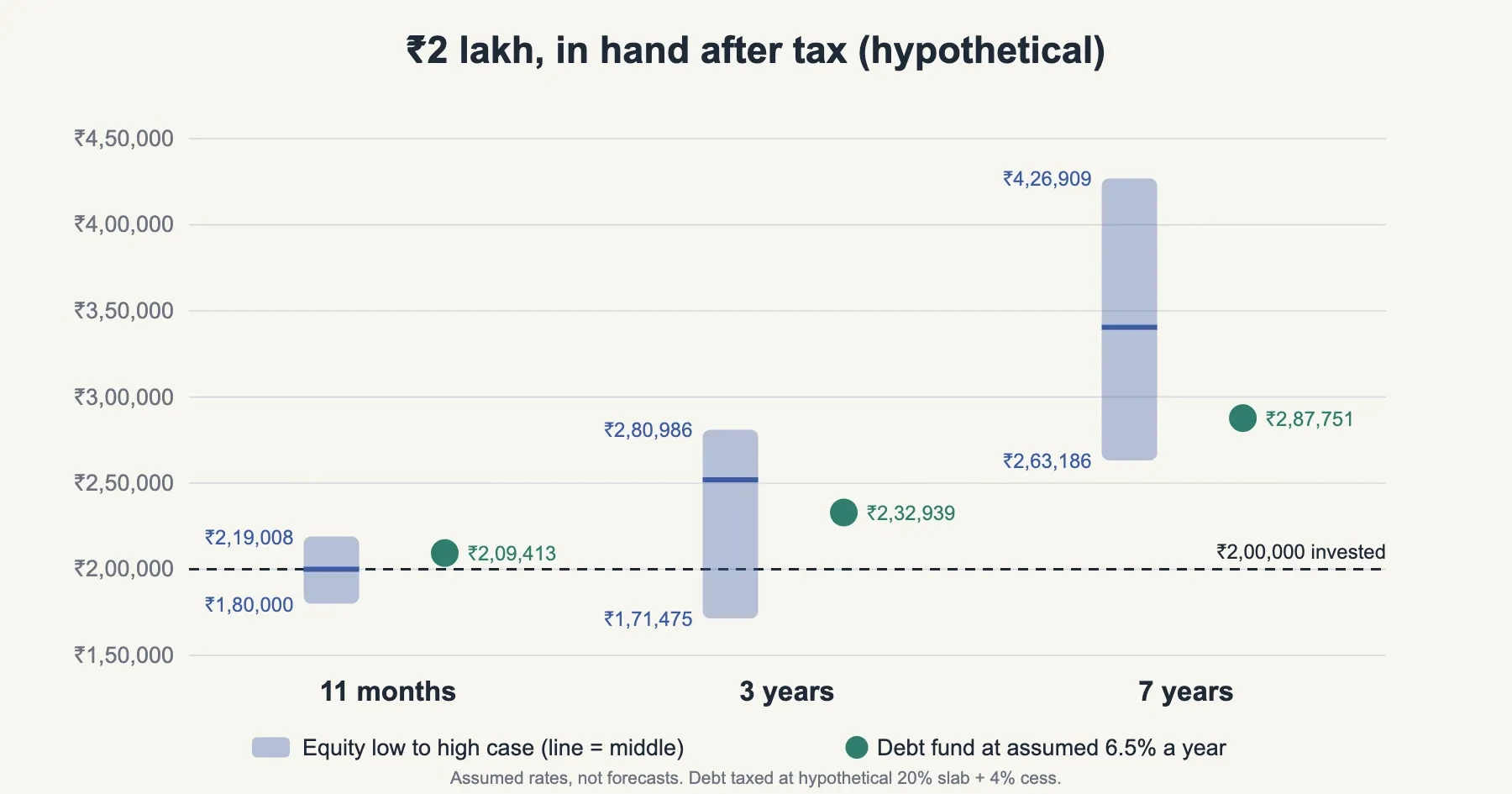
- At 11 months, equity runs from a ₹20,000 loss to a ₹19,008 post-tax gain; debt gains about ₹9,413 after tax.
- At 3 years, the equity low case is still below ₹2 lakh, yet debt's slab-rate tax (₹8,651) is higher than equity's in every case, because equity gains up to ₹1.25 lakh are exempt.
- At 7 years, the gap widens both ways, and debt's tax reaches ₹23,046 on a ₹1,10,797 gain. Equity tax assumes all units are sold in one financial year; the exemption applies per year.
None of this is a prediction. Equity can do worse than the low case, and a debt fund can earn less or fall.
How people commonly match them to time
The useful question is when you need the money:
- Within about three years (Mihir's bike): many people look at debt categories whose duration fits the window, because an equity fall just before the deadline leaves little time to recover.
- Five or more years away (the flat): many people consider equity for part of it, accepting the swings. More time to recover does not rule out a loss.
- Your tolerance: if a 10% fall would make you sell in panic, factor that in.
See which mutual fund type a beginner can start with for these factors applied to a first fund.
Holding both
Many portfolios hold both because each serves a different goal: debt for money with a near, fixed date, equity for goals far enough away to ride out swings. That does not remove risk; it matches each part of your money to its deadline. This page does not suggest a split.
Frequently asked questions
What is the difference between equity and debt mutual funds?
An equity fund mainly owns shares and usually swings more. A debt fund owns bonds and money market instruments and usually moves less, but can fall on rate rises or defaults. Tax also differs under the Income-tax Act, 2025.
Which is better, equity or debt mutual fund?
Neither in general. In the hypothetical example, equity ranged from ₹1,80,000 to ₹2,19,008 at 11 months against ₹2,09,413 for debt, and from ₹2,63,186 to ₹4,26,909 at 7 years against ₹2,87,751. The fit depends on when you need the money.
How are equity and debt mutual funds taxed in 2026?
Equity-oriented funds: 20% within 12 months (section 196), then 12.5% above ₹1.25 lakh a year (section 198). Specified mutual fund units bought from 1 April 2023: slab rate (section 76). Tax rules change; consult a tax professional for your situation.
Can debt mutual funds lose money?
Yes. Bond prices fall when interest rates rise, and borrowers can default or be downgraded. Check the category, duration and riskometer before you invest.
Is a hybrid fund taxed like equity or debt?
It depends on its mix. At least 65% in listed domestic equity is taxed as equity-oriented; more than 65% in debt is a specified mutual fund; anything in between follows the general rules.
Learn more
Save the side-by-side table and check each fund's category, riskometer and SID before you invest.