Exit Load in Mutual Funds: How It's Calculated on Each SIP Instalment, and SEBI's New 3% Ceiling
Exit load in mutual funds explained: how it's charged on each SIP instalment, a ₹ date table, and SEBI's 3% cap under the 2026 Regulations.
Summarize this article with AI






The short version
- Exit load is a percentage of the redemption value of units redeemed inside the load period, credited back to the scheme.
- SEBI (Mutual Funds) Regulations, 2026, Regulation 44(4): an open-ended scheme's exit load cannot exceed 3% of NAV (in force 1 April 2026).
- In an SIP, each instalment has its own clock; with FIFO, your oldest units leave first.
- Exit load is charged on value, not gain, and is separate from lock-in, expense ratio and tax.
- A scheme's actual load, period and any load-free portion are in its SID and KIM.
As of 22 November 2026: an exit load in a mutual fund is a fee, set as a percentage of NAV, that a scheme deducts when you redeem units before a period stated in its documents ends. Under the SEBI (Mutual Funds) Regulations, 2026, it cannot exceed 3% of NAV for an open-ended scheme, and the amount is credited back to the scheme. In an SIP, each instalment's units run on their own clock, so only units still inside the load period are charged.
Meenal, 27, in Kochi, has run a ₹3,000 monthly SIP for 14 months and now needs about ₹46,000 for a course fee. Her fund page says "Exit load: 1% if redeemed within 365 days". Does that mean ₹460? In her hypothetical case, no: it comes to ₹350.78.
Exit load in one paragraph
You are paid the redemption price, not the plain NAV. AMFI defines it as "Applicable NAV*(1- Exit Load, if any)": a NAV of ₹10 with a 2% load gives ₹9.80. The deduction is not income for the fund house. Regulation 44(3) of the 2026 Regulations says "Any exit load charged to the investors shall be credited to the respective scheme", so it stays with the investors who remain. Entry load was abolished by SEBI's circular of 30 June 2009.
What SEBI's 2026 Regulations say: the 3% ceiling
The SEBI (Mutual Funds) Regulations, 2026 came into force on 1 April 2026 (Regulation 1(2)); the text we checked is amended up to 7 July 2026. Regulation 44(4) reads: "The exit load of an open-ended mutual fund scheme shall not exceed three per cent of the Net Asset Value of the scheme."
The 1996 Regulations capped the load indirectly, through a floor on the repurchase price in Regulation 49(3):
| Period | Rule | Implied maximum load |
|---|---|---|
| Before 5 Mar 2021 | Repurchase price not below 93% of NAV | 7% |
| 5 Mar 2021 to 31 Oct 2025 | Floor 95% of NAV | 5% |
| From 1 Nov 2025 | Floor 97% of NAV | 3% |
| From 1 Apr 2026 | 2026 Regulations, Reg 44(4): exit load capped at 3% of NAV | 3% |
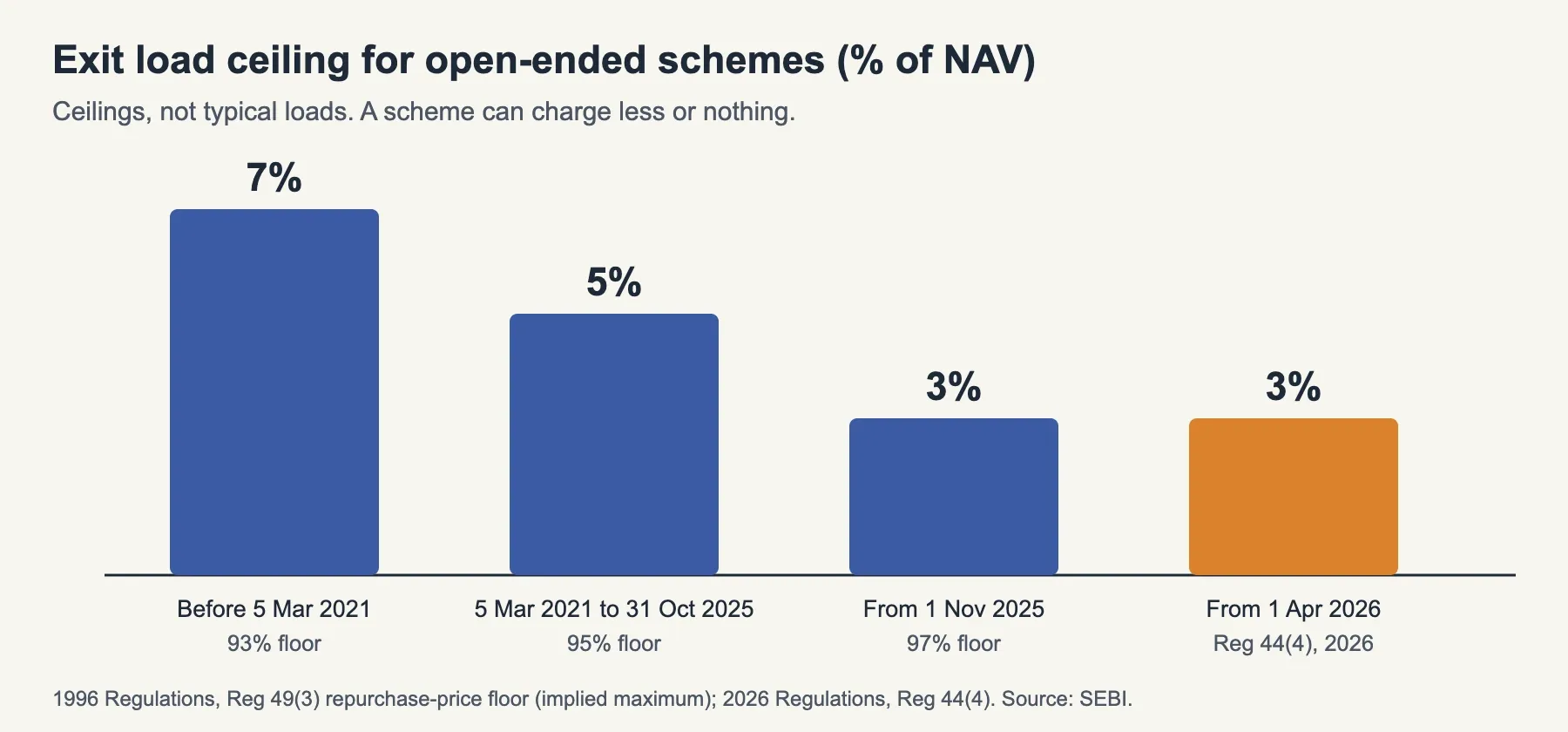
SEBI's board approved cutting the maximum exit load from 5% to 3% in September 2025, and the SEBI (Mutual Funds) (Second Amendment) Regulations, 2025 raised the repurchase-price floor to 97% of NAV from 1 November 2025; the 2026 Regulations now state the 3% cap directly. These are ceilings, not typical loads: a scheme can set a lower load or none. AMFI notes that "Any change in Load structure will be effective on prospective basis", so a change does not reprice units you already hold.
How exit load is calculated: on NAV × units, not on your gain
Exit load = units redeemed that are still inside the load period × NAV on the redemption date × load %.
So the load is charged on value, not profit. If a ₹10,000 redemption includes a ₹500 gain, a 1% load is ₹100, not ₹5. It can apply even at a loss, because it depends on time held. For partial redemptions, scheme documents commonly state that units leave first-in, first-out (FIFO), oldest first; check your scheme's SID.
SIP example: which instalments attract exit load
Assumptions (hypothetical, not a forecast): ₹3,000 on the 5th of each month, 5 September 2025 to 5 October 2026 (14 instalments, ₹42,000); NAV starts at ₹20.00 and is assumed to rise 1.5% a month; 1% load within 365 days; redemption of about ₹46,000 on 16 November 2026 at an assumed NAV of ₹24.6351; FIFO; units rounded down to three decimals.
| Instalment | NAV (₹) | Units bought | Days held | Load? | Units redeemed | Load (₹) |
|---|---|---|---|---|---|---|
| 5 Sep 2025 | 20.0000 | 150.000 | 437 | No | 150.000 | 0.00 |
| 5 Oct 2025 | 20.3000 | 147.783 | 407 | No | 147.783 | 0.00 |
| 5 Nov 2025 | 20.6045 | 145.599 | 376 | No | 145.599 | 0.00 |
| 5 Dec 2025 | 20.9136 | 143.447 | 346 | Yes | 143.447 | 35.34 |
| 5 Jan 2026 | 21.2273 | 141.327 | 315 | Yes | 141.327 | 34.82 |
| 5 Feb 2026 | 21.5457 | 139.238 | 284 | Yes | 139.238 | 34.30 |
| 5 Mar 2026 | 21.8689 | 137.181 | 256 | Yes | 137.181 | 33.79 |
| 5 Apr 2026 | 22.1969 | 135.154 | 225 | Yes | 135.154 | 33.30 |
| 5 May 2026 | 22.5299 | 133.156 | 195 | Yes | 133.156 | 32.80 |
| 5 Jun 2026 | 22.8678 | 131.188 | 164 | Yes | 131.188 | 32.32 |
| 5 Jul 2026 | 23.2108 | 129.250 | 134 | Yes | 129.250 | 31.84 |
| 5 Aug 2026 | 23.5590 | 127.339 | 103 | Yes | 127.339 | 31.37 |
| 5 Sep 2026 | 23.9124 | 125.457 | 72 | Yes | 125.457 | 30.91 |
| 5 Oct 2026 | 24.2710 | 123.604 | 42 | Yes | 81.135 | 19.99 |
- Meenal holds 1,909.723 units worth ₹47,046.22 and redeems 1,867.254 units (₹45,999.99).
- The three oldest instalments, 443.382 units worth ₹10,922.76, are past 365 days and leave free.
- The other 1,423.872 units, worth ₹35,077.23, carry the load: ₹350.78 in all, about 0.76% of the redemption.
- She receives ₹45,649.21 before tax. The 42.469 units left from 5 October 2026 stay inside the load period until about 5 October 2027; the SID's wording decides whether day 365 counts.
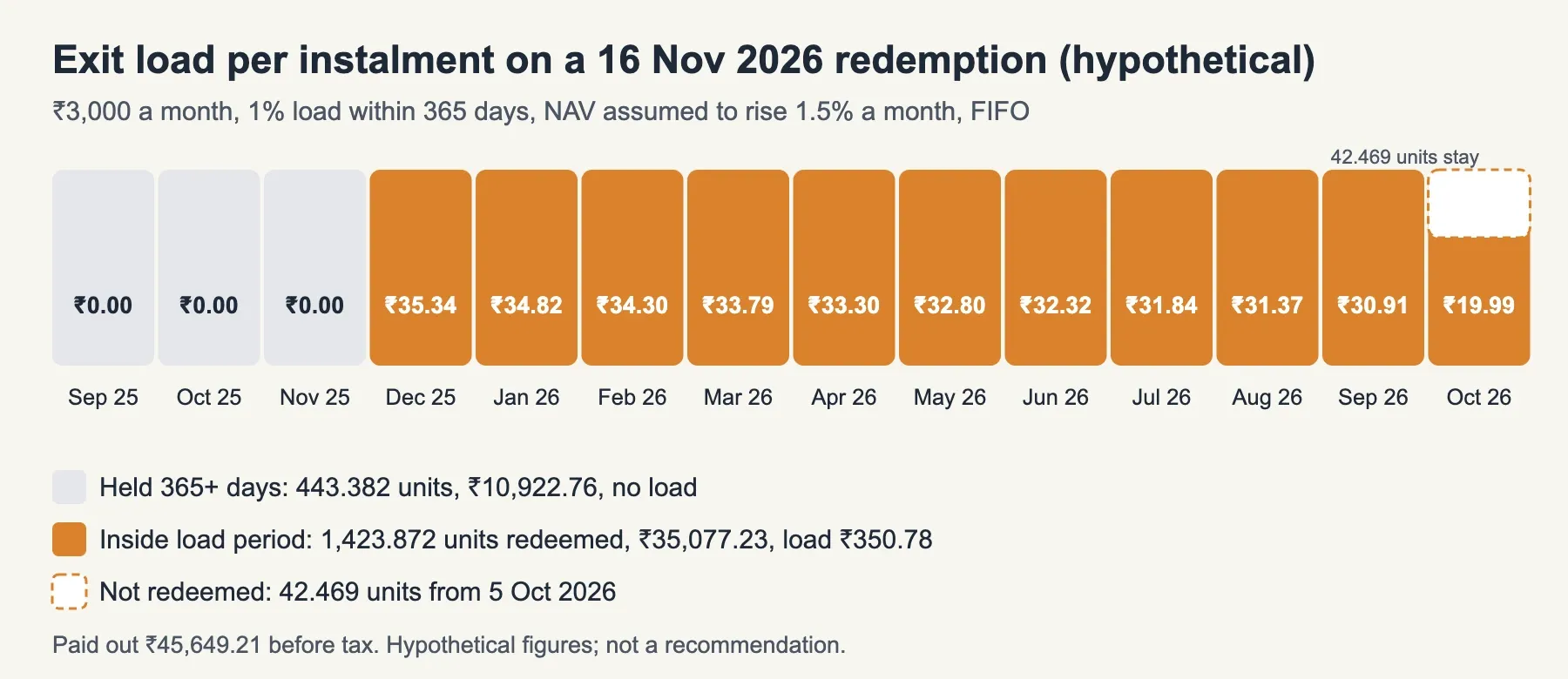
Hypothetical figures; NAV assumed to rise 1.5% a month for illustration only; not a recommendation.
Exit load vs lock-in vs expense ratio vs tax
| Exit load | Lock-in | Expense ratio | Tax | |
|---|---|---|---|---|
| What it is | Fee for leaving early | Period with no redemption (for example, ELSS) | Yearly cost of running the scheme | Capital gains tax |
| When it applies | Units redeemed inside the load period | Until it ends | Every day you hold | Redeeming at a gain |
| How it's charged | % of those units' value, credited to the scheme | Redemption not processed | From scheme assets, reflected in NAV | On your gain, separately from the load |
In short: a lock-in stops you, an exit load charges you for leaving early. More on costs in our expense ratio guide.
When you can exit without load
- After the load period, instalment by instalment.
- When a scheme changes a fundamental attribute. Regulation 22(9)(c) of the 2026 Regulations requires that unit holders get "an option to exit at the prevailing Net Asset Value without any exit load." The notice you receive sets the window.
- Load-free units, where offered. Some schemes let you redeem a stated portion inside the load period without a charge; the SID says whether yours does.
- Schemes with no exit load.
A switch to another scheme, including regular to direct, is generally processed as a redemption, so the load can apply. See our guide to switching from regular to direct.
Do liquid or index funds have an exit load?
Liquid funds: yes, for a few days. Every liquid fund carries the same graded exit load, set by AMFI with SEBI's agreement in 2019: 0.0070% of the redemption proceeds on day 1, stepping down to 0.0045% on day 6, and nil from day 7. On ₹1,00,000 redeemed on day 1, that is ₹7. Index funds and other schemes set their own load, which can last days, a year or longer, or be nil, so read that scheme's SID or KIM.
Where to find a fund's exit load
Check the Scheme Information Document (SID), Key Information Memorandum (KIM) and factsheet. Note: the percentage, the period, whether it counts days or months, and any load-free portion. Our factsheet walkthrough shows where it sits. If you are deciding whether to withdraw at all, see can you withdraw your SIP money anytime.
Frequently asked questions
What is exit load in mutual fund with example?
A fee deducted when you redeem units before the period in the scheme's documents ends. Hypothetically, redeeming ₹10,000 of units with a 1% load means ₹100 is deducted and ₹9,900 is paid out, before tax.
Is exit load charged on SIP?
Yes, per instalment. On a given redemption date only units still inside the load period are charged. In the example above, 3 of 14 instalments were load-free.
What is the maximum exit load allowed by SEBI?
Under Regulation 44(4) of the SEBI (Mutual Funds) Regulations, 2026, in force from 1 April 2026, an open-ended scheme's exit load shall not exceed 3% of NAV. A scheme can charge less or nothing.
Is exit load charged on profit or total amount?
On the redemption value of the units inside the load period, not on profit. Tax on any gain is a separate calculation.
Do liquid or index funds have an exit load?
Liquid funds carry a small graded exit load if you redeem within six days: 0.0070% on day 1, falling to 0.0045% on day 6, and nil from day 7. For index funds it varies by scheme; check the SID or KIM.
Can a fund raise the exit load on units I already hold?
AMFI states that a change in load structure applies prospectively, so it covers future purchases, not units you already hold.
Save this checklist
Before you redeem: note the load line, list instalment dates, count those inside the period, multiply their units by NAV and the load %, and compare with waiting.