How to Invest in a Gold ETF: The Order Screen Explained, From iNAV to Limit Price to Tax When You Sell
Buy a gold ETF like a share: demat, iNAV vs price, bid-ask, limit orders, costs and 2026 tax rules, with a hypothetical ₹25,000 example.
Summarize this article with AI






The short version
- A gold ETF is bought like a listed share: demat plus trading account, an exchange order during market hours, units credited after settlement.
- Read three numbers before buying: iNAV, best bid and best ask. SEBI requires ETF iNAV to be disclosed on the exchange.
- A limit order protects you when quotes thin out; in the hypothetical thin-market case a market order cost ₹240 more on 192 units.
- You buy whole units, not grams; gold per unit varies by scheme, so check the SID or KIM.
- Listed gold ETF units held more than 12 months give long-term gains taxed at 12.5%; shorter holdings are taxed at your slab rate.
You invest in a gold ETF the way you buy a listed share: through a demat and trading account, during market hours, by placing a buy order on the exchange. Before you press buy, compare the ETF's market price with its iNAV (indicative NAV), use a limit order instead of a market order, and know the costs and tax that apply when you sell. The units reach your demat account after the trade settles.
Before you start: what you need to invest in a gold ETF
A gold ETF is a mutual fund scheme whose units are listed and traded on a stock exchange. So you need two things:
- A demat account, held with a depository participant (DP), where the units will sit.
- A trading account with a stock broker, which sends your order to the exchange.
Both need completed KYC. If you are new to this, read what is a demat account first.
No demat account? Gold mutual funds (fund of funds that invest in gold ETFs) can be bought without one, at the day's NAV. The trade-offs are covered in gold ETF vs gold mutual fund.
Step by step: buying your first gold ETF units
- Log in to your trading account and search for the gold ETF by its exchange symbol.
- Read three numbers: last traded price, iNAV, and best bid/ask.
- Decide the quantity in units, within your budget.
- Place a limit order during market hours.
- Check the contract note, then confirm the units in your demat after settlement.
Harshita, 29, has set aside ₹25,000 for gold. Every figure below is hypothetical, for a made-up ETF.
Find the ETF and read three numbers: last traded price, iNAV, bid/ask
On the order screen, Harshita sees:
| What the screen shows | Hypothetical value | What it means |
|---|---|---|
| iNAV | ₹128.40 | An indicative, intraday estimate of the value of the gold behind one unit |
| Best bid | ₹128.25 | The highest price a buyer is offering right now |
| Best ask | ₹128.55 | The lowest price a seller is asking right now |
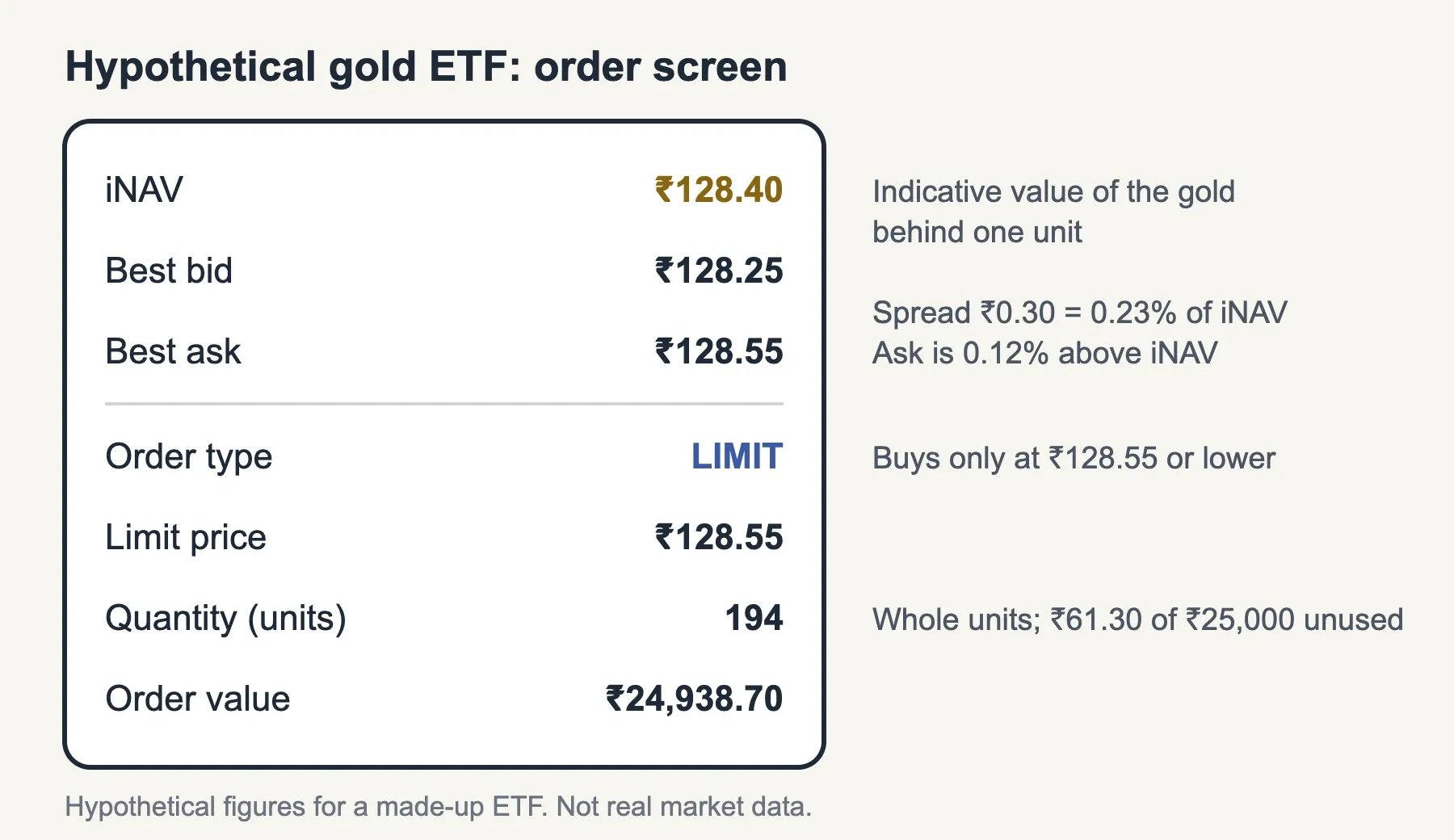
iNAV is the number most first-time buyers skip. Under SEBI's rules on passive funds, iNAV of ETFs must be disclosed on the stock exchanges where the units are listed; for gold and silver ETFs it is based on the latest available gold or silver price data.
The gap between bid and ask here is ₹0.30, which is 0.23% of the iNAV. If Harshita bought 194 units and sold them straight back, she would lose about ₹58.20 to that gap alone. The ask of ₹128.55 is 0.12% above the iNAV, a small premium.
Choose quantity: units, not grams
You buy whole units, not grams of gold. At ₹128.55, ₹25,000 buys 194 units for ₹24,938.70, leaving ₹61.30 unused.
How much gold one unit represents differs between schemes. Do not assume one unit equals one gram; read the figure in the scheme's Scheme Information Document (SID) or Key Information Memorandum (KIM).
Limit order vs market order, and why a limit order matters for thinly traded ETFs
A market order buys at whatever sellers are asking at that moment. A limit order buys only at your price or better.
SEBI requires each ETF's fund house to appoint at least two market makers who give two-way quotes on the exchange, but they must quote for at least 75% of market hours, not every second. Quotes can thin out, especially in smaller ETFs.
Suppose the best ask jumps to ₹129.80, which is 1.09% above the iNAV of ₹128.40. A market order from Harshita would buy only 192 units for ₹24,921.60, and she would pay ₹240 more for those 192 units than at ₹128.55. A limit order at ₹128.55 would simply wait, unfilled, until a seller met her price.
Practical rule: compare the ask with the iNAV, and place a limit at or near the iNAV-based price you are willing to pay.
After the trade: settlement, contract note, units in demat
Once the order executes, your broker issues a contract note listing price, quantity and charges. Units reach your demat after the trade settles. Keep the contract note: it is your cost record for tax.
What it costs to invest in a gold ETF
| Cost | When it hits | Where to check |
|---|---|---|
| Brokerage | On each buy and sell | Your broker's tariff sheet |
| Statutory charges and GST on brokerage | On each trade | Contract note |
| DP charge | When units are debited from your demat, typically on sale | Your DP's tariff |
| Expense ratio | Daily, inside the scheme | Scheme documents; reflected in NAV |
| Bid-ask spread | Each time you trade | Order screen (₹0.30 per unit in our example) |
| Premium or discount to iNAV | Each time you trade | Order screen vs iNAV |
The expense ratio and tracking error also matter over time. SEBI caps tracking error for ETFs other than debt ETFs at 2%, measured on rolling one-year data, and requires daily tracking-error disclosure on the fund house and AMFI websites.
SIP in a gold ETF: how it differs from a fund SIP
A mutual fund SIP buys units at the day's NAV, including fractional units. A gold ETF has no such facility on the exchange. What some brokers offer is a recurring buy order: on a set date, the broker places an order for a set number of units, or for as many whole units as your amount allows, at the market price at that moment.
The price is not fixed in advance, leftover cash stays in your trading account, and the iNAV and spread checks apply on every instalment. Comparing other gold formats? See digital gold vs gold ETF.
Selling a gold ETF and tax in 2026
Selling works in reverse: a sell order (preferably a limit order), after which the units leave your demat.
| Item | Rule under the Income-tax Act, 2025 |
|---|---|
| Holding period | Units of a fund listed on a recognised stock exchange are long-term if held for more than 12 months (section 2(101)) |
| Long-term capital gains | 12.5%, under section 197, with no indexation |
| Short-term gains (12 months or less) | Taxed at your normal slab rates |
Gold ETF units are listed securities, so the 12-month test applies to them. A gold mutual fund (fund of funds) is not listed, so its units need more than 24 months to be long-term.
Hypothetical example. Harshita sells her 194 units after 14 months at ₹151.20. Proceeds are ₹29,332.80, and her gain is ₹4,394.10 (before brokerage and DP charges, which reduce the gain). Held more than 12 months, it is long-term: tax at 12.5% is about ₹549.26.
Had she sold within 12 months, the same gain would be short-term: about ₹878.82 at a 20% slab rate, or ₹1,318.23 at 30%. Cess and any surcharge apply on top of these figures. Section 197 also lets resident individuals whose other income is below the non-taxable limit reduce the taxable gain by the shortfall.
Old pages still quoting "20% with indexation after three years" describe older rules that no longer apply to sales today.
Frequently asked questions
How do I buy a gold ETF in India?
Open a demat and trading account with KYC, search the ETF by its symbol, compare its price with the iNAV and bid/ask, place a limit order during market hours, and confirm the units in your demat after settlement.
Do I need a demat account to invest in a gold ETF?
Yes. Gold ETF units are exchange-listed and are held in demat form. Without a demat, a gold mutual fund (fund of funds) is the route.
What is iNAV in a gold ETF and why should I check it?
iNAV is the indicative, intraday value of the gold behind one unit, which SEBI requires to be disclosed on the exchange. In our hypothetical example, buying at ₹129.80 when the iNAV is ₹128.40 means paying 1.09% over value; a limit order helps you avoid this.
How is a gold ETF taxed when I sell in 2026?
Listed gold ETF units held for more than 12 months give long-term gains, taxed at 12.5% under section 197 of the Income-tax Act, 2025. Units held 12 months or less give short-term gains, taxed at your slab rate. On a hypothetical ₹4,394.10 long-term gain, that is about ₹549.26 before cess.
Can I do an SIP in a gold ETF?
Not in the fund-SIP sense. Some brokers let you set a recurring buy order that purchases whole units at the market price on chosen dates, so check iNAV and spread on each instalment.
Save this checklist
Before every gold ETF order: demat ready, iNAV checked, bid/ask checked, limit price set, charges known, contract note saved.