Direct vs regular mutual fund plans: same fund, different cost
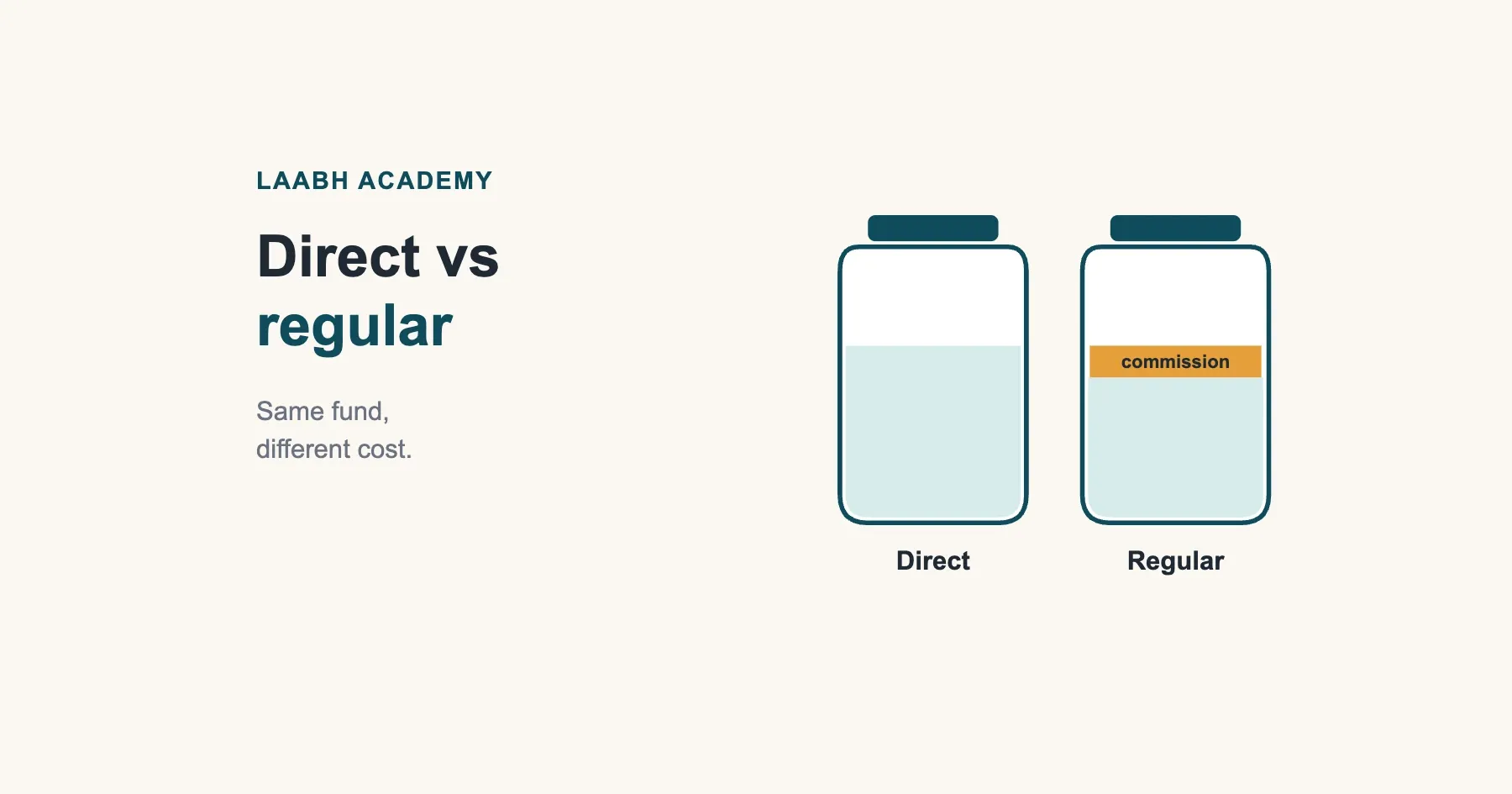
A direct and a regular plan of a scheme hold the same portfolio. The regular plan costs more because it pays a distributor. What that gap adds up to in ₹.
Summarize this article with AI





The short version
- Direct and regular plans of a scheme share one portfolio and one fund manager.
- The regular plan has a higher expense ratio because it pays a distributor's commission.
- The cost gap compounds: a hypothetical 1 percentage point a year adds up to lakhs over 20 years.
- A regular plan pays for a distributor's service; decide whether you need that service.
- Switching from regular to direct counts as a redemption, so check exit load and tax first.
A direct plan and a regular plan of the same mutual fund scheme invest in exactly the same portfolio, run by the same fund manager. The difference is cost. A regular plan is bought through a distributor, who is paid a commission out of the scheme's expenses, so it has a higher expense ratio and, over time, a lower NAV. A direct plan is bought straight from the fund house, with no distributor commission.
Priya, 24, works in Lucknow and is about to start her first SIP (Systematic Investment Plan). Her bank's app and a fund house's own website show what looks like the same fund at two different NAVs, one labelled "Regular" and one "Direct". Is one of them a different fund? Which should she pick?
What is the same, and what is different
SEBI required fund houses to offer a separate direct plan in their schemes from 1 January 2013, under circular CIR/IMD/DF/21/2012 dated 13 September 2012. Each scheme now usually has both plans side by side.
| Direct plan | Regular plan | |
|---|---|---|
| Portfolio and fund manager | Same | Same |
| Investment objective and risk | Same | Same |
| How you buy it | Straight from the fund house, or a platform that offers direct plans | Through a mutual fund distributor (including many banks and apps) |
| Distributor commission | None | Paid out of the scheme's expenses |
| Expense ratio | Lower | Higher |
| NAV | Higher over time, because less is deducted | Lower over time |
| Exit load and lock-in | Same as the scheme's | Same as the scheme's |
Expense ratio: the yearly cost of running a fund, shown as a percentage of your investment and taken out of the fund's assets before the NAV is published. You never see a separate bill; it shows up as a slightly lower NAV.
Why the NAVs differ: both plans start from the same portfolio, but the regular plan deducts a little more every day. Over the years that small difference builds up, so the regular plan's NAV falls further behind. A higher NAV does not mean the direct plan is "more expensive" to buy; you simply get fewer units of a plan that has kept more of its returns.
What the cost gap adds up to
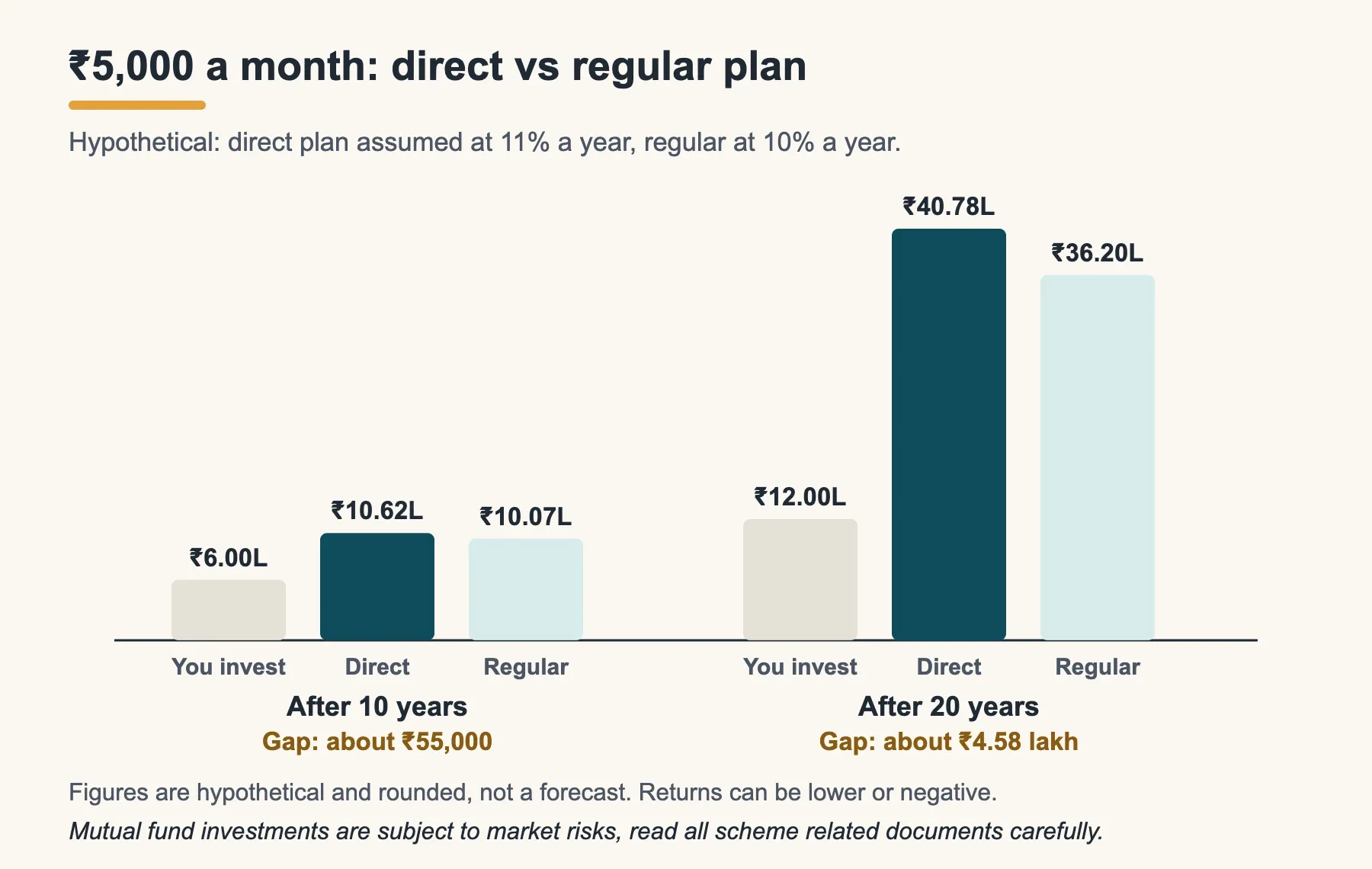
The gap between the two plans' expense ratios varies by scheme and changes over time; each plan's current figure is published by the fund house. To show why even a small gap matters, here is a hypothetical illustration with a 1 percentage point difference in yearly returns.
| ₹5,000 a month (SIP) | You invest | Direct plan, assumed 11% a year | Regular plan, assumed 10% a year | Difference |
|---|---|---|---|---|
| After 10 years | ₹6,00,000 | about ₹10.62 lakh | about ₹10.07 lakh | about ₹55,000 |
| After 20 years | ₹12,00,000 | about ₹40.78 lakh | about ₹36.20 lakh | about ₹4.58 lakh |
The difference grows faster than the years: about ₹55,000 after 10 years, about ₹4.58 lakh after 20. That is because the cost is taken every year from a balance that keeps growing, and the money taken out also stops compounding.
Method: hypothetical; ₹5,000 invested at the start of each month, compounded monthly at the equivalent of the assumed annual rate. The 11% and 10% rates are assumptions to illustrate a 1 percentage point gap, not predictions or the returns of any scheme. Actual returns can be lower, including below the amount invested. Taxes and exit loads are ignored.
What a regular plan pays for
The extra cost in a regular plan is not a hidden fee for nothing. It pays a mutual fund distributor, who must be registered with AMFI and hold an ARN (AMFI Registration Number). A distributor can help you open an account, complete paperwork, and keep track of your investments.
Two things are worth knowing:
- The commission is paid for as long as you hold. It is built into the expense ratio, so you pay it every year, not once.
- A distributor is not the same as an adviser. If you want personal advice on what to buy, a SEBI-registered investment adviser charges you a fee directly and isn't paid commissions, so usually recommends direct plans. A distributor is paid by the fund through the regular plan.
Whether that service is worth the cost is your call. Some first-time investors value hand-holding; others are comfortable buying directly once they understand the basics.
How to tell which plan you hold
- Look at the full scheme name on your statement or app. It includes "Direct Plan" or "Regular Plan", and "Growth" or "IDCW".
- Check your Consolidated Account Statement (CAS), sent by the registrars CAMS or KFintech for units held outside a demat account. It lists the plan for every holding.
- If you bought through a distributor, your statement usually shows their ARN; a direct holding does not have one.
Switching from regular to direct
You can move existing money from a regular plan to the direct plan of the same scheme, but the switch is treated as selling one and buying the other:
- Exit load: if your regular-plan units are still inside the scheme's exit-load period, the load can apply.
- Tax: a switch is a redemption, so any gain is taxed, split into short-term and long-term by how long each instalment was held.
- New money is simpler: you can start any new SIP in the direct plan without touching existing units.
Check the exit-load terms in the scheme's documents and, for the tax side, speak to a tax professional before switching a large amount. Tax rules change; consult a tax professional for your situation.
The catch
A direct plan only saves money; it does not choose the fund for you. Buying the wrong category directly costs more than buying the right one through a distributor. The plan decision comes after you have picked a category that fits your goal and time horizon.
Frequently asked questions
Is a direct mutual fund plan better than a regular plan?
A direct plan costs less, because no distributor commission is paid, and it holds exactly the same portfolio as the regular plan of the same scheme. A regular plan pays for a distributor's service. If you don't need that service, the direct plan keeps more of your returns; if you do, decide whether the service is worth its yearly cost.
Why is the NAV of the direct plan higher than the regular plan?
Both plans start with the same portfolio, but the regular plan deducts a slightly higher expense ratio every day. Over the years, the direct plan keeps more of its returns, so its NAV ends up higher. A higher NAV doesn't make it more expensive; you just get fewer units.
Direct plan aur regular plan mein kya fark hai?
Dono plan ek hi scheme ke hain, portfolio aur fund manager bhi same hain. Fark sirf kharche ka hai: regular plan mein distributor ka commission expense ratio mein juda hota hai, isliye uska kharcha zyada hota hai aur lambe samay mein NAV kam rehti hai. Direct plan seedha fund house se kharida jaata hai, bina commission ke.
Can I switch from a regular plan to a direct plan?
Yes. The switch counts as a redemption from the regular plan and a purchase in the direct plan, so exit load can apply if your units are still within the load period, and any gain is taxed. Starting new SIPs in the direct plan avoids this. Tax rules change; consult a tax professional for your situation.
What to do next
Pick your fund category first, using our guide on which type of mutual fund to start with. Then compare the expense ratios of the direct and regular plans of the scheme you choose, and decide whether you want a distributor's help.
Read next: How to start an SIP: a step-by-step guide for first-time investors



