Growth or IDCW? How to choose the option on your first fund page
IDCW pays part of the NAV out to you; it is not extra return. How Growth and IDCW differ, how each is taxed in 2026, and how your goal decides.
Summarize this article with AI





The short version
- Growth and IDCW hold the same portfolio; only what happens to gains differs.
- An IDCW payout lowers the NAV by the same amount: it is not extra return.
- IDCW amounts and dates are not fixed, and each payout is taxed in the year it arrives.
- Growth defers tax until you redeem or switch.
- Pick the option by whether the goal needs cash before its date.
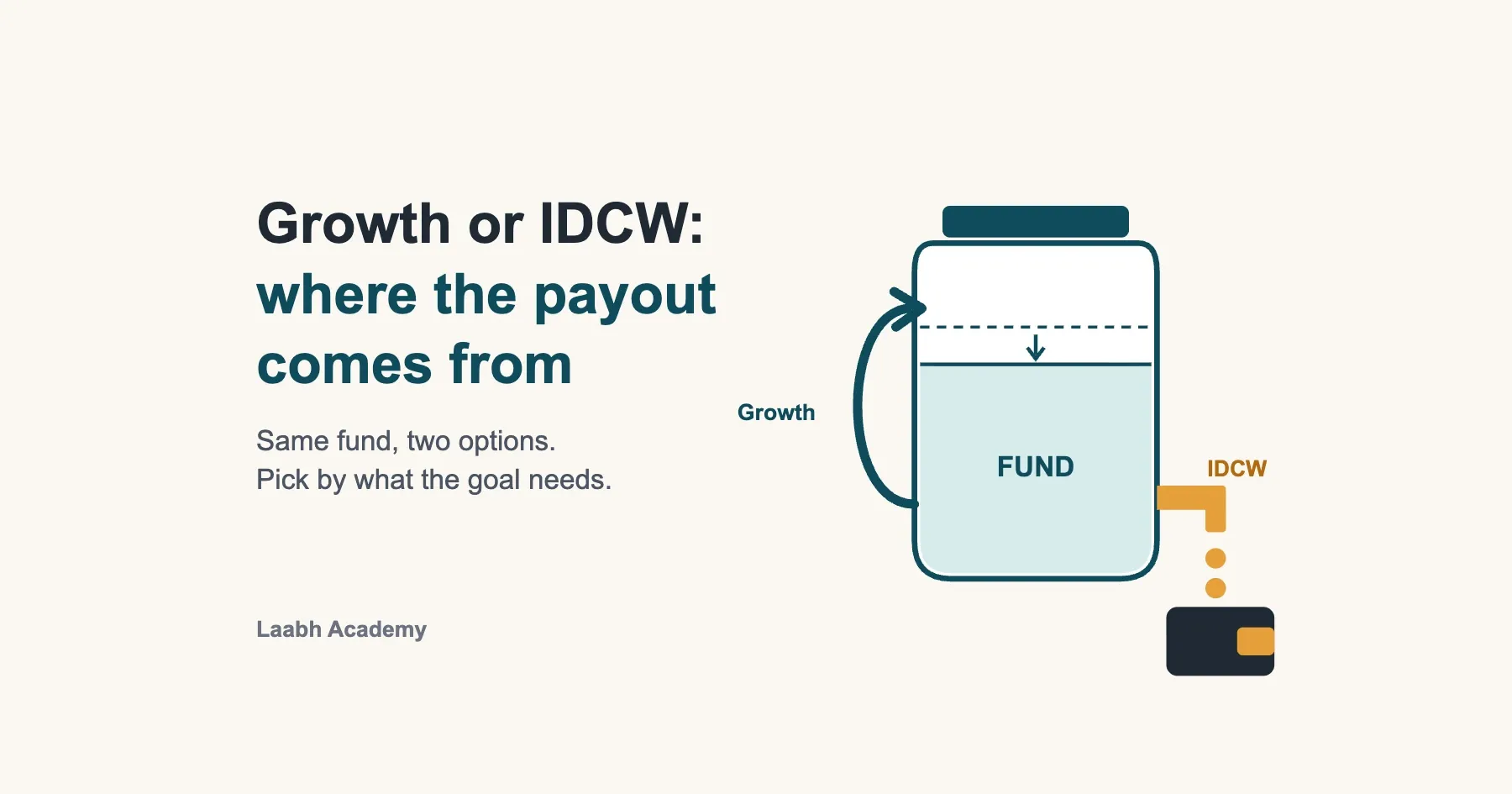
Growth and IDCW are two options on the same mutual fund scheme, holding the same portfolio. With Growth, gains stay inside the NAV (net asset value) until you redeem; with IDCW, the fund may pay part of that NAV out to you, the NAV falls by the amount paid, and neither the amount nor the date is fixed. So the choice is not about which earns more: it turns on whether your goal needs cash before its date.
Meenakshi, 27, is a pharmacist in Madurai (a fictional example). She has chosen a fund category for a home down payment about seven years away and opened the scheme page to start her first SIP. Under the scheme name sit two buttons, Growth and IDCW. IDCW sounds like extra income, so she wonders whether to tick it. This guide to the growth vs IDCW option in a mutual fund walks through what each one does to her money.
What Growth and IDCW mean on a fund page
IDCW stands for Income Distribution cum Capital Withdrawal. It was earlier called the dividend option. SEBI's FAQ for mutual fund investors says: "SEBI on April 1, 2021 has renamed the dividend option in mutual funds to Income Distribution cum Capital Withdrawal (IDCW)." The FAQ gives the reason as separating fund distributions from dividends on shares, and avoiding the impression that the old dividend option was a guaranteed bonus.
- Growth option: the scheme declares no IDCW. Gains and losses show up only in the NAV, and you receive money when you redeem units.
- IDCW option: the scheme may declare a distribution, subject to having distributable surplus. You then either receive it in your bank account (IDCW payout) or it buys you more units (IDCW reinvestment).
Option vs plan
The same page usually shows a second label, Direct or Regular. That is the plan, a separate choice. This guide covers only the option.
What happens to the NAV when IDCW is paid
AMFI's investor-education site, Mutual Funds Sahi Hai, puts it plainly: "Once the distribution is made, the net asset value (NAV) of the fund decreases by the amount of the payout."
The payout is part of your own investment
A distribution comes out of the scheme's distributable surplus. One Scheme Information Document (SID) filed with SEBI explains that distributions can be paid from an Equalisation Reserve, which it describes as "part of sale price paid by them", meaning by investors when they bought units. In plain terms, part of what comes back to you can be money investors put in. That is the "capital withdrawal" in the name.
A hypothetical example: 1,000 units at ₹20
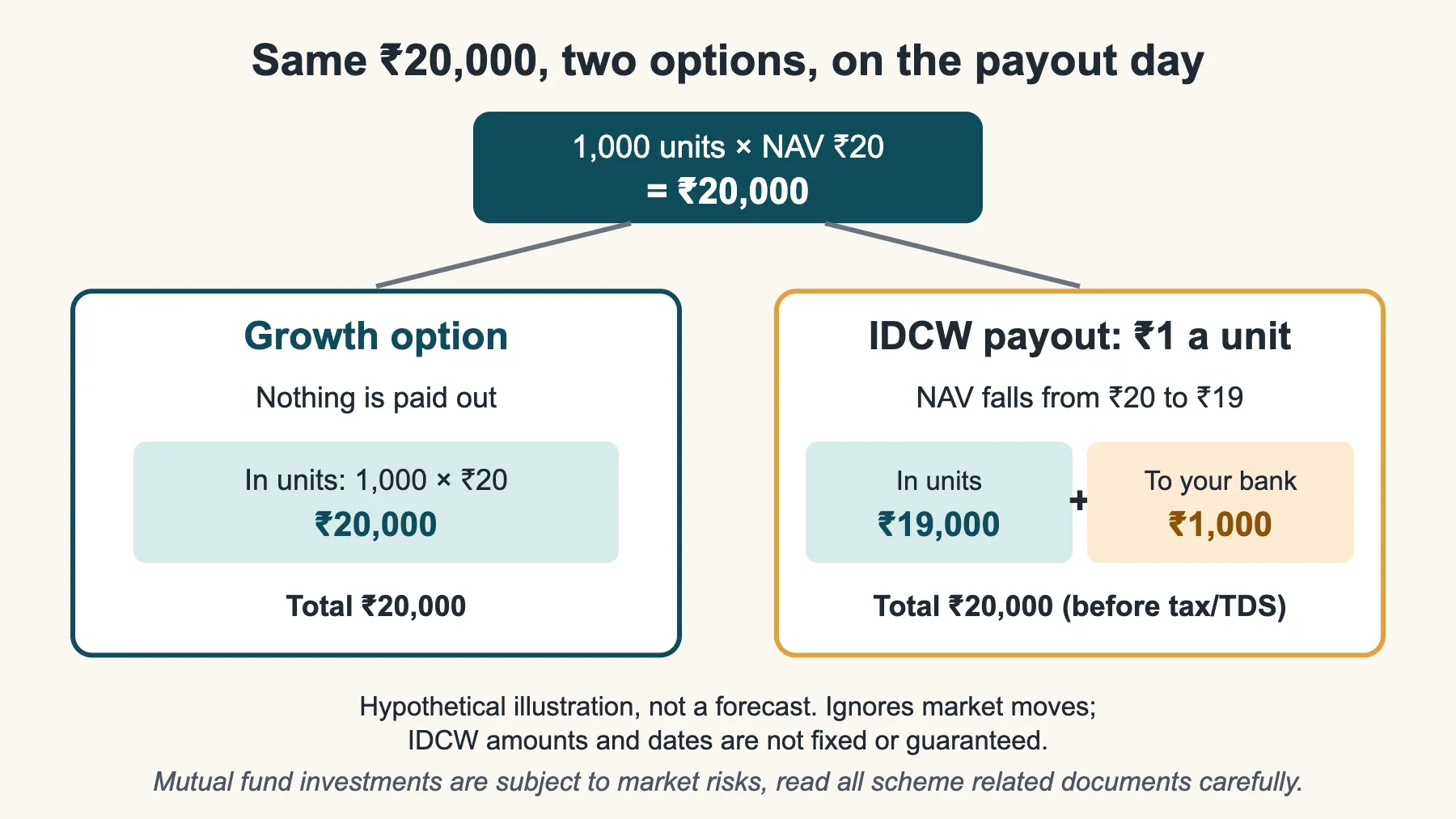
Say Meenakshi holds 1,000 units at a NAV of ₹20, worth ₹20,000. The figures are hypothetical and ignore market moves.
- Growth: nothing is paid. All ₹20,000 stays in units.
- IDCW payout of ₹1 a unit: ₹1,000 goes to her bank account and the NAV falls to ₹19. Her units are now worth 1,000 × ₹19 = ₹19,000. Add the ₹1,000 and she still has ₹20,000, before tax and TDS.
- IDCW reinvestment: the same ₹1,000 buys new units. At ₹19 a unit that is about 52.63 units, so she holds about 1,052.63 units worth about ₹20,000.
On the payout day, nothing was gained. What changed is where the money sits and when tax is due: tax applies to the ₹1,000 in the year it is paid, while under Growth it waits until she redeems. In real life the NAV also moves every day for market reasons, which is a separate effect (see what happens to your SIP when the market falls). IDCW amounts and dates are not fixed or guaranteed.
Growth vs IDCW side by side
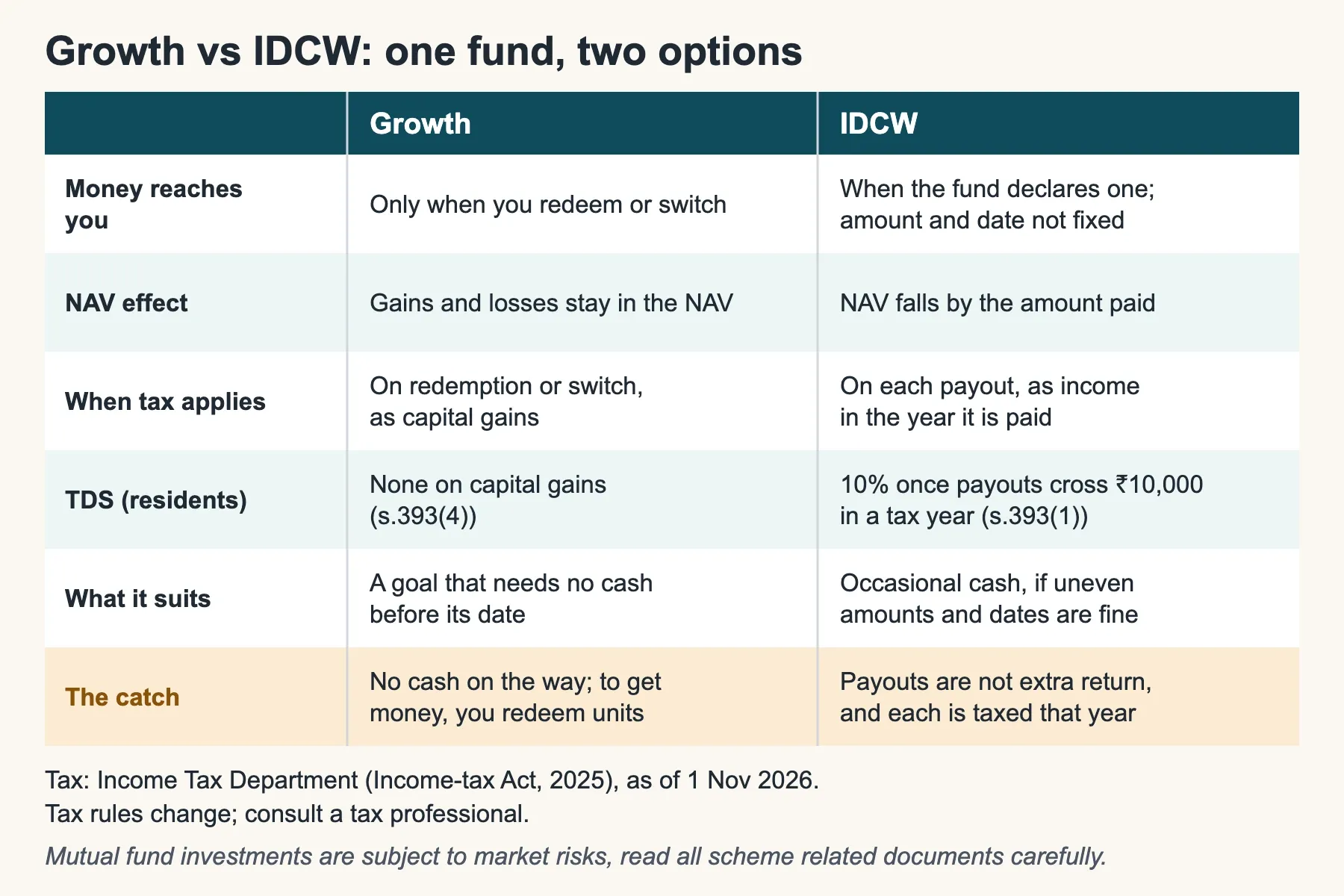
| Growth option | IDCW option | |
|---|---|---|
| When money reaches you | Only when you redeem or switch | When the fund declares a distribution; SEBI's FAQ says payment is made within seven working days of the record date |
| NAV effect | Gains and losses stay in the NAV | NAV falls by the amount paid |
| When tax applies | On redemption or switch, as capital gains | On each payout, as income in the year it is paid |
| TDS (resident investors) | None on capital gains (s.393(4)) | 10% once the year's payouts from the same mutual fund cross ₹10,000 (s.393(1)) |
| What it suits | A goal that needs no cash before its date | Occasional cash, if uneven amounts and dates are acceptable |
| The catch | No cash along the way; to get money, you redeem units | Payouts are not extra return, and each one is taxed in the year it arrives |
How each option is taxed (as of 1 November 2026)
The Income-tax Act, 2025 is now in force, and its section numbers differ from the older Act that many articles still quote. Everything below reflects the Income Tax Department's pages as we checked them on 1 November 2026.
IDCW
- TDS: under section 393(1) [Table S. No. 4(i)], tax is deducted at 10% on income in respect of mutual fund units paid to a resident, once the year's payouts from the same mutual fund exceed ₹10,000 in the tax year.
- Final tax: the payout is your income for that year. TDS is tax collected in advance, so your final tax depends on your total income and the regime you use, not on the 10%.
Growth
Nothing is taxed while you hold. When you redeem or switch, the gain is a capital gain. For units of equity-oriented funds, gains on units held for 12 months or less are taxed at 20% (section 196). Gains on units held longer are taxed at 12.5% on the amount above ₹1.25 lakh a year (section 198). Debt-oriented funds follow different rules (section 76). Section 393(4) says no TDS is deducted on mutual fund unit income that is a capital gain.
Payout vs reinvestment
The Income Tax Department pages we checked do not treat reinvestment separately. Don't assume reinvesting avoids tax: the distribution is still declared in your name before it buys new units. Check how your SID describes it, and ask a tax professional.
Tax rules change; consult a tax professional for your situation.
Which one fits your goal?
Start from the goal, not the label.
- A long goal that needs no cash before its date. This is Meenakshi's case. Growth fits it: nothing leaves the fund, and tax waits until she redeems.
- A goal that needs some cash along the way. IDCW is one way, but the fund decides whether and how much to pay, and when. A systematic withdrawal plan (SWP) is another: you choose an amount and dates, and units are redeemed to pay it. Each SWP redemption can carry capital gains tax and an exit load. Neither gives a fixed income; compare both against what the goal needs.
- Not sure yet. Let the goal date decide. If you can't name the date, settle that first; our guide on how long to continue an SIP covers it.
Picked the wrong option? Switching explained
SEBI's FAQ describes switching as "the process of redeeming one fund and purchasing another within the same AMC". Moving between options of the same scheme is also done as a switch, at the applicable NAVs, so the number of units changes.
- Exit load: check the load section of the SID. One SID we read charges no exit load on switches between options of the same scheme; others can differ.
- Tax: AMFI treats a switch as a sale (redemption), so capital gains tax may apply to the units you move, based on how long you held them.
Frequently asked questions
IDCW ya Growth, pehli baar invest kar raha hoon, kaunsa option lena chahiye?
Pehle yeh dekhein ki goal se pehle paisa chahiye ya nahi. Agar goal lamba hai aur beech mein paisa nahi chahiye, toh Growth mein sab paisa fund mein rehta hai aur tax redeem karne par lagta hai. IDCW extra return nahi hai: payout ke baad NAV utna hi gir jaata hai, aur amount aur date tay nahi hote. Beech mein paisa chahiye toh IDCW aur SWP dono ko goal ke hisaab se compare karein.
Is IDCW the same as the old dividend option?
Yes. SEBI renamed the dividend option in mutual funds to Income Distribution cum Capital Withdrawal (IDCW), effective 1 April 2021, according to SEBI's FAQ for mutual fund investors. The new name makes clear that a payout can include part of your own capital and is not a bonus on top of your investment.
How are IDCW and Growth taxed in 2026, and is TDS deducted?
As of 1 November 2026, under the Income-tax Act, 2025: an IDCW payout is income in the year it is paid, and for a resident, 10% TDS applies under section 393(1) once the year's payouts from the same mutual fund exceed ₹10,000 in the tax year. Growth is taxed only when you redeem or switch, as capital gains, with no TDS on capital gains for residents (section 393(4)). Tax rules change; consult a tax professional for your situation.
Does choosing IDCW reinvestment instead of payout avoid tax?
Don't assume it does. With reinvestment the distribution is still declared in your name and then used to buy new units. The Income Tax Department pages we checked do not treat it separately, so check your SID and ask a tax professional.
I chose IDCW by mistake. Can I switch to Growth, and what does it cost?
Usually you can switch between options of the same scheme. A switch is treated as a redemption followed by a purchase, so capital gains tax may apply to the units you move. Exit load depends on the SID; some SIDs charge none on switches between options, so read the load section first.
What to do next
- Write down the goal and its date.
- Write down whether this goal needs any cash before that date.
- Find the option names in the scheme's KIM and SID.
- If you need cash along the way, compare IDCW and an SWP against that need.
- If you hold the wrong option, read the SID's load section and check the tax before switching.
- Revisit each year: the goal date, whether it now needs cash, and whether the option still fits.
— Laabh



