How long should you continue your SIP? Let your goal decide
There's no ideal number of years for an SIP. Your goal sets the length, you review it yearly, and stopping instalments doesn't sell your units.
Summarize this article with AI





The short version
- An SIP has no ideal number of years; the goal sets the length.
- SIP tenure, goal horizon and holding period are three different clocks.
- Stopping an SIP ends the instalments; your units stay invested until you redeem.
- As the goal gets close, consider moving gradually to lower-risk categories, and check exit load and tax before any switch.
- Revisit the goal, the amount and the category once a year.
An SIP has no ideal number of years. Keep it running for as long as the goal it is funding needs, and review it once a year. Stopping your instalments does not sell your units: they stay invested until you redeem them.
Rohit, 25, works in Jaipur. Fourteen months ago he started a ₹2,000 monthly SIP (Systematic Investment Plan) towards a down payment on a home, which he hopes to buy in about 6 years. A friend just told him he stopped his own SIP "after 3 years, because that's enough". Should Rohit do the same?
Three terms that get mixed up
Most confusion about "how long" comes from treating three clocks as one.
| Term | What it means | Rohit's example |
|---|---|---|
| SIP tenure | The period for which your SIP instalments are set to run. You can usually change it, and ending it does not sell your units. | The end date he picked when he signed up. He can usually extend or shorten it. |
| Goal horizon | The time left until you need the money for a specific goal. | About 6 years, until the home down payment. |
| Holding period | How long your units stay invested. Each instalment's units have their own holding period, which runs until you redeem them. | 14 months so far for his first instalment; less for each later one. |
His friend's "3 years" was an SIP tenure. Rohit's real question is his goal horizon.
Your goal sets the SIP length
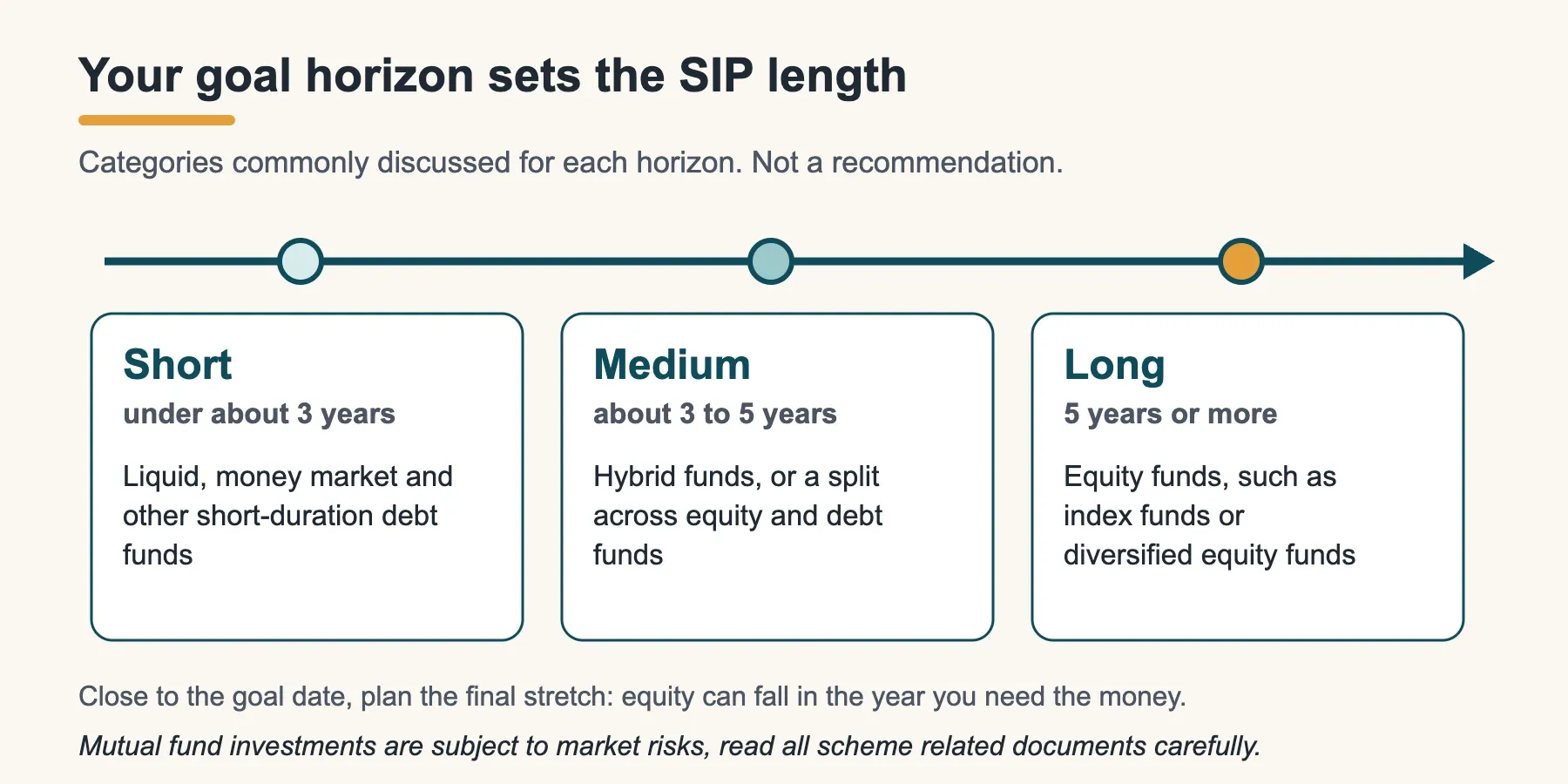
"Is 5 years enough?" has no single answer: it depends on when you need the money and what kind of fund the SIP is in. Match the goal horizon with a fund category, then let the SIP run for as long as the goal needs. The bands below are our interpretation of common investor-education guidance, not a SEBI rule or a fixed count of years.
| Goal horizon | Categories commonly discussed | The catch |
|---|---|---|
| Short (under about 3 years) | Liquid, money market and other short-duration debt funds | Prices usually move less, but returns may not keep up with inflation, and debt funds still carry interest-rate and credit risk. |
| Medium (about 3 to 5 years) | Hybrid funds that mix equity and debt, or a split across equity and debt funds | The equity part can still fall in the year you need the money. |
| Long (5 years or more) | Equity funds, such as index funds or diversified equity funds | Equity can fall sharply in some years, including close to the goal date, so you need a plan for the final stretch. |
For Rohit, a goal about 6 years away sits in the long band today. Within a year or so it will be a medium-horizon goal, and in about three years a short one. The years left keep shrinking, which is why a yearly check matters more than the tenure he chose at sign-up.
Perpetual or fixed-tenure SIP?
AMFI's investor-education site says you can increase or decrease your SIP tenure, change the instalment amount, and opt for a perpetual SIP that continues without interruption. A perpetual SIP is an SIP set up with no end date, which runs until you choose to stop it.
- Fixed tenure: the instalments end on a date you chose. The catch: that date may arrive before your goal does, and the instalments stop quietly unless you extend them.
- Perpetual: the instalments carry on until you stop them. The catch: it is easy to forget, so the SIP can keep running in the same fund after the goal has changed or passed.
Neither is better in itself; what matters is a yearly check that the SIP still matches the goal. If you do want to stop or pause instalments, AMFI suggests sending the request at least 30 days before the next due date to be safe. Pause options and timelines vary by fund house and platform, so check yours.
What happens when your SIP ends
When the SIP tenure ends, or you stop it, only the instalments stop. The units you have already bought stay in the scheme and keep moving with the market, up or down. Ending the SIP does not pay anything out; the money reaches you when you redeem units.
An AMC investor-education page (updated 3 August 2026) puts it plainly: your accumulated investment continues to remain invested in the scheme unless you choose to redeem it.
A hypothetical illustration: stop versus redeem
Take a simplified SIP: ₹2,000 a month for 5 years, paid at the start of each month. That is ₹1,20,000 invested.
| Scenario | Invested | Hypothetical value |
|---|---|---|
| SIP runs 5 years, then all units are redeemed | ₹1,20,000 | about ₹1,54,300 at year 5 |
| SIP runs 5 years, instalments stop, units stay invested 3 more years, then redeemed | ₹1,20,000 | about ₹2,05,400 at year 8 |
The second row adds no new money. The higher figure comes only from three more years in the market at a steady assumed 10%; real returns vary, and a fall in those years could leave the year-8 value below the year-5 value. The point is that stopping the SIP did not sell the units, not that holding longer pays more.
Hypothetical; assumed 10% a year, compounded monthly at the equivalent monthly rate. This is not an expected return or a projection for any fund. Actual values can be lower, including below the amount invested. Figures are before tax, exit load and other costs.
As your goal gets close
Say Rohit's down payment is two years away and his SIP is still entirely in an equity fund. That deserves a look, because a fall in the final two years leaves little time to recover before he needs the money. He has three broad options:
- Keep holding. The catch: the full amount stays exposed to equity swings right up to the goal date.
- Move gradually to lower-risk categories, for example by redirecting new instalments and shifting part of the money to debt or hybrid funds over several months. The catch: too early can give up growth he still had time for.
- Redeem in stages as the goal approaches. The catch: too late, and he may end up selling in a fall.
Some funds build this shift in. SEBI's life cycle fund category, introduced by a circular in February 2026, gives each fund a target date and reduces its equity share on a pre-set schedule as that date approaches.
Switching between schemes counts as a redemption, so exit load and capital-gains tax can apply. As of 29 October 2026, under the Income-tax Act, 2025, long-term gains on equity-oriented fund units are taxed at 12.5% on your total such gains (including from listed shares) above ₹1.25 lakh in a financial year; short-term gains and debt funds follow different rules. Tax rules change; consult a tax professional for your situation.
Stop or keep going? A quick guide
| What changed | A reasonable response |
|---|---|
| The goal is reached, or nearly | Stop new instalments into that fund and plan the move or redemption described above. |
| The goal changed (new date, new amount) | Re-match the SIP's amount, tenure and category to the new goal rather than stopping by default. |
| Money is tight for a few months | Reduce the amount, or pause if your fund house allows it, rather than redeeming. |
| A friend stopped after "3 years" | Not a reason on its own. His goal is not yours. |
| The market fell | See our guide: What happens to your SIP when the market falls (and should you stop it?) |
Stop for a goal reason, not a headline.
Revisit each year
An SIP needs one honest check a year. Pick a date you will remember, such as your birthday or the day your increment lands, and look at four things:
- Goal amount. Is it still the right figure? A home in Jaipur six years from now may cost more than you first wrote down.
- Goal date. Has it moved closer or further away?
- SIP amount. Can you afford to raise it? Some investors increase the SIP each year as income grows; it is optional.
- Category fit. Does the fund category still suit the years left? This is where a long-horizon equity SIP starts to shift as the goal comes nearer.
So 3 years is not Rohit's number. His number is "until the down payment", checked once a year.
Frequently asked questions
What is the ideal SIP tenure? Is 5 years enough?
There is no ideal tenure that suits everyone. Five years can be enough for a goal five years away, and too short for a goal fifteen years away. Set the tenure to cover your goal horizon, choose a category that fits the years left, and review it once a year.
SIP kitne saal tak karna chahiye?
Koi fixed number of saal nahi hai. SIP utne saal chalna chahiye jitne saal aapke goal ko chahiye, aur saal mein ek baar review zaroor karein. SIP band karne se aapke units bikte nahi; woh tab tak invested rehte hain jab tak aap redeem nahi karte.
Should I stop my SIP once I reach my goal amount?
Often, yes: the goal is why the SIP exists. But reaching the amount on paper is not the same as having the money in hand. Before the goal date, plan how to move gradually to lower-risk categories or redeem in stages, and check exit load and tax first.
What happens to my money when my SIP tenure ends?
The instalments stop, and your units stay invested in the scheme. Their value keeps moving with the market until you redeem them. Nothing is paid out automatically when the tenure ends.
Perpetual SIP or fixed-tenure SIP: which should I choose?
A perpetual SIP runs until you choose to stop it; a fixed-tenure SIP ends on a set date, which you can usually change. Choose a fixed tenure if you want the end date tied to a clear goal, or a perpetual SIP if you would rather not renew, but review either one each year.
What to do next
Write your goal amount and goal date next to your SIP's name, check whether its category still fits the years left, and put a yearly review date in your calendar.
Read next: What happens to your SIP when the market falls (and should you stop it?)



