How many mutual funds should a beginner have? When a second fund earns its place
No fixed number. A second fund earns its place only when it does a different job. How to check goal, category and portfolio overlap first.
Summarize this article with AI





The short version
- There is no fixed count; a second fund should do a job your first one doesn't.
- Good reasons: a new goal with a different date, a missing category, a deliberate split.
- Weak reasons: the same category twice, last year's returns, a new launch, or feeling safer.
- Check overlap by hand from monthly portfolio disclosures; weights matter as much as count.
- Published ranges (2–4, 4–5) are opinions for specific investors, not rules.
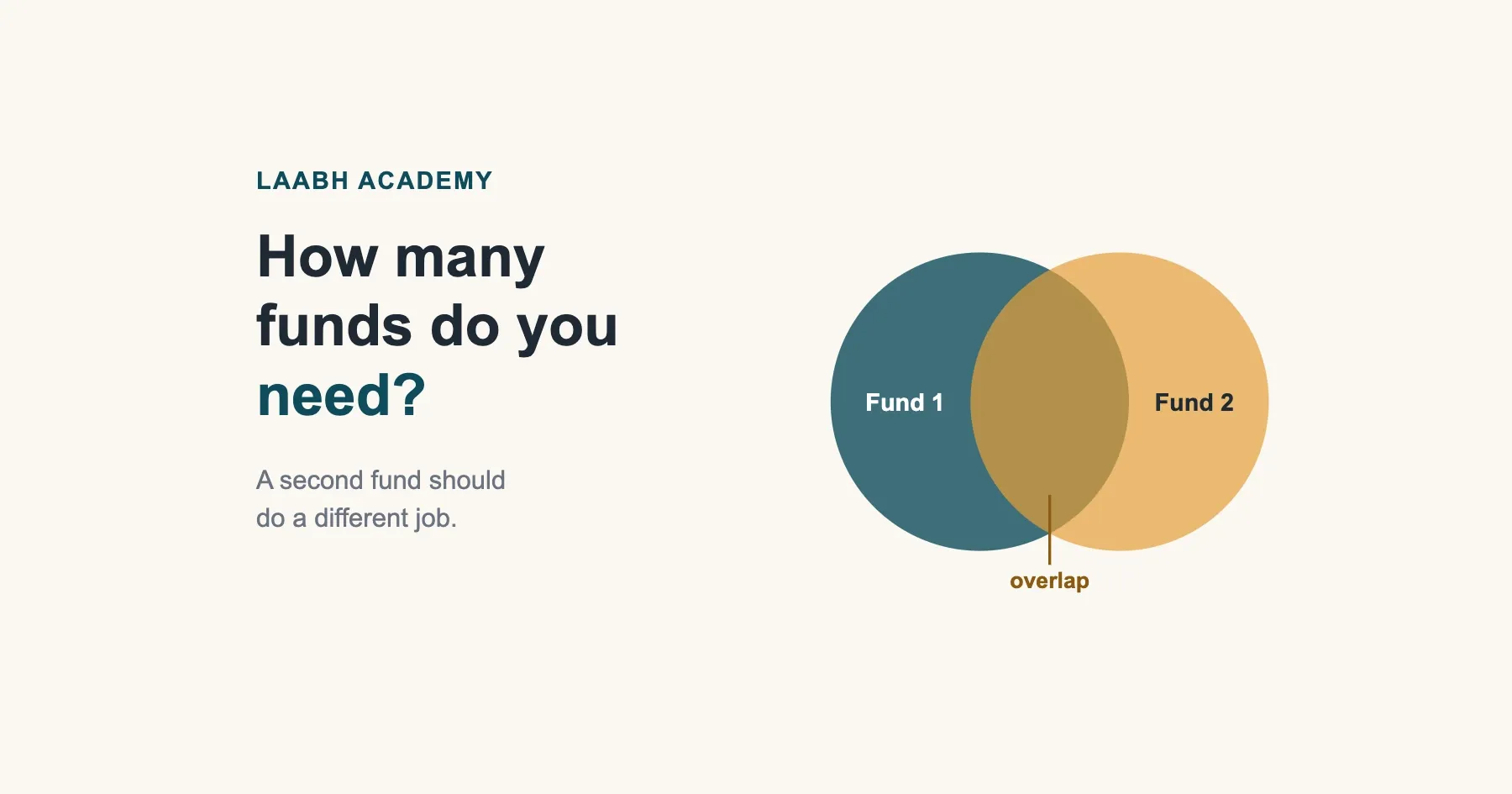
There is no fixed number of mutual funds a beginner should have. One diversified fund can be a reasonable start; a second fund earns its place when it does a different job, such as a separate goal, a different time horizon or a category your first fund doesn't cover. If it holds mostly the same stocks, it adds overlap, not variety.
Ananya, 27, works in Kochi and has run a ₹3,000 SIP (Systematic Investment Plan) in one diversified equity fund for eight months. A raise has freed up ₹2,000 more a month, and a colleague tells her, "You need at least four funds." Does she? This guide is for anyone with one fund running, a little more to invest, and a lot of advice about counts.
Is one fund enough to start?
For many first-time investors, yes. A diversified equity fund already spreads money across many companies, which is the basic idea of diversification: spreading money across investments that behave differently, so one fall doesn't affect everything at once. Choosing that first fund's category was the subject of our earlier guide in this series.
What one fund can't do is serve two goals with very different dates. A fund suited to a 15-year goal may not suit money you need in three years. That gap, not a target count, is usually the first real reason to think about a second fund.
Three signs a second fund may help
1. A new goal with a different date
You now want money for a course, a wedding or a home deposit within a few years, alongside your long-term SIP. A fund for a 15-year goal and one for a 3-year goal do different jobs, so keeping them separate makes each easier to judge.
The catch: if the new money is really for the same long-term goal, a new fund adds nothing a bigger SIP couldn't.
2. A category your first fund doesn't cover
SEBI groups schemes into fund categories by what they must invest in, under its framework of 26 February 2026. A hybrid fund, which mixes equity and debt, does a different job from a diversified equity fund. So does a debt-oriented fund for nearer money.
The catch: read the category's mandate, not just its name, and check the scheme's riskometer, which shows its risk on a six-level scale from Low to Very High.
3. A grown SIP you want to split on purpose
Once your monthly amount has grown, you may want a deliberate mix: for example, part in an index fund and part in an actively managed fund, because you have decided you want both approaches.
The catch: "on purpose" means you can name what the split does. If you can't, one larger SIP is simpler to track.
Three signs it won't help
1. The same category twice
Two funds in one category follow the same broad rulebook, so they can end up holding many of the same companies. You pay two expense ratios and track two funds for less variety than it seems.
The catch: they are not necessarily near-copies. You only know by comparing what they hold (see the overlap check below).
2. Chasing a recent top performer or a new launch
Last year's chart-topper, or a new fund offer (NFO) in the news, is a reason to look, not a reason to add. New fund offers often arrive in waves, and a launch being in the news says nothing about whether it fits your goal.
The catch: past returns don't tell you whether a fund does a different job for you. Ask a new launch the same three questions as any fund: which goal, which category, how much overlap.
3. Adding funds to "feel safer"
If all your funds hold large Indian companies, they tend to fall together. Adding funds won't stop a market fall from showing up in your portfolio; for what a fall does to a running SIP, read What happens to your SIP when the market falls.
The catch: safety comes from matching the category to your goal and time horizon, not from the number of funds.
What portfolio overlap is, and how to check it yourself
Portfolio overlap is the share of the same stocks held by two or more of your funds. High overlap means a second fund adds less variety than it seems.
A hypothetical example (hypothetical funds; not real schemes): Fund A and Fund B each hold 40 stocks, and 24 appear in both. By count, that is 24 ÷ 40 = 60% overlap.
Weights matter too. Suppose those 24 shared stocks make up 75% of Fund A's money. Then three-quarters of what you own through Fund A is in companies you also own through Fund B, so the overlap that matters to you is higher than the count suggests.
How to check by hand
SEBI's investor FAQs state that mutual funds must disclose the full portfolio of every scheme monthly, within 10 days of the month's close, on the fund house's website and on AMFI's website. Debt schemes also disclose fortnightly, within 5 days of each fortnight.
- Open the latest monthly portfolio disclosure, or the factsheet, for each fund on its fund house's website.
- List each fund's top 10 holdings and the percentage each takes.
- Mark the stocks in both lists and add up their percentages for each fund.
- If most of the top 10 match and the shared stocks carry a large share of each fund, the second fund is unlikely to add much variety.
Top 10 holdings won't capture everything, so treat this as a first look rather than a full measure.
Top up your SIP or start a second one?
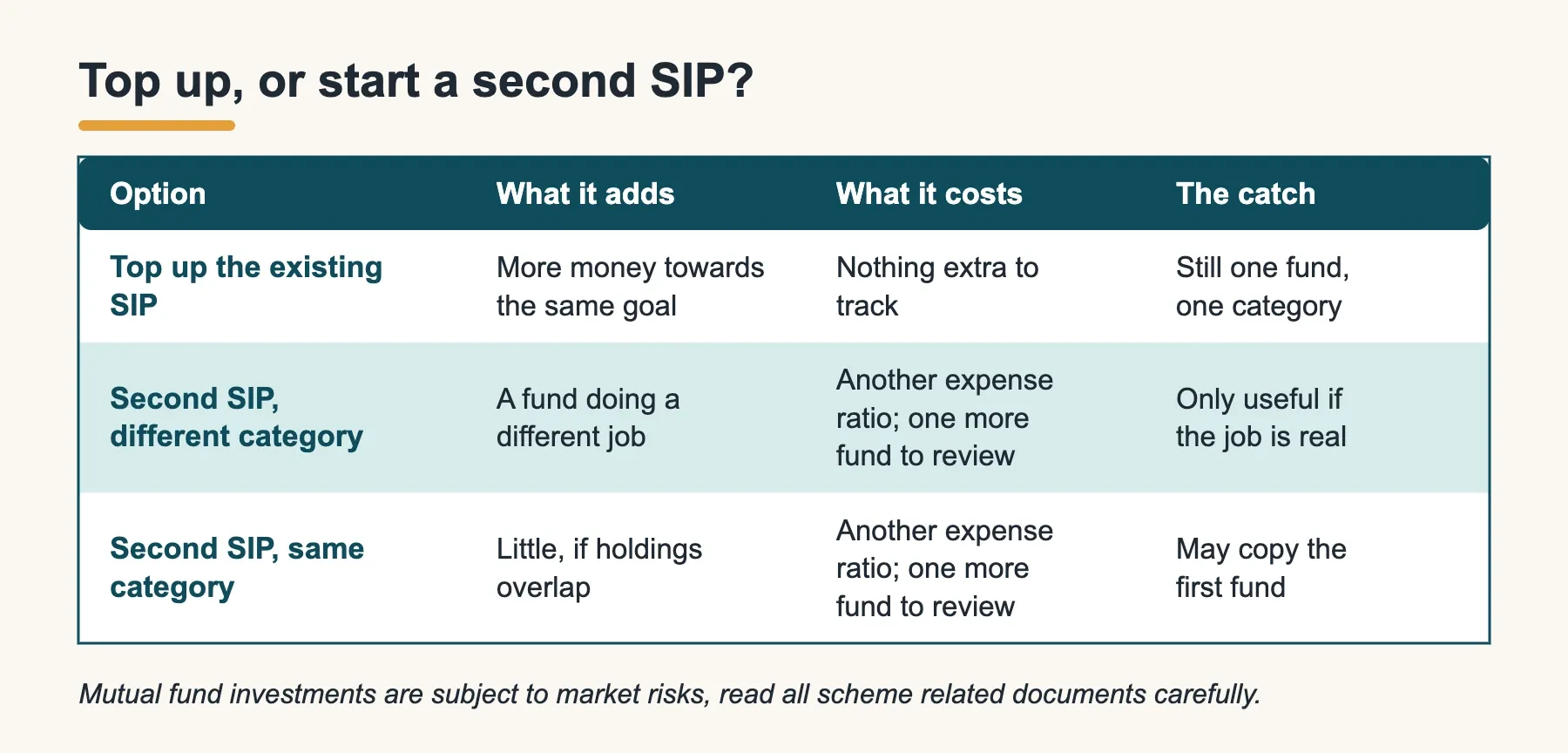
This is the question Ananya actually faces. There is no rule here, only trade-offs.
| Option | What it adds | What it costs | The catch |
|---|---|---|---|
| Top up the existing SIP | More money towards the same goal | Nothing extra to track | Still one fund, one category |
| Second SIP, different category | A fund doing a different job, e.g. a nearer goal | Another expense ratio; one more fund to review | Only useful if the job is real |
| Second SIP, same category | Little, if holdings overlap | Another expense ratio; one more fund to review | May copy the first fund |
Ananya, worked through (hypothetical):
- If the extra ₹2,000 is for the same long-term goal: topping up takes her SIP to ₹5,000 a month in one fund. One statement, one review.
- If she wants money for a course in about 3 years: ₹2,000 a month for 36 months is ₹72,000 of contributions, before any gain or loss. For money needed that soon, common investor-education guidance treats equity-heavy categories as less suited (our interpretation, not a SEBI rule), so a second SIP in a different category may fit.
- On cost: expense ratios are charged on the money in the fund. Hypothetically, on a ₹24,000 balance (about a year of her extra ₹2,000 instalments), 1.0% works out to about ₹240 a year and 0.5% to about ₹120. A scheme's actual ratio is in its scheme documents.
That is a way of reasoning, not a pick. The same ₹2,000 can sensibly go either way, depending on what it is for.
When do more funds stop helping?
Published ranges vary, and each is written for a different investor:
- PrimeInvestor (Vidya Bala, republished January 2023) suggested that a beginner with roughly ₹5,000–10,000 a month in SIPs "probably" doesn't need more than 2–4 funds.
- An expert on Business Today (Prableen Bajpai, 4 September 2026) said investors with a long-term horizon can consider around four to five equity schemes.
The first is about small, early portfolios; the second about long-term equity holdings.
Our interpretation: past a point, more funds of the same kind mostly add overlap and tracking effort rather than variety. Where that point sits depends on your goals and categories, not on a count.
The catch
No method here predicts performance. A low-overlap pair can still fall together, and two funds that look different today can drift closer as their managers buy and sell. Overlap changes as portfolios change, so recheck it each year.
Frequently asked questions
Is it okay to have only one mutual fund?
Yes, for many first-time investors one diversified fund is a reasonable place to be. It becomes limiting when you have a second goal with a very different date, because one fund can't easily suit both.
How many mutual funds are too many for a small portfolio?
There is no fixed cut-off. One fund research writer (PrimeInvestor, 2023) suggested that a beginner investing roughly ₹5,000–10,000 a month probably doesn't need more than 2–4 funds. The practical test is whether each fund does a job the others don't; if two hold mostly the same stocks, one of them adds little.
Mere paas ek hi mutual fund hai, kya doosra fund lena chahiye?
Zaroori nahi hai. Doosra fund tabhi lijiye jab woh alag kaam kare, jaise alag goal, alag time horizon, ya aisi category jo pehle fund mein nahi hai. Agar paisa usi goal ke liye hai, toh pehle SIP ka amount badhana aksar simple rehta hai. Doosra SIP shuru karne se pehle dono funds ke top 10 holdings compare kar lijiye.
What is mutual fund overlap, and how do I check it?
Overlap is the share of the same stocks held by two or more of your funds. To check it, open each fund's latest monthly portfolio disclosure or factsheet on the fund house's website, compare the top 10 holdings and add up the weight of the stocks they share.
Should I start a second SIP or increase my existing one?
If the extra money is for the same goal, increasing the existing SIP keeps things simple. If it is for a different goal or time horizon, a second SIP in a different category may fit better. A second SIP in the same category often adds cost without much variety.
What to do next
Write one line for each fund you hold or plan to hold: the job it does and the goal it serves. Compare the top 10 holdings of any fund you are considering against your current one, then run the "Before you decide" list. Revisit both each year, as your goals, income and the funds' portfolios change.



