How much SIP should you start with your first salary? A month-by-month plan
Plan your first SIP from in-hand pay, not CTC: a month-by-month plan, a ₹ table for six first-job situations, and how to step up after your first hike.
Summarize this article with AI





The short version
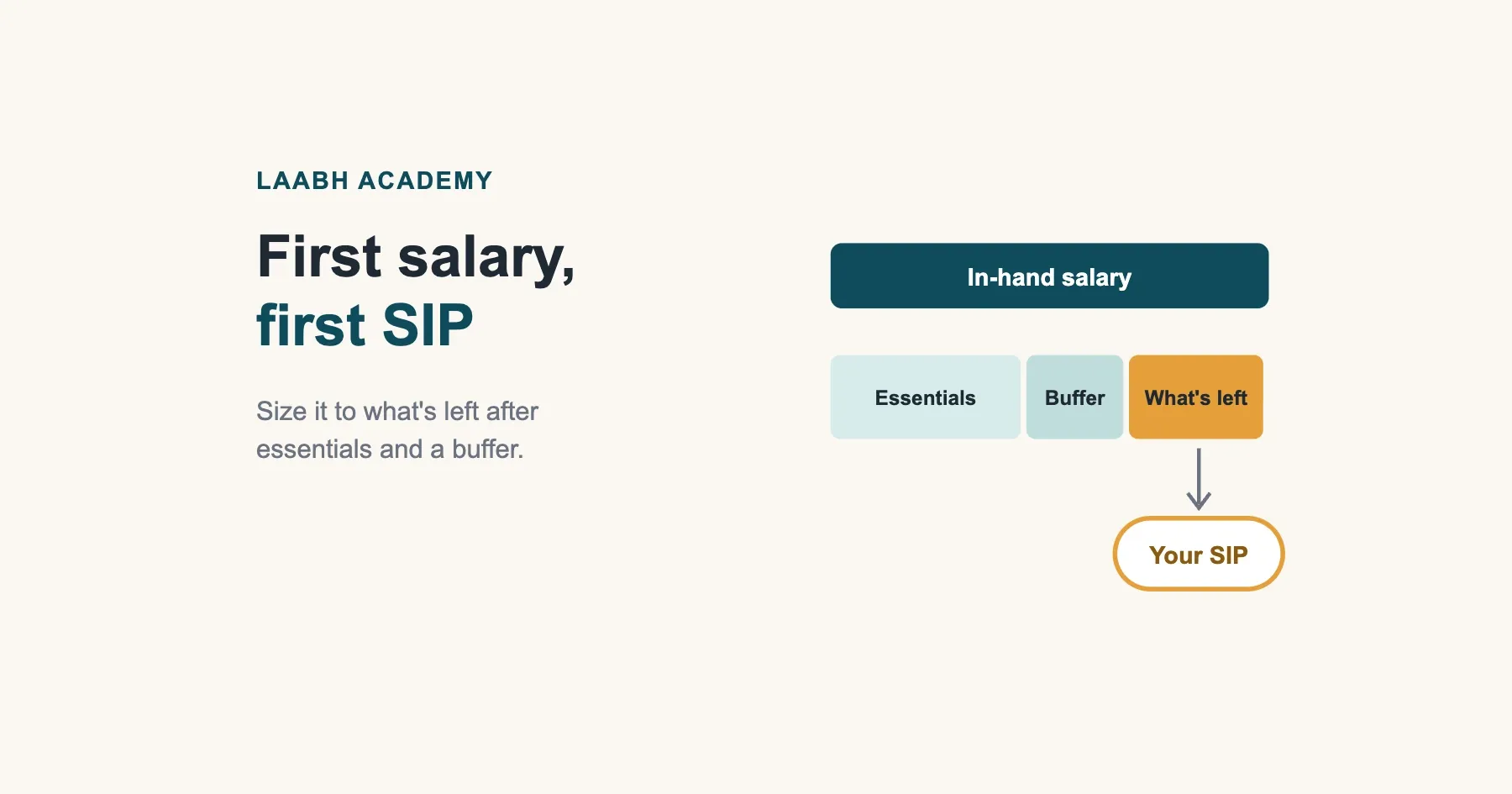
- Plan from in-hand pay ("Net pay"), not CTC.
- Build an emergency buffer first or alongside.
- Treat 10–20% as a reference; the real test is the smallest SIP you will keep paying in a tight month.
- Step up with every hike: 10% a year puts about 22% more money to work over five years.
- Returns are not assured. The habit matters more than the starting number.
There is no single right amount. Work from your in-hand (take-home) pay, not your CTC, and start a Systematic Investment Plan (SIP) you can keep paying for years, alongside a basic emergency buffer. Many guides suggest roughly 10–20% of in-hand pay as a starting band (a guideline, not a rule); even ₹500–₹1,000 a month is a real start, and you raise it with each hike.
Ishita, 23, has just received her first salary from a design studio in Pune. Her offer letter said ₹5.4 lakh CTC, but ₹35,000 is what landed in her account. With a ₹9,000 rent share, groceries, travel and the ₹2,000 she sends home, essentials come to about ₹19,000. Is a ₹1,000 SIP pointless? Should she use the CTC figure? What if she commits ₹10,000 and has to stop in March? This guide follows her numbers so you can work out your own.
Start with your in-hand salary, not your CTC
- SIP: A Systematic Investment Plan: investing a fixed amount in a mutual fund scheme at regular intervals, usually monthly.
- CTC: Cost to company: the employer's total annual cost for you, including components you don't receive as monthly cash.
- In-hand (take-home) pay: The salary credited to your bank account after deductions such as tax, PF and professional tax. It differs from CTC.
What sits between the two:
- Provident Fund (PF). In the standard case, you contribute 12% of basic wages plus dearness allowance, and your employer adds a matching 12%. The employer's share is usually counted in your CTC, but it goes into your PF account, not your bank account.
- Professional tax, levied by some states and capped by the Constitution at ₹2,500 a year.
- Income tax deducted at source (TDS), if your income is taxable.
- Pay that isn't monthly cash, such as gratuity or annual variable pay.
Find it on your payslip: look for "Net pay". That figure, not "Gross" and not the CTC in your offer letter, is your starting point.
What comes before (or alongside) your first SIP
One sensible order, adapted from India TV (8 October 2026) and Axis Mutual Fund (24 July 2026). It is a sequence, not a mandate.
- Essentials: rent, food, travel, bills, money you send home.
- A basic emergency buffer.
- Health cover, and term cover if anyone depends on your income.
- High-interest debt: clear credit-card or buy-now-pay-later dues. Paying them off is a certain saving; SIP returns are not.
- Your SIP.
- Wants.
How big should the emergency fund be, and where should it sit?
An emergency fund is money kept aside, easy to access, for unplanned expenses or loss of income. It is not invested for growth.
There is no official size. The National Institute of Securities Markets (NISM), set up by SEBI, says the usual advice is three to six months of household expenses, and some advisers now suggest six to twelve. Axis Mutual Fund suggests a minimum of around six to eight months. For a first job with no dependants, three months of essentials is a reasonable first target, with six as the next.
Keep it in a savings account; NISM and Axis Mutual Fund both mention liquid funds for the part that can wait a day or two. It does not belong in equity funds.
Must you finish the buffer before your first SIP? No. Axis Mutual Fund notes that with stable income, a small SIP can begin alongside an emergency fund plan. Split each month's surplus between the two until the buffer reaches its target.
How much to start with: a band, not a magic number
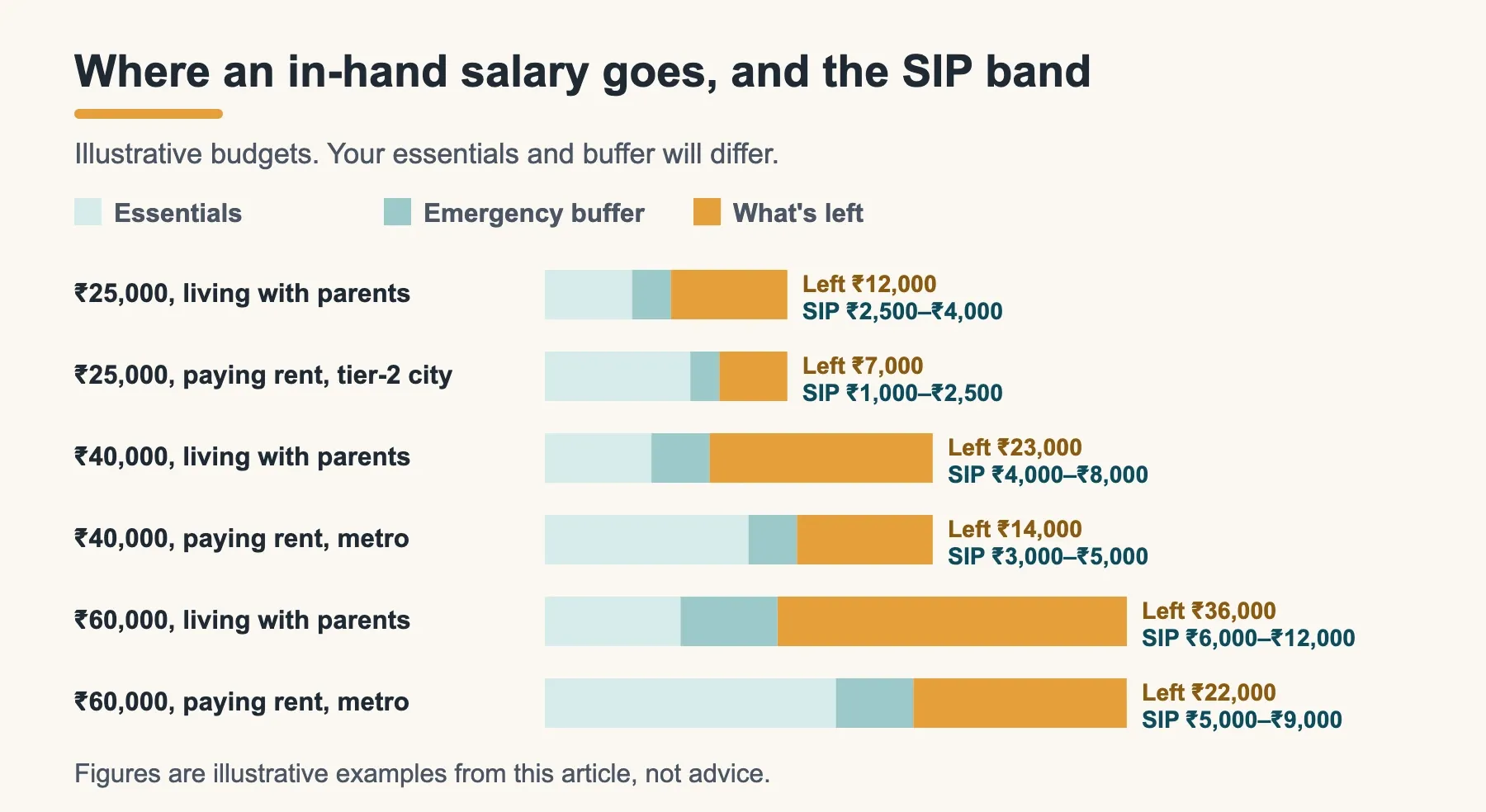
The 10–20% band appears in many budgeting guides, but no regulator sets it. The real test is simpler: what is the smallest SIP you will keep paying even in a tight month? A ₹2,000 SIP that runs for five years puts ₹1,20,000 of your money to work. A ₹6,000 SIP you stop in month four puts in ₹24,000.
Minimum SIP amounts are set by each scheme and stated in its Scheme Information Document (SID) and Key Information Memorandum (KIM). AMFI's investor education site says an SIP can be as little as ₹500 a month, and some fund houses now accept ₹100 in selected schemes. A small SIP is only too small if it never grows.
Here is how it can play out in six first-job situations. Illustrative only; your expenses will differ.
| In-hand pay | Situation | Essentials (illustrative) | Emergency-buffer contribution | What's left | Illustrative SIP band |
|---|---|---|---|---|---|
| ₹25,000 | Living with parents | ₹9,000 | ₹4,000 | ₹12,000 | ₹2,500–₹4,000 |
| ₹25,000 | Paying rent, tier-2 city | ₹15,000 (incl. ₹6,000 rent) | ₹3,000 | ₹7,000 | ₹1,000–₹2,500 |
| ₹40,000 | Living with parents | ₹11,000 | ₹6,000 | ₹23,000 | ₹4,000–₹8,000 |
| ₹40,000 | Paying rent, metro | ₹21,000 (incl. ₹10,000 rent) | ₹5,000 | ₹14,000 | ₹3,000–₹5,000 |
| ₹60,000 | Living with parents | ₹14,000 | ₹10,000 | ₹36,000 | ₹6,000–₹12,000 |
| ₹60,000 | Paying rent, metro | ₹30,000 (incl. ₹16,000 rent) | ₹8,000 | ₹22,000 | ₹5,000–₹9,000 |
Rent changes the answer a lot: at every salary, the renter's band is a smaller share of pay, and the tier-2 renter's tops out at 10%. That is fine. "What's left" also covers clothes, outings and surprise bills; a plan with no room for wants gets abandoned.
Your first-salary plan: Month 1, Month 6, first hike
Ishita falls between the ₹25,000 and ₹40,000 rent rows.
Month 1: set up
- Track every rupee for a month. Her essentials come to ₹19,000.
- Open a separate savings account for the buffer and move ₹8,000 into it on salary day.
- Start an SIP she is sure of: ₹3,000, a little under 10% of her in-hand pay, dated a few days after payday.
That leaves ₹5,000 for wants. Choosing the fund is a separate decision.
By Month 6: review
- Her buffer is about ₹48,000, roughly two and a half months of essentials, and reaches three months (₹57,000) by about month 8.
- Did ₹3,000 ever feel hard? If not, she raises it. Once the buffer hits three months, part of the ₹8,000 can move to the SIP while the rest keeps building.
First hike: step up
- Say her in-hand pay rises by ₹3,500 (a hypothetical 10%). One illustrative option is to send half, ₹1,750, to her SIP before lifestyle spending absorbs it; the expert quoted by India TV suggests about 40% of a raise. This is one option, not advice.
Step up your SIP with every hike
A step-up SIP is an SIP whose instalment increases by a fixed amount or percentage at set intervals, for example once a year.
Its effect on what you invest needs no return assumption:
- ₹3,000 a month, flat, for five years: ₹1,80,000 invested.
- ₹3,000 a month, stepped up 10% each year (₹3,000 → ₹3,300 → ₹3,630 → ₹3,993 → ₹4,392.30): about ₹2,19,784 invested.
That is ₹39,784, about 22%, more of your own money at work. If your pay also grows 10% a year, the SIP stays the same share of your income. Whether an SIP can step up automatically depends on the fund house and platform.
Show the working: what a small SIP can and can't do
A hypothetical illustration: ₹3,000 a month for 10 years (₹3,60,000 invested). The rates are assumptions, not predictions, and returns are not assured.
| Assumed annual return | Hypothetical value after 10 years | Your money | Growth |
|---|---|---|---|
| 0% (flat) | ₹3,60,000 | ₹3,60,000 | ₹0 |
| 6% a year (assumed) | about ₹4.87 lakh | ₹3,60,000 | about ₹1.27 lakh |
| 10% a year (assumed) | about ₹6.00 lakh | ₹3,60,000 | about ₹2.40 lakh |
Method: each ₹3,000 is invested at the end of the month and compounds monthly at the equivalent of the assumed annual rate. Costs and taxes are ignored.
Even at an assumed 10%, about 60% of the final value is your own money. The early years are mostly contributions: after three years at that rate, the value would be about ₹1.25 lakh, of which ₹1.08 lakh is what you paid. The flat row is not the worst case either. Equity funds can fall, sometimes for long periods, so your value can sit below what you invested.
The catch
An SIP builds the habit; it doesn't guarantee the outcome. Pick an amount you can keep through a bad year. Equity SIPs suit long horizons, and SIP money is not emergency money.
Before you decide: 5 questions
Save this list for your next salary day.
What if you miss a month, or the market falls right after you start?
A missed instalment usually doesn't end your SIP; most fund houses cancel an SIP only after three failed debits in a row, and your bank may charge a bounce fee for each one. Check your mandate and scheme terms.
If the market falls soon after you start, new instalments buy more units while existing value drops. The loss stays on paper until you sell. More in what happens to your SIP when the market falls.
Frequently asked questions
Emergency fund first or SIP first? Can I do both from my first salary?
You can do both. Split each month's surplus: part to an easy-to-access emergency buffer, part to a small SIP. Once the buffer reaches a first target, often three months of essential expenses, shift part of that money to the SIP while the rest keeps building the buffer. Keep the buffer out of equity funds.
Pehli salary se kitna SIP karna chahiye?
Koi ek fixed amount nahi hai. Apni in-hand salary se hisaab lagaiye, CTC se nahi, aur saath-saath ek chhota emergency fund banaiye. Phir utna SIP shuru kijiye jo aap har mahine bina ruke de sakein. Kai guides in-hand ka 10–20% batate hain, lekin ₹500–₹1,000 se shuru karna bhi theek hai. Har hike par SIP badhaiye.
Should I calculate my SIP on CTC or on in-hand salary?
On in-hand salary. CTC includes money you never receive as monthly cash, such as your employer's PF share, gratuity and annual variable pay. Your SIP is debited from your bank account, so plan it from the "Net pay" figure on your payslip, and leave quarterly or yearly bonuses out of the monthly amount.
Is a ₹500 or ₹1,000 SIP too small to matter? What's the minimum SIP?
No. Minimums are set by each scheme and listed in its SID and KIM. AMFI cites ₹500 a month as a typical starting point, and some fund houses accept ₹100 in selected schemes. A small SIP builds the habit and can be stepped up as your pay grows.
Should I increase my SIP every year when I get a hike? By how much?
Raising it with each hike grows your SIP without squeezing today's budget. One illustrative option is to send part of each raise, say a third to a half, to the SIP before spending absorbs it. Stepping up ₹3,000 by 10% a year puts about ₹2,19,784 to work over five years, against ₹1,80,000 flat.
What if I can't pay the SIP one month, or the market falls right after I start?
One missed instalment usually doesn't cancel an SIP, though your bank may charge a bounce fee; most fund houses cancel an SIP only after three failures in a row. If the market falls soon after you start, new instalments buy more units while the value of your existing units drops. The loss stays on paper until you sell.
What to read next
Next: what happens to your SIP when the market falls. Save the "Before you decide" checklist for your next salary day.
— Laabh



