How much term insurance cover do you need? Work it out from what your dependants need
Size term cover from what your dependants need: expenses × years, plus loans and goals, minus savings. A hypothetical ₹98 lakh worksheet, step by step.
Summarize this article with AI





The short version
- Size term cover from what your dependants rely on you for: expenses × years, plus loans and big goals, minus savings you can count on.
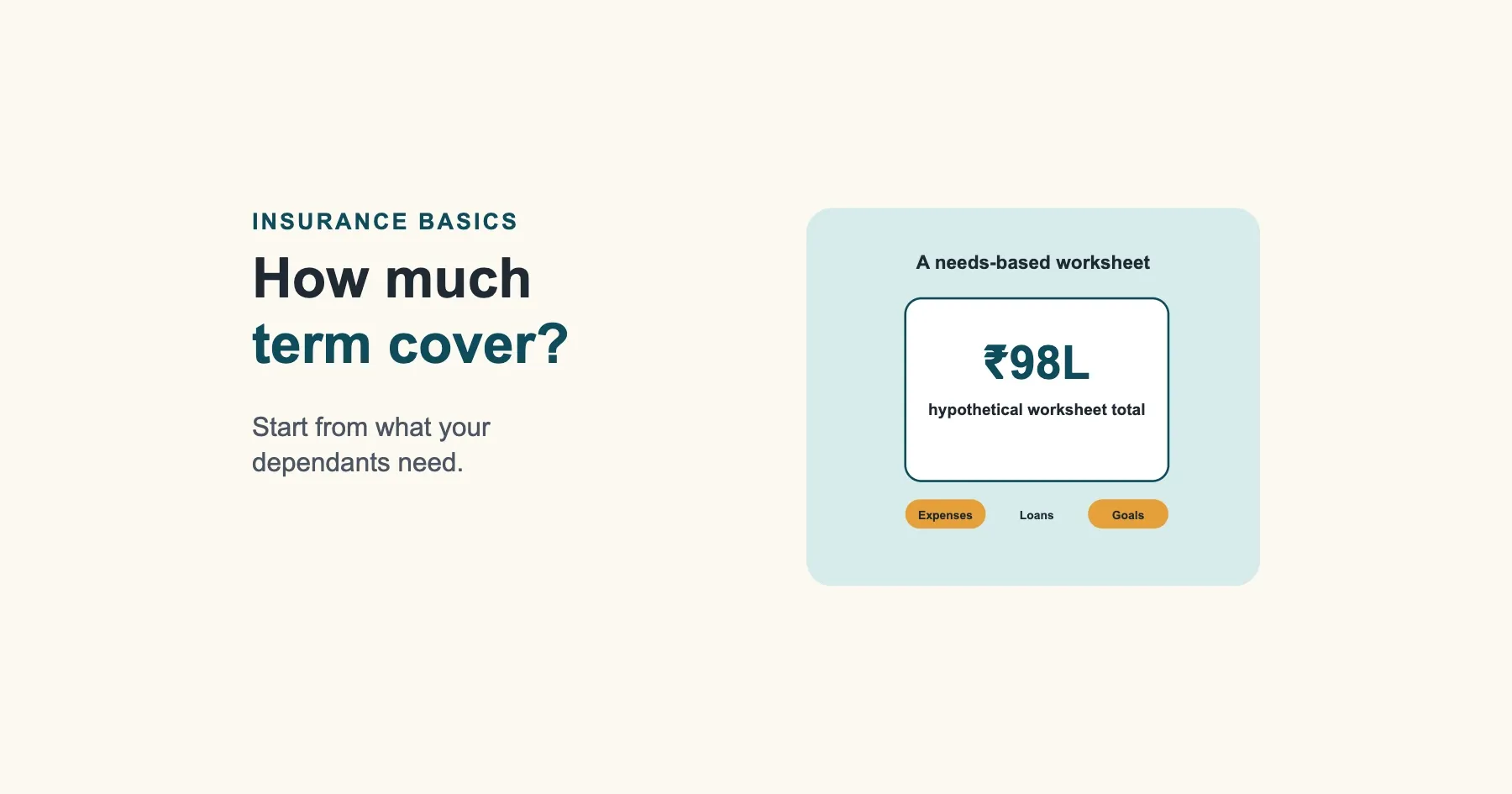
- In Dhruv's hypothetical worksheet, ₹63 lakh + ₹25 lakh + ₹15 lakh − ₹5 lakh ≈ ₹98 lakh; with rising costs it is about ₹1.07 crore. Not a recommended amount.
- "10–15 times income" is a rule of thumb for a cross-check, not a regulation.
- If no one depends on you and you owe nothing that others would repay, you may not need cover yet.
- Rerun the worksheet at marriage, a child, a new loan and later in life; disclose fully on the proposal form.
To decide how much term insurance cover you need, start from what your dependants rely on you for, not a multiple of salary. Add their yearly expenses for the years they would need support, your outstanding loans and big goals such as a child's education, then subtract savings you can count on. Income multiples are only a rough cross-check.
Take Dhruv, 32, in Jalandhar. He earns ₹10 lakh a year, his wife looks after their three-year-old full time, and a ₹25 lakh home loan is running. A colleague said "take 10 times your salary". Here is how Dhruv builds his own number instead, line by line.
What term insurance cover is for
Term insurance is pure life cover. If the insured person dies during the policy term, the insurer pays the sum assured, a fixed amount chosen at purchase, to the nominee; if they outlive the term, nothing is paid.
So the useful question is what money your family would stop receiving and what they would still have to pay. That makes your dependants, not your salary slip, the starting point.
How much term insurance cover do I need on a ₹10 lakh salary?
Salary alone does not decide it. One person on ₹10 lakh supports a spouse, a child and a home loan; another is single and debt-free. Use four lines instead:
- Dependants' essential expenses × years of support. Household running costs, not your personal spending.
- Plus outstanding loans you would not want your family to carry.
- Plus big goals, such as a child's education.
- Minus savings and cover you can rely on, such as investments earmarked for the family.
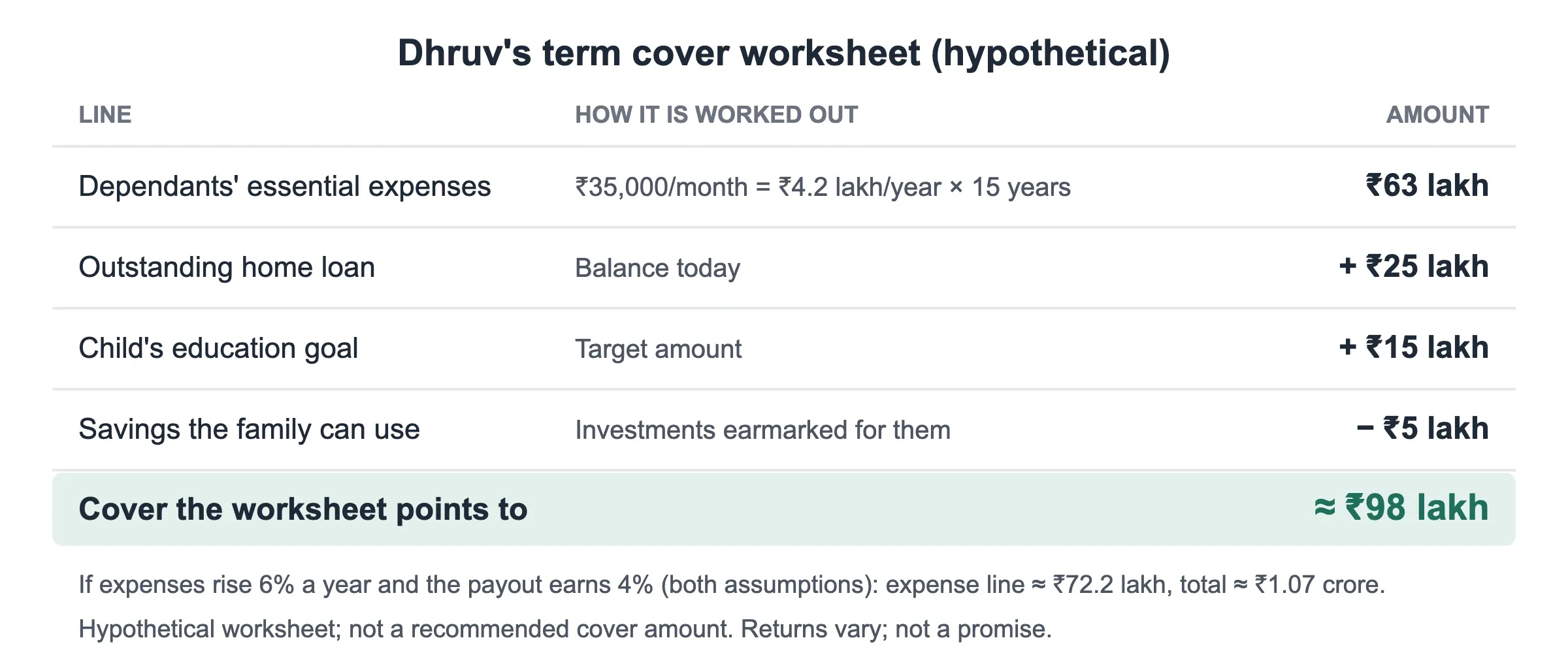
Dhruv's worksheet (hypothetical; not a recommended cover amount)
| Line | Hypothetical figure | Amount |
|---|---|---|
| Dependants' essential expenses | ₹35,000 a month = ₹4.2 lakh a year × 15 years | ₹63 lakh |
| Outstanding home loan | Balance today | + ₹25 lakh |
| Child's education goal | Amount set aside as a target | + ₹15 lakh |
| Savings the family can use | Investments earmarked for them | − ₹5 lakh |
| Cover the worksheet points to | ≈ ₹98 lakh |
All figures are hypothetical; this is not a recommended cover amount. Dhruv picked 15 years as roughly when his child would finish education. He leaves out his employer's group cover, because it usually lasts only while he works there.
What about inflation?
The ₹63 lakh line ignores two opposing forces: costs tend to rise each year, and a lump sum can be invested and earn something. If the two matched, they would roughly cancel.
If they do not, the line changes. Assume, hypothetically, that expenses rise 6% a year while the payout earns 4% a year. The expense line becomes about ₹72.2 lakh and the total about ₹1.07 crore. These rates are assumptions, not a forecast; returns vary and are not guaranteed. What matters is knowing which assumption your number rests on.
Is 10–15 times annual income the right rule for term cover?
"10 to 15 times annual income" is a common rule of thumb, not a regulation. It is useful as a sense check, not as the answer.
For Dhruv, 10 times his ₹10 lakh salary is ₹1 crore and 15 times is ₹1.5 crore. His worksheet gives about ₹98 lakh, near the lower end. For someone with no dependants the rule would overshoot; with three dependants and two loans it could undershoot.
A related idea is human life value (HLV): an estimate of the income you would bring to your family over your remaining working years, net of your own expenses, expressed as a single amount today. It starts from your earnings; the worksheet starts from your family's needs.
Should I add my home loan and other loans to the term cover amount?
It belongs on the worksheet if you want your family to keep the asset without the repayments. Three checks:
- Is the loan already covered? If you bought separate cover linked to the loan, avoid counting it twice.
- Is there a co-borrower? A co-borrower stays liable, which matters if that person depends on your income.
- Does the balance fall? A home loan shrinks every year, so review cover rather than set it once.
Car loans, personal loans and education loans you have co-signed belong on the same line.
I'm single with no dependants: do I need term insurance yet?
Possibly not yet. If no one relies on your income and no one else would have to repay your loans, the worksheet may come out close to zero. An emergency fund and health cover may matter more for now.
It can still come out above zero when you are single:
- You support your parents with a monthly amount they rely on.
- You have a co-signed loan, such as an education loan where a parent is co-borrower.
- You expect dependants soon, for example marriage within a year or two.
Premiums are generally linked to age and health when you buy, so some people buy early. That is a trade-off, not a reason to buy cover nobody needs yet.
When should I increase my term cover: marriage, child, new loan?
Your number changes when your life does. Rerun the worksheet at each of these points:
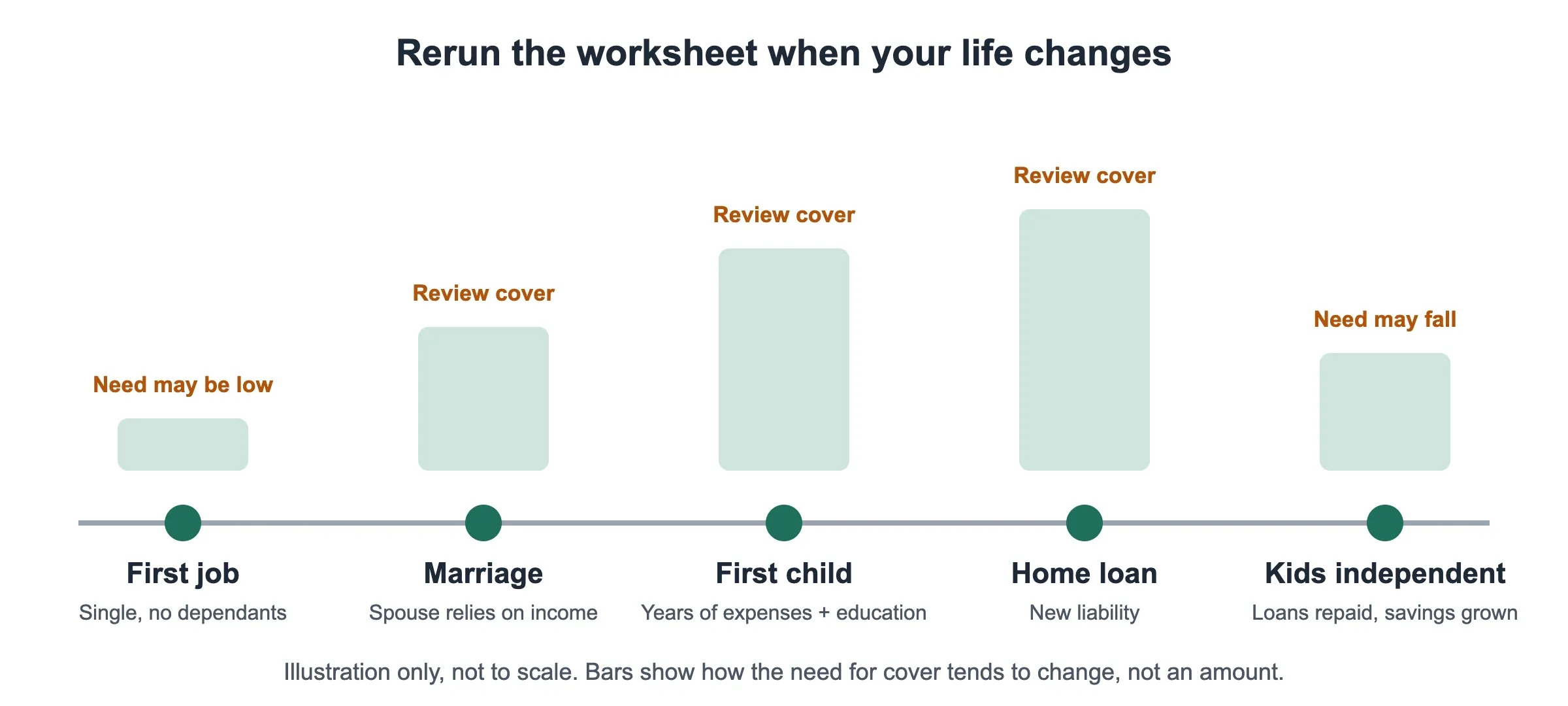
- Marriage, if your spouse would rely on your income.
- A child, which adds years of expenses and an education goal.
- A new or bigger loan, which adds a liability.
- Later in life, when loans are repaid and children are independent, the need may fall.
Disclosure duty and claim basics
A term policy only works if the claim is paid. Three basics, as of 16 November 2026:
- Disclose fully on the proposal form. Answer honestly about health, tobacco use, occupation, income and other life cover you hold. Under Section 45 of the Insurance Act, 1938, an insurer can question a policy for fraud or a material misstatement within three years of the policy, and not on any ground after that.
- Know the timelines. IRDAI's 2024 master circular on protection of policyholders' interests sets 15 days from receiving all documents to settle a death claim that needs no investigation, and 45 days from intimation where one is needed. New policies come with a 30-day free-look period.
- Tell your nominee that the policy exists and where the documents are.
If a claim or complaint is not resolved, you can escalate through IRDAI's grievance system (Bima Bharosa) and the Insurance Ombudsman.
Frequently asked questions
What is sum assured in term insurance?
The sum assured is the fixed amount the insurer agrees to pay the nominee if the insured person dies during the policy term. You choose it when buying the policy, and it is the figure this worksheet helps you estimate.
What is human life value?
Human life value is an estimate of the income a person would contribute to their family over their remaining working years, net of their own expenses, expressed as a single amount today. It is one way to cross-check a needs-based number.
Does employer group cover count towards my term cover?
It helps while you are employed, but group cover is usually tied to the job and can change or end when you leave. You can leave it out of the worksheet, or count it only as a temporary top-up.
Should inflation be included in the calculation?
It helps to test it. Expenses tend to rise each year, while a lump sum can earn a return. In our hypothetical example, assuming costs rise 6% a year and the payout earns 4%, the expense line moves from ₹63 lakh to about ₹72.2 lakh.
What is claim settlement ratio?
It is the share of death claims an insurer paid out of the claims it decided in a year. IRDAI publishes these figures in its annual report. If you compare insurers on it, use IRDAI's figures, note the year and look at more than one year.
Read next
Protection or your first SIP: what comes first? Read term insurance before your first SIP.
— Laabh