Cashless vs Reimbursement Health Insurance Claims: How Each Works, What IRDAI's Timelines Say, and What to Do If Cashless Is Denied
How cashless and reimbursement claims work, IRDAI's 1-hour and 3-hour limits, the documents you need, and what to do if cashless is denied.
Summarize this article with AI





The short version
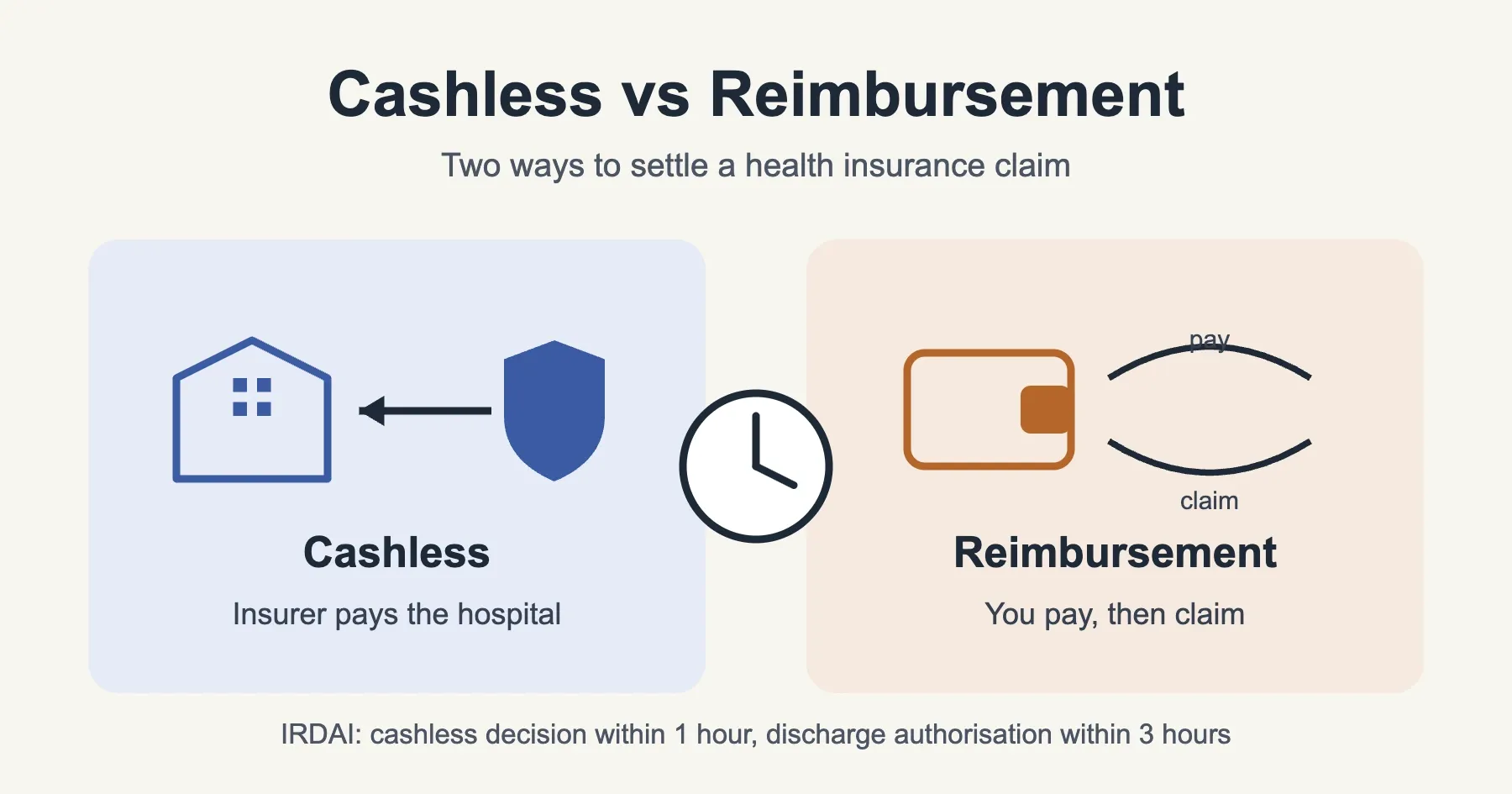
- Cashless: insurer pays a network hospital after pre-authorisation. Reimbursement: you pay, then claim.
- IRDAI's 29 May 2024 master circular sets a 1-hour limit for a cashless decision and 3 hours for discharge authorisation.
- The route changes your cash flow, not the policy's coverage: exclusions, co-pay and limits apply to both.
- A denied cashless request can still be filed as a reimbursement claim.
- If you disagree: insurer grievance, then Bima Bharosa, then the Insurance Ombudsman (compensation sought up to ₹50 lakh, no fee).
In a cashless claim, your insurer (often through a third party administrator, or TPA) pays a network hospital directly after approving a pre-authorisation request, and you pay only what the policy does not cover. In a reimbursement claim, you pay the hospital yourself and then claim the money back from the insurer. IRDAI's Master Circular on Health Insurance Business (29 May 2024) asks insurers to decide a cashless request within one hour and to give final discharge authorisation within three hours; your policy wording decides what is actually payable.
Ananya, 29, in Hyderabad, has employer cover that includes her father. His knee surgery is next month, and the hospital desk has asked: "Cashless or reimbursement?" Here are both routes, step by step.
The two routes at a glance
| Cashless claim | Reimbursement claim | |
|---|---|---|
| Who pays the hospital | Insurer or TPA, directly | You, first |
| When you pay | Only non-covered amounts, at discharge | The full bill, at discharge |
| Hospital type | Usually a network hospital (one that has an agreement with your insurer or TPA) | Network or non-network |
| Paperwork | Pre-authorisation form at the hospital's insurance desk; hospital sends records | Claim form plus bills and medical records, within the policy's deadline |
| Decision time | Cashless request: within 1 hour. Final discharge authorisation: within 3 hours | Set by IRDAI's claim-settlement rules and your policy wording |
| Cash on hand | Lower | The full bill, until settlement |
The route changes when you pay, not how much the policy pays: the same exclusions, room-rent limits, co-pay and sub-limits apply.
How a cashless claim works, step by step
Planned admission
- Check network status of the hospital for your policy. Employer policies often have their own list.
- Carry your health card and ID to the hospital's insurance (TPA) desk.
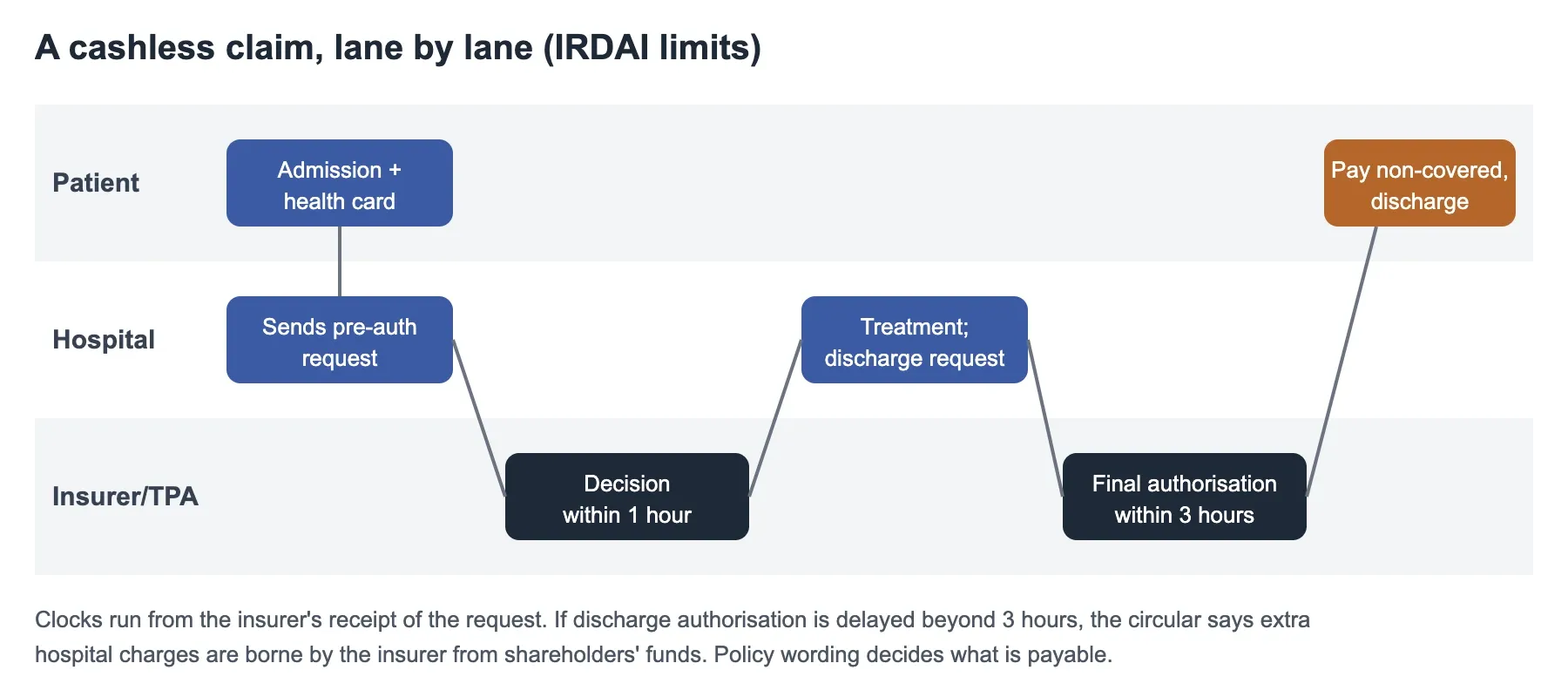
- Submit the pre-authorisation request before admission. The hospital adds the diagnosis, planned treatment and estimated cost.
- Get the approval letter. The approved amount can be lower than the estimate; the hospital can ask for an enhancement later.
- At discharge, the hospital sends the final bill for discharge authorisation. You pay non-payable items, any co-pay and anything above the approved amount.
Emergency admission
Treatment comes first. Ask the insurance desk to send the request as soon as possible, and inform your insurer within the time your policy states. If approval does not come through, you can pay and file for reimbursement.
What IRDAI's master circular says about decision times
IRDAI's Master Circular on Health Insurance Business (Ref. IRDAI/HLT/CIR/PRO/84/5/2024, dated 29 May 2024) says:
- Insurers must decide a request for cashless authorisation immediately, and in no more than one hour of receiving it.
- Insurers must grant final authorisation within three hours of receiving the discharge authorisation request. If there is a delay beyond that, any additional amount charged by the hospital is to be borne by the insurer from its shareholders' fund.
- Every insurer is to strive for 100% cashless claim settlement in a time-bound manner.
Queries for missing details can stretch real-world time.
How a reimbursement claim works, step by step
- Inform the insurer within the time your policy states.
- Pay the hospital and collect originals at discharge.
- Fill in the claim form (employer policies often route this through HR).
- Submit within the policy's deadline, which is in the policy wording.
- Receive settlement, with a statement of what was paid and deducted.
Reimbursement claim documents: a checklist
Your insurer's claim form is the final list. A typical set:
- Duly filled and signed claim form
- Discharge summary
- Final hospital bill with an itemised break-up
- Payment receipts
- Doctor's prescriptions and consultation notes
- Investigation and lab reports (with films or scans where relevant)
- Pharmacy bills matched to prescriptions
- Policy number or health card, and ID proof
- Bank details (often a cancelled cheque) for the payout
- For accidents: FIR or medico-legal certificate, if made
The 29 May 2024 master circular says insurers and TPAs are to collect the required documents from hospitals, and the policyholder is not required to submit them. Keep copies of everything anyway.
A worked example: one ₹1,85,000 bill, both routes (hypothetical)
Illustrative only: a ₹1,85,000 planned-surgery bill, a 10% co-pay, and ₹5,000 of non-payable items.
| Step | Amount |
|---|---|
| Total bill | ₹1,85,000 |
| Less non-payable items | ₹5,000 |
| Admissible amount | ₹1,80,000 |
| Less 10% co-pay on the admissible amount | ₹18,000 |
| Insurer pays | ₹1,62,000 |
| You pay (non-payable + co-pay) | ₹23,000 |
Cashless: the insurer authorises ₹1,62,000 at discharge; you pay the hospital ₹23,000.
Reimbursement: you pay ₹1,85,000, claim within the policy's deadline, and receive ₹1,62,000 under the same terms. Same final cost of ₹23,000, but you carry ₹1,85,000 until settlement.
On how co-pay changes this split, see co-payment in health insurance.
Why cashless gets denied or partly approved, and what to do
Common reasons:
- Non-network hospital. Cashless usually needs a network hospital. The General Insurance Council's "Cashless Everywhere" initiative is reported to need 48 hours' notice before a planned admission (within 48 hours for emergencies); ask your insurer before relying on it.
- Waiting period not over for the illness or procedure. See health insurance waiting periods.
- Exclusions or incomplete information (which usually triggers a query).
- Room-rent limits, co-pay or sub-limits, which cut the approved amount.
- Sum insured used up. A higher-deductible layer can sit on top; see super top-up and its deductible.
What you can do:
- Get the denial or query letter in writing and read the reason.
- If it is a query, send the missing details quickly.
- A cashless denial is not a claim rejection: you can pay and file for reimbursement, assessed on full documents.
Where TPAs fit
A third party administrator is an IRDAI-registered entity many insurers use to issue health cards and process claims; the insurer remains responsible for the decision. With employer cover, HR usually knows your TPA; see is employer health insurance enough.
If you disagree: insurer grievance, then Bima Bharosa, then the Insurance Ombudsman
- Complain to the insurer first, in writing, and note the complaint number. The master circular says no claim shall be repudiated without approval of the insurer's Claims Review Committee, so ask for the reason.
- Bima Bharosa, IRDAI's grievance portal, lets you register and track a complaint against an insurer.
- Insurance Ombudsman. Per the Council for Insurance Ombudsmen, you can approach an Ombudsman if unhappy with the insurer's reply or if it has not replied within one month, within one year of that point. Compensation sought can be up to ₹50 lakh, with no fee, under the Insurance Ombudsman Rules, 2017. Insurers must comply with an award within 30 days, per the master circular.
Frequently asked questions
What is the difference between cashless and reimbursement claims?
In a cashless claim, the insurer or its TPA pays a network hospital directly after approving pre-authorisation. In a reimbursement claim, you pay the bill and claim it back with documents. The policy's coverage rules are the same for both.
How long does an insurer have to approve a cashless claim?
IRDAI's Master Circular on Health Insurance Business (29 May 2024) says insurers must decide a cashless request within one hour of receiving it and grant final discharge authorisation within three hours. Extra hospital charges caused by a delay beyond three hours are to be borne by the insurer. Your policy wording governs what is payable.
Can I get cashless treatment at a non-network hospital?
Generally, cashless is offered at network hospitals. The General Insurance Council's "Cashless Everywhere" initiative is reported to allow cashless at other hospitals with 48 hours' prior notice for planned care, but it depends on your insurer and the hospital. Check with your insurer before admission; reimbursement remains available.
What documents do I need for a reimbursement claim?
Typically: the claim form, discharge summary, itemised final bill, payment receipts, prescriptions, investigation reports, pharmacy bills, policy and ID details, and bank details. For accidents, an FIR or medico-legal certificate if one was made. Your insurer's claim form is the final checklist.
What can I do if my cashless claim is rejected?
Read the written reason, and send any missing information. You can pay and file a reimbursement claim. If you still disagree, complain to the insurer, then use IRDAI's Bima Bharosa portal, and then approach the Insurance Ombudsman.
Save this checklist
Save the step lists and the document checklist before a planned admission.