Term Insurance vs Life Insurance: Same Premium, Very Different Cover, Worked Out in ₹
Term is cover only; endowment-style plans add savings with less cover. A ₹ example with cover per rupee and IRR, plus 2026 GST and tax rules.
Summarize this article with AI





The short version
- Term insurance is life insurance without a savings part; endowment-style plans add one and give less cover per rupee.
- Judge any plan by two numbers: the cover your family gets, and the IRR of what comes back.
- In the hypothetical example, ₹1 lakh a year buys ₹12 lakh of cover on one path, and ₹1 crore plus ₹88,000 a year to set aside on the other.
- Individual life policies carry no GST from 22 September 2025; maturity is tax-exempt only within the premium limits.
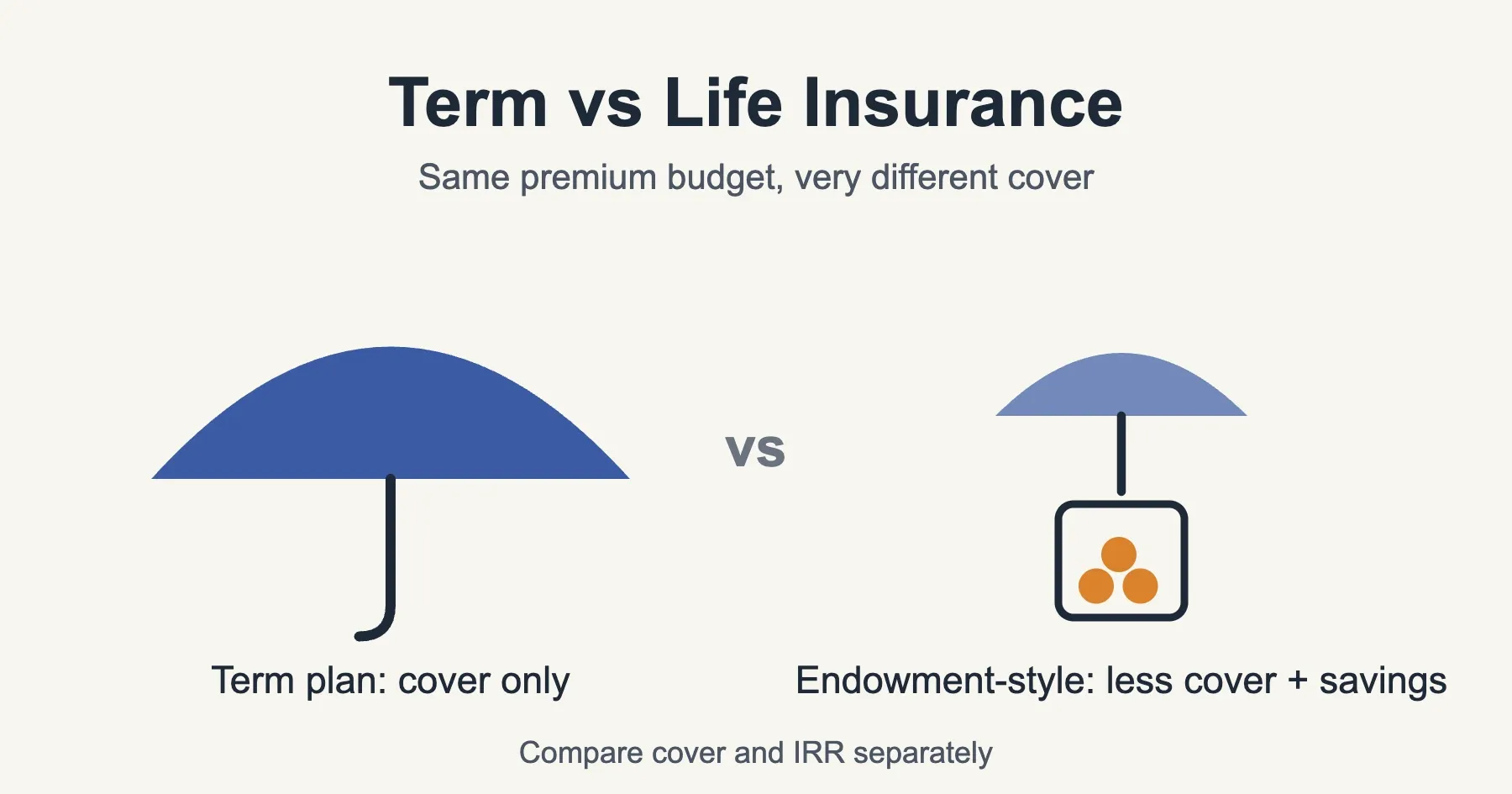
Term insurance is a type of life insurance. A plain term plan is cover only: it pays your nominee if you die during the policy term and nothing if you outlive it. What is usually sold as "life insurance" (endowment, money-back and whole life plans) bundles a smaller cover with a savings part that pays out on maturity. Compare them with two separate numbers: the cover your family gets, and the return the savings part earns.
Aman, 28, in Lucknow, has been offered a "life insurance plan" by a relative: "₹1 lakh a year, and ₹26 lakh back after 20 years. Term gives you nothing back." Both halves can be true, yet neither says how well protected his family is or how good the savings part is. The worked example separates the two.
The life insurance family, one line each
- Term insurance (pure protection): pays the sum assured on death during the term; no maturity benefit.
- Return-of-premium term: refunds premiums if you survive the term, for a higher premium than plain term with the same cover.
- Endowment plan: pays on death during the term, or a maturity amount (plus any bonus) if you survive.
- Money-back plan: an endowment-style plan that pays parts of the benefit at set intervals.
- Whole life plan: cover to an advanced age set in the policy, usually with a savings element.
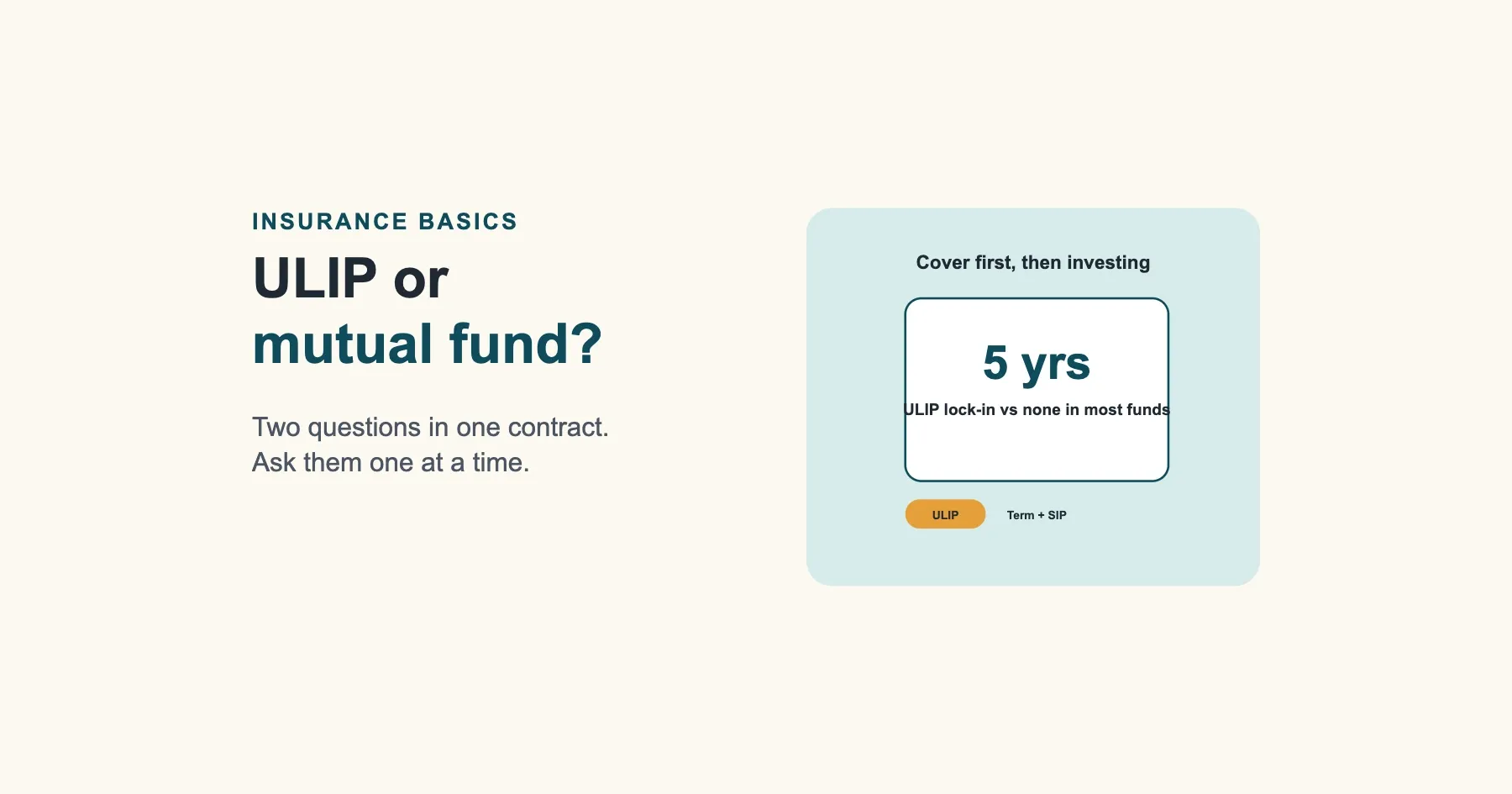
- ULIP: part of the premium buys market-linked units, part pays for cover. See ULIP vs mutual fund.
Each plan's benefit illustration shows what you pay and may get back, year by year.
Term vs endowment-style plans: side by side
| What you compare | Term plan | Endowment-style plan |
|---|---|---|
| Main job | Replace income if you die during the term | Cover plus a fixed-term savings pot |
| Cover per ₹1 of premium (hypothetical example) | About ₹833 | ₹12 |
| If you survive the term | Nothing (plain term) | Maturity amount, per the benefit illustration |
| Leaving early | Cover stops when premiums stop | Surrender value per the policy's table, which can be below premiums paid in early years |
| GST on an individual policy | Exempt from 22 September 2025 | Exempt from 22 September 2025 |
| Tax on payout | Death benefit exempt | Death benefit exempt; maturity exempt only within premium limits |
| Who it may suit | People whose dependants rely on their income | Someone who wants a fixed-term savings commitment and accepts its return |
The worked example: one premium budget, two paths
All figures are hypothetical, not quotes. Real premiums depend on age, health, term and each insurer's underwriting, and no real plan is implied to earn the rates below.
Aman has ₹1,00,000 a year for 20 years.
| Input | Path A: endowment-style plan | Path B: term plan + separate savings |
|---|---|---|
| Premium | ₹1,00,000 a year for 20 years | ₹12,000 a year to age 58 (30 years) |
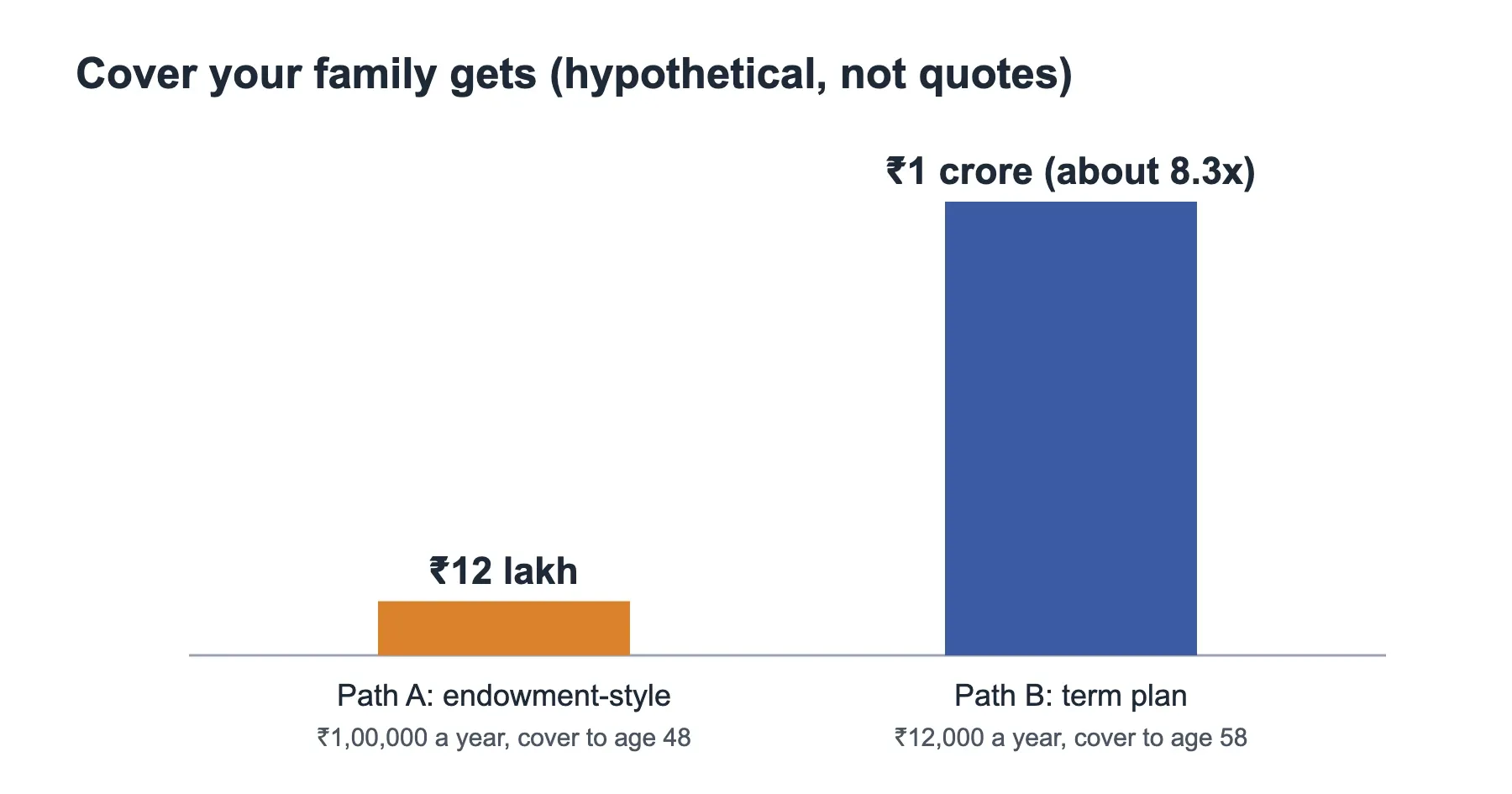
| Cover | ₹12,00,000 to age 48 | ₹1,00,00,000 to age 58 |
| Total premium | ₹20,00,000 | ₹2,40,000 over 20 years; ₹3,60,000 over 30 |
| Set aside separately | Nothing | ₹88,000 a year for 20 years (₹17,60,000) |
| Value at end of year 20 | ₹26,00,000 maturity (hypothetical) | Depends on what the ₹88,000 earns |
Cover your family gets on each path
Path B's ₹1 crore is about 8.3 times Path A's ₹12 lakh, and it runs 10 years longer. If Aman died in year 5, his family would receive ₹12 lakh on one path and ₹1 crore on the other. To size your own, see how much cover you need.
What the savings part earns (IRR) and the break-even rate
Paying ₹1,00,000 at the start of each year for 20 years and receiving ₹26,00,000 at the end of year 20 works out to an internal rate of return (IRR) of about 2.44% a year, with the ₹12 lakh cover riding along.
The break-even: if Aman sets aside ₹88,000 at the start of each year instead, what yearly return takes that pile to the same ₹26,00,000? About 3.58% a year.
| ₹88,000 a year for 20 years, at a hypothetical | Value at end of year 20 |
|---|---|
| 0% (kept as cash) | ₹17,60,000 |
| 2.44% (Path A's own IRR) | ₹22,88,000 |
| 3.58% (break-even) | ₹26,00,000 |
This is arithmetic, not a forecast. The 3.58% is the hurdle a separate option would need to clear to match Path A's maturity value; it says nothing about what any option will earn. The separate money carries its own risk (market risk, or lower rates when you reinvest), and it only works if Aman sets it aside every year and leaves it alone.
What the example does not show
- Years 21 to 30: Path B still costs ₹12,000 a year (₹1,20,000 in all) after Path A has ended.
- Riders and health: add-on riders and medical history change both premiums.
- Inflation: ₹1 crore in 20 years will buy less than today; ₹12 lakh even less.
- Behaviour: a fixed premium forces saving; a separate pile can be spent.
Tax and GST in 2026
| Rule | What it says |
|---|---|
| GST on premium | Individual life and health policies exempt from 22 September 2025 (Notification No. 16/2025-Central Tax (Rate)); it was 18%. Group policies, including group term, still attract 18% |
| Premium deduction | Section 123, Income-tax Act, 2025: up to ₹1,50,000 a tax year across items in Schedule XV, which include life insurance premia. Available in the old regime only |
| Maturity exemption | Section 11 read with Schedule II, Sl. No. 2: premium at most 10% of the sum assured; for non-ULIP policies issued on or after 1 April 2023, total premium at most ₹5,00,000 a year; ULIPs have a separate ₹2,50,000 limit |
| Death benefit | An amount received on the insured's death stays exempt even where the premium limits are crossed |
| TDS | If a maturity amount is taxable, the insurer deducts TDS at 2% of the income part for residents (section 393) |
In Path A, the premium is 8.3% of the sum assured and ₹1 lakh a year is under ₹5 lakh, so the maturity amount would meet today's conditions. Rules can change over 20 years. Whether the deduction helps you depends on your tax regime; the full list is in section 80C, now section 123.
Surrendering a traditional plan early
If you stop an endowment-style plan early, what you get back is the surrender value in the policy's table, which in early years can be well below the premiums paid. IRDAI revised its surrender-value rules for life insurance products in its Master Circular on Life Insurance Products (June 2024). The figure that applies is the one in your own policy document: read it before you sign and before you surrender.
Questions to ask before you sign
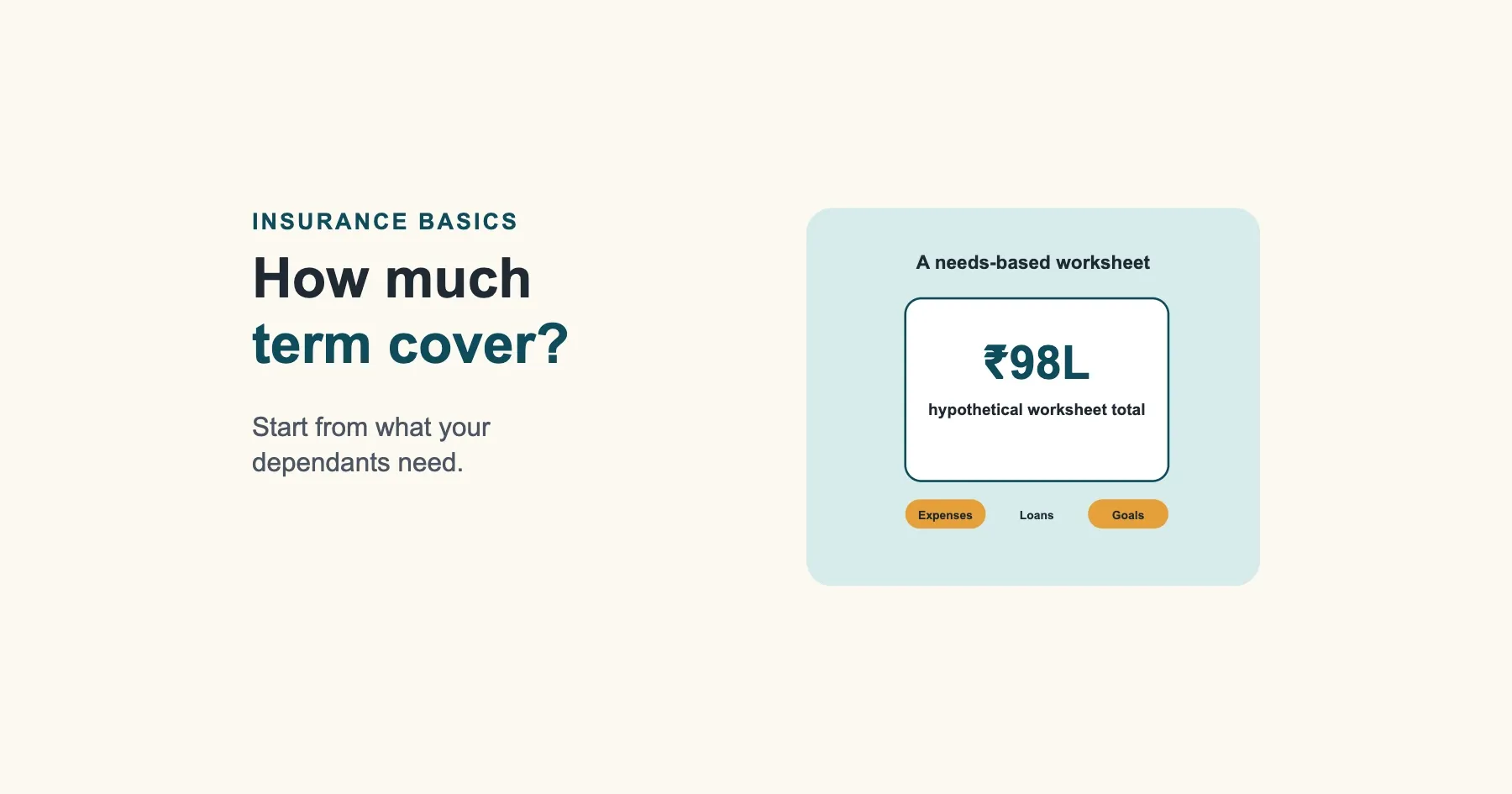
- How much cover do my dependants need, and for how many years?
- What is the premium as a share of my income, and can I pay it for the whole term?
- What IRR does the benefit illustration imply, and which parts of the benefit are fixed and which depend on bonuses?
- What would I get back if I stopped in year 2, 5 or 10?
- Is my cover in place before I start investing? See term insurance before your first SIP.
Before comparing insurers, read what a claim settlement ratio can and can't tell you.
Frequently asked questions
What is the difference between term insurance and life insurance?
Term insurance is a type of life insurance that offers cover only: it pays on death within the term and nothing on survival. Endowment, money-back and whole life plans add a savings part, so they pay on death or maturity but give less cover for the same premium.
Is term insurance better than an endowment plan?
It depends on the job. In our hypothetical example, the same budget buys about 8.3 times the cover on the term path, while the endowment's savings part earns an IRR of about 2.44% a year. Compare both numbers for any plan you are offered.
Does term insurance give money back if I survive?
A plain term plan does not. A return-of-premium term plan refunds premiums if you survive the term, but it costs more than plain term for the same cover; the extra premium pays for the refund.
Is life insurance maturity amount taxable in 2026?
It is exempt if the premium is at most 10% of the sum assured and, for non-ULIP policies issued on or after 1 April 2023, total premiums are at most ₹5 lakh a year (₹2.5 lakh for ULIPs). An amount paid on death stays exempt.
Is there GST on term insurance now?
Not on individual policies. GST on individual life and health insurance was exempted from 22 September 2025, per the Department of Financial Services. Group policies, including group term, still attract 18%.
Save this checklist
Before you sign, note two numbers from the benefit illustration: the cover, and the IRR of what comes back. Compare them with term plus separate savings for the same budget.