ULIP or mutual fund? Separate the insurance question from the investment one
A ULIP bundles life cover and investing under IRDAI; a mutual fund is investment only under SEBI. Compare charges, lock-in and tax, cover first.
Summarize this article with AI






The short version
- A ULIP combines life cover and market-linked investing in one IRDAI-regulated contract. A mutual fund is investment only, regulated by SEBI.
- ULIPs carry a five-year lock-in and several charge types; stopping premiums early moves your money to a discontinued policy fund and ends the cover.
- Open-ended mutual funds usually have no lock-in and one expense ratio inside the NAV.
- Settle the cover question first, then choose how to invest.
A ULIP (unit linked insurance plan) is a life insurance contract regulated by IRDAI that also invests part of your premium in market-linked funds. It has a five-year lock-in and several charges. A mutual fund is a SEBI-regulated investment with no life cover, an expense ratio and, for most open-ended schemes, no lock-in. Decide your life cover need first, then how to invest.
Say you're about to start your first SIP when someone offers you a plan for ₹50,000 a year that "gives insurance and returns together". The ULIP vs mutual fund question is really two questions in one contract. Below, the IRDAI and SEBI rules sit side by side so you can ask them one at a time.
What is the difference between ULIP and mutual fund?
The difference is structure. A ULIP does two jobs: it pays your family a sum if you die during the term, and invests the rest of your premium in market-linked funds. IRDAI's 2024 master circular requires individual ULIPs to carry a guaranteed sum assured on death (or a health cover, as applicable), and every policy document must state that the investment risk is borne by the policyholder.
A mutual fund does only the investing job, with no life cover. Its costs sit inside the NAV. SEBI's Mutual Funds Regulations, 2026, define an open-ended scheme as one that offers units "without specifying any duration for redemption".
| ULIP | Mutual fund (open-ended) | |
|---|---|---|
| Regulator | IRDAI | SEBI |
| Purpose | Life cover plus market-linked investment | Investment only |
| Life cover | Yes, a sum assured on death | None |
| Lock-in | 5 years for linked products | Usually none; some categories, such as ELSS, have one |
| Charges | Premium allocation, mortality, policy administration, fund management, others where applicable | Expense ratio within the NAV; exit load may apply |
| Leaving early | Fund moves to a discontinued policy fund; paid out after the lock-in | Redeem at NAV, less any exit load |
| Tax | See the tax section below | See the tax section below |
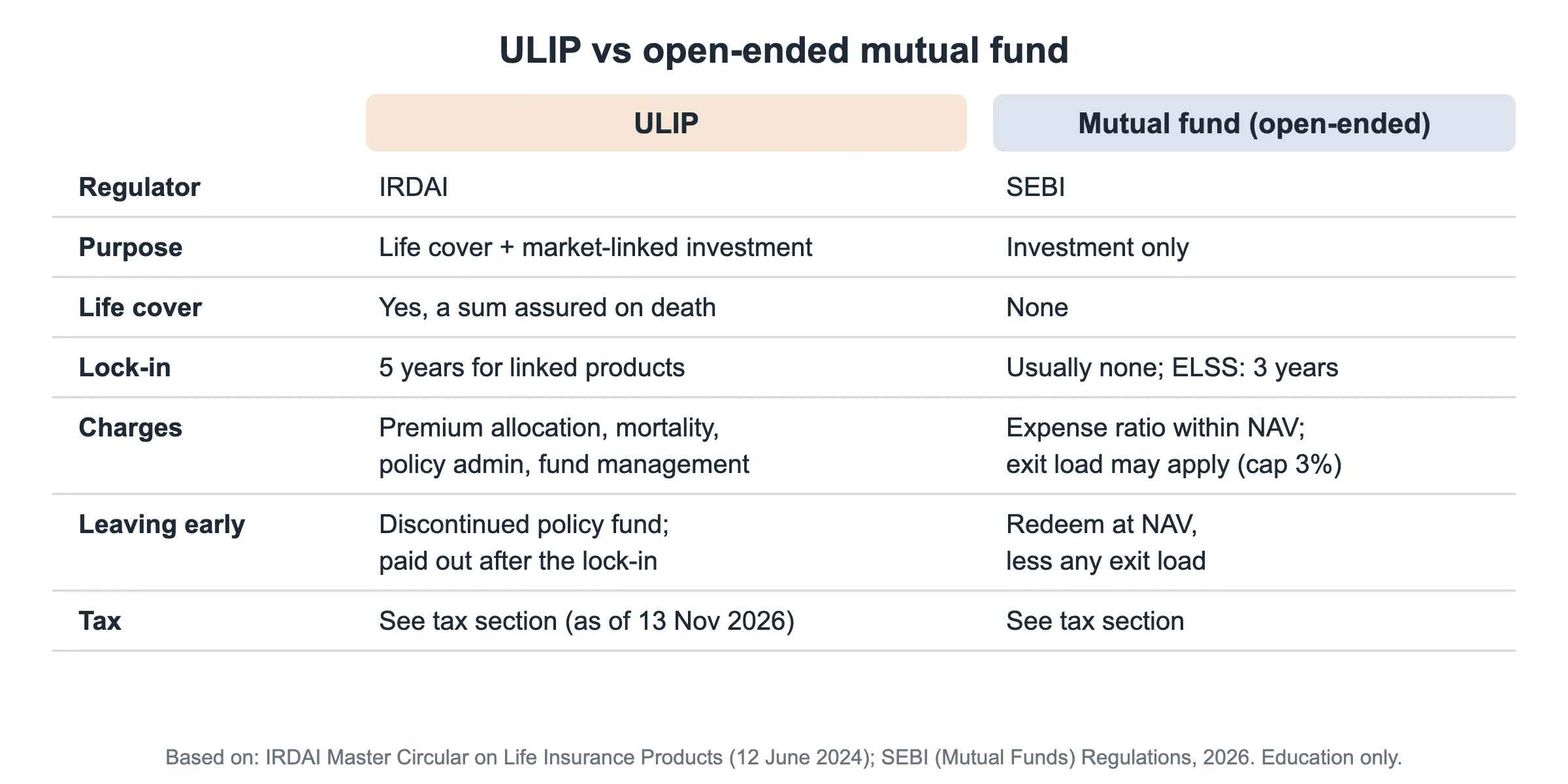
What charges are there in a ULIP compared with a mutual fund's expense ratio?
Take ₹50,000 a year down both paths; as an SIP, that is about ₹4,167 a month. Rates vary by product, so we name charge types, not numbers.
Inside a ₹50,000 ULIP premium, these are the charge types IRDAI's master circular refers to:
- Premium allocation charge: taken from the premium before the rest buys units.
- Mortality charge: the cost of the life cover.
- Policy administration charge: for servicing the policy.
- Fund management charge: levied on each fund, similar in idea to a mutual fund's expense ratio.
- Others where applicable: a guarantee charge if the product has an investment guarantee, and a discontinuance charge if you stop paying within the lock-in.
Inside a ₹4,167 monthly SIP, the whole amount buys units at the day's NAV (stamp duty aside), and the expense ratio is deducted within the NAV, with no separate bill. An exit load may apply if you redeem early; SEBI's 2026 regulations cap it at 3% of NAV. Our guide to the expense ratio in mutual funds shows how that cost works.
Here is what one percentage point of cost can do. Invest ₹4,167 at the start of each month for 10 years, a total of ₹5,00,040. At an assumed 10% a year, it grows to about ₹8,60,700. At an assumed 9% a year, it reaches about ₹8,12,400. The gap is roughly ₹48,300. Hypothetical: assumed rates of 10% and 9% a year, compounded monthly; not a promise; returns vary. This shows how cost compounds in general; it is not an estimate of the cost difference between any ULIP and any mutual fund. Higher total yearly costs leave less in the fund, so compare the total cost of each option before you sign.
What is the lock-in period of ULIP vs mutual fund (ELSS)?
IRDAI's master circular sets a lock-in period of five years for linked insurance products. Promotional material must say that these products "do not offer any liquidity during the first five years of the contract", and partial withdrawals are allowed only after the lock-in. On a ₹50,000 premium, that is ₹2,50,000 paid in over five years before you can withdraw any of it.
Stop paying in the first five years and, after the grace period, your fund value less a discontinuance charge moves to a discontinued policy fund and the cover stops. The FAQ below covers revival and payout.
An open-ended mutual fund has no lock-in. You can redeem on any business day at the applicable NAV, and an exit load may apply in the early months. Our guide to withdrawing SIP money covers exit loads and timing. ELSS is the best-known exception: SEBI's investor education page says it has a three-year lock-in. Some other categories also carry a lock-in, so check the scheme documents.
Tax treatment of ULIP vs mutual fund: rules as of 13 November 2026
ULIP: Under the Income-tax Act, 2025, Schedule II (see section 11) lists sums received under a life insurance policy as income not included in total income, subject to conditions. For ULIPs issued on or after 1 February 2021, these include an aggregate annual premium limit of ₹2,50,000 across such policies, and a premium of no more than 10% of the sum assured (15% for certain special policies). A ₹50,000 premium is well inside the aggregate limit; under the 10% condition, it needs a sum assured of at least ₹5,00,000. A ULIP that misses the conditions loses this exclusion for amounts received other than on death, and its tax then depends on your policy and income.
Mutual fund: gains when you redeem units are generally taxed as capital gains. The rate depends on the type of scheme and how long you held the units.
Tax rules change; consult a tax professional for your situation.
Is ULIP better than mutual fund for long-term investment?
Each is built for a different job, so here is a rule instead of a verdict.
A ULIP fits if you want cover and investing in one contract, you can pay the premium for at least five years, and you have compared its total charges and sum assured with the alternatives.
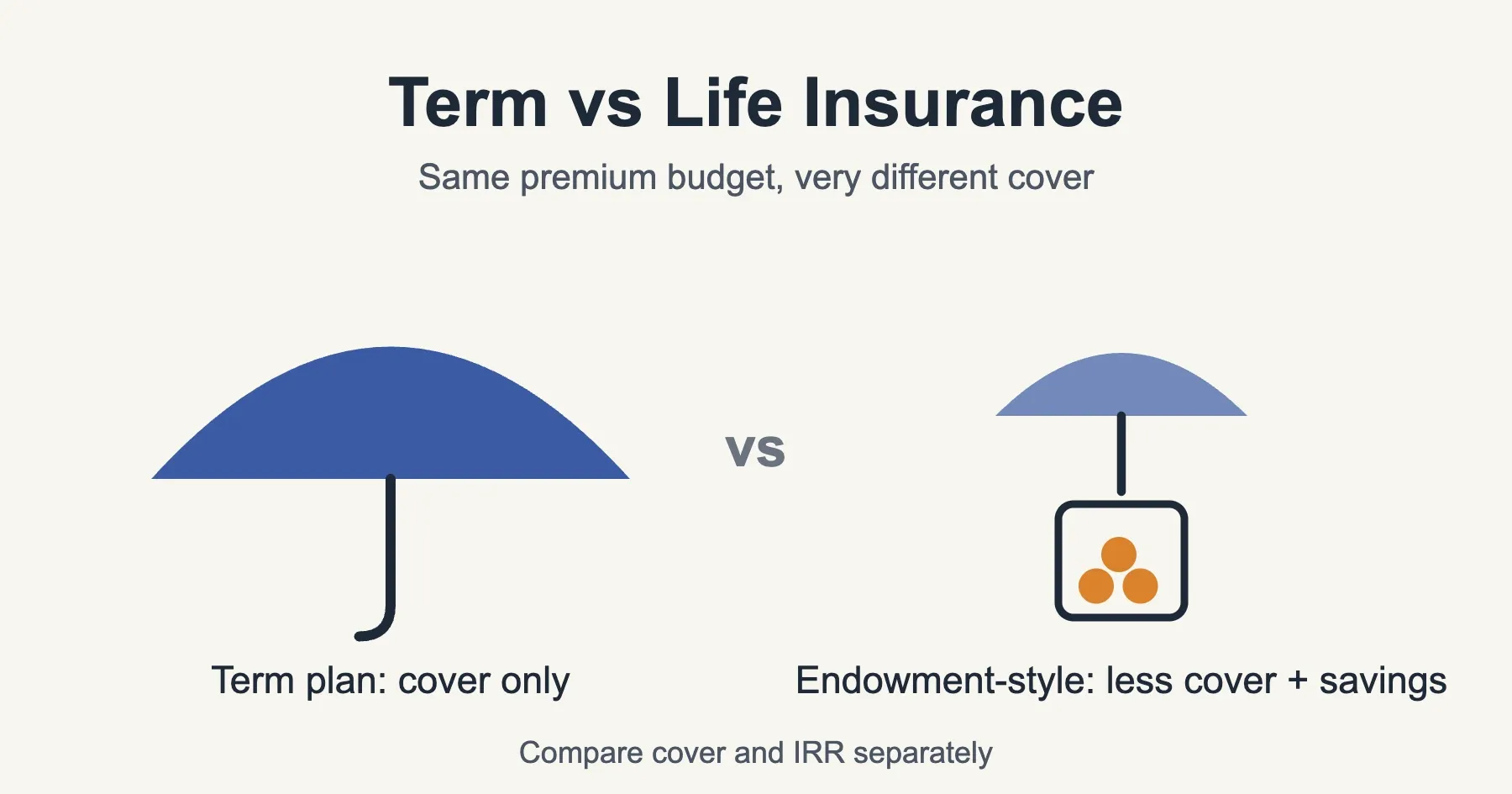
A term plan plus a mutual fund fits if you want to set cover and investing separately, pause the investing without touching the cover, or may need the money within five years.
Check either way: the sum assured against your family's needs, total charges over the full term, and what happens if you stop paying in year two.
Should I buy term insurance plus a mutual fund instead of a ULIP?
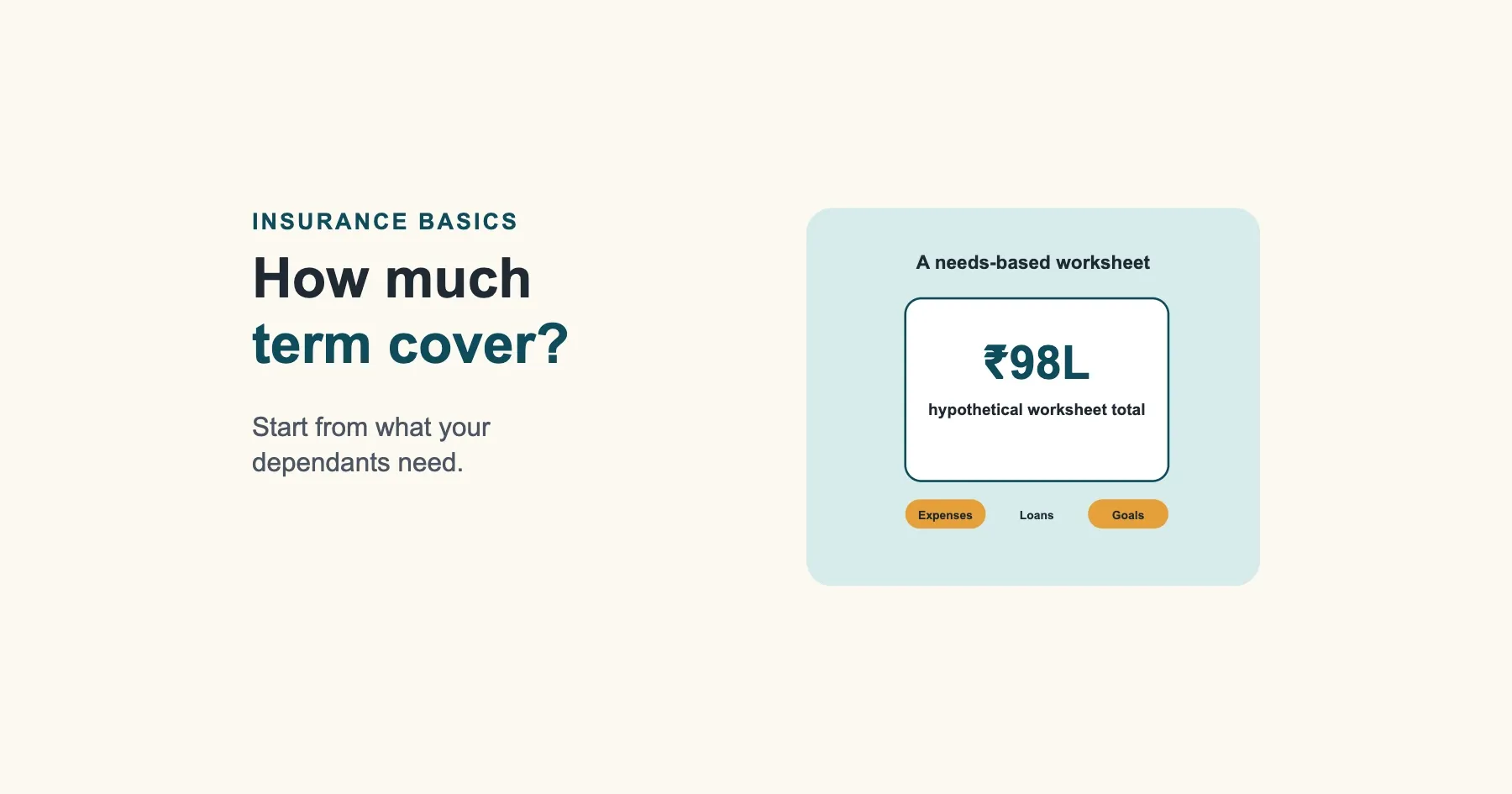
Start with the cover question: would parents, a spouse or a child struggle without your salary? If so, you may need life cover. If nobody depends on you yet, the question may be smaller than it first seems. Our piece on term insurance before your first SIP walks through the factors, and how much term cover you need sizes the number.
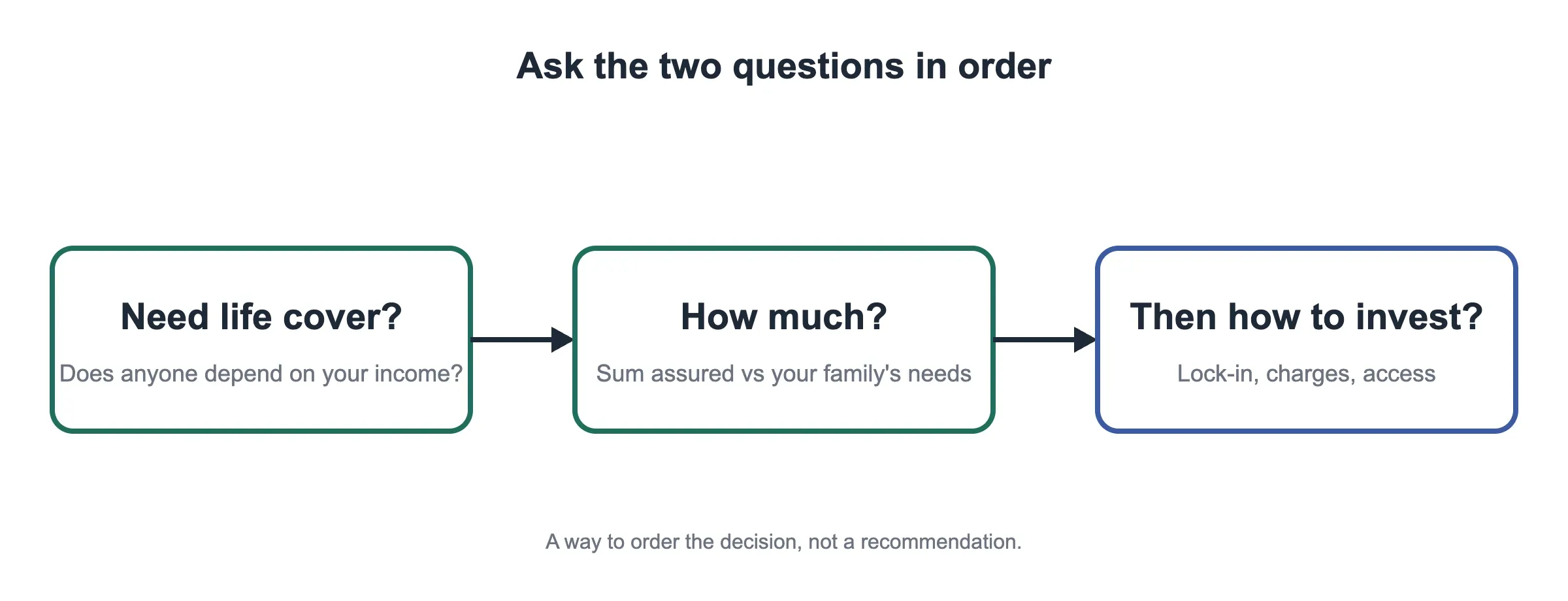
Then ask any bundled offer three questions:
- How much cover does this give? Compare the sum assured with what a term plan for a similar premium would offer.
- How much of my premium is invested in year one? The benefit illustration shows this after charges.
- What would I get back if I stopped after two years? The discontinuance terms answer this.
Employer group cover may handle part of the protection question. Check whether employer health insurance is enough before counting on it.
Before signing any bundled policy
- Read the benefit illustration. IRDAI requires one at the point of sale, at gross returns of 4% and 8% a year, after applicable charges and taxes. Neither rate is a forecast.
- Use the free-look period of 30 days from receiving the policy document (see the FAQ).
- Match the lock-in to your plans, such as a course, a move or a wedding in the next five years.
Frequently asked questions
What is the free-look period?
It is a 30-day window from the date you receive the policy document. You can review the terms and cancel the policy if they don't suit you; the policy document sets out any deductions from the refund.
What if I stop paying ULIP premiums?
If you stop within the five-year lock-in, your fund value, less a discontinuance charge, moves to a discontinued policy fund and the life cover stops. You can revive the policy within three years of the first unpaid premium. If you don't, the money is paid out at the end of the revival period or the lock-in, whichever is later.
Can I withdraw money from a ULIP before five years?
IRDAI's rules allow partial withdrawals only after the five-year lock-in. Before that, stopping premiums leads to discontinuance, and the money is paid out only after the lock-in (later, if the revival period runs past it).
Is a ULIP's fund management charge the same as a mutual fund's expense ratio?
They are similar in idea, as both are charged on the fund. A ULIP adds other charges, such as premium allocation, mortality and policy administration.
Work out the cover question first
Decide whether you need life cover, and how much, before you compare returns. Start with term insurance before your first SIP.
— Laabh