How mutual funds are taxed in India in 2026, explained by what you hold and for how long
Equity funds: 20% short-term, 12.5% long-term above ₹1.25 lakh (FY 2026-27). See why each SIP instalment has its own clock, with a FIFO example.
Summarize this article with AI





The short version
- Equity funds: 20% short-term (12 months or less); 12.5% long-term above ₹1.25 lakh a year (as of FY 2026-27).
- Debt-heavy funds bought on or after 1 April 2023 are treated as short-term and taxed at your slab rate.
- In an SIP, each instalment has its own holding clock and units leave FIFO: in our hypothetical example, 2 instalments were long-term and 12 short-term.
- A switch, even regular to direct in the same scheme, counts as a redemption for tax.
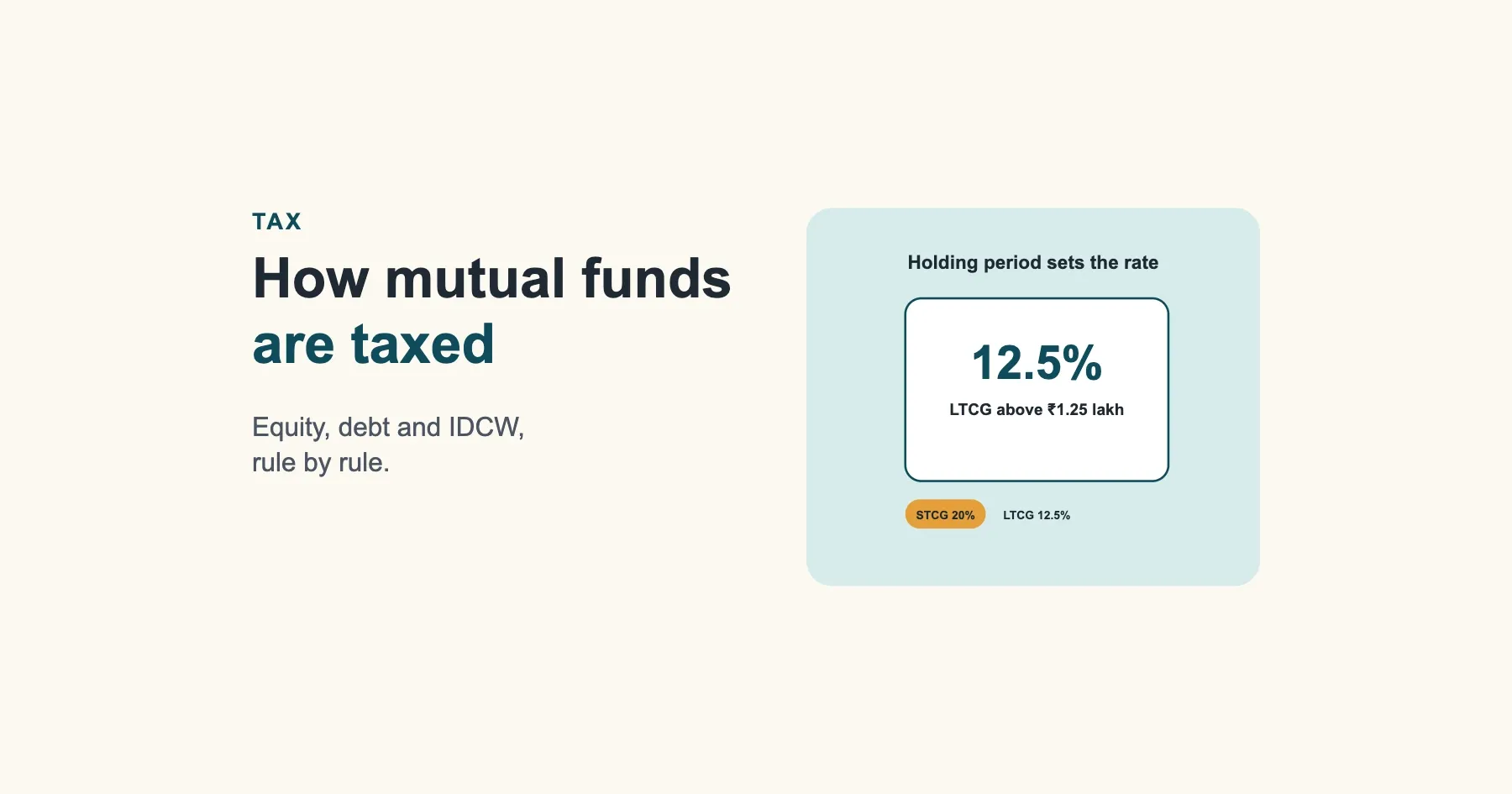
Capital gains on mutual funds in India are taxed when you redeem or switch units; IDCW payouts are taxed separately as income. The rate depends on the fund type and how long each unit was held. For equity funds, short-term gains are taxed at 20% and long-term gains at 12.5% above ₹1.25 lakh a year.
All rates here are as of FY 2026-27, under the Income-tax Act, 2025, which replaced the 1961 Act for this tax year. Rules as of 16 November 2026.
Deepa, 28, in Thrissur, has run an ₹8,000 monthly SIP in an equity fund for just over a year. She wants to redeem it all and asks: since the SIP is more than a year old, is all of the gain long-term? It isn't, and the reason is the most useful thing to know about mutual fund tax.
Start with two questions: what do you hold, and for how long?
Mutual fund tax gets simpler if you ask two questions in order.
- What kind of fund is it? For tax, the split that matters is equity-oriented funds versus debt-heavy funds (the Act calls the latter "specified mutual funds"). Hybrid funds sit in between, and each scheme's SID explains its own tax treatment.
- How long did you hold each unit? Not the folio, not the SIP: each unit, from the day it was allotted to the day it was redeemed or switched out.
Only then does the rate come in.
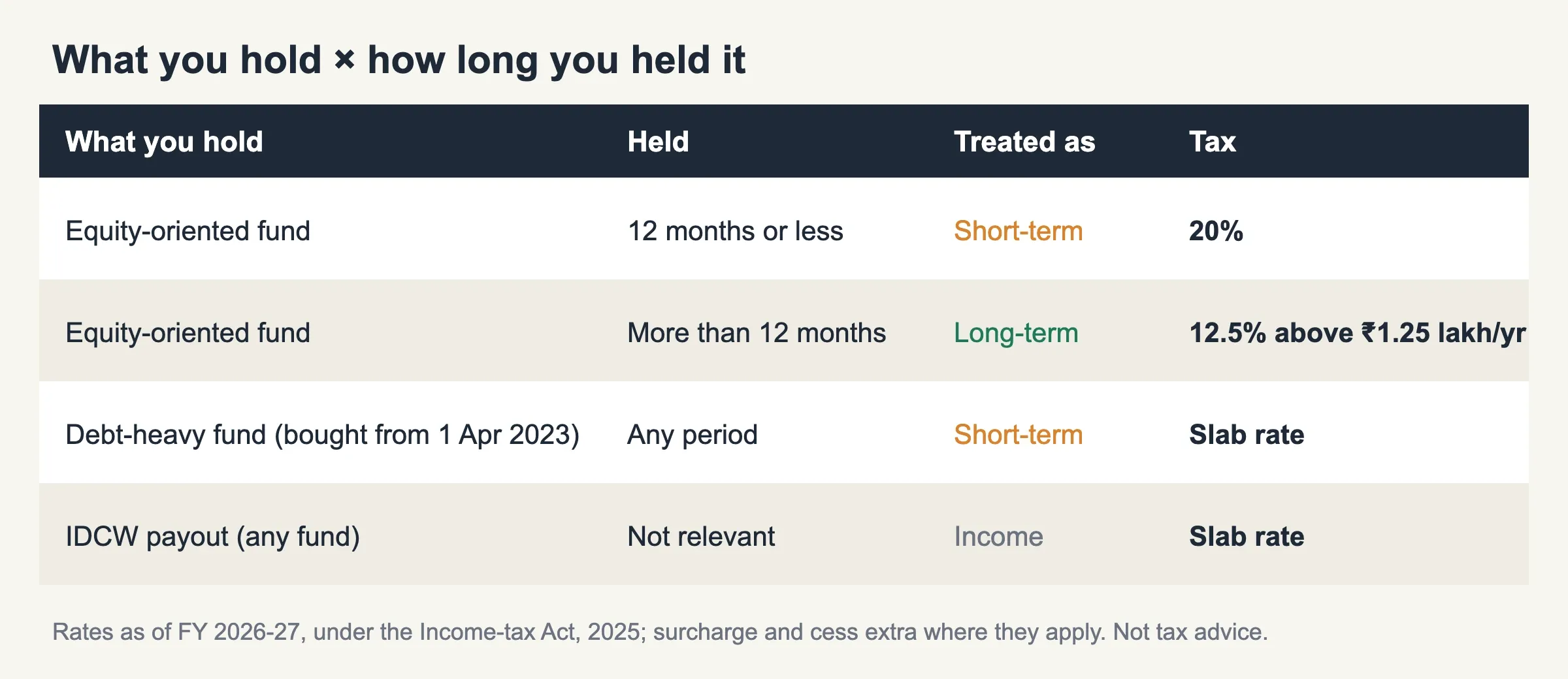
| What you hold | Held this long | Treated as | Tax (as of FY 2026-27) |
|---|---|---|---|
| Equity-oriented fund | 12 months or less | Short-term | 20% |
| Equity-oriented fund | More than 12 months | Long-term | 12.5% on gains above ₹1.25 lakh a year |
| Debt-heavy (specified) fund bought on or after 1 April 2023 | Any period | Treated as short-term | Your income-tax slab rate |
| IDCW payout from any fund | Not relevant | Income, not capital gain | Your slab rate |
How are equity mutual fund gains taxed in India in 2026, short-term and long-term?
For equity-oriented funds, units held for 12 months or less produce short-term capital gains (STCG). Under section 196 of the Income-tax Act, 2025, these are taxed at 20% when the sale is subject to securities transaction tax, which applies to equity fund redemptions. The rate was 15% for transfers before 23 July 2024.
Units held for more than 12 months produce long-term capital gains (LTCG). These are taxed at 12.5%, but only on long-term gains above ₹1,25,000 in a financial year, a rate and limit introduced by the Finance (No. 2) Act, 2024 for transfers from 23 July 2024. In the new Act this sits in section 198.
The ₹1.25 lakh limit is per person per year across all your equity shares and equity fund units, not per fund. Surcharge and cess, where they apply, come on top.
How are debt fund gains taxed now if I bought after 1 April 2023?
Since 1 April 2023, gains on units of a "specified mutual fund" bought on or after that date are treated as short-term whatever the holding period, and added to your income at your slab rate. From FY 2025-26, a specified mutual fund means a fund that puts more than 65% of its money in debt and money market instruments, or a fund that puts 65% or more of its money in such funds.
Debt fund units bought before 1 April 2023 follow older rules, under which units held for more than 24 months are long-term. Check your capital gains statement and the scheme's SID rather than assuming.
In an SIP, is each instalment treated separately for the holding period (FIFO)?
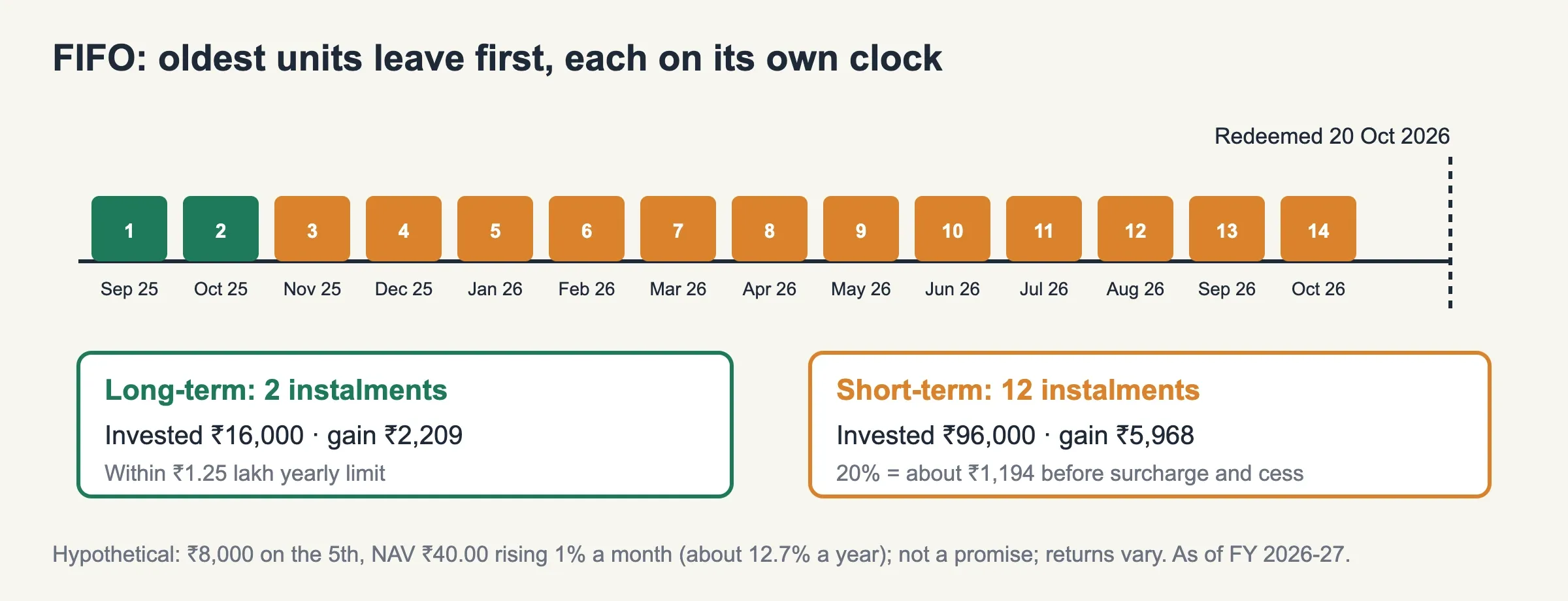
Yes. Every SIP instalment buys a fresh batch of units on its own date. When you redeem, units go out on a first in, first out (FIFO) basis: the oldest units first. Each batch has its own clock.
Back to Deepa. Here is her SIP, with a hypothetical NAV path.
- Instalments: ₹8,000 on the 5th of every month, from 5 September 2025 to 5 October 2026. That is 14 instalments, ₹1,12,000 in all.
- Hypothetical NAV: ₹40.00 on 5 September 2025, rising 1% a month (about 12.7% a year), reaching ₹45.52 on 5 October 2026 and ₹45.75 on the redemption date. Hypothetical, not a promise; returns vary.
- Redemption: all 2,626.823 units on 20 October 2026, worth ₹1,20,177.
On 20 October 2026, only two instalments have been held for more than 12 months: 5 September 2025 and 5 October 2025. The 5 November 2025 instalment is still 16 days short of its first year. So the 2 oldest instalments are long-term and the 12 newer ones are short-term, even though the SIP itself is more than a year old.
| Instalments | Invested | Hypothetical gain | |
|---|---|---|---|
| Long-term (held more than 12 months) | 2 (Sep and Oct 2025) | ₹16,000 | ₹2,209 |
| Short-term (held 12 months or less) | 12 (Nov 2025 to Oct 2026) | ₹96,000 | ₹5,968 |
| Total | 14 | ₹1,12,000 | ₹8,177 |
What this means for tax, as of FY 2026-27:
- The ₹2,209 long-term gain is within the ₹1.25 lakh yearly limit, so if Deepa has no other long-term equity gains this year, no LTCG tax arises on it.
- The ₹5,968 short-term gain is taxed at 20%, about ₹1,194 before any surcharge and cess.
Dates matter by the day. Had she redeemed on 5 October 2026, the October 2025 instalment would have been held for exactly 12 months. The Income Tax Department's wording is "not more than" 12 months for short-term, so it would still have counted as short-term.
Hypothetical; FIFO illustration only; not tax advice; as of FY 2026-27, under the Income-tax Act, 2025.
Do I pay any tax if I stay invested and don't redeem?
Not on capital gains. A rising NAV is an unrealised gain, and capital gains tax arises only when units are transferred, which means a redemption or a switch.
The exception is the IDCW option. Each IDCW payout is income in your hands and is taxed at your slab rate. The fund house deducts TDS of 10% once a resident's IDCW from the same mutual fund crosses ₹10,000 in the tax year (section 393 of the Income-tax Act, 2025). Under the growth option there is no payout, so nothing is taxed until you redeem.
Is switching from a regular plan to a direct plan of the same fund taxable?
Generally, yes. A switch is a redemption from one plan and a purchase in another, even within the same scheme, so it is a transfer for tax. The units you switch out are taxed by their own holding periods, as in Deepa's example, and an exit load may apply. The new direct-plan units start a fresh holding clock.
Frequently asked questions
What is the ₹1.25 lakh exemption?
It is the yearly limit up to which long-term capital gains on equity shares and equity-oriented fund units are not taxed. Gains above ₹1,25,000 in a financial year are taxed at 12.5%. The limit applies to your total such gains for the year, not per fund.
Is IDCW taxed?
Yes. IDCW payouts are treated as income and taxed at your slab rate in the year you receive them. TDS of 10% applies once IDCW from a fund house crosses ₹10,000 in a year; confirm the current threshold.
Where is my capital gains statement?
Your fund's registrar and transfer agent (RTA) can issue a capital gains statement for a financial year, showing each redemption split into short-term and long-term. Your Consolidated Account Statement (CAS) shows the transactions behind it.
Did the new Income-tax Act, 2025 change mutual fund tax?
It replaced the 1961 Act from FY 2026-27 and renumbered the sections: the 20% short-term rate on equity funds is now in section 196. The rates set by the Finance (No. 2) Act, 2024 continue as of FY 2026-27. Check the bare Act for any provision you rely on.
Before you redeem
Exit load and lock-in can matter as much as tax. Our guide, "Can you withdraw your SIP money anytime? Lock-in, exit load and tax, explained", covers both.
— Laabh



