How to start an SIP: a step-by-step guide for first-time investors
KYC, choosing a fund, picking an amount and date, nominating, and setting up the auto-debit. What happens at each step, and how long your first SIP really takes.
Summarize this article with AI





The short version
- You need a PAN, completed KYC and a bank account in your name.
- Pick the fund category for your goal first, then the scheme, then direct or regular.
- Choose an amount you can keep paying and a date a few days after payday.
- Nominate up to 10 people, or formally opt out.
- Your first debit can come a few days later than the date you chose while the mandate registers.
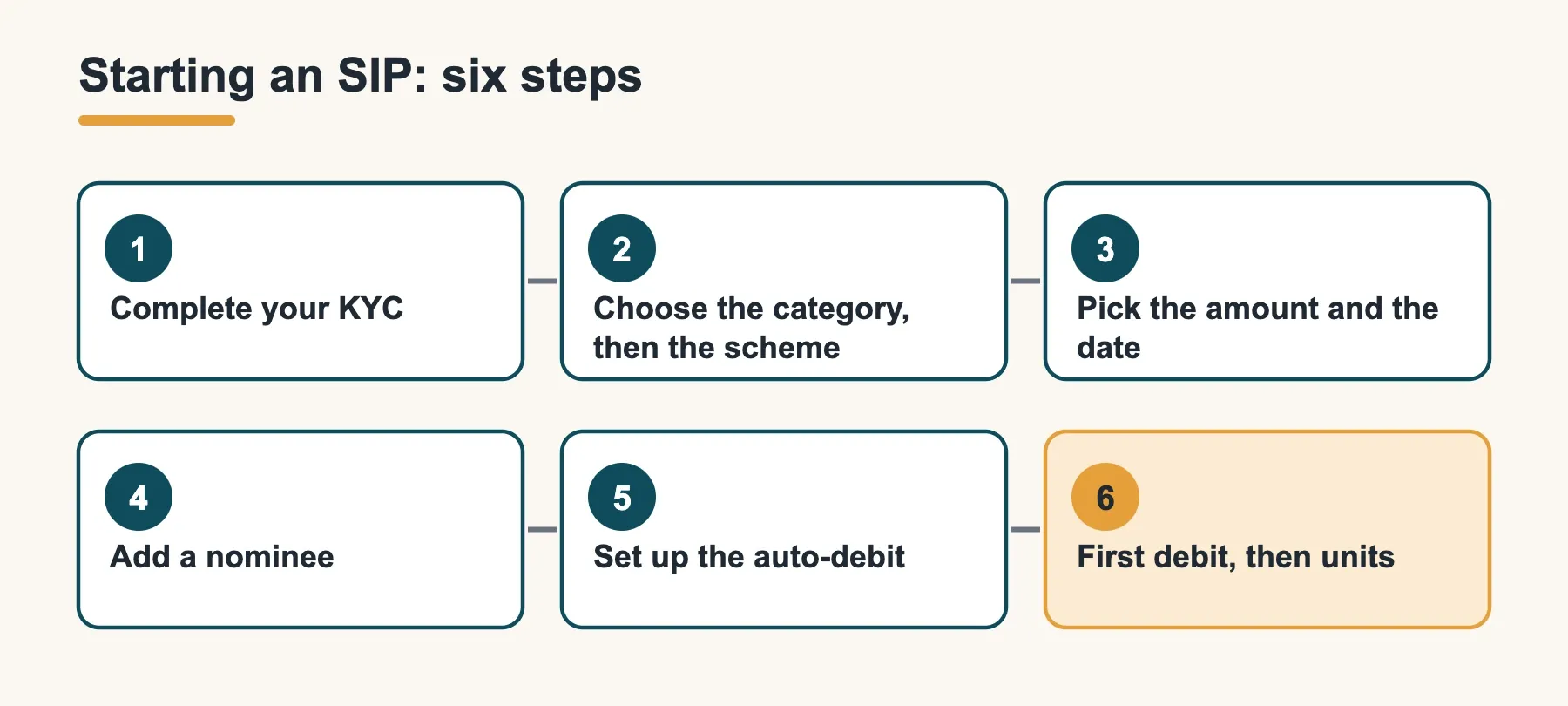
To start an SIP (Systematic Investment Plan), you need three things: a PAN, completed KYC (Know Your Customer) verification, and a bank account in your name. Then you choose a fund, an amount and a date, add a nominee, and approve an auto-debit from your bank. Most of it can be done online in one sitting; the first instalment may take a few extra days while your bank registers the auto-debit.
Sameer, 23, has just joined a firm in Nagpur and wants to put ₹2,000 a month into his first SIP. He has a PAN and a salary account, and nothing else. This guide walks through what he does, step by step, and what to expect at each one.
Before you start: what you need
- PAN: mandatory for investing in mutual funds.
- Aadhaar linked to your PAN: needed for the quickest, fully online KYC route.
- A mobile number and email address in your own name, for OTPs and statements.
- A bank account in your name, with net banking, a debit card or UPI for the auto-debit.
Step 1: Complete your KYC
KYC is a one-time identity check. It is recorded with a KYC Registration Agency (KRA), so once done, it works across fund houses. You can complete it online with Aadhaar-based eKYC, or with other officially valid documents such as a passport, voter ID or driving licence.
Your KYC record has a status. The three you will most often see:
- KYC Validated: your PAN, name, address, email and mobile have all been verified against official sources. You can invest with any fund house without submitting documents again.
- KYC Registered: your KYC is done, but one or more details could not be cross-verified, often an email or mobile number. You can usually keep investing where you already have an account, but a new fund house may ask you to complete more verification.
- KYC On Hold: a key detail failed a check, for example your PAN and Aadhaar are not linked. New investments and SIPs are blocked until you fix it.
You can check your status on any KRA's website using your PAN. If Sameer's shows "On Hold", he fixes that first; nothing else will go through.
Step 2: Choose the fund category, then the scheme
Start with your goal and when you need the money, then pick a category that fits that time horizon. Our guide on which type of mutual fund a beginner should start with walks through this. Only then compare schemes within the category: what they hold, their expense ratio, their exit load and their riskometer.
Two more choices come with every scheme:
- Direct or regular plan: the same portfolio at a different cost. See our guide on direct vs regular plans.
- Growth or IDCW option: growth reinvests any gains inside the fund; IDCW (Income Distribution cum Capital Withdrawal) pays some out from time to time. For a long-term goal, most first-time investors pick growth.
Step 3: Pick the amount and the date
Amount: pick one you can keep paying even in a tight month. Each scheme sets its own minimum in its Scheme Information Document (SID). AMFI's investor education site says an SIP can be as little as ₹500 a month, and some fund houses accept ₹100 or ₹250 in selected schemes. For working out a starting amount, see our first-salary SIP guide.
Date: choose a date a few days after your salary usually arrives, so the money is in your account when the debit runs. If the debit fails for lack of funds, that instalment is skipped and your bank may charge a fee; most fund houses cancel an SIP only after three failures in a row.
Tenure: you can set an end date or choose a perpetual SIP that runs until you stop it. Either way, you can usually change it later.
Step 4: Add a nominee
A nominee is the person who receives your units if something happens to you. Under SEBI's nomination rules, in force from 1 March 2025, you can name up to 10 nominees and set each one's share, or formally opt out. Nominating takes a couple of minutes and saves your family a long process later.
Step 5: Set up the auto-debit
The SIP is paid through a mandate: a standing instruction that lets the fund house debit your bank account on the SIP date. There are two common types:
- e-mandate (NACH): approved once through net banking or your debit card.
- UPI AutoPay: approved in your UPI app. Since December 2023, the RBI allows recurring payments for mutual fund subscriptions of up to ₹1 lakh per transaction without an extra OTP each time.
Your bank needs to register the mandate before the first debit. That can take a few working days, so if the date you picked is very close, your first instalment may run in the following month.
Step 6: The first debit, and when you get units
On the SIP date, the money moves from your bank to the fund. Your units are bought at the NAV of the business day on which the fund receives your money, if it arrives before the 3 PM cut-off for most schemes; otherwise, at the next business day's NAV. This rule has applied to all purchases, including SIPs, since 1 February 2021.
Within a few days you get a confirmation with the units allotted. After that, your consolidated account statement (CAS) from CAMS or KFintech shows every SIP instalment each month.
Sameer's first month, in order
| When | What Sameer does | What happens |
|---|---|---|
| Day 1 | Checks his KYC status with his PAN | It shows Validated, so he can continue |
| Day 1 | Picks a category for his long-term goal, then a scheme, direct plan, growth option | The scheme's SID gives the minimum SIP and the exit load |
| Day 1 | Sets ₹2,000 a month, on the 5th, perpetual | His salary arrives on the 1st |
| Day 1 | Adds his mother as nominee | Confirmed by OTP |
| Day 1 | Approves a UPI AutoPay mandate | The mandate is registered |
| 5th of the month | Nothing | ₹2,000 is debited and units are bought at that day's NAV |
| A few days later | Checks the confirmation | Units allotted; his SIP is running |
Illustrative timeline; how long each step takes varies by fund house, platform and bank.
The catch
Starting an SIP is easy; keeping it going is the real work. The steps above take an afternoon, but the SIP only does its job if it runs for years, through markets that fall as well as rise. Pick an amount you won't need to stop, and review it once a year rather than every time the market moves.
Frequently asked questions
What documents do I need to start an SIP?
A PAN, an Aadhaar linked to it for the fastest online KYC, a mobile number and email in your name, and a bank account in your name for the auto-debit. If you have completed KYC before, you may not need to submit documents again.
Do I need a demat account to start an SIP?
No. Mutual fund units can be held in a folio with the fund house, without a demat account; holding them in demat is optional. Our guide on mutual funds without a demat account explains both routes.
How long does it take to start an SIP?
Setting it up can take one sitting if your KYC is already validated. The first instalment depends on when your bank registers the auto-debit mandate, which can take a few working days, so it may run in the following month if your chosen date is very close.
SIP kaise shuru karein?
Pehle apna KYC poora karein: PAN aur Aadhaar se online ho jaata hai. Phir apne goal ke hisaab se fund ki category chuniye, uske baad scheme, aur direct ya regular plan. Har mahine kitna aur kis tareekh ko, yeh tay kariye, nominee jodiye, aur bank ka auto-debit mandate approve kariye. Pehli kist kuch din baad kat sakti hai.
What happens if my SIP debit fails?
That instalment is skipped and no units are bought for it; your bank may charge a fee. The SIP itself continues. Most fund houses cancel an SIP only after three failed debits in a row.
Can I change my SIP amount or date later?
Usually yes. You can increase or decrease the amount, change the tenure, or stop the SIP. Changing the date may mean cancelling and starting a new SIP, depending on your fund house or platform. Requests can take a few working days, so make them well before the next debit.
What to do next
Check your KYC status today using your PAN. If it shows Validated, choose your category using our guide on which type of mutual fund to start with, then come back to Step 3.
Read next: What happens to your SIP when the market falls (and should you stop it?)



