Index funds for beginners: how they work and how to compare two that track the same index
An index fund aims to mirror an index, not beat it. Learn how it works and the four labels to compare between funds on the same index, with a ₹ example.
Summarize this article with AI





The short version
- An index fund aims to mirror an index, not beat it, and it falls when the index falls.
- Choose the index first; only funds on the same index are comparable on cost and tracking.
- Compare four labels: expense ratio, tracking difference, tracking error and plan type.
- In the hypothetical illustration, a 0.6% a year cost gap became ₹1,44,890 over 20 years.
An index fund is a mutual fund that aims to mirror an index by holding the index's stocks in the same proportion. It does not try to beat the index. It usually costs less than an actively managed fund and is simpler to compare, but it still falls when its index falls. Between funds that track the same index, compare cost and how closely each one tracks.
Harjot, 25, is a physiotherapist in Ludhiana (fictional). She has read that index funds are a simple place to start, so she searched "Nifty 50 index fund". She found many funds, all following the same index, all showing slightly different 1-year returns. Her question: if they copy the same thing, why are the numbers different, and which labels should she compare?
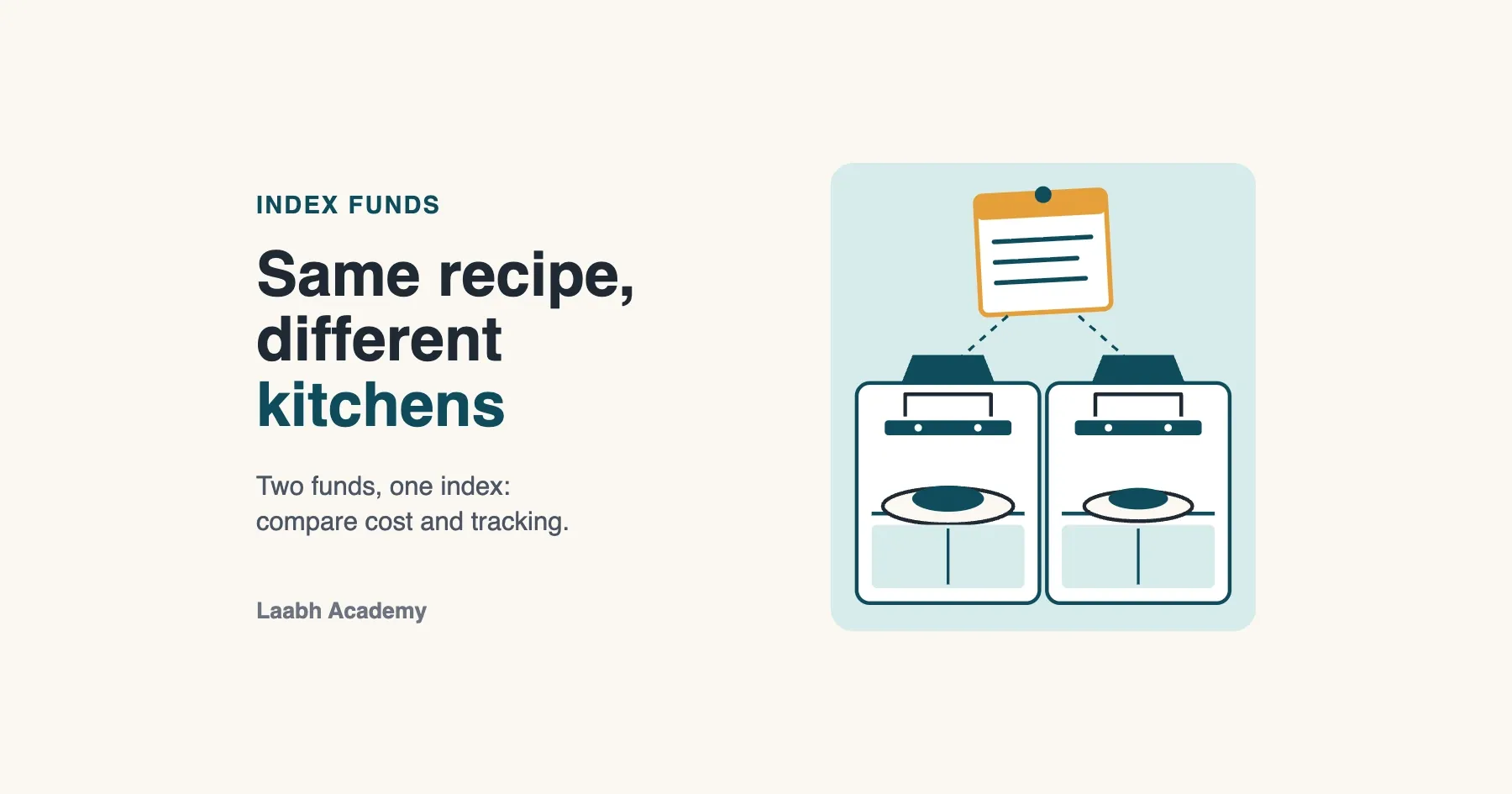
Think of the index as a recipe the fund did not write. Two kitchens can follow the same recipe and still serve slightly different plates. Here is what makes them differ.
How an index fund works
SEBI's Mutual Funds Regulations, 2026 describe an index fund as a scheme "that invests in securities in the same proportion of an index of securities". The fund manager's job is to follow the index, not to pick stocks.
What an index is
An index is a published list of stocks with a rule for how much weight each one gets. The Nifty 50 and the BSE Sensex are two well-known examples, built from large listed companies. You cannot invest in an index itself, only in a fund that copies it.
Rebalancing when the index changes
The index provider reviews its list from time to time. When a stock is added, dropped or reweighted, the fund buys and sells to match. The scheme documents we read commit at least 95% of assets to the index's stocks; the rest covers cash needs such as redemptions.
What it does not do
An index fund does not protect you from a fall. If the index drops 15% in a bad year, a fund that tracks it closely drops by roughly as much, plus its costs. Whatever the index holds, the fund holds.
Index fund or actively managed fund?
An index fund follows its index's rules; an actively managed fund pays a manager to make calls, usually at a higher cost, and can lag its benchmark if those calls go wrong. SEBI sets a lower expense limit for index funds and ETFs. Neither type always does better. Our guide on which type of mutual fund a beginner can start with covers that choice; this article assumes you have chosen index funds.
First choose the index, then the fund
Funds on different indices are not comparable on cost or tracking. A broad index of large companies and a narrow index of one sector or theme hold different stocks and carry different risks. Their returns differ because the recipes differ.
So decide first which index fits your goal and how many ups and downs you can sit through. The fund's scheme information document (SID) and the index provider's website say what the index contains. Then compare only funds on that same index. We are not recommending any index here.
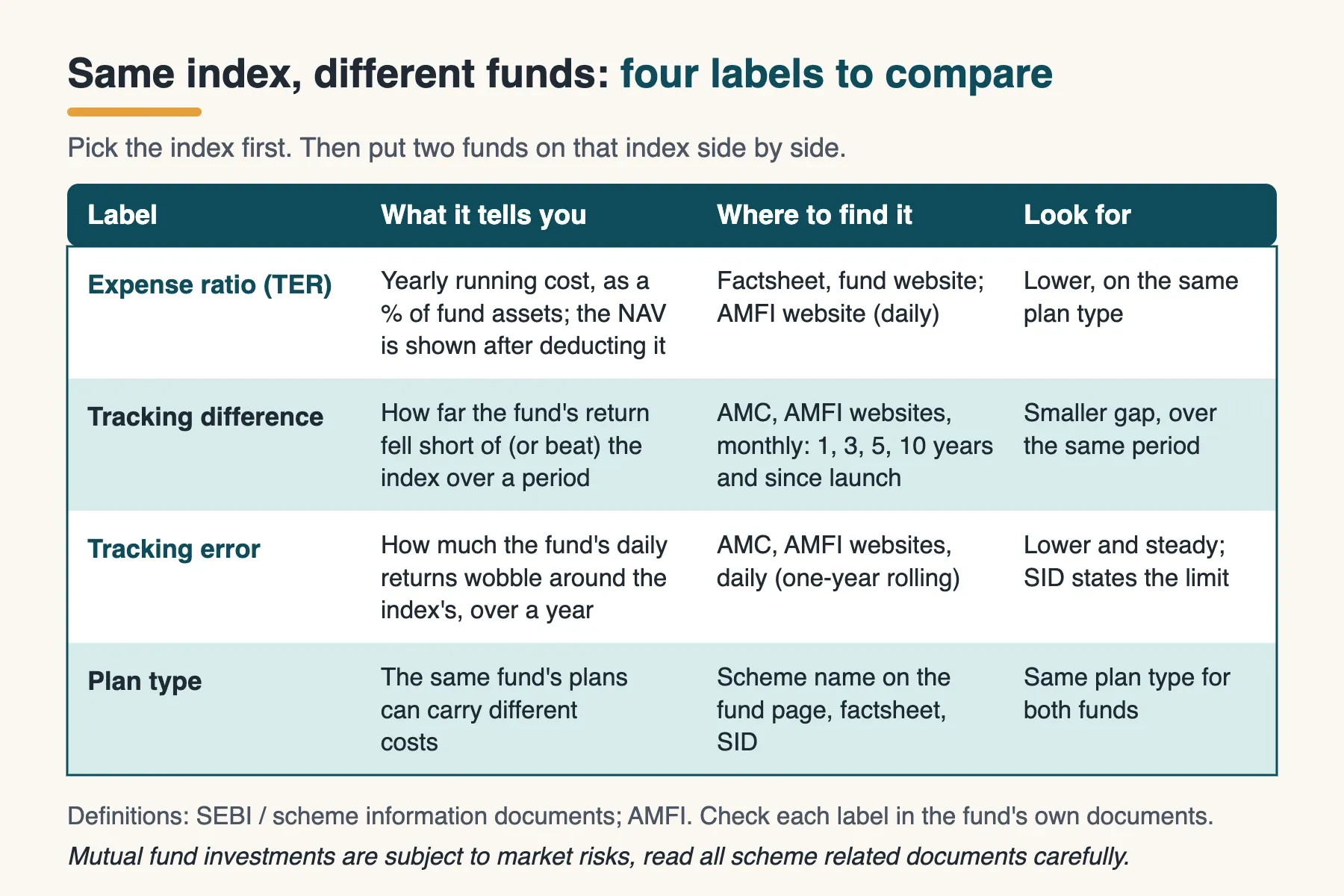
Same index, different funds: the four labels to compare
Expense ratio (TER)
The total expense ratio (TER) is the fund's yearly running cost, as a percentage of its assets. AMFI notes that it is charged on the fund's daily net assets and that "the daily NAV of a mutual fund is disclosed after deducting the expenses". You do not pay it separately. Funds disclose TER daily on their own websites and AMFI's.
Under changes SEBI's board approved in December 2025, the cost is split: the TER is the base expense ratio (BER) plus brokerage, regulatory levies and statutory levies. When you compare two funds, compare the same figure for both: TER with TER, or BER with BER.
Tracking difference
Tracking difference is how far the fund's return was from the index's over a period. SIDs define it as the annualised difference of daily returns between the index and the fund's NAV. Much of it usually comes from the expense ratio; cash held for redemptions and trading costs add to it.
Fund houses publish it monthly, on their own website and AMFI's, for 1, 3, 5 and 10 years and since launch. Compare two funds over the same period. A smaller gap is better.
Tracking error
Tracking error measures how much the fund's daily returns wobble around the index's. SIDs define it as the annualised standard deviation of the difference in daily returns between the index and the fund's NAV, based on one year of rolling data, and disclose it daily. The SIDs we read say it "shall not exceed 2%", except in force-majeure situations beyond the fund house's control, and cite SEBI's master circular for mutual funds.
Tracking difference shows how far behind the fund ended up; tracking error shows how steady the copying was along the way. A fund can have a small tracking error and still lag the index by its cost every year, so check both.
Plan type: compare like with like
Most funds offer more than one plan, and each plan has its own expense ratio. Comparing one fund's plan with a different plan type of another fund mixes two things, so put the same plan type side by side. Which plan type suits you is a separate question this article does not answer.
Fund size and exit load are worth a glance too, though no official fund size makes a fund "good".
Why a small cost gap grows
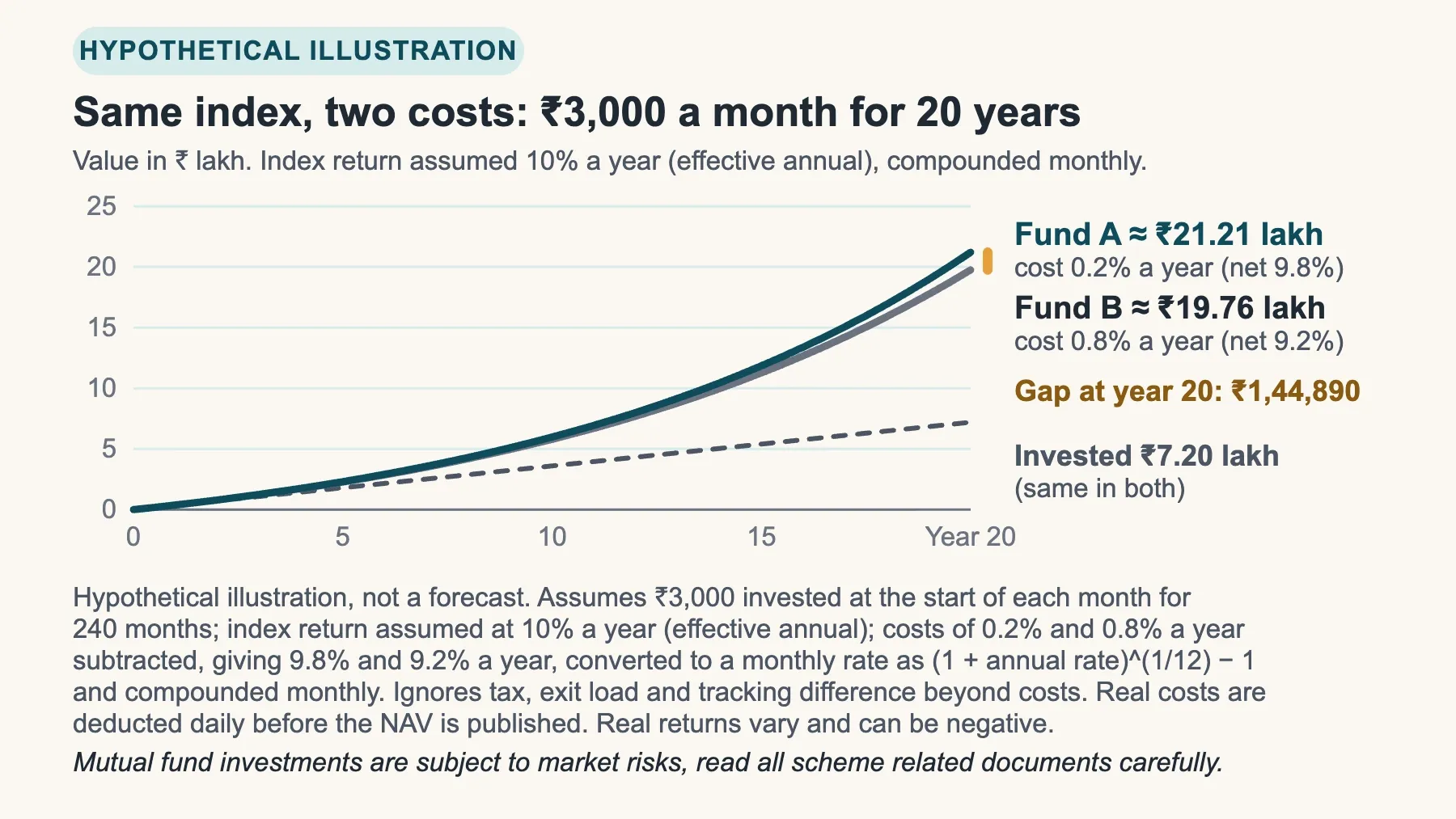
Suppose Harjot invests ₹3,000 at the start of every month for 20 years (240 months), ₹7.20 lakh in all. Assume, purely as a hypothetical, that the index returns 10% a year (effective annual). Fund A costs 0.2% a year and Fund B 0.8%, so they grow at 9.8% and 9.2% a year, converted to monthly rates as (1 + annual rate)^(1/12) − 1 (about 0.782% and 0.736%) and compounded monthly.
| After | Fund A (0.2% cost) | Fund B (0.8% cost) | Invested |
|---|---|---|---|
| 5 years | ₹2,30,365 | ₹2,26,944 | ₹1,80,000 |
| 10 years | ₹5,98,009 | ₹5,79,342 | ₹3,60,000 |
| 15 years | ₹11,84,740 | ₹11,26,541 | ₹5,40,000 |
| 20 years | ₹21,21,118 | ₹19,76,228 | ₹7,20,000 |
After 5 years, the gap is ₹3,420. After 20 years, it is ₹1,44,890, about 6.8% of Fund A's value, for the same ₹7.20 lakh put in. This is a hypothetical illustration, not a forecast; real returns vary and can be negative.
The catch: costs come out every year, whether the index is up or down. That is why a 0.6% a year gap keeps compounding.
Index fund or ETF without a demat account?
An exchange traded fund (ETF) also tracks an index, but SEBI's regulations require its units to be listed and traded on a stock exchange. AMFI's investor-education site says ETF units are usually bought and sold through a registered stockbroker, and its gold ETF guide lists opening a demat and trading account as the direct route. An index fund is bought and redeemed with the fund house at the day's NAV, like any other mutual fund, and needs no demat account. It also allows an SIP in the usual way.
ETFs trade at market prices during the day, which can sit a little above or below their NAV. Neither route suits everyone, but without a demat account, an index fund is the simpler start.
How to start
- Finish KYC. You need it for any mutual fund.
- Choose the index that fits your goal and your comfort with falls.
- List the funds on that index and compare the four labels, on the same plan type, from the SID, factsheet and AMFI website.
- Decide your SIP amount. Start with an amount you can keep through a bad year.
- Read the SID and KIM before you invest, including the exit load.
What if the market falls right after you start?
Your fund will fall with the index; that is what it is built to do. An SIP keeps buying units through the fall. Our guide What happens to your SIP when the market falls (and should you stop it?) walks through what to do and what not to do.
Frequently asked questions
I'm 25 and starting my first SIP. Is an index fund a sensible start?
It can be, if you accept its ups and downs. An index fund aims to mirror an index rather than beat it, usually costs less than an actively managed fund and is simpler to compare. It still falls when its index falls, so choose an SIP amount you can keep through a bad year.
Two Nifty 50 index funds track the same index. Why are their returns different?
Same recipe, different kitchens. The gap comes mostly from the expense ratio, plus cash and trading costs, which together show up as tracking difference. Comparing different plan types or periods also makes returns look different.
Tracking error vs tracking difference: which one should a beginner look at?
Start with tracking difference: how far the fund's return was from the index's, published monthly for 1, 3, 5 and 10 years and since launch. Tracking error shows how steady the daily copying was over the last year. Check both, over the same period.
How much does the expense ratio really matter in an index fund over 10–20 years?
More than the small number suggests, because it is taken every year whether returns are up or down. In this article's hypothetical illustration (₹3,000 a month, index return assumed at 10% a year, compounded monthly), a 0.2% vs 0.8% cost left a gap of ₹18,667 after 10 years and ₹1,44,890 after 20 years. This is not a forecast.
Index fund or ETF: which is simpler if I don't have a demat account?
An index fund. You buy and redeem it with the fund house at the day's NAV, like any mutual fund, and can run an SIP without a demat account. ETF units trade on a stock exchange, so buying them usually needs a demat and trading account through a stockbroker.
Index fund kya hota hai, aur beginner ko isme kaise shuru karna chahiye?
Index fund ek mutual fund hai jo kisi index, jaise Nifty 50, ke shares usi anupaat mein rakhta hai. Yeh index ko beat karne ki koshish nahi karta, aur index girne par yeh bhi girta hai. Shuru karne ke liye: KYC poora karein, pehle index chunein, phir usi index wale funds ka expense ratio aur tracking difference ek hi plan type par compare karein, aur nivesh se pehle SID padhein.
What to do next
Pick the index first, then compare four labels on the fund's own documents: open the SIDs of two funds on your chosen index and fill in the checklist above, side by side.
— Laabh



