Life cycle funds explained: SEBI's new mutual funds that change with your goal
Life cycle funds are SEBI's new target-year mutual funds that shift from equity to debt over time. Rules, exit loads, trade-offs and how to pick a year.
Summarize this article with AI





The short version
- Life cycle funds are a SEBI category introduced on 26 February 2026, built around a target year in the scheme name.
- Equity falls from 65% to 95% far from the target to 5% to 20% in the final year.
- Tenures run from 5 to 30 years in 5-year steps, with at most six open per fund house.
- Exits within three years attract a 3%, 2% or 1% exit load, and the maturity-day process is set at scheme level.
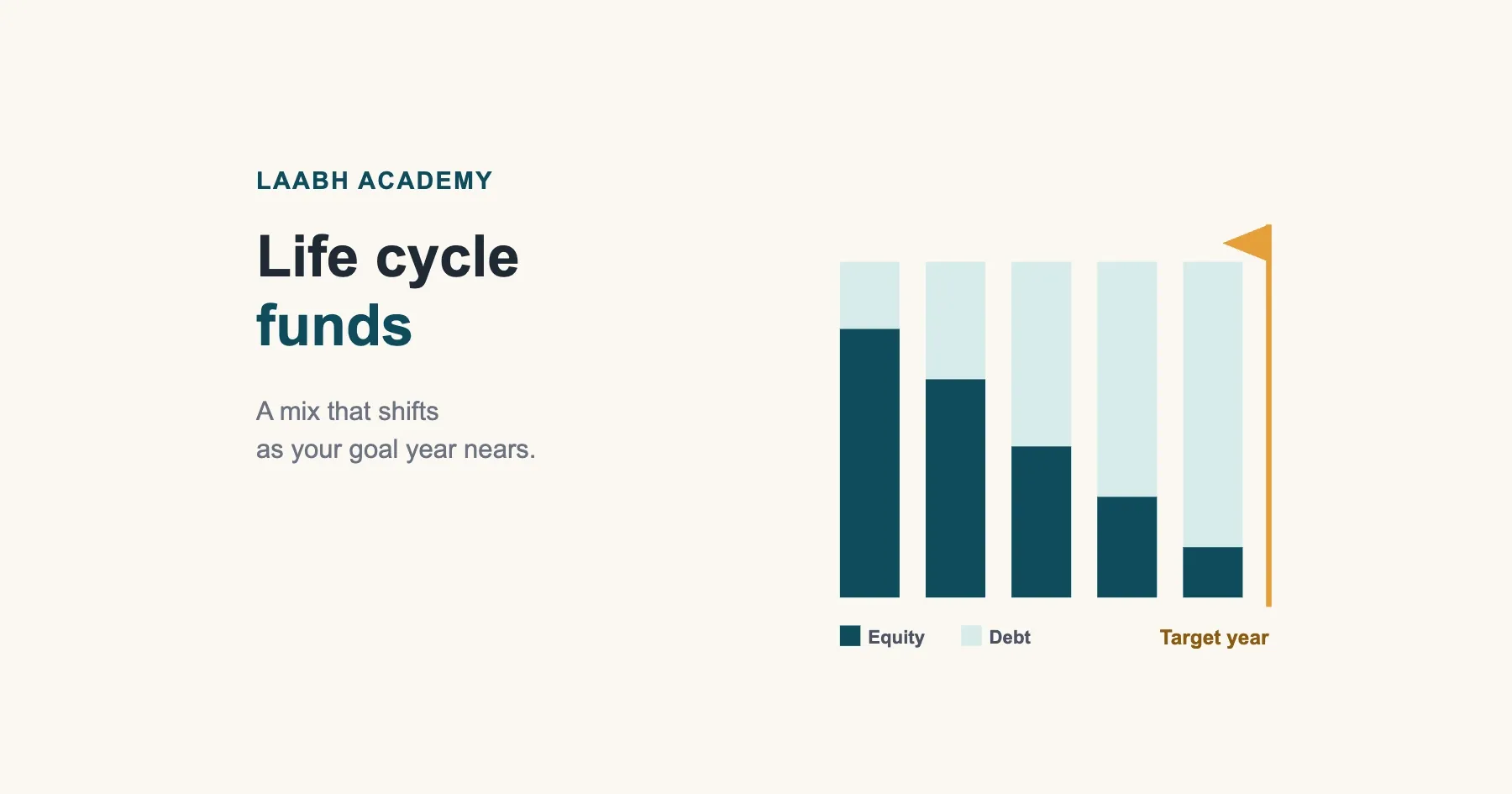
A life cycle fund is a mutual fund category SEBI introduced on 26 February 2026. Each fund is built around a target year in its name, starting with more equity and moving towards debt as that year approaches, along a glide path SEBI sets in ranges. It is a convenience for dated goals, not a guarantee: its value still moves with markets, and selling in the first three years attracts an exit load.
Rohan and Meera live in Pune. Their daughter Ira was born in 2024, and they expect her college fees to fall due around 2041 or 2042. They have heard about "a mutual fund with a year in its name". We will use their plan to explain how life cycle funds work, what the rules say, and what you give up compared with managing the mix yourself.
What SEBI changed, and when
SEBI's circular "Categorization and Rationalization of Mutual Fund Schemes" is dated 26 February 2026 and came into force the same day. Two changes matter for goal-based investors.
- A new category, the Life Cycle Fund. SEBI describes it as "an open ended fund with attributes of predetermined maturity and glide path for goal based investing".
- The solution-oriented category is gone. Retirement funds and children's funds belonged to this category under SEBI's earlier categorisation circular of 6 October 2017. The 2026 circular discontinued the category from its date of issue. Existing schemes had to stop all subscriptions immediately and are to be merged with schemes of similar asset allocation and risk profile, with SEBI's prior approval.
Under the 2017 circular, retirement funds had a lock-in of at least 5 years or until retirement age, and children's funds at least 5 years or until the child reached majority, whichever was earlier. The 2026 circular sets no lock-in for life cycle funds; it uses a graded exit load instead.
How a life cycle fund works
The target year
You choose a fund whose target year sits close to when you need the money. SEBI requires the maturity date in the scheme's name, so Rohan and Meera would look at funds named for years near 2041.
The glide path
The glide path is the planned route from growth to stability. SEBI sets allocation ranges by years left to maturity: with 15 or more years left on the longest tenures, equity can be 65% to 95%; in the final year, 5% to 20%. Gold and silver ETFs, exchange traded commodity derivatives (ETCDs) and InvITs can be 0% to 10% throughout, with the rest largely in debt.
Within those ranges each fund house sets its own path, which you will find in the scheme information document (SID).
Rebalancing happens inside the fund
The fund shifts the mix as the years pass, so you do not need to sell equity funds and buy debt funds yourself.
A hypothetical glide path for a 2041 goal
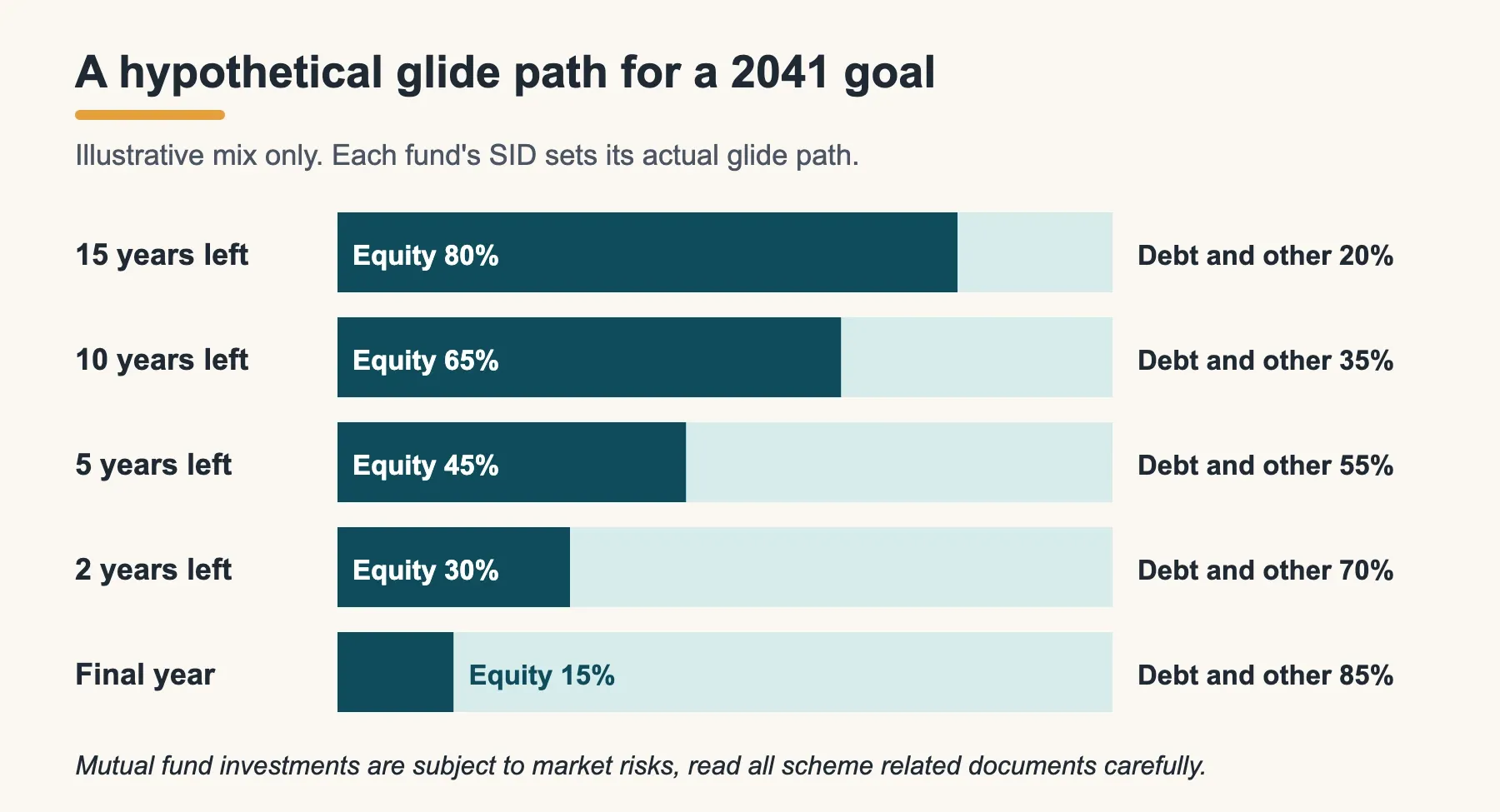
The table below is hypothetical and for illustration only. It is not SEBI's rule, not from any scheme, and not a prediction.
| Years left to target | Equity (illustrative) | Debt and other assets (illustrative) |
|---|---|---|
| 15 | 80% | 20% |
| 10 | 65% | 35% |
| 5 | 45% | 55% |
| 2 | 30% | 70% |
| Final year | 15% | 85% |
The point is the shape: heavier on growth while Ira is small, lighter on equity when fees are due, so a late market fall has less room to dent the money.
Key rules investors should know
| Rule (SEBI, 26 February 2026) | What the circular says |
|---|---|
| Structure | Open-ended, with a predetermined maturity and glide path |
| Tenure | Minimum 5 years, maximum 30 years, in multiples of 5 years |
| Number per fund house | A maximum of 6 life cycle funds can be open for subscription at any time |
| Name | Must include the maturity year |
| Equity range | 65% to 95% with 15 or more years left (longest tenures), falling to 5% to 20% in the final year |
| Gold/silver ETFs, ETCDs, InvITs | 0% to 10% |
| Exit load | 3% within one year, 2% within two years, 1% within three years of investment |
| Near maturity | With less than 1 year to maturity, a fund may be merged with the nearest-maturity life cycle fund, with positive consent from unitholders |
What the exit load means in ₹
Say Meera redeems ₹1,00,000. Reading the schedule as graded by year, as explainers do:
- Within the first year: 3% of ₹1,00,000 = ₹3,000 deducted.
- In the second year: 2% = ₹2,000.
- In the third year: 1% = ₹1,000.
The circular's schedule stops at three years. Check the SID for exact terms.
What happens at the target year
The circular does not spell out what happens on the maturity date. It says only that once less than a year remains, a fund may be merged with the nearest-maturity life cycle fund, with positive consent from unitholders. How proceeds are paid out is a scheme-level detail, so read the SID rather than assuming.
Mapping life cycle funds to life milestones
- Child's education. Ira's fees start around 2041. Since college costs are spread over several years, a target year near the first payment is a natural anchor.
- Retirement. Meera, 34, hopes to retire in 2052, 26 years away. With tenures in 5-year steps up to 30 years, a fund launched in 2026 would aim roughly 25 or 30 years out, so she would pick the nearest available year.
- Home down payment. A goal 5 years away sits at the minimum tenure, where the fund starts with far less equity than a long-dated one.
Choosing a target year
Start with the year you will actually need the money. If the target year falls after your withdrawal date, you may sell while the fund still holds more equity than intended. If it falls well before, the money may sit in the conservative phase longer than necessary. With 5-year steps and six funds per fund house, your exact year may not exist, so pick the nearest one that does not land after your need.
Life cycle fund vs doing it yourself vs balanced advantage or hybrid
| Life cycle fund | Doing it yourself | Balanced advantage / hybrid fund | |
|---|---|---|---|
| What sets the mix | Glide path to the target year | You | Scheme mandate; balanced advantage funds vary it dynamically, with no end date |
| Who rebalances | The fund | You, through switches and redemptions | The fund |
| Flexibility | One path for everyone in that fund | Full control | Within the scheme's mandate |
| Costs to weigh | Expense ratio; 3%/2%/1% exit load for three years | Each fund's expense ratio, plus exit loads and tax on every switch | Expense ratio; exit load per SID |
In short: a life cycle fund fits a need with a date; doing it yourself fits someone who will actually rebalance on schedule; a balanced advantage fund fits someone without a fixed end date.
Trade-offs and risks
- Still market-linked. Even in the final year a fund can hold some equity, and debt carries interest rate and credit risk. Nothing is guaranteed.
- One path for everyone. The glide path does not know your other savings, income or risk appetite.
- Calendar, not market. Equity is reduced on schedule, even if markets rally late.
- Early exits cost money. The exit load runs for three years.
- Expense ratio adds up. A small yearly difference compounds over 15 years. Compare direct and regular plans.
- No track record. The category began in 2026, so there is no history across a full market cycle.
- Tax. Check how gains will be taxed when you redeem. Tax rules change; consult a tax professional for your situation.
Questions to ask before choosing one
- Does the target year match when I will first need the money?
- What glide path does the SID or key information memorandum (KIM) describe?
- What is the expense ratio, for both direct and regular plans?
- What does the riskometer show?
- What is the exit load, and could I need this money within three years?
- What happens to my units at maturity, or if a merger is proposed?
Frequently asked questions
What is a life cycle fund in India?
It is an open-ended mutual fund category created by SEBI's circular of 26 February 2026. Each fund has a target year in its name and follows a glide path that reduces equity as that year approaches. Tenures range from 5 to 30 years.
How is a life cycle fund different from a balanced advantage or hybrid fund?
A life cycle fund changes its mix by years remaining to its target date, within SEBI's ranges. A balanced advantage fund varies its mix dynamically under its own mandate, and hybrid funds follow their category's mix; neither has a target year.
What happens when a life cycle fund reaches its target year?
SEBI's circular does not specify the maturity-day process. It allows a fund with less than one year to maturity to be merged with the nearest-maturity life cycle fund, but only with positive consent from unitholders. Check the scheme's SID for how proceeds are handled.
Can I withdraw early from a life cycle fund, and what is the exit load?
Yes. The circular sets no lock-in, but early exits carry an exit load: 3% within one year, 2% within two years and 1% within three years of investment. On a ₹1,00,000 redemption in the first year, that is ₹3,000.
Why did SEBI remove solution-oriented retirement and children's funds?
The circular discontinues the category without stating a reason. Media coverage reports that these funds had no mandatory glide path and often resembled ordinary equity or hybrid funds. Life cycle funds replace them with a date-linked, rule-based approach.
Stay with the milestone series
Life cycle funds are one tool for goals with a date. Get updates from Laabh when the next guide on investing for life's milestones is published.



