Pay off your personal loan or start an SIP? Compare a certain saving with an uncertain return
Prepaying a personal loan is a certain saving; an SIP's return is uncertain. Compare APR, prepayment charges and risk, with a hypothetical ₹ example.
Summarize this article with AI





The short version
- Prepaying a loan gives a certain, roughly after-tax saving equal to the interest avoided, minus any charge.
- Equity SIP returns are not assured and can be negative over short periods.
- Compare using your KFS: the APR and the prepayment charge.
- For floating-rate loans to individuals for non-business purposes sanctioned on or after 1 January 2026, RBI bars prepayment charges; fixed-rate loans follow the lender's disclosed policy.
- A common order: emergency fund, insurance, card debt, then loan versus investing.
Prepaying a personal loan gives a certain saving equal to the interest you no longer pay, minus any prepayment charge. An SIP's returns are uncertain and can be negative over short periods. Many people first keep an emergency fund and clear high-cost debt like credit cards, then compare the remaining loan's rate with their horizon and risk comfort. This page is a framework for thinking, not personal financial advice. Rules described are as of 17 November 2026.
If you are asking "should I pay off my personal loan or start an SIP first?", you are comparing two different kinds of number. One is a known cost written into your loan papers. The other is a market return nobody can know in advance. The trick is to compare them like with like.
I have a personal loan at 14–16%. Should I prepay it first or start an SIP?
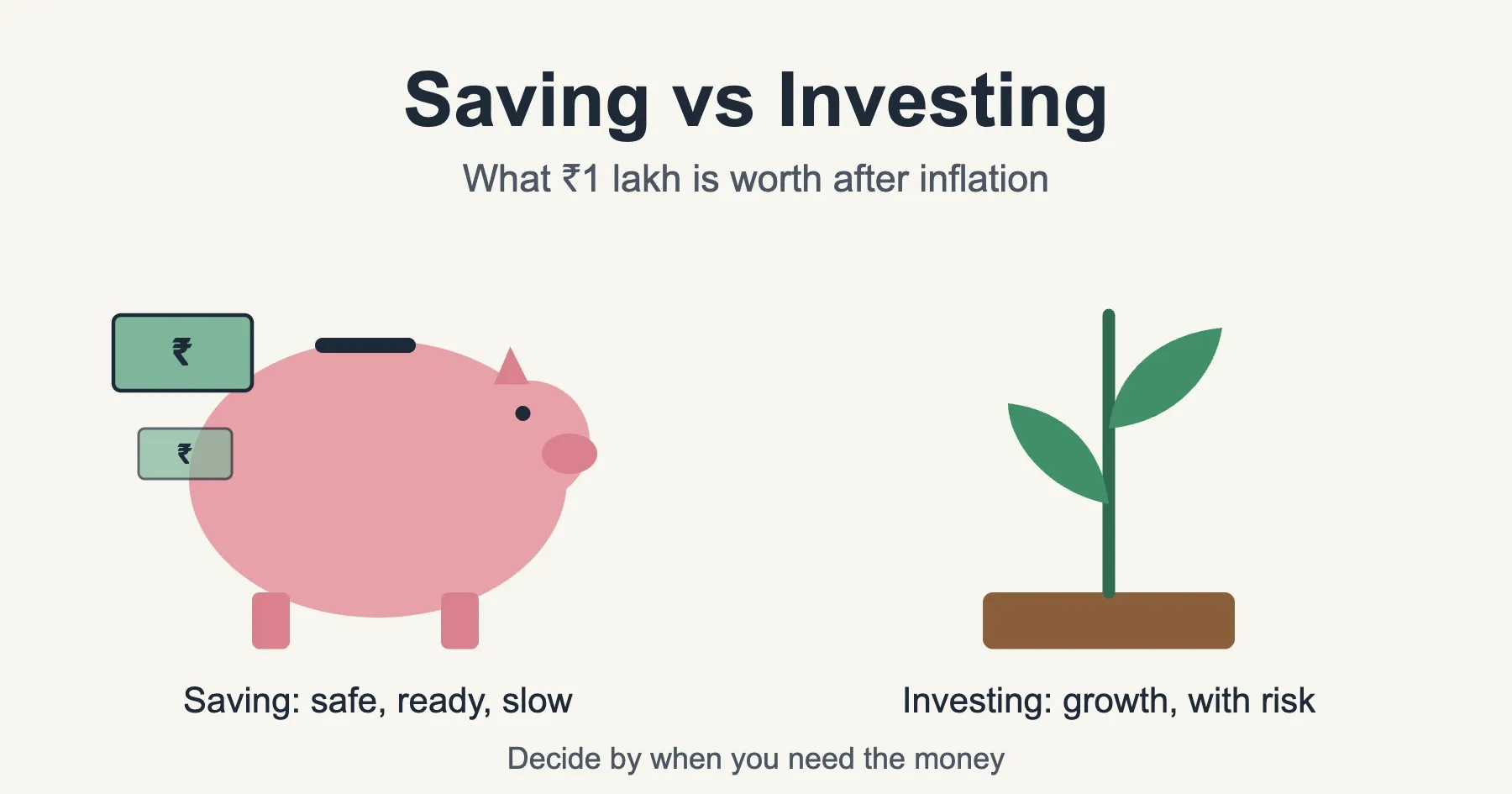
Start with what each rupee does. A rupee used to prepay a loan at 15% stops costing you 15% a year on that rupee for as long as it would have stayed outstanding. That saving is certain: it does not depend on markets.
A rupee put into an equity mutual fund SIP may grow or shrink. Equity fund returns are not assured, and over one or two years they can be negative. A long-run average you may have seen is not a rate any fund promises.
Two more things make the loan side stronger than its headline rate suggests:
- It's already after tax. Interest on a personal loan taken for personal spending generally gets no tax deduction, so a 15% saving is roughly a 15% after-tax saving (rules as of 17 November 2026; check your own case). A fund's gain, by contrast, may be taxed when you redeem. Tax rules change; consult a tax professional for your situation.
- It has no bad year. The loan saving does not depend on timing. An investment return does.
So the question is not "is 15% more than what funds have averaged?" It is "am I comfortable swapping a certain saving for a return that might be higher, lower or negative?"
Is it better to use my bonus to prepay a loan or invest it?
Here is a worked example. All figures are hypothetical.
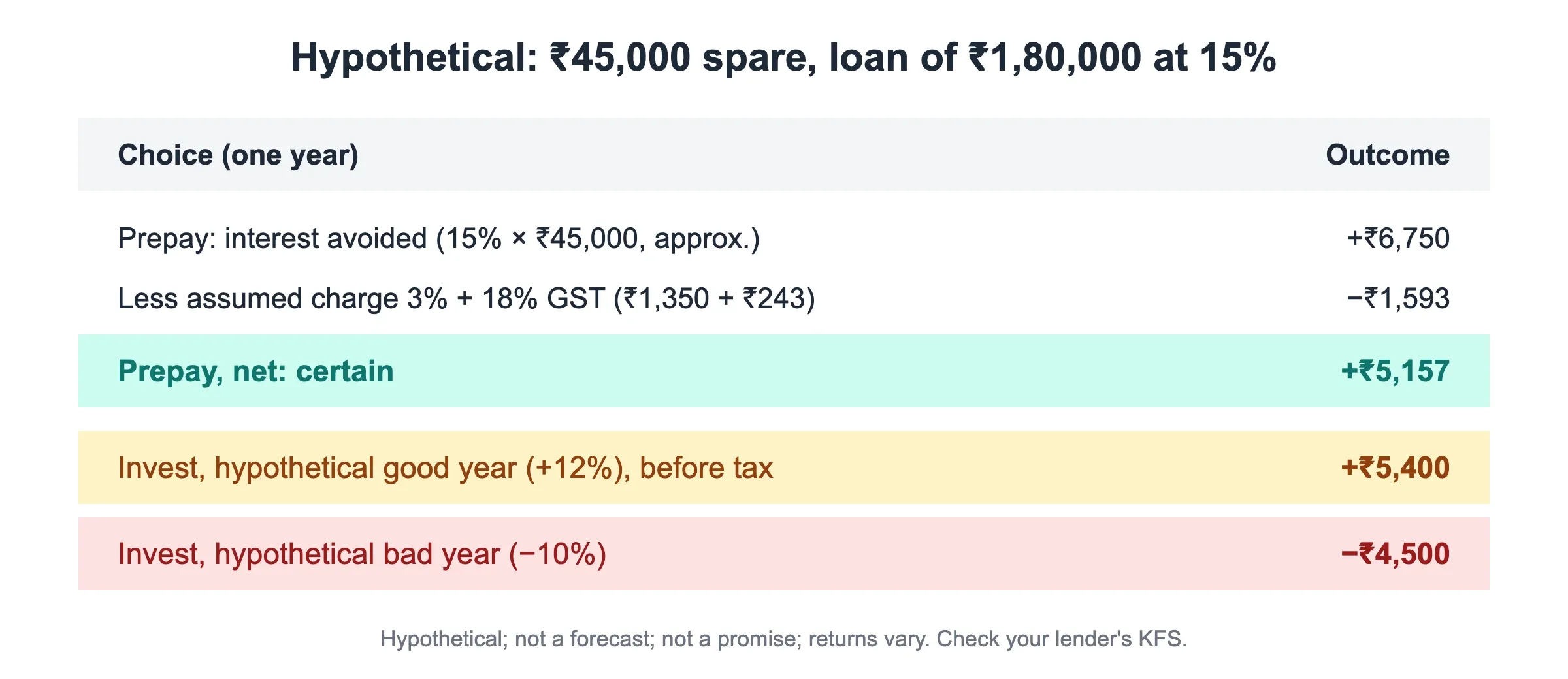
Say ₹1,80,000 is outstanding on a personal loan at 15% a year, with 24 monthly EMIs of about ₹8,728 left, and you have ₹45,000 spare from a bonus.
Rough one-year view of prepaying ₹45,000:
- Interest avoided in a year, if that ₹45,000 would otherwise have stayed outstanding: 15% × ₹45,000 ≈ ₹6,750 (approximate; real loans reduce the balance each month).
- Prepayment charge, assumed at 3%: ₹1,350, plus 18% GST on the charge: ₹243. Total: ₹1,593.
- Net saving ≈ ₹5,157, which is certain. That is about 11.5% of ₹45,000 in the first year.
Investing the same ₹45,000 instead, for one year:
- In a hypothetical +12% year: about +₹5,400 before tax.
- In a hypothetical −10% year: about −₹4,500.
Hypothetical; not a forecast; not a promise; returns vary. Check your own lender's Key Facts Statement.
| One year, ₹45,000 | Outcome |
|---|---|
| Prepay (net of assumed charge) | ≈ +₹5,157, certain |
| Invest, hypothetical good year (+12%) | ≈ +₹5,400, before tax |
| Invest, hypothetical bad year (−10%) | ≈ −₹4,500 |
Reduce your EMI or your tenure?
When you part-prepay, many lenders let you either keep the EMI and finish sooner, or keep the end date and pay a smaller EMI. Using the same hypothetical loan, computed month by month:
- Keep the EMI (₹8,728), cut the tenure: the loan ends in about 18 months instead of 24. Total remaining interest falls from about ₹29,462 to ₹15,970, a saving of about ₹13,493 (about ₹11,900 after the assumed ₹1,593 charge).
- Keep the tenure, cut the EMI: the EMI drops to about ₹6,546, freeing about ₹2,182 a month. Total remaining interest falls to about ₹22,097, a saving of about ₹7,366 (about ₹5,773 after the charge).
Cutting tenure saves more interest. Cutting the EMI frees monthly cash, which some people then use to start or raise an SIP. Which matters more depends on your monthly budget.
What loan interest rate makes prepayment the better choice?
There is no single cut-off rate that fits everyone, because the answer depends on your charges, tax and horizon. Use this checklist instead:
- Find your real rate. Your Key Facts Statement (KFS) shows the Annual Percentage Rate (APR), which RBI defines as the annual cost of credit including interest and all other charges. Compare using the APR, not the advertised rate.
- Find the prepayment charge. RBI's Pre-payment Charges on Loans Directions, 2025 (2 July 2025) say regulated lenders cannot charge for part or full prepayment of floating-rate loans to individuals for non-business purposes, for loans sanctioned or renewed on or after 1 January 2026, with no minimum lock-in. Older floating-rate loans were covered by earlier RBI circulars on the same subject, so check your own loan papers. Many personal loans are fixed-rate, and for those the lender's own policy applies. Either way, the charge must be disclosed in the sanction letter, loan agreement and KFS, and an undisclosed charge cannot be levied.
- Compare after charges and tax. The net certain saving (here about 11.5% in year one) is the number an investment would have to beat, after its own costs and tax, over the time the loan would have run, bad years included.
- Check your horizon. Money needed within a few years is a weak fit for equity in any case.
- Check your sleep test. If a loan EMI worries you every month, the certain saving has a value that a spreadsheet does not show.
As the loan rate rises, prepaying looks more compelling. As it falls, and as your horizon lengthens, the case for investing alongside becomes easier to weigh. Neither path is right for everyone.
Should I build an emergency fund before prepaying?
Usually people do, and here is why. Money you prepay is gone: you cannot take it back from the lender if your job or health changes next month. If you then need cash, the fallback may be a new loan or a credit card, often at a higher rate than the loan you just cut.
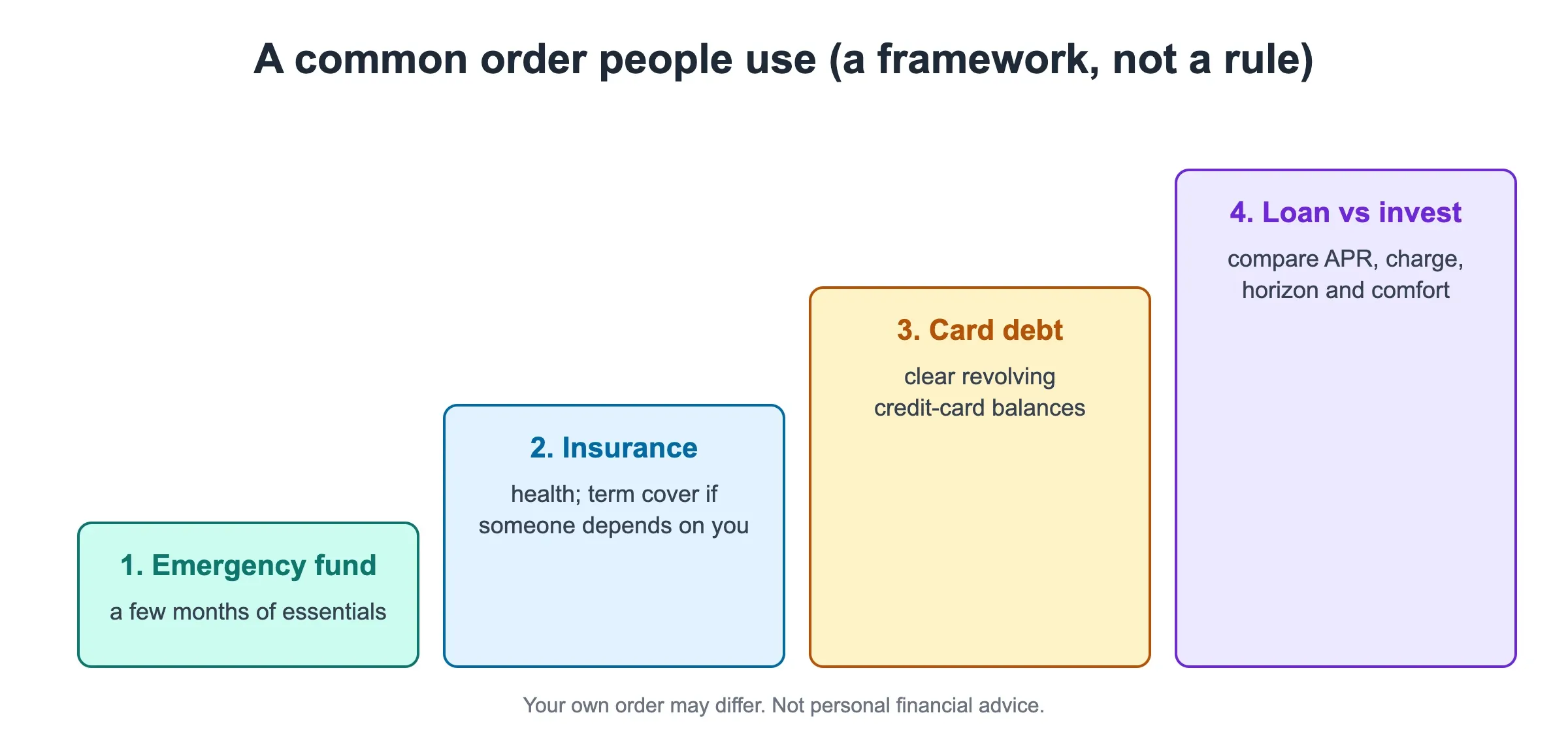
A common order that people use, a framework rather than a rule:
- An emergency fund of a few months of essential expenses.
- Health and, if anyone depends on your income, term insurance.
- Clear revolving credit-card debt.
- Then weigh the remaining loan against investing.
Can I do both: part-prepay and start a small SIP?
Yes. A split can look like this: keep the emergency fund intact, part-prepay some of the spare money, and start a small SIP from the EMI you save or from regular salary. This gets the certain saving on part of the money while you build the habit of investing.
If you already have an SIP running, stopping it to prepay is a separate choice. Pausing and stopping work differently; see the guide linked below before you change a mandate.