Investment Options in India for Beginners: Nine Choices Compared by Risk, Access, Lock-In and Tax
Nine common investment options in India compared on risk, access, lock-in and tax, with the same ₹1 lakh traced through five of them.
Summarize this article with AI





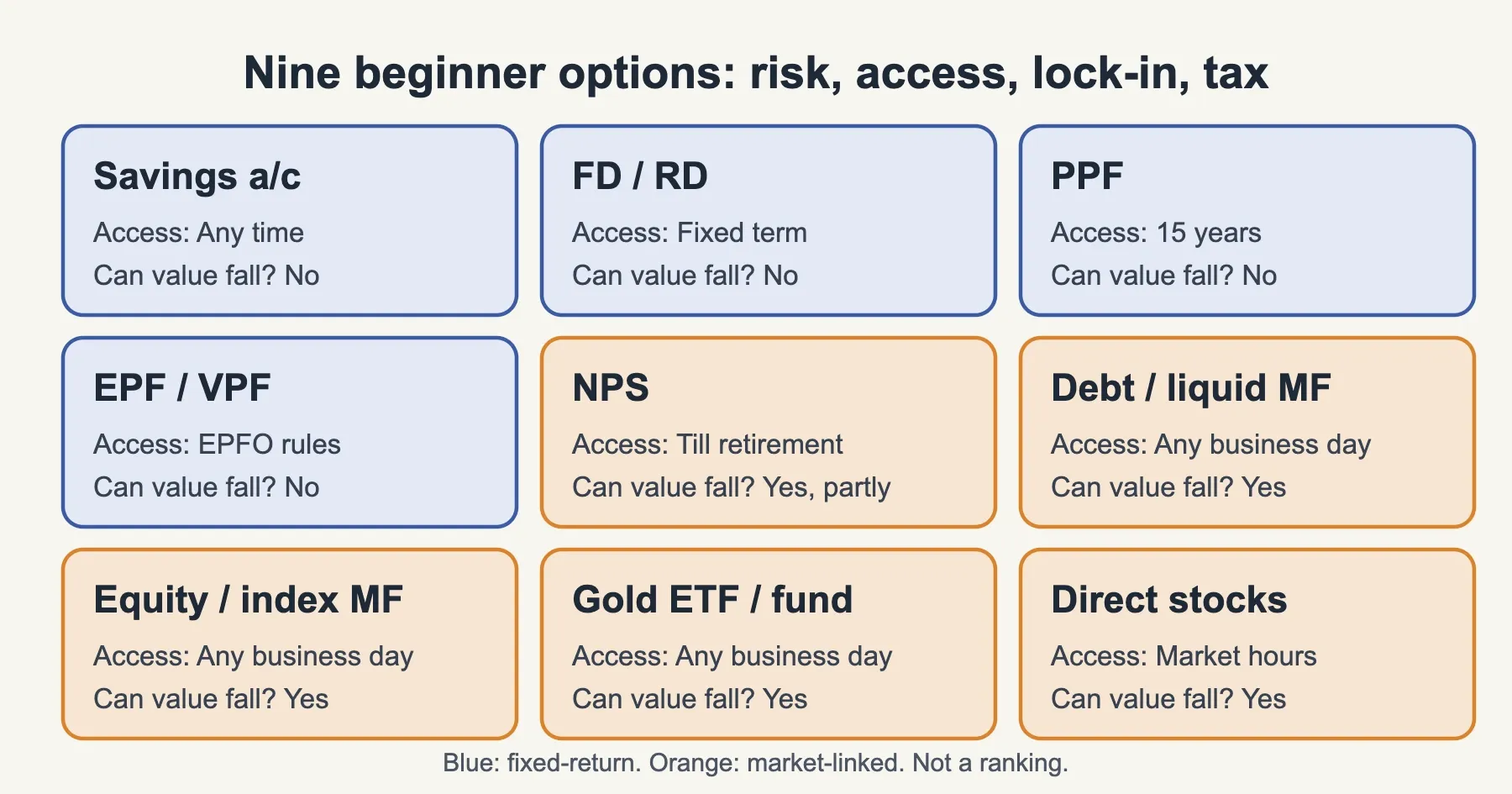
The short version
- Beginner options split into fixed-return (savings account, FD/RD, PPF, EPF/VPF) and market-linked (mutual funds, gold ETFs and funds, stocks, NPS in part).
- Compare any option on four questions: can the value fall, who backs it, how fast you can get money out, and how the gain is taxed.
- DICGC insures bank deposits up to ₹5 lakh per depositor per bank; market-linked products, including debt funds, can lose value.
- In the hypothetical ₹1 lakh example, fixed options land in a narrow band, while equity ranges from a ₹20,000 loss at one year to a wide spread at seven years.
- Emergency fund first; money needed within about three years and money for five years or more face different trade-offs.
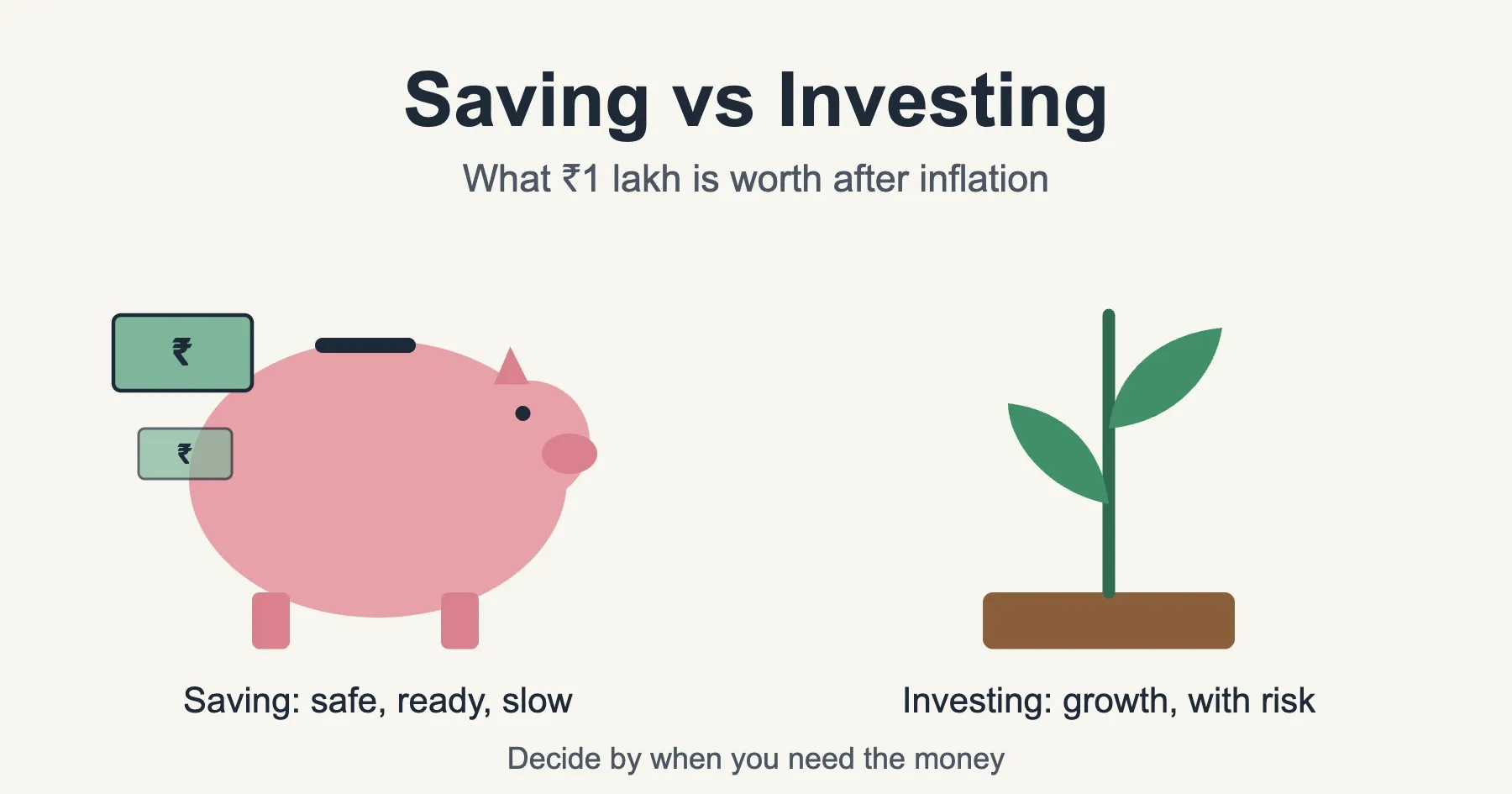
The common investment options in India for beginners fall into two groups: fixed-return options (savings account, bank FD and RD, PPF, EPF/VPF) and market-linked options (debt and equity mutual funds, gold ETFs and funds, direct stocks, and NPS, which is partly market-linked). Fixed-return options give certainty but bring lock-ins or taxable interest; market-linked options can fall in value and have historically been used for longer horizons. Compare them on risk, access, lock-in and tax rather than on past returns.
Nandini, 24, works in Jaipur and has ₹1,00,000 in a savings account. Every list she finds is a ranking or a sales page. This page is a map, not a recommendation: nine options side by side.
Four questions to ask of any option
- Can the value fall? A deposit balance does not; a NAV or share price can.
- Who stands behind it? A bank, a government scheme, a SEBI-regulated fund or one company.
- How fast can I get money out? In days, or only after years.
- How is the gain taxed? Interest at your slab rate; equity gains at their own rates under the Income-tax Act, 2025.
The nine options in one table
| Option | Backer / regulator | Can value fall? | Access / lock-in | Minimum | Tax on returns |
|---|---|---|---|---|---|
| 1. Savings account (baseline) | Bank; DICGC cover up to ₹5 lakh per depositor per bank | No (inflation still erodes it) | Any time | Bank sets it | Slab rate |
| 2. Bank FD / RD | Bank; same DICGC cover | No, if held to maturity | Fixed term; early exit costs extra | Bank sets it | Slab rate; TDS may apply |
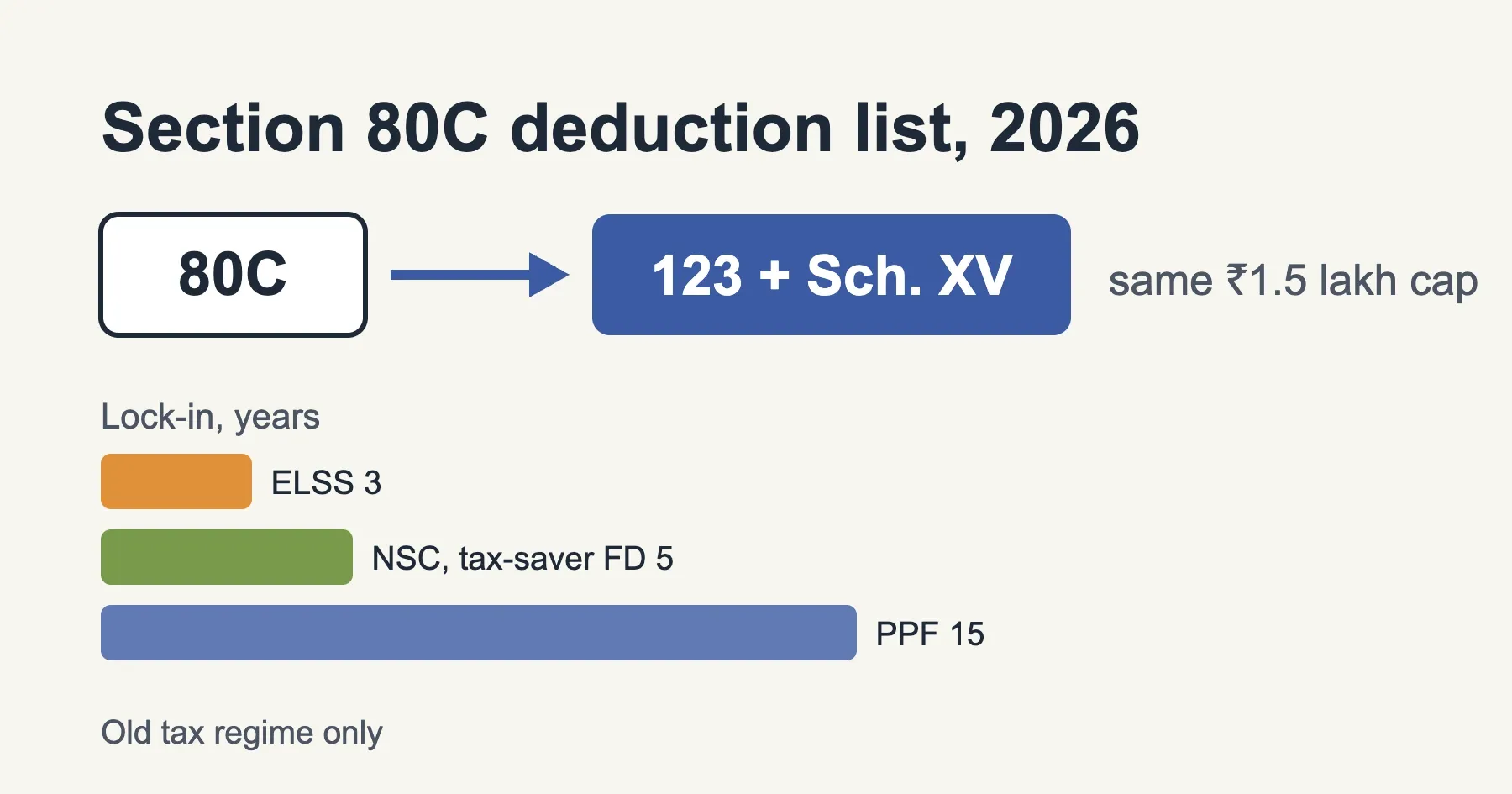
| 3. Public Provident Fund (PPF) | Government small savings scheme | No; rate reset quarterly (7.1% for Oct to Dec 2026) | 15 years; early access restricted | Scheme rules | Deposits count towards the ₹1.5 lakh deduction (section 123, old regime) |
| 4. EPF / VPF | EPFO, via employer | No market price | Withdrawal only on EPFO conditions | Employee share: 12% of wages | Depends on contributions and timing |
| 5. National Pension System (NPS) | PFRDA | Yes, partly | Mostly locked till retirement | PFRDA sets it | Own rules |
| 6. Debt / liquid mutual fund | SEBI; no guarantee | Yes, usually less than equity | Any business day | Scheme sets it | Slab rate for units bought from 1 April 2023 (section 76) |
| 7. Equity / index fund via SIP | SEBI; no guarantee | Yes, sharply in the short term | Any business day (ELSS has a lock-in) | Scheme sets it | ≤12 months: 20% (section 196); longer: 12.5% above ₹1.25 lakh a year (section 198) |
| 8. Gold ETF / gold fund | SEBI | Yes, with gold | ETF on exchange (demat); fund via fund house | One unit / scheme minimum | Short-term at slab; long-term 12.5% (section 197) |
| 9. Direct stocks | SEBI; demat with NSDL or CDSL | Yes; one company can fall far | Exchange, market hours | One share plus charges | As equity funds: 20% / 12.5% above ₹1.25 lakh |
Also available: government securities via RBI Retail Direct. The RBI account is free; minimum bid ₹10,000; interest taxed at slab rate; the price can fall if rates rise and you sell before maturity.
Fixed-return options
Bank FD and RD
The Deposit Insurance and Credit Guarantee Corporation (DICGC) insures each depositor up to ₹5,00,000 per bank, principal and interest together, including savings, fixed and recurring deposits. Interest is taxed at your slab rate and banks can deduct TDS. Breaking an FD early usually costs you a lower rate or a penalty. For a goal-date comparison, see SIP vs FD vs RD.
Public Provident Fund (PPF)
A government-backed small savings scheme with a 15-year account. The rate is reset every quarter; for October to December 2026 it is 7.1% a year. Loans and partial withdrawals open up only after set periods under the scheme rules, which is the trade-off for certainty. See what a PPF account is and PPF vs SIP.
EPF and VPF
If you are salaried, you and your employer each contribute 12% of wages to the Employees' Provident Fund, run by EPFO. VPF is a voluntary top-up to the same account. If it is on your payslip, count it; see how to check your PF balance.
Market-linked options
Debt and liquid mutual funds
These hold bonds and money market instruments. Value can fall when interest rates rise or a borrower defaults; liquid funds usually move less. For a fund with more than 65% in debt and money market instruments, gains on units bought on or after 1 April 2023 are treated as short-term and taxed at your slab rate (section 76, Income-tax Act, 2025), however long you hold. More in equity vs debt mutual funds.
Equity and index mutual funds via SIP
An SIP buys units at a set interval, often monthly, at that day's NAV. SEBI states that mutual funds do not guarantee returns or capital, so check the risk level in the scheme documents. Gains on units held 12 months or less are taxed at 20% (section 196); after that, gains above ₹1.25 lakh a year are taxed at 12.5% (section 198).
Gold ETFs and gold funds
Both follow the gold price. An ETF trades on the exchange and needs a demat account; a gold fund is bought from the fund house. See gold ETF vs gold mutual fund.
Direct stocks
You need a demat and a trading account. One company carries risks a fund spreads out. Torn between the two? See mutual funds vs stocks for beginners.
National Pension System (NPS)
A retirement account regulated by the Pension Fund Regulatory and Development Authority (PFRDA); its value moves with markets. Exits follow PFRDA's exit regulations.
Worked example: the same ₹1 lakh in five places, after 1 year and 7 years
Hypothetical: Nandini puts ₹1,00,000 in one place at a time. Every rate is an assumption for illustration, not a forecast.
| Option (assumed rate) | After 1 year | After 7 years | Out at 1 year? |
|---|---|---|---|
| Savings account, 2.5% | ₹1,02,500 | ₹1,18,869 | Yes |
| Bank FD, 7% compounded quarterly | ₹1,07,186 | ₹1,62,541 | Yes, at a cost |
| PPF, 7.1% held constant | ₹1,07,100 | ₹1,61,632 | No |
| Liquid / debt fund, 6.5% | ₹1,06,500 | ₹1,55,399 | Yes, at that day's NAV |
| Equity index fund | −20%: ₹80,000 / 0%: ₹1,00,000 / +12%: ₹1,12,000 | 4% a year: ₹1,31,593 / 8%: ₹1,71,382 / 12%: ₹2,21,068 | Yes, at that day's value |
Before tax. At a hypothetical 10% slab plus 4% cess, year-one tax is about ₹747 on the FD's ₹7,186 interest and ₹676 on the liquid fund's ₹6,500 gain. If the equity fund rose 12% and Nandini sold within the year, 20% on the ₹12,000 gain is ₹2,400. Each 7-year equity gain is under ₹1.25 lakh, so it falls within the yearly exemption if she has no other equity gains that year. PPF assumes one early-year deposit and an unchanged rate, which is unlikely.
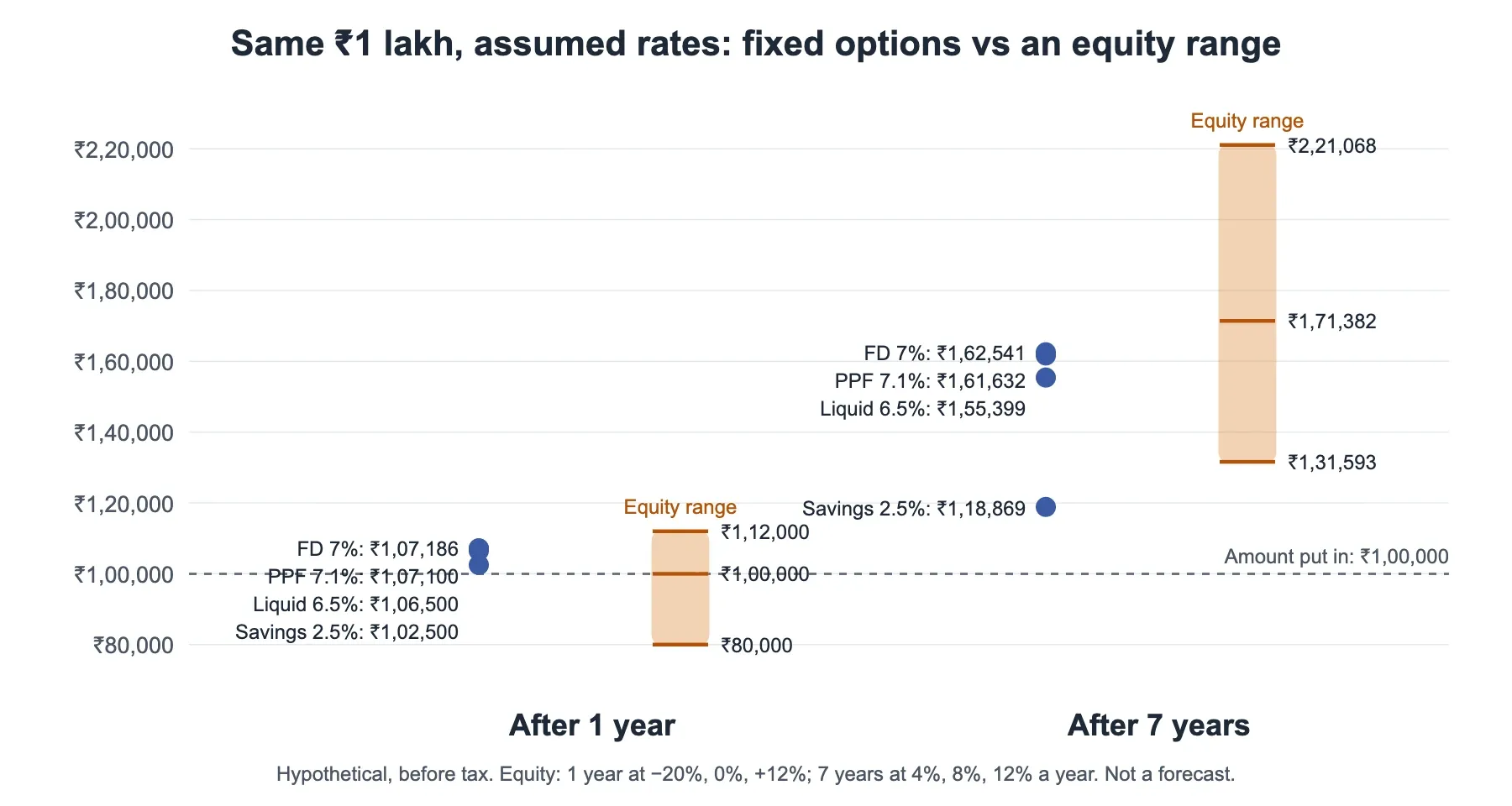
The fixed options land in a narrow band. Equity's one-year range includes a ₹20,000 loss, and its seven-year range is wide in both directions.
What doesn't belong on a beginner's first list
Unregulated deposit schemes, messaging-app tips promising fixed high returns, and futures and options trading are not starting points. Check that anyone advising you is registered with SEBI.
How to use the table
Factors to weigh, not a recommendation:
- Emergency fund first. It needs to be instantly available and stable. See how much emergency fund you need.
- Needed within about three years? Options whose value does not fall, or falls little, and that you can access on time, fit that need.
- Not needed for five years or more? Market-linked options can be considered, if you could sit through a −20% year without selling.
Frequently asked questions
What are the investment options in India for beginners?
Fixed-return options (savings account, FD and RD, PPF, EPF/VPF) and market-linked ones (mutual funds, gold ETFs and funds, stocks, and NPS in part). Compare them on risk, backer, access, lock-in and tax.
Where should a beginner invest ₹1 lakh in India?
This page does not recommend one place. Start with when you need the money and whether you can accept a fall. In the hypothetical above, fixed options land near ₹1.02 lakh to ₹1.07 lakh after a year; equity from ₹80,000 up.
Which investments in India have no risk of losing money?
None is free of every risk. Bank deposits are insured by DICGC up to ₹5 lakh per depositor per bank; PPF is government-backed. Market-linked products, including debt funds, can lose value.
Which investments have a lock-in period?
PPF runs 15 years with restricted early access. NPS keeps most money until retirement under PFRDA rules. Tax-saving ELSS funds and tax-saver deposits carry lock-ins stated in their documents. FDs can be broken early at a cost.
Do I need a demat account to invest?
Only for some options. Direct stocks and gold ETFs need a demat and trading account; mutual funds, PPF, FDs and NPS do not.
Learn more
Save this table; small savings rates are reset each quarter. For a step-by-step start, see how to start investing in India.