How to Make a Will in India: Writing, Witnessing and Registering It, and Why Your Nominee Isn't Your Heir
Write it, sign it before two witnesses, register it if you wish. Probate is no longer compulsory, and your nominee isn't automatically your heir.
Summarize this article with AI





The short version
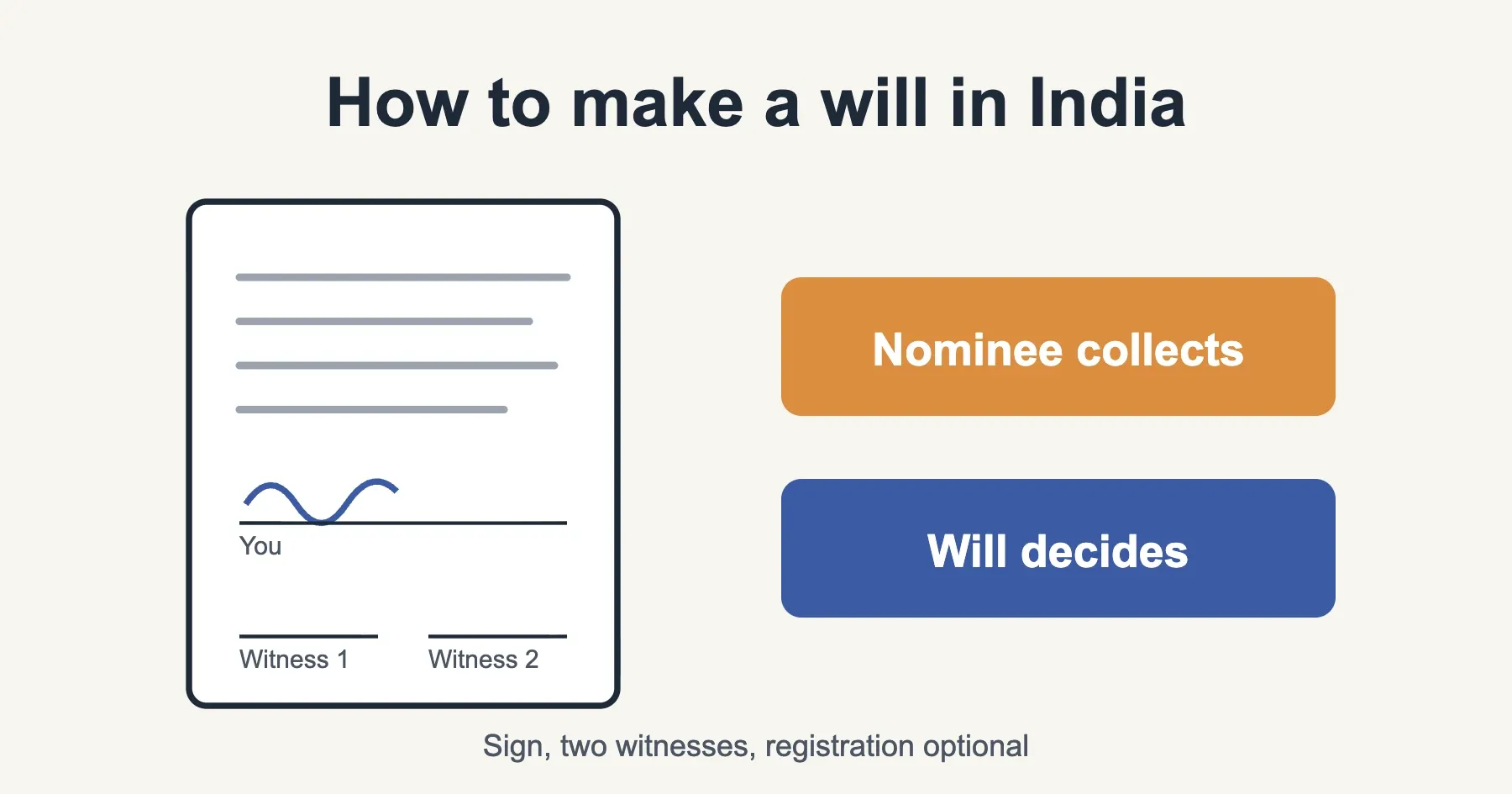
- A valid will needs your signature and two witnesses who sign in your presence (section 63, Indian Succession Act).
- Registration is optional (section 18, Registration Act); it adds evidence, not validity.
- From 20 December 2025, probate is no longer compulsory; it can still be sought.
- A nominee collects your mutual fund units or shares as a trustee for your legal heirs; the will decides who owns them.
- Keep nominations consistent with your will, and review both after major life events.
To make a will in India, write down who gets what, sign it, and have two witnesses sign it in your presence; that is what section 63 of the Indian Succession Act, 1925 requires. Registration is optional under section 18 of the Registration Act, 1908. Probate is also no longer compulsory anywhere in India, because section 213 of the Succession Act was omitted with effect from 20 December 2025.
One more thing most people miss: the nominee on your mutual fund folio or demat account is not automatically the person who inherits it. A nominee collects the assets; your will (or, without one, succession law) decides who owns them.
Harish, 34, works in Mysuru. He has mutual fund folios, a demat account and a bank FD, with nominees added years ago, and assumed that settled everything. It doesn't.
Who can make a will, and what it can cover
Section 59 of the Indian Succession Act says that every person of sound mind who is not a minor may dispose of their property by will. The Act's explanations make two practical points: being deaf, mute or blind does not stop someone from making a will, and a person who is ordinarily of unsound mind may make one during an interval when they are of sound mind.
A will can cover property you own: mutual fund units, shares, bank deposits, a flat in your name, jewellery, a car.
Succession rules also differ by personal law (broadly, by religion) and, in places, by state. If your family follows a personal law with its own limits on what can be left by will, or you hold ancestral or jointly owned property, ask a lawyer what applies before you write.
How to make a will, step by step
1. List what you own and what you owe
Identify each asset precisely: folio numbers, your demat account's DP and client ID, bank and FD numbers, property addresses, policy numbers. Add loans.
2. Name your beneficiaries and their shares
Say who gets what, in percentages or by asset, with an alternate for each person. Vague phrases such as "my investments to my family" invite arguments.
3. Appoint an executor
The executor is the person who carries out your will. Pick someone you trust, and ask them first.
4. Write it clearly
Nothing in section 63 asks for stamp paper or a lawyer's letterhead. Typed or handwritten both work. Date it, give your full name and address, and state that it revokes any earlier will.
5. Sign it in front of two witnesses
You sign (or put your mark) at the end, and at least two witnesses sign in your presence, as section 63 requires. Choose adult witnesses who get nothing under the will. Under section 67, if a witness is also a beneficiary, the will stays valid, but the gift to that witness is void.
6. Optional: register it, or deposit it
You can register the will with the Sub-Registrar; section 27 of the Registration Act allows this at any time. Section 42 also lets you deposit it with a Registrar in a sealed cover. Some people add a doctor's note on their fitness that day, or a video of the signing. None of this is compulsory, and registration fees vary by state.
7. Store it, tell your executor, and review it
Keep the original somewhere safe and tell your executor where. Review it after marriage, a child's birth or a large purchase. Under section 69, marriage revokes an earlier will, though section 57 excludes wills made by Hindus, Buddhists, Sikhs and Jains from that rule, and section 58 leaves Muslim wills to personal law. Either way, a will written before your marriage probably no longer says what you want.
Will vs nominee: who gets what
In its investor service FAQs, SEBI says a nominee is merely a trustee, limited to collecting the assets of the deceased and transferring them to the legal heirs. It cites a Supreme Court order of 14 December 2023 and says SEBI's 2025 nomination circulars put the same position into the nomination forms for demat accounts and mutual fund folios.
Here is Harish's situation. All figures are hypothetical, and values are held constant for simplicity.
| Asset | Value | Nominee on record | Will says (50:50 wife and daughter) |
|---|---|---|---|
| Mutual fund folios | ₹6,00,000 | His mother | Wife ₹3,00,000, daughter ₹3,00,000 |
| Demat holdings | ₹4,00,000 | His wife | Wife ₹2,00,000, daughter ₹2,00,000 |
| Bank FD | ₹3,00,000 | His wife | Wife ₹1,50,000, daughter ₹1,50,000 |
| Total | ₹13,00,000 | Mother ₹6,00,000, wife ₹7,00,000, daughter ₹0 | Wife ₹6,50,000, daughter ₹6,50,000 |
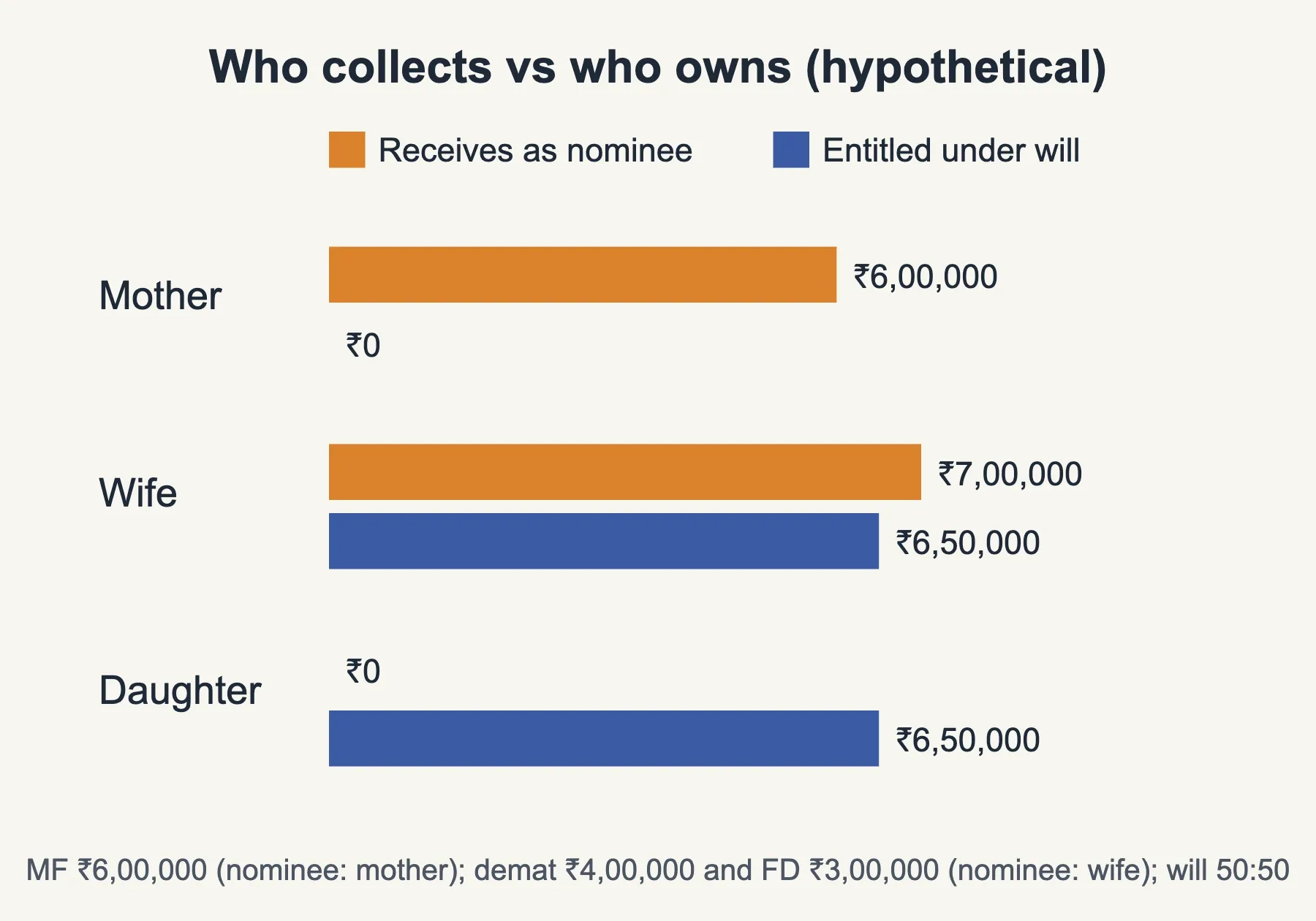
If Harish dies, the folios pass to his mother as nominee, and the demat holdings and the FD go to his wife. His mother receives ₹6,00,000 she is not entitled to under the will, and she would be expected to pass it on: ₹3,00,000 to his wife and ₹3,00,000 to his daughter. His wife receives ₹7,00,000 but is entitled to ₹6,50,000, so ₹3,50,000 of what she collects belongs to their daughter. His daughter receives nothing directly.
The law ends in the right place, but only after extra paperwork and goodwill. The bank FD follows the bank's own nomination and claim process, so ask your bank how it handles a claim when a will exists.
The fix is simple: make the nominations match the will. If you want the daughter to receive her share directly, you can nominate both and set percentages. If a nominee is a minor, the form asks for extra details, including their date of birth. See adding a mutual fund nominee and adding a demat nominee; for what the family does afterwards, see claiming mutual funds after a death.
Probate in 2026: what changed
Section 213 of the Indian Succession Act, which barred an executor or legatee from establishing rights under certain wills in court without probate, has been omitted by Act 37 of 2025 (the Repealing and Amending Act, 2025), with effect from 20 December 2025. The requirement had mainly affected wills covering immovable property in Mumbai, Chennai and Kolkata.
Probate is a court's certificate that a will is genuine and that the executor may act on it. What changed is that it is no longer a legal precondition. Probate still exists: an executor can still apply for it, and a family facing a dispute may want it. How the change applies to cases already pending is a question for a lawyer.
Registered vs unregistered will
| Unregistered will | Registered will | |
|---|---|---|
| Valid? | Yes, if signed and witnessed under section 63 | Yes, on the same conditions |
| Proof if challenged | Witnesses may need to confirm it | Registration record supports it, though it can still be challenged |
| Cost | Paper and your time | State registration fee and a visit to the Sub-Registrar |
| Privacy | Only you know the contents | Registered with an official office |
| Changing it | Make a new will, signed and witnessed the same way | Same; a later valid will can replace a registered one |
Registration adds evidence, not validity.
Common mistakes
- Unsigned changes. Handwritten edits after signing can be disputed. Make a fresh will instead.
- A beneficiary as witness. Their gift fails under section 67.
- Outdated nominations. A nominee from ten years ago may no longer match your will. Check both together.
- Vague asset descriptions. "My shares" is weaker than naming the DP, client ID and folio numbers.
Frequently asked questions
How do I make a valid will in India?
Write who gets what, sign it, and have at least two witnesses sign it in your presence (section 63, Indian Succession Act). You must be an adult of sound mind. Registration is optional.
Is it mandatory to register a will in India?
No. Section 18 of the Registration Act, 1908 lists wills among documents whose registration is optional. Registering one at the Sub-Registrar adds evidence of its existence and signing, but an unregistered, properly witnessed will is equally valid.
Is probate still mandatory in Mumbai, Chennai and Kolkata?
No. Section 213 of the Indian Succession Act, which created that requirement, was omitted by the Repealing and Amending Act, 2025 (Act 37 of 2025), with effect from 20 December 2025. Executors can still choose to apply for probate.
Does a nominee get ownership of my mutual funds or shares?
Not by default. SEBI's investor service FAQs say a nominee is a trustee who collects the assets and transfers them to the legal heirs, citing a Supreme Court order of 14 December 2023. Your will, or succession law, decides ownership.
What happens if I die without a will in India?
Your assets pass to your legal heirs under the succession law that applies to you, which usually depends on your religion. Your heirs may need more documents to claim them.
Save this checklist
Save this page and list your folios, demat account and FDs next to their nominees before you write your will. For what a demat account holds, see what is a demat account.