How to Manage a ₹50,000 Salary: Three Budgets for Three Living Situations, Starting From What Reaches Your Account
Budget a ₹50,000 salary from in-hand pay, count your EPF, and see three budgets (parents, metro flat, sending money home) with emergency fund timelines.
Summarize this article with AI





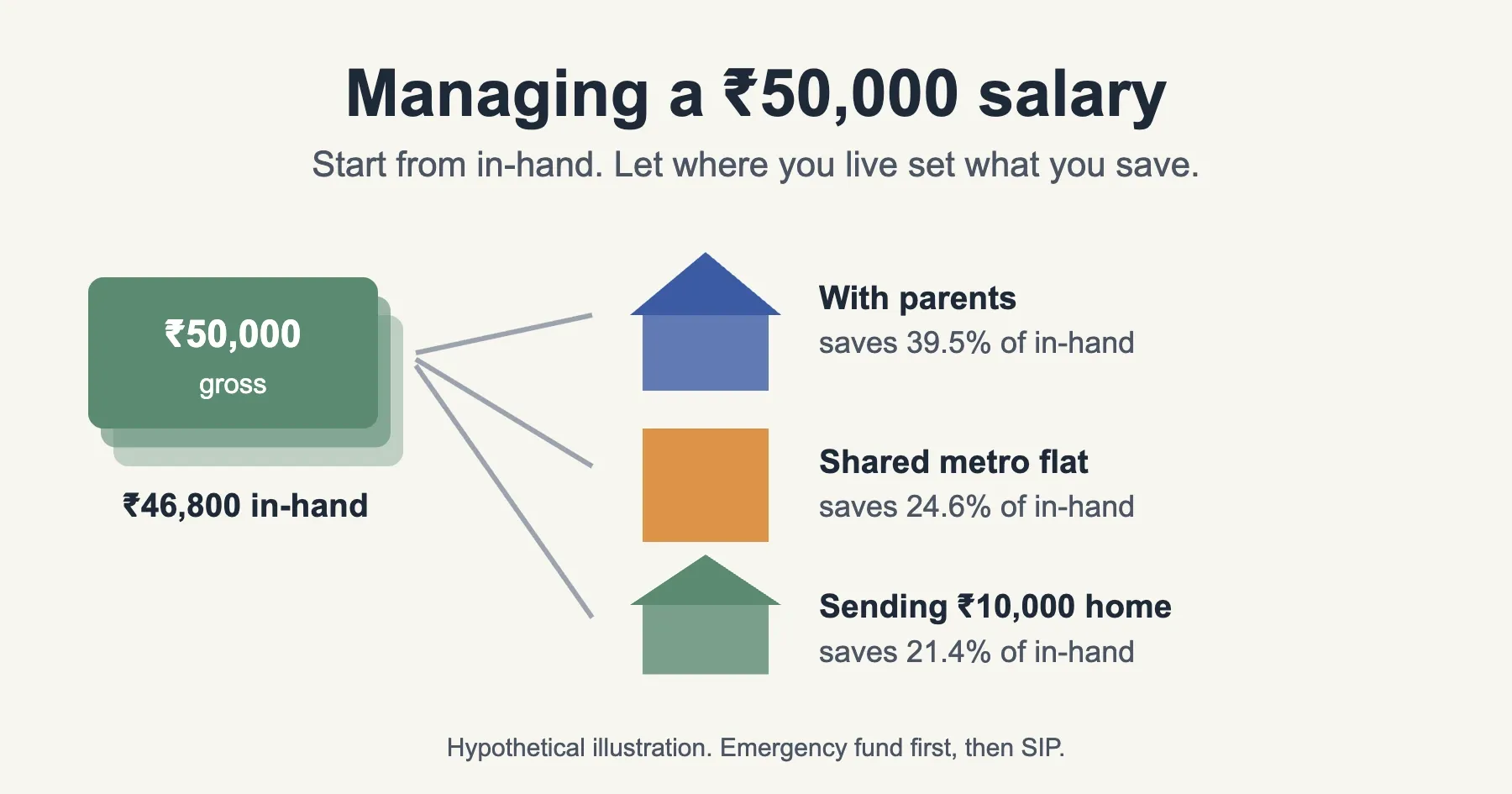
The short version
- Budget from in-hand pay, not the gross or CTC figure on your offer letter.
- At ₹6 lakh a year of salary alone, income tax under the new regime is nil after the section 156 rebate.
- EPF already saves ₹6,000 a month in this example; count it, but keep it out of your emergency fund.
- Your rent and family commitments set your savings rate: about 21% to 40% of in-hand in our three budgets.
- Fill the emergency fund first, run a smaller SIP alongside it, then move the full savings to goals.
The way to manage a ₹50,000 salary per month is to budget from the amount that actually reaches your bank account, count the EPF already deducted from your pay as saving, and let your rent and family commitments decide how much more you can save. In the three hypothetical budgets below, that works out to saving about 21% to 40% of in-hand pay. Put most of your savings into an emergency fund first, with a smaller SIP alongside, then move the full amount to goals.
Irfan, 26, works in Pune. His offer letter says ₹6 lakh a year, so he expected ₹50,000 a month, but the credit on salary day is smaller. His colleague, who lives with his parents, saves far more. Irfan is probably doing nothing wrong: one rule applied to a headline number, such as the 50/30/20 rule, cannot account for different rents. The steps below can.
In this guide, in-hand pay means the amount credited to your bank account after every payslip deduction.
Step 1: Is your ₹50,000 gross or in-hand?
Most offer letters quote gross or CTC (see CTC vs in-hand salary). Here is a hypothetical ₹50,000 gross salary, assuming basic pay of ₹25,000 and salary as your only income:
| Payslip line | Per month | Per year |
|---|---|---|
| Gross salary | ₹50,000 | ₹6,00,000 |
| Your EPF contribution (12% of assumed basic) | -₹3,000 | -₹36,000 |
| Professional tax (assumed; varies by state) | -₹200 | -₹2,400 |
| Income tax (new regime) | ₹0 | ₹0 |
| In-hand pay | ₹46,800 | ₹5,61,600 |
Why the income tax line is zero. Under the Income-tax Act, 2025, the new tax regime in section 202 applies by default unless you opt out. Its slabs tax the first ₹4 lakh of total income at nil and the next ₹4 lakh at 5%. Even on the full ₹6 lakh, before any deduction, that is ₹10,000. Section 156(2) gives a resident individual taxed under this regime a rebate of the full tax, up to ₹60,000, when total income does not exceed ₹12 lakh. So at ₹6 lakh a year, income tax payable is nil. If you have other income, such as interest, it is added to your total income.
Professional tax is a state levy. Its amount, and whether it applies at all, depends on where you work, so read the figure on your own payslip.
If ₹50,000 is already your in-hand pay, or your PF deduction differs, use your payslip figures; employers structure salaries differently.
Step 2: Count what you already save
Under the EPF scheme, you and your employer each contribute 12% of wages. The statutory wage ceiling rose from ₹15,000 to ₹25,000 a month from 17 September 2026, so with a ₹25,000 basic the full 12% on both sides falls within it. Of the employer's ₹3,000, 8.33% of wages (about ₹2,083) goes to the Employees' Pension Scheme (EPS) and the rest (about ₹917) to your EPF account. In all, ₹6,000 a month, or ₹72,000 a year, is set aside for retirement before you budget a single rupee.
So you are not starting from zero. But EPF is retirement money, not your buffer: withdrawals come with conditions, so keep it out of your emergency-fund maths.
To see it, register on the EPFO Member Portal with the UAN printed on your payslip and download your e-passbook; our guide on how to check your PF balance walks through it.
Step 3: Pick the budget that matches how you live
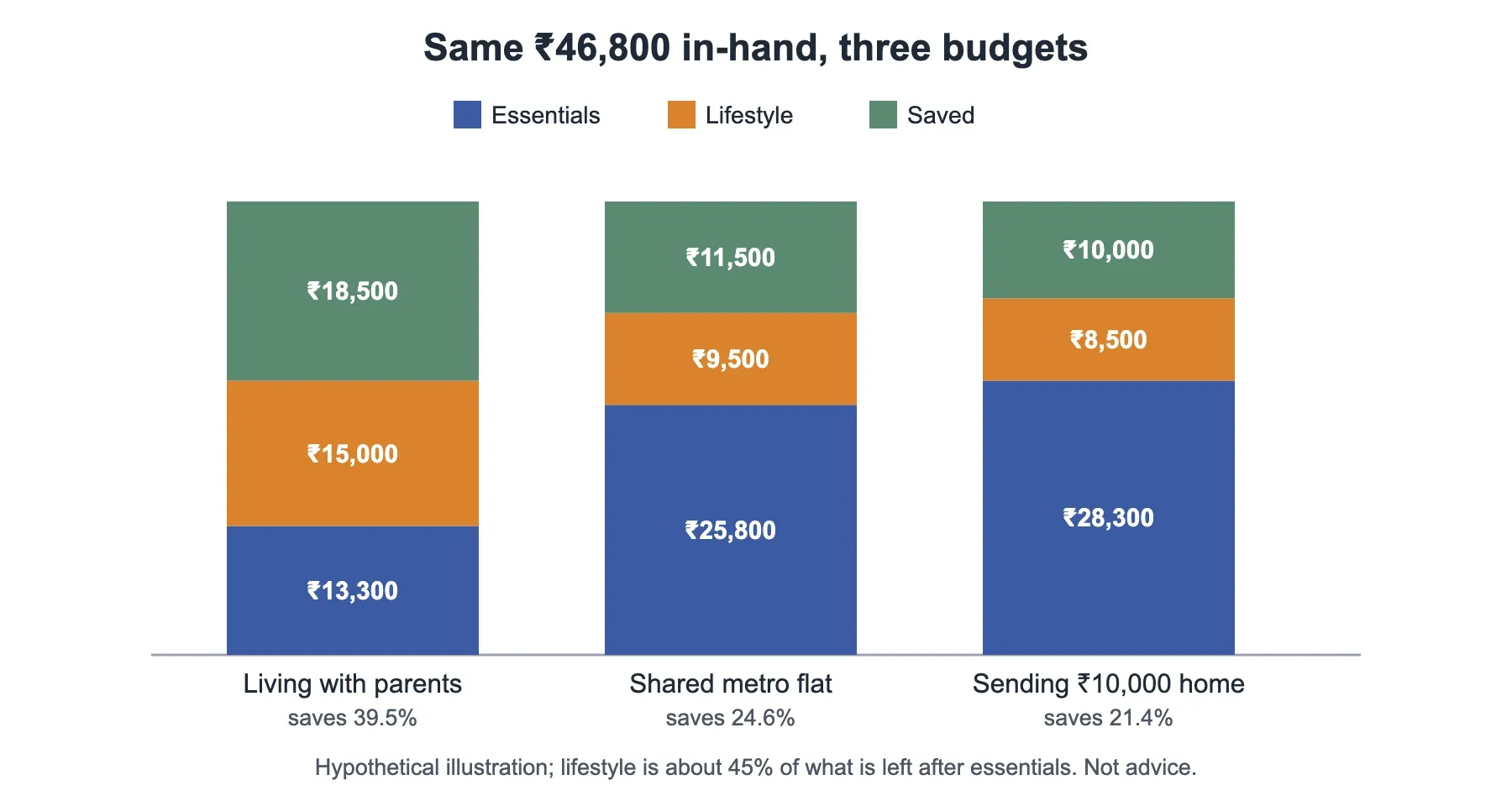
Each budget below uses the same method on ₹46,800 in-hand:
- Essentials first: rent or household contribution, food, transport, phone, a health insurance premium and any money sent home.
- Lifestyle next: about 45% of whatever is left, for eating out, shopping, trips and subscriptions.
- Saved: the rest.
| Setup (hypothetical) | Essentials | Lifestyle | Saved | Saved % of in-hand |
|---|---|---|---|---|
| Living with parents | ₹13,300 | ₹15,000 | ₹18,500 | 39.5% |
| Shared flat in a metro | ₹25,800 | ₹9,500 | ₹11,500 | 24.6% |
| Sending ₹10,000 home | ₹28,300 | ₹8,500 | ₹10,000 | 21.4% |
Living with parents
Essentials: ₹8,000 to the household, ₹3,000 transport, ₹800 phone, ₹1,500 insurance. With ₹33,500 left, saving about 40% is realistic. The risk is spending it because you can; low fixed costs make this the cheapest time to build a buffer.
Renting a shared flat in a metro
Essentials: ₹15,000 rent share, ₹6,000 food, ₹2,500 transport, ₹800 phone, ₹1,500 insurance. Rent decides this budget: a flatmate or a flat further out moves your savings more than skipping coffee does.
Sending money home every month
Essentials: ₹10,000 home, ₹9,000 rent, ₹5,000 food, ₹2,000 transport, ₹800 phone, ₹1,500 insurance. Pay the money home on salary day, as a fixed bill, so it never competes with lifestyle spending. Saving about 21% while supporting family is solid progress.
Swap in your own figures; the method is what carries over.
Step 4: Emergency fund first, then SIP
An emergency fund pays for essentials if your income stops. Here the target is six months of essentials, and about 60% of monthly savings goes to it until it is full, with the rest going to an SIP:
| Setup (hypothetical) | Emergency fund target | To fund each month | SIP each month | Months to fill |
|---|---|---|---|---|
| Living with parents | ₹79,800 | ₹11,000 | ₹7,500 | 8 |
| Shared flat in a metro | ₹1,54,800 | ₹7,000 | ₹4,500 | 23 |
| Sending ₹10,000 home | ₹1,69,800 | ₹6,000 | ₹4,000 | 29 |
Once the fund is full, the whole saved amount can go towards goals. In these examples it takes 8 to 29 months, so a slow build-up is normal at this salary. Six months is one choice; our guide on how much emergency fund you need helps you pick your own number and where to keep it.
Without a buffer, the first surprise bill may force you to stop the SIP or redeem at a bad time. For how much to start with and how to set it up, see how much SIP to start with your first salary. No return rate is assumed on this page.
Step 5: Protection basics
- Health cover. Group health cover from an employer is usually linked to the job. Each budget above includes ₹1,500 a month (₹18,000 a year) for a personal health policy as a hypothetical figure; your premium depends on your age, cover and city. Compare the cover amount, waiting periods and exclusions, not only the price.
- Term cover. Life cover protects people who depend on your income, such as parents relying on the ₹10,000 you send. If no one depends on you yet, it can usually wait.
What to do when your salary rises
Raise your SIP before your lifestyle catches up: decide what share of the increment goes to the SIP before the first higher salary is credited. Our step-up SIP post shows how to size it.
Three mistakes at this salary
- EMI creep. An EMI is a new essential. In the metro budget, an ₹8,000 phone or bike EMI paid out of savings would cut ₹11,500 to ₹3,500 a month.
- No buffer. Investing everything means one medical bill can undo months of discipline.
- Treating a bonus as income. A one-off bonus can fill the emergency fund faster; building monthly spending around it creates a gap next year.
Frequently asked questions
How should I manage a ₹50,000 monthly salary?
Start from in-hand pay, cover essentials, cap lifestyle spending and save the rest. Put most savings into an emergency fund until it covers about six months of essentials, with a smaller SIP alongside. Our hypothetical budgets save 21% to 40% of in-hand.
How much can I save from a ₹50,000 salary?
It depends mainly on rent and family support. In our hypothetical examples on ₹46,800 in-hand, someone living with parents saves ₹18,500 a month, someone in a shared metro flat ₹11,500, and someone sending ₹10,000 home ₹10,000. EPF adds another ₹6,000 a month on top.
What is the in-hand salary on ₹50,000 gross?
With an assumed basic of ₹25,000, EPF takes ₹3,000 and professional tax (assumed) ₹200, leaving about ₹46,800. Income tax is nil under the new regime if salary is your only income.
How much should I invest in SIP on a ₹50,000 salary?
There is no single right amount. In our examples, an SIP of ₹4,000 to ₹7,500 runs while the emergency fund fills; after that, the full saved amount can go to goals.
Do I pay income tax on a ₹50,000 monthly salary?
For tax year 2026-27 under the Income-tax Act, 2025: no, if ₹6 lakh of salary is your total income and you are a resident under the default new regime. The slab tax works out to ₹10,000 at most, and the section 156 rebate of up to ₹60,000 brings it to nil.
Save this checklist
- Find your in-hand figure on last month's payslip.
- Open your EPF e-passbook and note the monthly credit.
- List your essentials and pick the budget closest to how you live.
- Set your emergency fund target and the date it fills.
- Fix your SIP amount and the date it will rise.