Saving vs Investing: What ₹1 Lakh Is Worth After 5 and 10 Years of Inflation, and How to Decide Which Money Goes Where
What ₹1 lakh is worth after 5 and 10 years at 6% inflation, and a simple test to decide which money to save and which to invest.
Summarize this article with AI





The short version
- Saving protects rupees and access; investing seeks growth and accepts the chance of loss.
- At an assumed 6% inflation, ₹1 lakh in cash buys about ₹55,800 worth after 10 years.
- A savings account at an assumed 3% slows the loss (about ₹75,300 in today's money) but doesn't stop it.
- Over five years, one −20% year can wipe out nearly all the extra return over savings; ten years gives more room to recover, with no guarantee.
- Decide by deadline: under 3 years, save; 5 years and more, investing can be considered.
Saving keeps money safe and ready to use, but it usually grows more slowly than prices. Investing can grow faster than inflation over long periods, but it can lose value, especially over short ones. So in the saving vs investing question, neither is better in general: decide by when you will need each rupee.
Shalini, 23, has been working in Coimbatore for eight months, and ₹1,00,000 now sits in her savings account. Her friends say the money "should be working"; her parents say it is "safe in the bank". Both are partly right.
Saving and investing in one line each
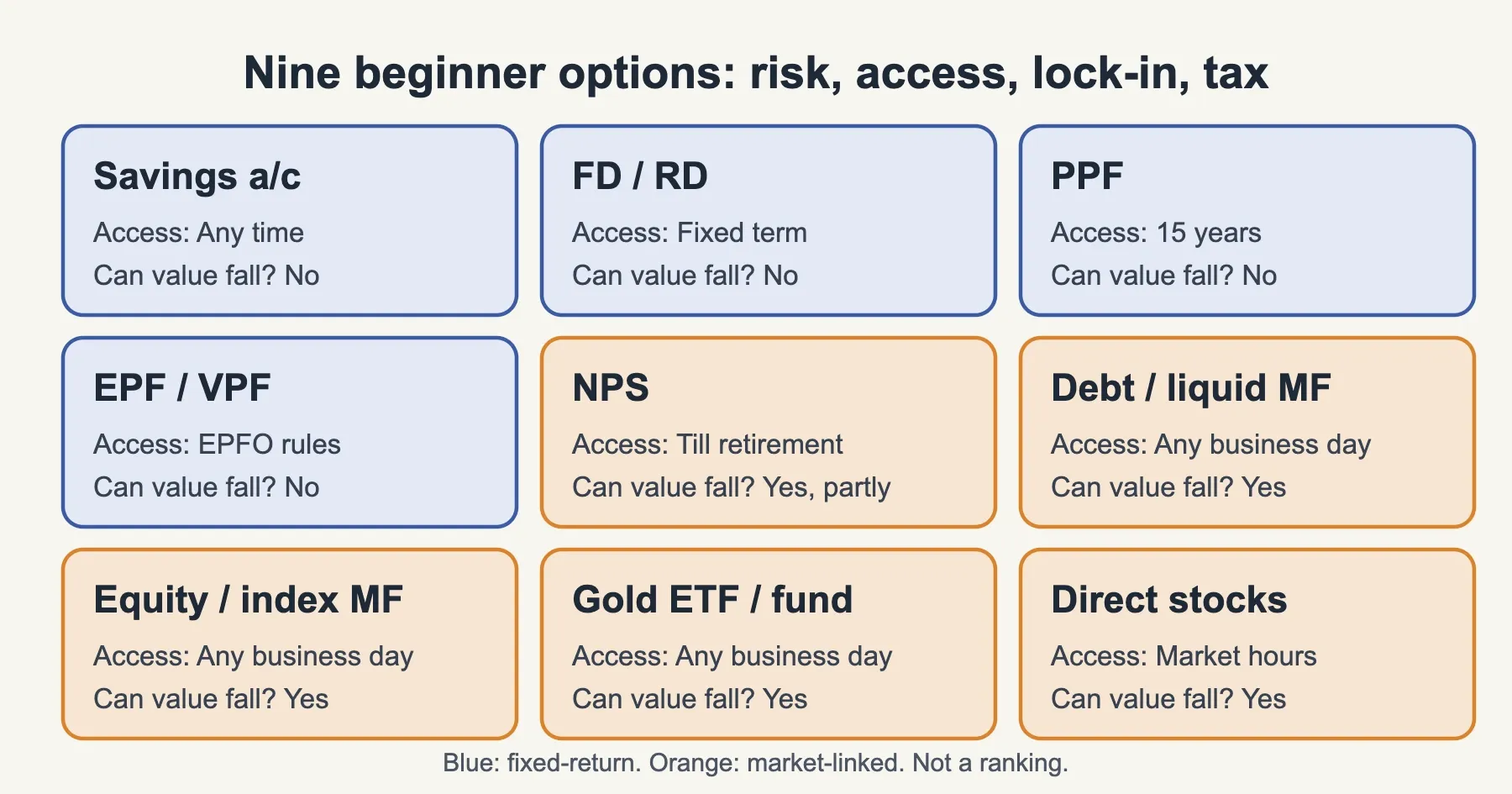
Saving is setting money aside where its value in rupees stays put and you can reach it quickly: cash, a savings account, a fixed or recurring deposit.
Investing is putting money into assets whose value can rise or fall, such as shares or mutual funds, in exchange for the chance of higher growth over time.
| Saving | Investing | |
|---|---|---|
| Purpose | Safety and access | Growth over time |
| Risk | Rupee value stays put; inflation slowly eats it | Value can fall, sometimes sharply, before it recovers (or doesn't) |
| Access | Same day for a savings account; fixed term for deposits | Varies by product; selling during a fall locks in the loss |
| Typical places | Savings account, fixed deposit, recurring deposit | Shares, mutual funds (equity, debt, hybrid) |
| Protection | Bank deposits insured by DICGC up to a limit | Regulated by SEBI, but no guarantee of returns or capital |
| What inflation does | Reduces what the money can buy | Growth may stay ahead of it over long periods; not guaranteed |
What inflation does to money that sits still
India's all-India CPI inflation for October 2026 was 6.09% (provisional), according to the Ministry of Statistics and Programme Implementation (MoSPI) release of 12 November 2026; food inflation was 8.94%. One month's figure is not a forecast, so this page uses a round 6% a year, assumed, to show the effect.
Here is Shalini's ₹1,00,000 followed down five paths. "Today's money" means what the amount could buy in today's prices.
| Path (hypothetical) | Value after 5 yrs | In today's money | Value after 10 yrs | In today's money |
|---|---|---|---|---|
| Cash at home (0%) | ₹1,00,000 | ₹74,726 | ₹1,00,000 | ₹55,839 |
| Savings account, 3% | ₹1,16,118 | ₹86,770 | ₹1,34,835 | ₹75,291 |
| Savings, 3%, interest taxed at an assumed 20% | ₹1,12,709 | ₹84,223 | ₹1,27,034 | ₹70,935 |
| Hypothetical investment, 10% every year | ₹1,61,051 | ₹1,20,347 | ₹2,59,374 | ₹1,44,833 |
| Same, with one −20% year | ₹1,17,128 | ₹87,525 | ₹1,88,636 | ₹1,05,333 |
How we calculated: ₹1,00,000 today; inflation 6% a year (assumed); savings interest 3% a year credited quarterly (assumed; actual rates vary by bank); the investment path is an assumed 10% a year, illustrative only and not a forecast; before costs and, except in row 3, before tax. Today's money = value ÷ 1.06 raised to the number of years.
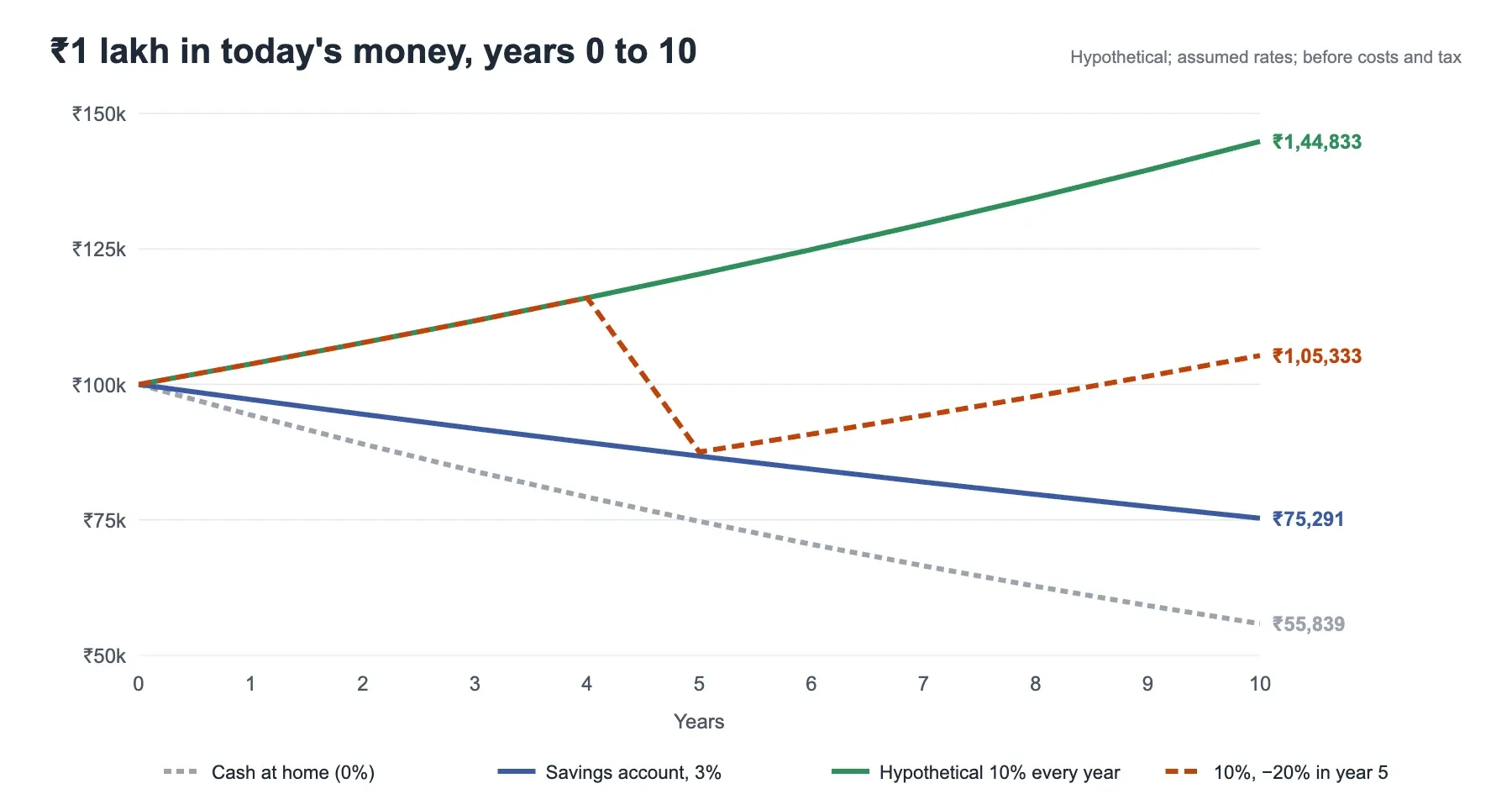
At these assumptions, cash at home buys about ₹55,800 worth of today's goods after 10 years. The savings account slows the loss, leaving about ₹75,300, but does not stop it.
Why "safe" and "keeps its value" are not the same thing
A savings account is safe in rupees: ₹1,00,000 stays ₹1,00,000 plus interest. It is not safe in purchasing power when interest is below inflation. Tax widens the gap. Savings interest is added to your income and taxed at your slab rate. Under the old tax regime, section 153 of the Income-tax Act, 2025 allows a deduction of up to ₹10,000 a year of savings-account interest for individuals who are not senior citizens. Under the new regime, which applies unless you opt out, section 202 does not allow this deduction. Row 3 shows what an assumed 20% tax rate does: about ₹70,900 in today's money after 10 years.
What investing adds, and what it risks
At an assumed 10% every year, the same ₹1,00,000 grows to ₹2,59,374, about ₹1,44,800 in today's money: growth that can stay ahead of prices over long periods.
But returns do not arrive evenly. SEBI's FAQ for mutual fund investors says investors are offered neither guaranteed returns nor a guarantee on repayment of capital. So add one bad year, a fall of 20%, to the hypothetical path:
- After 5 years: ₹1,17,128, or ₹87,525 in today's money. That is roughly level with the savings account (₹86,770).
- After 10 years: ₹1,88,636, or ₹1,05,333 in today's money. Still ahead of the savings account at these assumptions, because there were more years to recover.
For a lump sum, the timing of the bad year does not change the end value: a −20% year first or last both give ₹1,17,128 after 5 years. What matters is whether you are forced to sell during the fall. Real markets can also have more than one bad year. See is SIP risk free? for what can go wrong in an SIP.
The "money's job" test: decide by when you need it
Before asking "save or invest?", give each rupee a job and a date.
| When you need it | Its job | Kind of place people commonly consider |
|---|---|---|
| Under 1 year | Bills, emergencies, a planned purchase | Savings account, short fixed deposit |
| 1 to 3 years | A known expense: course fees, a bike, a wedding contribution | Fixed or recurring deposits, other fixed-return options |
| 3 to 5 years | A goal with some flexibility on date | Mostly fixed-return options; any market-linked portion sized for a fall |
| 5 years and more | Long goals: a home down payment, retirement | Market-linked investments can be considered, accepting falls on the way |
SEBI's mutual fund FAQ describes growth schemes as suited to investors with a long-term outlook. The table follows the same logic: the shorter the deadline, the less room to wait out a fall. For a product-level comparison, see SIP vs FD vs RD.
Order of operations: savings first, then investing
- Emergency fund first. Keep several months of essential expenses in savings-type places. Our guide on how much emergency fund you need shows how to count them.
- Short goals next. Money needed within about three years stays in savings-type options.
- Then invest what can wait. Only money with a five-year-plus job goes into market-linked investments, after reading the scheme documents. If you are starting out, see how to start investing in India.
How each is protected
Bank deposits. The Deposit Insurance and Credit Guarantee Corporation (DICGC), a subsidiary of the Reserve Bank of India, insures savings, fixed, current and recurring deposits up to ₹5,00,000 per depositor per bank, principal and interest together. Deposits at different branches of the same bank are added together. Check DICGC's site for the current limit before relying on it.
RBI's 2025 directions on deposit interest say savings interest is calculated on a daily product basis (the end-of-day balance) and credited at quarterly or shorter intervals. Your bank's rate is set under its own board-approved policy.
Investments. SEBI regulates mutual funds and the securities markets, but regulation is not a guarantee. Market value can fall, and nothing insures you against that loss. To see how inflation affects investment returns, read SIP returns after inflation.
Frequently asked questions
What is the difference between saving and investing?
Saving keeps money safe in rupees and easy to reach; investing puts it into assets that can grow faster but can also fall. Use saving for money you need soon and investing for money that can wait five years or more.
Which is better, saving or investing?
Neither, in general. It depends on when you need the money. For under three years, savings-type options usually fit; for five years and more, market-linked investments can be considered, accepting that they can fall.
Does money in a savings account lose value?
Its rupee value doesn't fall, but its buying power can. At an assumed 3% interest and 6% inflation, ₹1,00,000 grows to ₹1,34,835 in 10 years, worth about ₹75,291 in today's money (hypothetical).
Can investing lose money?
Yes. SEBI states that mutual fund investors get no guarantee of returns or capital. In our hypothetical, one −20% year left ₹1 lakh worth ₹87,525 in today's money after 5 years, about level with a savings account.
Is money in a bank account insured?
Yes, up to a limit. DICGC insures savings, fixed, current and recurring deposits up to ₹5,00,000 per depositor per bank, principal and interest together.
Save this test
Write down each pot of money, its job and its date. Anything needed within three years stays in savings; only money that can wait five years or more is a candidate for investing.