Missed the ITR Deadline? The Late Fee, the Interest and the 31 December 2026 Cut-Off for a Belated Return
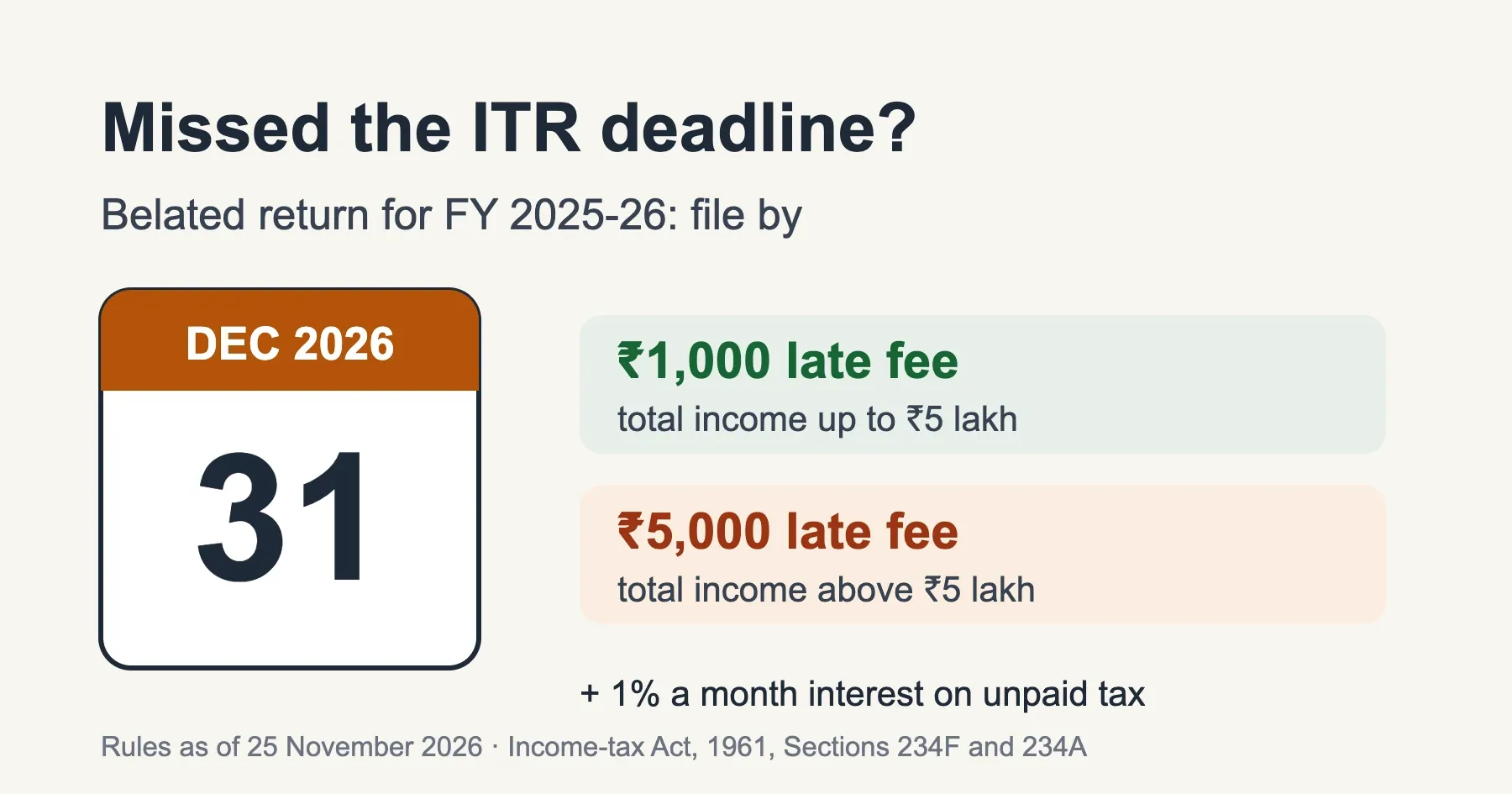
Missed the ITR due date? File a belated return by 31 Dec 2026. Late fee ₹1,000 or ₹5,000, 1% a month interest on unpaid tax. Worked examples inside.
Summarize this article with AI





The short version
- You can file a belated return for FY 2025-26 (AY 2026-27) until 31 December 2026, as of 25 November 2026.
- The Section 234F late fee is ₹1,000 if total income is up to ₹5 lakh and ₹5,000 above that; it does not depend on tax due.
- Section 234A interest is 1% a month or part month on unpaid tax only; if all tax was paid by the due date, there is none.
- A belated filer should expect the new tax regime, and capital or business losses generally cannot be carried forward.
- After 31 December, only an updated return remains, and it cannot raise a refund.
As of 25 November 2026, if you missed your income tax return (ITR) due date for FY 2025-26 (AY 2026-27), you can still file a belated return until 31 December 2026 under the Income-tax Act, 1961. The penalty for late filing ITR is a fixed late fee under Section 234F: ₹1,000 if your total income is up to ₹5 lakh, ₹5,000 if it is higher. If any tax is still unpaid, interest under Section 234A adds 1% for every month or part of a month after the due date.
That leaves about five weeks. The fee depends on your total income, not the tax you owe, so salaried people with zero tax after rebate are often surprised by it. The less visible costs are the regime choice and, for some, losses that cannot be carried forward.
What a belated return is, and who actually owes the late fee
A belated return is a return filed after the due date in Section 139(1) but within the window in Section 139(4). The e-filing portal says a belated return for AY 2026-27 "may be furnished on or before 31st December 2026", or before the assessment is completed, whichever is earlier.
The due date you missed depends on your return form. For AY 2026-27, the e-filing portal lists 31 July 2026 for most individuals (ITR-1 and ITR-2) and 31 August 2026 for non-audit cases, which covers ITR-3 and ITR-4 filers with business or professional income that needs no audit. The CBDT extended the date this year only for audit cases (to 21 November 2026); as of 25 November 2026 there is no extension for these filers.
"Required to file" is the trigger, not "tax payable"
The Income Tax Department's note on interest and fees says the Section 234F fee applies to a person required to file under Section 139(1) who misses the due date. There is no fee if you were not required to file at all.
The requirement to file is linked to your total income before the rebate. Under the new regime for FY 2025-26, the basic exemption limit is ₹4 lakh, while the Section 87A rebate of up to ₹60,000 wipes out the tax when taxable income is up to ₹12 lakh. So someone earning ₹8 or ₹10 lakh can owe zero tax and still be required to file. There are other filing triggers too; the e-filing portal lists them.
The fee is based on total income, not tax due
The fee has two levels and no link to your tax: ₹1,000 where total income does not exceed ₹5 lakh, ₹5,000 in all other cases. The department's note also says the CBDT may issue orders waiving the fee, so check the portal for any notice before you pay.
The three costs of filing late
1. The late fee (Section 234F)
A flat ₹1,000 or ₹5,000, paid before you file. It applies even if TDS covered all your tax.
2. Interest on unpaid tax (Section 234A)
Interest is simple interest at 1% for every month or part of a month, counted from the day after the due date to the day you file. It is charged on the tax still unpaid after TDS, advance tax and any self-assessment tax paid by the due date. The tax figure is rounded down to the nearest ₹100, and the interest itself is rounded to the nearest ₹10. If all your tax was paid by the due date, a late return attracts no Section 234A interest (Circular No. 2/2015).
If you also had income without TDS, such as freelance fees, interest for missed advance tax under Sections 234B and 234C may apply as well.
3. What you lose: regime choice and some losses
Regime choice. The new regime is the default. The portal's page for salaried individuals says the old regime can be chosen in the ITR when the return is filed "on or before the due date specified under section 139(1)". A belated return misses that condition, so a salaried filer without business income should expect to be taxed under the new regime. Rules differ for people with business or professional income; check the portal.
Losses. The portal states that filing a loss return by the due date is a condition for carrying forward business and capital-gains losses, and that the new Act "retains" this condition (Section 121 of the Income-tax Act, 2025). So if you sold shares or mutual fund units at a loss in FY 2025-26, expect a belated return not to carry that loss forward, and confirm with a tax professional. Under the new regime, a house-property loss cannot be set off or carried forward in any case.
Worked example: two people, same 22 December filing date
Both examples are hypothetical, using the FY 2025-26 new-regime slabs, rebate and 4% cess from the e-filing portal. Each files on 22 December 2026.
- Devika, 27, salaried in Kochi, total income ₹8,65,000. Return form ITR-1, due 31 July 2026.
- Farhan, 31, salary plus freelance design work in Indore, total income ₹16,40,000. Because of the freelance income he files ITR-3 or ITR-4, due 31 August 2026.
| Devika (salary only) | Farhan (salary + freelance) | |
|---|---|---|
| Total income | ₹8,65,000 | ₹16,40,000 |
| Slab tax before rebate | ₹26,500 | ₹1,28,000 |
| Tax after rebate + 4% cess | ₹0 (rebate up to ₹60,000) | ₹1,33,120 |
| TDS already deducted | ₹0 | ₹1,09,670 |
| Unpaid tax | ₹0 | ₹23,450 |
| Late fee (Section 234F) | ₹5,000 (income above ₹5 lakh) | ₹5,000 |
| Interest (Section 234A): 1% × 4 months on ₹23,400 | ₹0 | ₹940 |
| Extra cost of filing late | ₹5,000 | ₹5,940, plus any 234B/234C interest (not computed) |
Devika's ₹5,000 is the surprise: zero tax, still a fee. If her total income had been ₹4,80,000, the tax would also be zero after rebate and the fee would be ₹1,000.
Farhan's interest runs for four months (September, October, November and part of December) because his due date was 31 August. Had he been an ITR-2 filer with a 31 July due date, the same unpaid tax would carry five months of interest, ₹1,170. Altogether he pays ₹29,390 before filing: ₹23,450 of tax he owed anyway plus ₹5,940 for being late.
Timeline: what you can still do, by date
| Date | What applies |
|---|---|
| 31 July 2026 (passed) | Due date for ITR-1 and ITR-2 filers |
| 31 August 2026 (passed) | Due date for non-audit cases, as listed on the e-filing portal |
| Now to 31 December 2026 | File a belated return under Section 139(4), with the Section 234F fee and any Section 234A interest |
| 31 December 2026 | Last date for a belated return for AY 2026-27 |
| 1 January to 31 March 2027 | Revising an already-filed return: the portal lists 31 March 2027 as the limit; the Income Tax Department's site lists a Section 234I fee of ₹1,000 or ₹5,000 for late revisions, so check the window and fee on the portal before revising |
| After 31 December 2026, no return filed | The updated return (ITR-U) is the remaining route, with additional tax at prescribed rates. It cannot reduce tax, raise a refund or increase a loss |
| July 2027 | First returns under the Income-tax Act, 2025 (tax year 2026-27) fall due |
If you are owed a refund and miss 31 December, an updated return cannot be used to claim it.
Which law applies: 1961 Act now, 2025 Act from tax year 2026-27
The Income-tax Act, 2025 took effect on 1 April 2026, but your FY 2025-26 return is still filed under the Income-tax Act, 1961. The e-filing portal maps the key provisions:
| What | FY 2025-26 return (Income-tax Act, 1961) | Tax year 2026-27 onwards (Income-tax Act, 2025) |
|---|---|---|
| Late filing fee | Section 234F | Section 428, same ₹1,000 / ₹5,000 amounts |
| Updated return | Section 139(8A) | Section 263(6), within 48 months from the end of the following financial year |
| Additional tax on updated return | Payable with the updated return | Section 267, at prescribed rates |
| Carrying forward business and capital-gains losses | Loss return filed by the due date (the portal says the new Act retains this condition) | Section 121: loss return filed by the due date |
The fee amounts do not change; "tax year" replaces the AY/FY pair. Losses determined for AY 2026-27 can be carried into the new Act, subject to prescribed conditions.
How to file a belated return on the e-filing portal
- Work out what you owe. Use your Form 16, Form 26AS and the Annual Information Statement (AIS) to total your income, TDS and any tax still due.
- Pay tax, interest and fee first. Use the portal's e-Pay Tax service and pay it as self-assessment tax, so the return does not show a demand.
- Start the return. Log in, open the income tax return filing option, select AY 2026-27 and the belated filing option (Section 139(4)).
- Check the regime and schedules. Expect the new regime. Enter the self-assessment tax challan in the taxes-paid section.
- Submit and verify. Verify the return on the portal (e-verification is the quickest route) and check the time limit shown there.
Refund still due? What happens to it
A belated return can still claim a refund. Refund interest under Section 244A is 0.5% a month, and the department's note says the period depends on when the return was filed, so filing late can also mean less interest.
Frequently asked questions
What is the penalty for filing ITR after the due date in 2026?
For FY 2025-26 (AY 2026-27), Section 234F of the Income-tax Act, 1961 charges a late fee of ₹1,000 if total income is up to ₹5 lakh and ₹5,000 if it is higher. If tax is still unpaid, Section 234A adds simple interest of 1% for every month or part of a month from the day after the due date until you file. Rules as of 25 November 2026.
What is the last date to file a belated return for FY 2025-26?
31 December 2026, or before the assessment is completed if that happens earlier, as stated on the Income Tax e-Filing portal. As of 25 November 2026 the CBDT has not extended it; check the portal before you file.
My tax is zero after rebate. Do I still pay the late fee?
Usually yes, if your total income was above the basic exemption limit (₹4 lakh under the new regime for FY 2025-26), because the fee applies to anyone required to file who misses the due date. In the hypothetical example, Devika's total income of ₹8,65,000 gives zero tax after rebate but a ₹5,000 fee, because her income is above ₹5 lakh.
What happens if I miss the 31 December belated deadline too?
The updated return (ITR-U) is the route the e-filing portal describes for later filing, with additional tax at prescribed rates. It cannot reduce your tax, raise a refund or increase a loss, so a refund you have not claimed by 31 December 2026 cannot be claimed through it. A tax professional can tell you whether any other route applies to you.
Does the new Income-tax Act 2025 change the late filing fee?
Not the amounts. The e-filing portal says Section 428 of the Income-tax Act, 2025 charges the same ₹1,000 / ₹5,000 fee for tax year 2026-27 onwards. Your FY 2025-26 return still falls under Section 234F of the 1961 Act.
Save this checklist
Save this page with your Form 16 for next year's due date.