SIP vs FD vs RD: which fits your goal? Start with when you need the money
FDs and RDs pay a fixed rate; an SIP's value moves with its fund. Match each goal to a tool by when you need the money, with DICGC cover and tax compared.
Summarize this article with AI





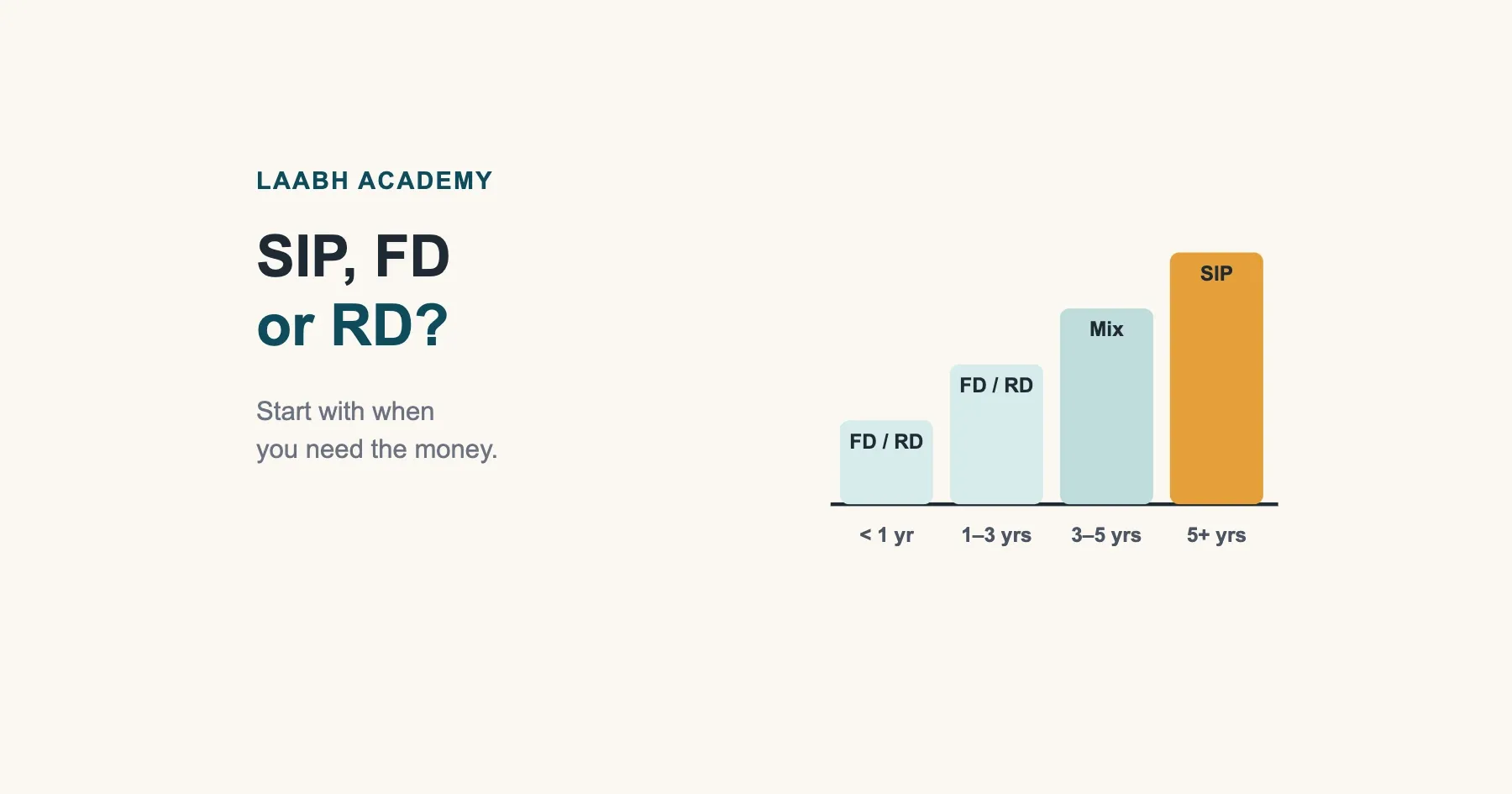
The short version
- FD, RD and SIP answer different questions about time; start with when you need the money.
- An SIP is a way of investing. The fund it buys decides the risk.
- Short, dated goals usually suit deposits; goals 5 or more years away are where an SIP is commonly considered.
- DICGC covers bank deposits up to ₹5 lakh per depositor, per bank, principal and interest together; mutual funds and NBFC deposits are outside it.
A fixed deposit (FD) or recurring deposit (RD) pays an interest rate that is fixed when you open it. An SIP puts a fixed amount into a mutual fund at regular intervals, and its value moves with the fund. In the SIP vs FD vs RD question, which fits depends mainly on when you need the money.
Meera, 24, works in Nagpur. Since her first salary she has paid ₹5,000 a month into an RD, as her parents advised. She has two goals: about ₹60,000 for a professional course in roughly 12 months, and a down payment on a home in about 7 years. Friends at work talk about SIPs. Should her RD money move? FD, RD and SIP aren't rivals: they answer different questions about time.
Three tools: what is fixed, what moves
- Fixed deposit (FD): a bank deposit of a lump sum for a set tenure at an interest rate fixed when you open it. Banks also call it a term deposit. Fixed: the rate and the maturity date.
- Recurring deposit (RD): a bank deposit where you pay a fixed instalment every month for a set tenure, at an interest rate fixed when you open it. Fixed: the instalment, rate and maturity date.
- SIP in a mutual fund: AMFI describes an SIP as "an investment route offered by Mutual Funds wherein one can invest a fixed amount in a Mutual Fund scheme at regular intervals". Fixed: the amount. Moving: the value of your investment, which follows the fund's NAV.
The point most comparisons skip: an SIP is a way of investing, not a product. The fund it buys decides the risk. And unlike a deposit, an SIP has no maturity: your units stay invested until you redeem them. If you are still choosing a category, start with our guide to which type of mutual fund suits a beginner.
Match the tool to your goal's horizon
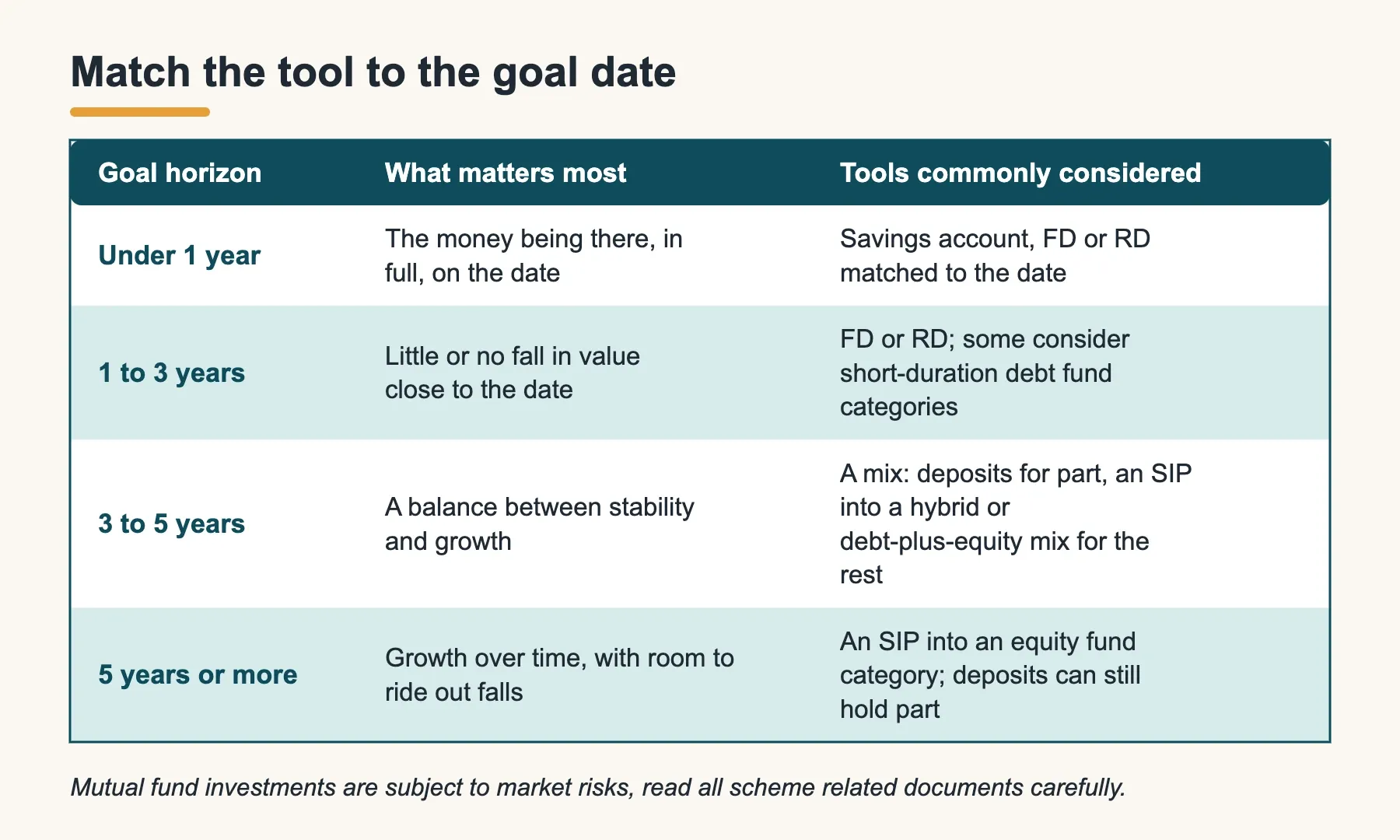
A goal horizon is the time left until you need the money for a specific goal. The bands below are our interpretation of common investor-education guidance, not a SEBI rule. For the fund categories inside each band, see our guide on how long to continue an SIP.
| Goal horizon | What matters most | Tools commonly considered | The catch |
|---|---|---|---|
| Under 1 year | The money being there, in full, on the date | Savings account, FD or RD matched to the date | The interest you earn is modest, and breaking a deposit early can cost some of it. |
| 1 to 3 years | Little or no fall in value close to the date | FD or RD; some consider short-duration debt fund categories | An equity SIP has little time to recover from a fall before the money is needed. |
| 3 to 5 years | A balance between stability and growth | A mix: deposits for part, an SIP into a hybrid or debt-plus-equity mix for the rest | The equity part can still fall in the year you need the money. |
| 5 years or more | Growth over time, with room to ride out falls | An SIP into an equity fund category is commonly considered; deposits can still hold part | Equity values can fall sharply in some years, so the last few years need a plan. |
A hypothetical example: one saver, two goals
Goal 1: about ₹60,000 in 12 months. Say her RD for this goal is ₹5,000 a month for 12 months, at an assumed 6.5% a year, compounded quarterly. This is not any bank's quoted rate. At maturity she would have about ₹62,100, roughly ₹2,100 of interest, before tax. She knows this figure on the day she opens the RD, if she keeps it to maturity.
Now suppose the same ₹60,000 goes through an SIP into an equity fund over the same 12 months. If, on the day she needs the money, her units are worth 10% less than she paid, she would have about ₹54,000. If they are worth 10% more, about ₹66,000. Both are hypothetical, not forecasts.
For a dated goal a year away, the range matters more than the upside: a ₹6,000 shortfall could mean postponing the course.
Goal 2: a home down payment in about 7 years. We won't project a figure, because any 7-year number would rest on an assumed return. What time does is give a fall more room to recover before the money is needed, while the SIP keeps buying units through good months and bad. Recovery is not certain, and it can take time. For what to do when markets drop, read what happens to your SIP when the market falls.
Inflation matters here too: a home in Nagpur may cost more in 7 years, so after-tax growth counts for this goal in a way it doesn't for the course.
FD vs RD vs SIP: how they compare
| FD | RD | SIP in a mutual fund | |
|---|---|---|---|
| How the value is set | Rate fixed at opening | Rate fixed at opening | Moves with the fund's NAV; can fall below what you put in |
| Deposit insurance | DICGC cover for bank deposits, up to ₹5 lakh per depositor, per bank, principal and interest together | Same as FD | None. DICGC lists mutual funds among what it does not cover |
| Breaking early | Premature withdrawal as per your bank's terms; usually some interest is given up | Closing early as per your bank's terms | Stopping ends future instalments without selling units; redeeming may carry an exit load |
| Lock-ins | Tax-saving FDs run for at least 5 years | Depends on the bank's scheme | ELSS funds have a 3-year lock-in; many other open-ended funds have none, though an exit load may apply |
| Tax | Interest taxed as income, with TDS above a threshold | Same as FD | Gains taxed when you redeem, by fund type and holding period |
| The catch | The rate stays fixed, even if rates or prices rise | Same as FD | No fixed outcome; the date you redeem matters |
What happens to an FD or RD if the bank fails?
Bank deposits in India are insured by the Deposit Insurance and Credit Guarantee Corporation (DICGC), which is a wholly owned subsidiary of the Reserve Bank of India.
According to DICGC's guide, "The DICGC insures all deposits such as savings, fixed, current, recurring, etc. deposits", with listed exceptions, and "The DICGC insures principal and interest upto a maximum amount of ₹ 5 lakh." Three qualifiers matter:
- The limit is per depositor, per bank. Branches of one bank are added together; different banks count separately.
- It covers principal and interest together, not ₹5 lakh plus interest.
- It covers banks. DICGC's list of what is not covered includes deposits mobilised by non-banking financial companies (NBFCs), and mutual funds.
So a company or NBFC deposit is a different instrument from a bank FD, even when it is called a fixed deposit.
How each is taxed
As of 30 October 2026, under the Income-tax Act, 2025:
- FD and RD interest is income from other sources. It is added to your income and taxed at your slab rate. A bank deducts tax at source (TDS) once the interest it pays you crosses ₹50,000, or ₹1,00,000 for a senior citizen (Income Tax Department, section 393).
- Equity-oriented fund gains are taxed when you redeem. Held for 12 months or less, the gain is taxed at 20%; held for longer, gains above ₹1.25 lakh in a year (counted together with listed shares) are taxed at 12.5% (section 198).
- Debt-oriented fund units follow different rules. Check them before you redeem.
Tax rules change; consult a tax professional for your situation.
Using them together
It is rarely either-or. A common order:
- Emergency fund first. Keep a few months of expenses somewhere you can reach quickly.
- Short, dated goals in deposits. Meera's course money fits an RD that matures before the fees are due.
- Long goals through an SIP into a fund category that suits the years left, reviewed each year.
Meera doesn't have to stop her RD. She could let the current one run for the course and start a separate SIP for the home goal. The RD habit is the same muscle an SIP uses: a fixed amount, every month, without thinking about it. If you're starting small, see our guide on how much SIP to start with from a first salary.
Frequently asked questions
SIP ya FD, mere goal ke liye kaunsa sahi hai?
Goal kab hai, uske hisaab se decide karein. Agar paisa ek-do saal mein chahiye aur us din kam nahi hona chahiye, toh FD ya RD zyada fit hota hai. Agar goal 5 saal ya usse door hai aur beech mein value girne se aap ghabraenge nahi, toh ek suitable fund mein SIP consider kar sakte hain. Dono saath bhi chal sakte hain.
Is an SIP better than an FD if I need the money in one year?
Neither is better in general. For a one-year goal, an SIP into an equity fund can be worth less than you put in on the day you need it, while an FD or RD gives a figure you know at the start. For a short, dated goal, a deposit usually fits more closely.
Can I lose money in an SIP but not in an FD or RD?
An SIP's value can fall below what you put in, because it follows the fund it buys; how far depends on the category. An FD or RD pays its fixed rate, and bank deposits are insured by DICGC within its limit. Breaking a deposit early can reduce the interest you get.
Is my FD or RD money insured if the bank fails?
Yes, up to a limit. DICGC insures bank deposits, including fixed and recurring deposits, up to ₹5 lakh per depositor, per bank, counting principal and interest together. Deposits with NBFCs are not covered.
What happens if I break my FD or stop my RD or SIP early?
Breaking an FD or closing an RD early is called premature withdrawal, and the penalty or reduced interest depends on your bank's terms. Stopping an SIP only ends future instalments; your units stay invested. Redeeming units is a separate step, and an exit load may apply.
What to do next
- List your goals, with a date beside each.
- Place each goal in a band from the horizon table.
- Revisit each year: in four years, a 7-year goal is a 3-year goal.
— Laabh



