What happens to your SIP when the market falls (and should you stop it?)
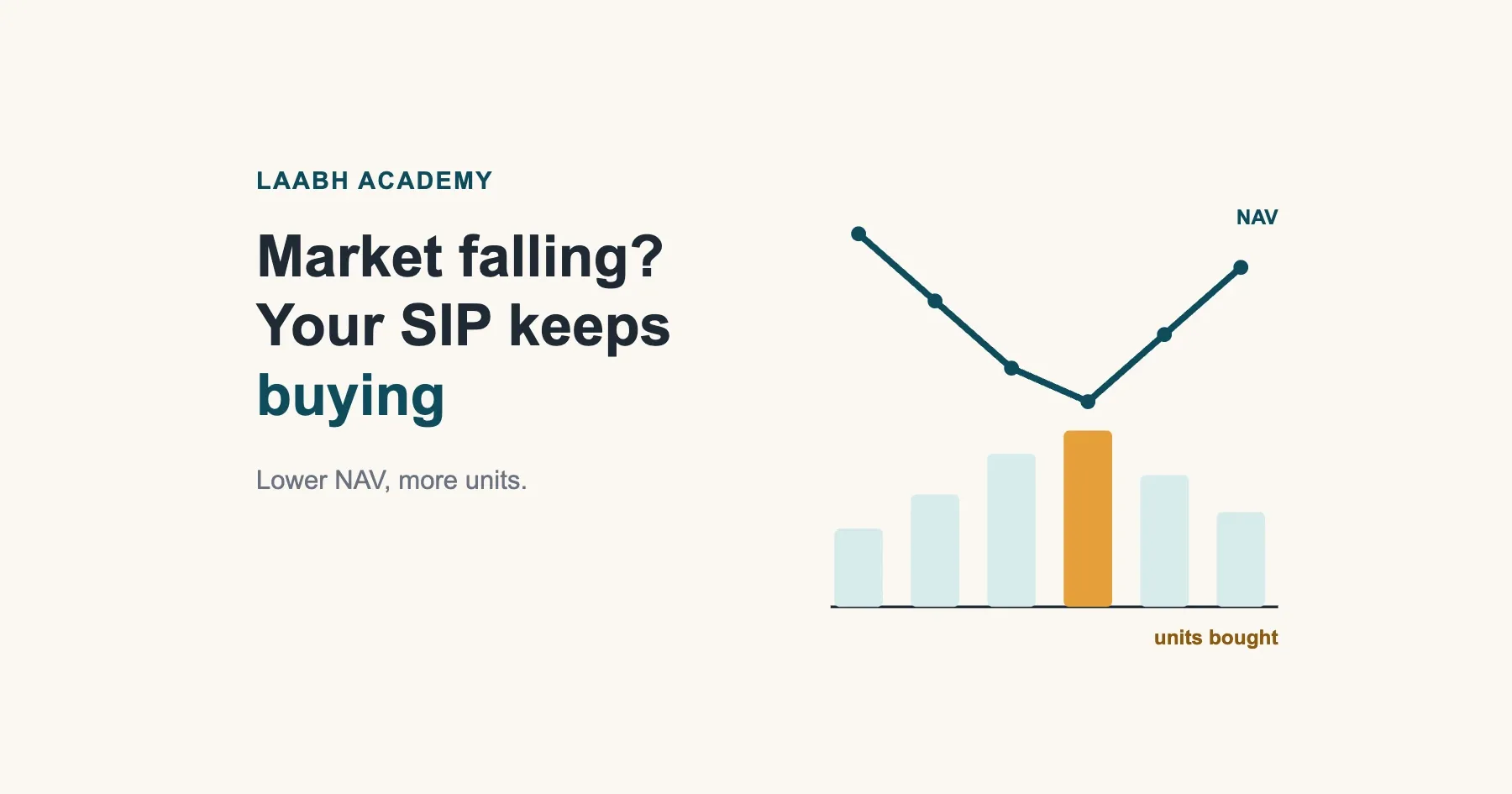
When the market falls, each SIP instalment buys more units at a lower NAV, while the units you hold dip on paper. Nothing is lost unless you sell. Here's how to decide whether to continue, pause, reduce or stop.
Summarize this article with AI





The short version
- A falling NAV means each instalment buys more units; existing units lose value only on paper.
- Rupee-cost averaging smooths your purchase price but guarantees neither a lower cost nor a profit.
- Stopping an SIP ends instalments; it does not sell your units.
- The 78.5% stoppage ratio compares closures, including completed SIPs, with new registrations.
- Decide on goal horizon, emergency fund, affordability and fund fit.
When the market falls, each SIP instalment buys more mutual fund units because the NAV (Net Asset Value) is lower, while the units you already hold are worth less on paper. Nothing is lost unless you sell. Whether to continue, pause, reduce or stop depends on your goal, your timeline and whether you can afford the instalment, not on where the Sensex is today.
Riya, 27, works in Bengaluru and started a ₹5,000 monthly SIP in an equity mutual fund in 2025. This is her first real market fall. The Sensex closed at 85,188.60 on 1 January 2026, the year's first trading day, and at 74,529.08 on 22 September 2026, a drop of about 12.5%. Her portfolio is in red, and she is tempted to stop. This guide is for anyone seeing negative returns for the first time.
What a market fall does to your SIP
A Systematic Investment Plan (SIP) invests a fixed amount at regular intervals at that day's NAV. A fall affects you in two ways:
- Existing units fall in value. 500 units at a NAV of ₹50 are worth ₹25,000; at ₹40 they are worth ₹20,000. The number of units does not change, and the loss is unrealised until you redeem.
- New instalments buy more units. The same ₹5,000 buys 100 units at ₹50 but 125 units at ₹40.
This second effect is rupee-cost averaging. AMFI's investor education site explains that with an SIP "you buy more units when NAV is low and vice versa", and that the cost per unit is averaged out over the long run if NAVs move both ways. Averaging smooths your purchase price. It does not guarantee a lower cost than every alternative, and it does not guarantee a profit.
A worked ₹ example: six months of falling and recovering NAVs
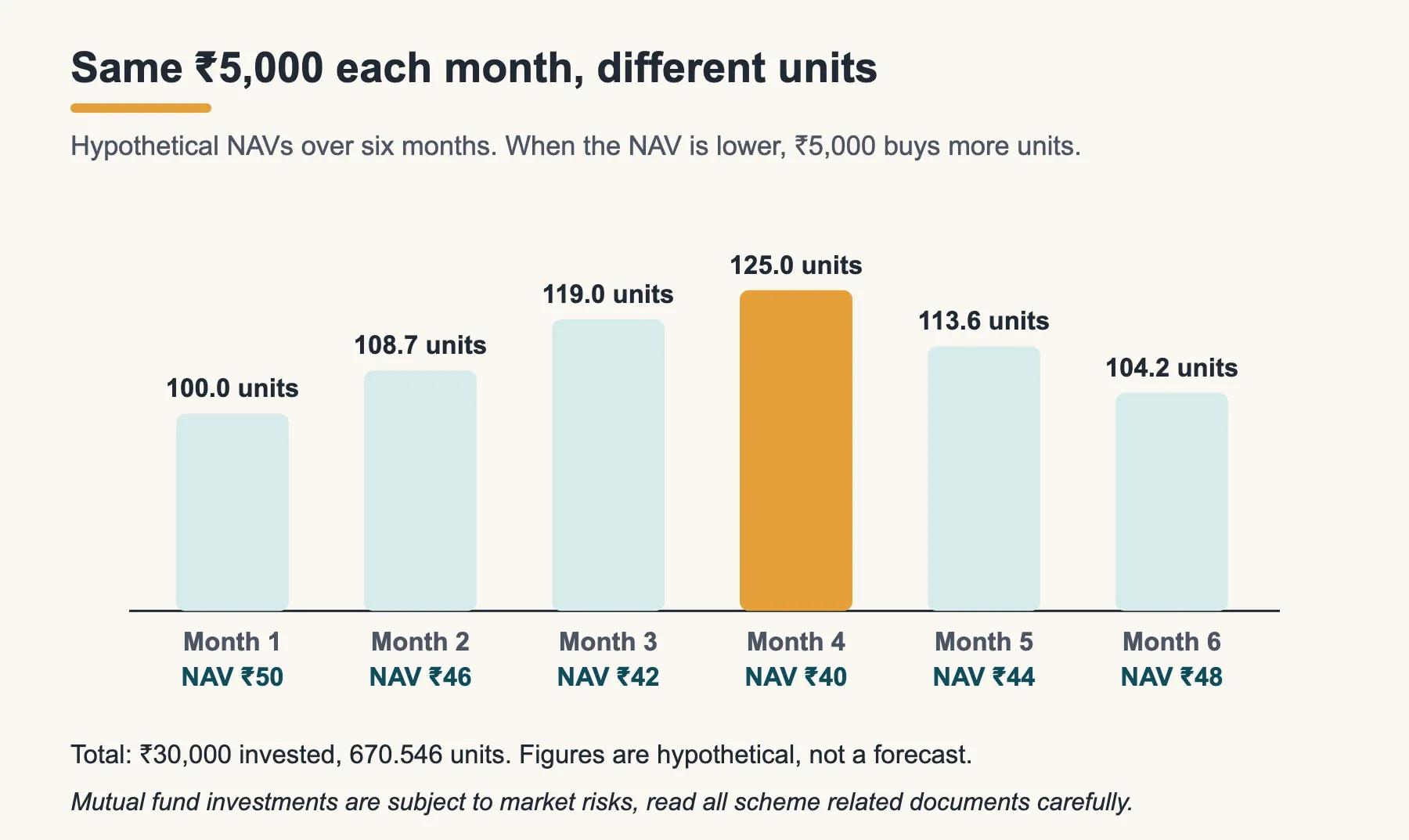
This is a hypothetical illustration. The NAVs are invented to show the arithmetic and are not a prediction for any fund or the market.
Riya invests ₹5,000 a month for six months. Units bought = ₹5,000 ÷ NAV.
| Month | Hypothetical NAV (₹) | Invested (₹) | Units bought |
|---|---|---|---|
| 1 | 50 | 5,000 | 100.000 |
| 2 | 46 | 5,000 | 108.696 |
| 3 | 42 | 5,000 | 119.048 |
| 4 | 40 | 5,000 | 125.000 |
| 5 | 44 | 5,000 | 113.636 |
| 6 | 48 | 5,000 | 104.167 |
| Total | 30,000 | 670.546 |
- Average cost per unit = ₹30,000 ÷ 670.546 = ₹44.74.
- Simple average NAV = (50 + 46 + 42 + 40 + 44 + 48) ÷ 6 = ₹45.00. Buying more units at low NAVs pulled her average cost slightly below the average NAV.
- Value at the month-6 NAV of ₹48 = 670.546 × 48 = ₹32,186, which is ₹2,186 above the ₹30,000 invested, even though the NAV is still below where she started.
- Lump sum comparison: ₹30,000 at ₹50 buys 600 units, worth ₹28,800 at ₹48.
If the NAV had stayed at ₹40, her units would be worth 670.546 × 40 = ₹26,822, a paper loss of about ₹3,178. She is only ahead if the NAV rises above her average cost of ₹44.74. Averaging lowered her break-even point; it did not remove the risk. If the market had risen steadily instead, a lump sum at ₹50 would have bought more units.
Stop, pause, reduce or continue: what each option means
| Option | Future instalments | Units you already hold | Keep in mind |
|---|---|---|---|
| Continue | Carry on as scheduled | Stay invested | You keep buying at lower NAVs if the fall continues |
| Pause | Skipped for a set period, then resume | Stay invested | Usually limited in duration and frequency; rules vary by fund house and platform |
| Reduce | Smaller amount | Stay invested | Often means stopping the SIP and starting a smaller one |
| Stop | End; restarting needs a new SIP | Stay invested; nothing is sold | Fund houses generally do not charge a penalty for stopping |
| Step up | Larger amount | Stay invested | Only if your budget and emergency fund allow it |
A 4-question checklist before you change anything
- When do I need this money?Equity funds suit goals several years away. If you need the money within a year or two, ask whether it belongs in equity at all.
- Do I have an emergency fund?If a surprise bill would force you to redeem at a low NAV, build a cash buffer first. Pausing or reducing an SIP to do that is sensible, not a failure.
- Can I comfortably afford the instalment?If income has dropped or expenses have jumped, reduce or pause. An SIP should never cause a missed EMI or rent payment.
- Is the fund still right for the goal?Check its category, riskometer and objective. Falling with the whole market is different from no longer fitting your goal.
If all four answers are reassuring, the market level alone is not a reason to change your SIP.
Reading the headlines: what the SIP stoppage ratio means
Headlines said the SIP stoppage ratio was 78.5% in September 2026. That does not mean four in five investors quit.
The ratio divides SIPs discontinued or completed in a month by new SIPs registered that month. AMFI data for September 2026, as reported in the media:
- New SIP registrations: 63.26 lakh
- SIPs discontinued or completed: 49.68 lakh
- Stoppage ratio: 49.68 ÷ 63.26 × 100 = 78.5%, down from 81.1% in August
So it is not a share of existing investors, it includes SIPs that simply completed their scheduled tenure, and a figure below 100% means more SIPs started than ended. Monthly SIP contributions also reached a record ₹32,490 crore in September 2026, up from ₹32,297 crore in August. The data does not show investors leaving SIPs en masse. That is context, not a reason to invest; your decision should still come from the checklist.
When stopping or changing your SIP may make sense
Changing course can be right when your goal is close, when you face a cash crunch or emergency, when the fund no longer fits your goal (fix that mismatch on its merits, not because of one bad month), or when you cannot afford the instalment. A smaller SIP you keep beats a larger one you abandon. In each case the reason is your situation, not the index level.
Who should be careful
Investors with short horizons in equity funds carry the most risk. If Riya were saving for a home down payment due next year, a 12% fall could derail the plan. Equity funds can stay below your cost for long stretches, and past performance does not guarantee future returns. Matching the fund category to the goal date matters more than whether you continue an SIP in a market fall.
Frequently asked questions
Should I stop my SIP when the market is falling?
Not just because of the fall. It lowers the price of new units but does not change why you started. Review your goal horizon, emergency fund, affordability and fund fit, and change your SIP only if one of those has changed.
What happens to my SIP units when NAV falls?
The number of units you own stays the same, but their value falls with the NAV. Each new instalment buys more units because each unit costs less. The loss stays on paper unless you redeem.
Is it better to pause or stop an SIP?
A pause skips instalments for a limited period and then resumes, so it suits a short-term cash squeeze. Stopping ends instalments, and you need a new SIP to restart. Either way your existing units stay invested; pause rules vary by fund house and platform.
Does rupee-cost averaging guarantee lower cost or profits?
No. You buy more units when prices are low and fewer when they are high, which smooths your average cost. If prices keep rising, a lump sum could have cost less per unit, and if prices stay low, your investment can remain below what you put in.
What does the SIP stoppage ratio mean, and does 78.5% mean most investors quit?
It is SIPs discontinued or completed in a month divided by new SIP registrations that month: 49.68 lakh against 63.26 lakh in September 2026, or 78.5%. It includes SIPs that completed their tenure and is not a share of all investors, so it does not mean most investors quit.



