Step-up SIP: how much to raise your SIP when your salary goes up
Size your SIP step-up to what your raise leaves after costs and your emergency fund, not a fixed 10%. Flat years are fine. Hypothetical ₹ example.
Summarize this article with AI





The short version
- A step-up SIP raises your instalment on a schedule, by a fixed ₹ amount or a percentage.
- Size it to what your raise leaves after higher costs and your emergency fund, not to a fixed 10%.
- In the hypothetical illustration, most of the gap between flat and step-up is extra money invested.
- Flat years are fine. A step-up you keep does more than a bigger one you cancel.
A step-up SIP raises your SIP instalment at set intervals, by a fixed ₹ amount or by a percentage. How much to step up is best sized to the part of your raise that is left after your higher costs and your emergency fund, not to a fixed 10% a year. A small step-up you can keep, and the odd flat year, are both fine.
Vikram, 25, is an accounts executive in Raipur (fictional). He has run a ₹3,000 monthly SIP since his first salary, and his first appraisal has just landed: his take-home pay goes up by ₹4,000 a month (a hypothetical figure). Everyone tells him to "step up 10% every year". His question is simpler: how much of this ₹4,000 should go to the SIP?
What a step-up SIP is
AMFI's investor-education site, Mutual Funds Sahi Hai, puts it this way: "A Step-Up SIP automatically increases the amount you invest in your mutual fund by a set percentage." Its worked example uses a 10% yearly increase. That is an illustration of how the feature works, not a rule for how much you should add.
You choose how much the instalment rises and how often (the step-up frequency); each increase then happens on schedule.
Fixed-amount vs percentage step-up
One fund house's published terms offer both kinds:
- Fixed-amount step-up: the instalment rises by the same ₹ amount each time, say ₹500. Easy to plan, because you know next year's instalment today.
- Percentage step-up: the instalment rises by a set percentage of the previous one, say 10%. The rupee increase grows each year.
The same terms allow a half-yearly or yearly step-up frequency for a monthly SIP, set a minimum increase for the fixed-amount kind, and cap the total instalment. Other fund houses may differ, so read the SID/KIM or the SIP form of the scheme you use.
The catch with a percentage step-up: it compounds. 10% of ₹3,000 is ₹300; by year ten the yearly increase is above ₹600. Your raises may not keep pace.
Step-up, top-up, or a new SIP?
Some fund houses call this facility "top-up". The fund house terms mentioned above use "SIP Top-Up" for exactly this increase in the instalment. There are three ways to invest more each month:
| Route | What happens | What to check |
|---|---|---|
| Step-up / top-up on your existing SIP | The same SIP's instalment rises on a schedule | Whether adding it means cancelling and re-registering the SIP; the bank mandate limit |
| Change the amount yourself each year | You raise the SIP when you decide to | The fund house's process for changing an amount |
| A new SIP | A second SIP runs beside the first, in the same or another fund | Whether a second fund matches a goal you have actually named |
At one fund house, converting a running SIP to a top-up SIP cancels the old SIP and registers a new one. That is paperwork: units you have already bought stay invested.
How much to step up: start from your raise
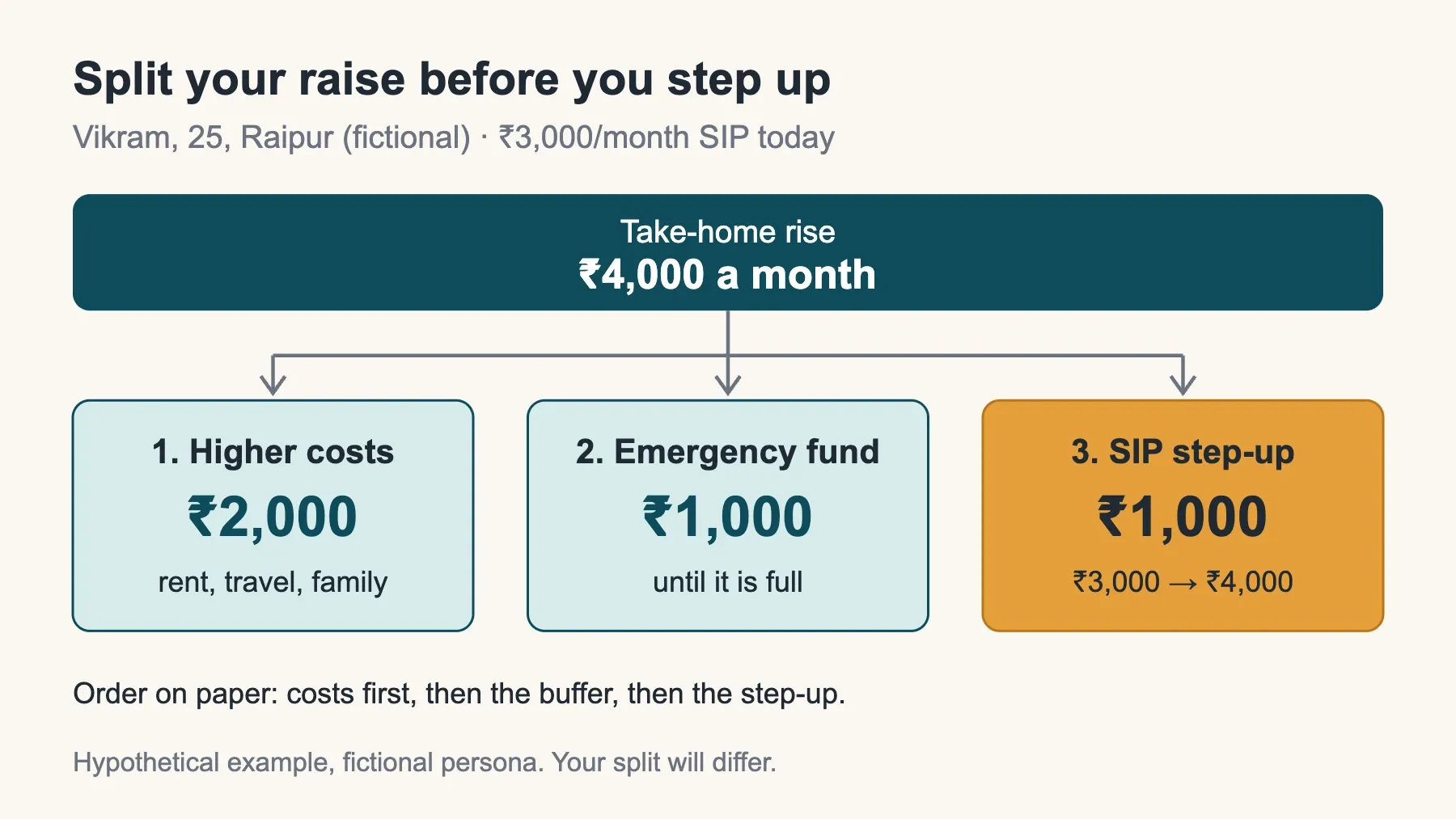
The 10% rule ignores the number that matters most: what your raise actually leaves you each month. Start there.
- Write down the monthly take-home increase. Not the CTC change, the amount that lands in your account. For Vikram, ₹4,000.
- Take out the new costs first. A raise often comes with higher rent, travel or more help at home. Vikram's costs go up by ₹2,000.
- Give the emergency fund its share. If it is not yet full, part of the raise goes there. Vikram sends ₹1,000 a month until it covers the months he has set as his target.
- What is left is your step-up. For Vikram, ₹1,000: his SIP goes from ₹3,000 to ₹4,000.
Once the emergency fund is full, that ₹1,000 can go to the SIP or another goal.
That is 33% of his SIP this year, well above 10%. Next year's raise may be smaller, and his step-up ₹500 or nothing. The raise sets the step, so the step-up stays one he can keep.
The catch: a big step-up looks good in the month you set it, but it is hard to keep in a tight year. A step-up you cancel helps less than a smaller one you keep.
What a step-up can change (hypothetical)
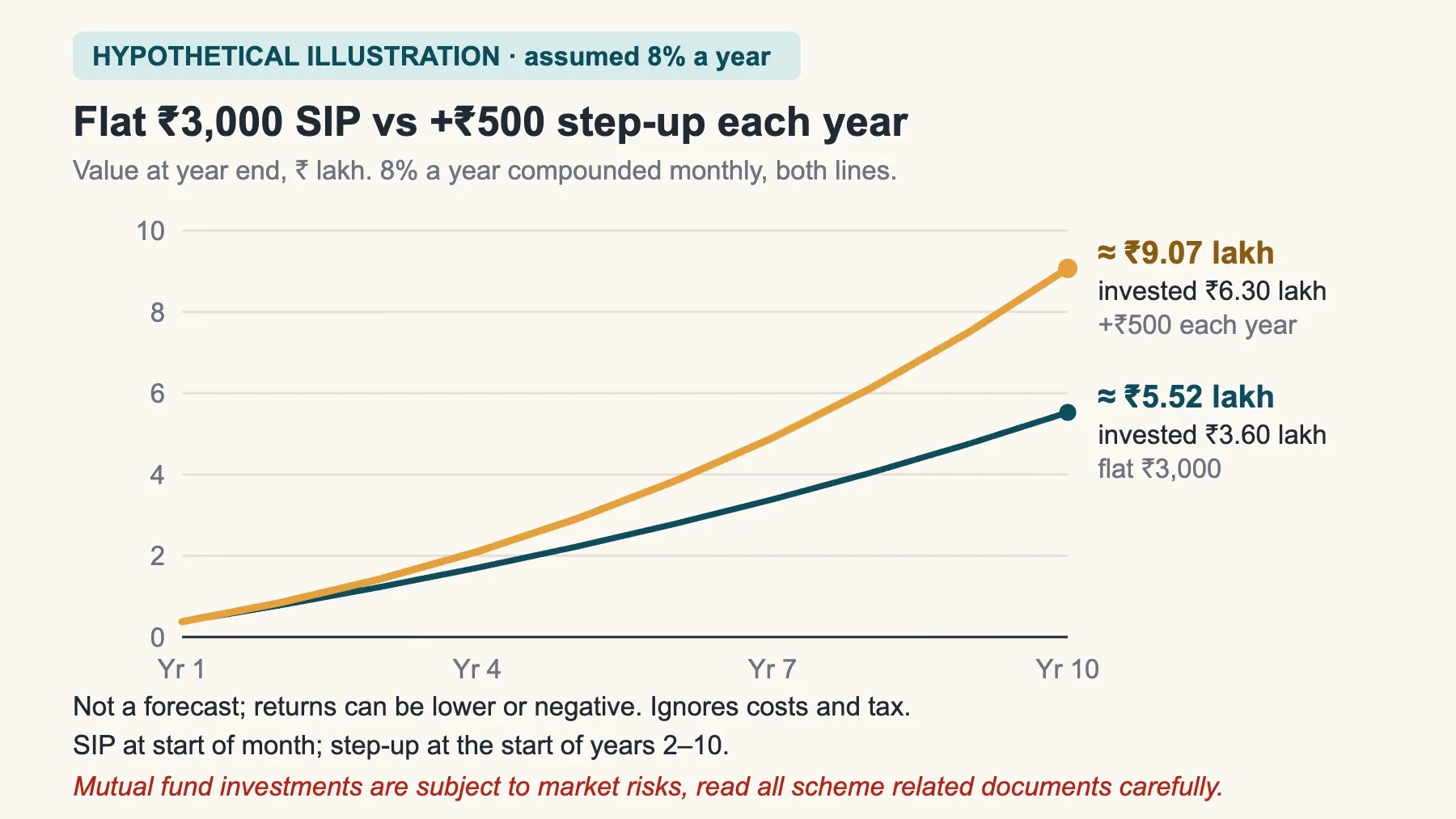
Here is what different paths could look like over 10 years. This is a hypothetical illustration at an assumed 8% a year, compounded monthly, with the SIP paid at the start of each month and each step-up at the start of years 2 to 10. It ignores costs, tax and market swings. It is not a forecast; actual returns can be lower or negative, and they will not arrive in a straight line.
| After 10 years (hypothetical, assumed 8% a year, compounded monthly) | Monthly SIP in year 10 | Invested | Hypothetical value |
|---|---|---|---|
| Flat ₹3,000 a month | ₹3,000 | ₹3.60 lakh | ≈ ₹5.52 lakh |
| +₹500 a month each year | ₹7,500 | ₹6.30 lakh | ≈ ₹9.07 lakh |
| +₹500 a year, but flat in year 4 | ₹7,000 | ₹5.88 lakh | ≈ ₹8.51 lakh |
| 10% a year (for reference) | ₹7,073 | ₹5.74 lakh | ≈ ₹8.27 lakh |
| Vikram's path: ₹3,000 in year 1, +₹1,000 in year 2, then +₹500 a year | ₹8,000 | ₹6.84 lakh | ≈ ₹9.86 lakh |
Three things to read from this table:
- Most of the gap is your own money. The +₹500 path ends about ₹3.54 lakh above the flat one, and ₹2.70 lakh of that is extra money invested. The step-up mostly works because you put in more, not because of a special feature.
- One flat year does not break the plan. Skipping the step in year 4 ends about ₹56,000 lower in this illustration, with ₹42,000 less invested. The habit continues.
- A percentage is not automatically bigger. Here a steady ₹500 a year ends above the 10% path (≈ ₹9.07 lakh vs ≈ ₹8.27 lakh), because 10% of a small SIP is a small amount at first.
When to keep your SIP flat, pause or reduce
Not every year brings a raise. Some bring a new city, a family cost or a gap between jobs. A flat SIP in those years is still a running SIP.
- A tight year: keep the SIP flat, or lower the amount if the full instalment strains your monthly budget. Check how your fund house lets you change or skip a scheduled step-up; terms differ.
- A job change or job loss: your emergency fund exists for this. Some fund houses offer a pause, which stops instalments for a while without cancelling the mandate. The permitted pause period varies by fund house and scheme, according to one fund house's investor-education page (16 October 2026).
- Stopping: stopping an SIP stops future instalments; it does not sell the units you already hold. Mutual funds generally do not charge a penalty merely for stopping, per the same page, but exit loads can apply when you redeem, so check the scheme terms before you sell anything.
If the worry is a falling market rather than your own cash flow, that is a different question: see What happens to your SIP when the market falls (and should you stop it?).
Step up, or emergency fund or a new goal first?
There is no single right order. Weigh these:
- Emergency fund not full yet? A step-up you have to reverse after one surprise bill does not help. Splitting the raise, as Vikram did, is one way through.
- Costly debt, such as a credit-card balance? It also competes for the raise. How to order it against the buffer depends on the rate and your situation; weigh it before you commit the step-up.
- A new goal with a date? Raising your current SIP grows the money for the goal it already serves. A goal with a different date may suit its own SIP in a category that fits that horizon.
Frequently asked questions
Step-up SIP kya hai, aur har saal SIP kitna badhana chahiye?
Step-up SIP mein aapka SIP amount tay samay par apne aap badhta hai, ek fixed ₹ amount se ya ek percentage se. Kitna badhana chahiye, yeh 10% ke rule se nahi, aapke raise se tay karein: take-home mein jo badha, usmein se pehle naye kharche aur emergency fund ka hissa nikaalein, jo bachta hai woh step-up. Kisi saal SIP flat rahe toh bhi theek hai.
Is 10% a year realistic if my raise is smaller? Can I skip a year?
Use 10% as a reference, not a rule. If your raise is small, a ₹500 step-up or none at all is fine. In this article's hypothetical illustration at an assumed 8% a year, one flat year ended about ₹56,000 lower after 10 years, with ₹42,000 less invested. Keeping the SIP running matters more than the size of any single step.
What is the difference between step-up and top-up SIP, or starting a new SIP?
Some fund houses call the step-up facility "top-up"; both describe raising the instalment of your existing SIP on a schedule. A new SIP is a separate instalment, often in a different fund. At some fund houses, adding a step-up to a running SIP means cancelling and re-registering it, so check the SID/KIM.
What if my expenses rise or I lose my job? Can I pause or reduce my SIP?
Yes. You can keep the SIP flat, lower the amount, or use a pause facility where your fund house offers one; pause periods vary by fund house and scheme. Stopping an SIP stops future instalments without selling the units you hold. Lean on your emergency fund first, and restart or step up when your income settles.
What to do next
When your raise lands, split it on paper first: costs, buffer, step-up.
- Write down the monthly take-home increase.
- List the new monthly costs that come with it.
- Decide the emergency fund's share until it is full.
- Choose a step-up you could keep through a flat year: fixed amount or percentage, and how often.
- Read your fund house's step-up and pause terms in the SID/KIM.
- Revisit each year: the raise, the step-up amount, and whether the goal date and category still fit.
— Laabh



