Which type of mutual fund should a beginner start with? How to think it through
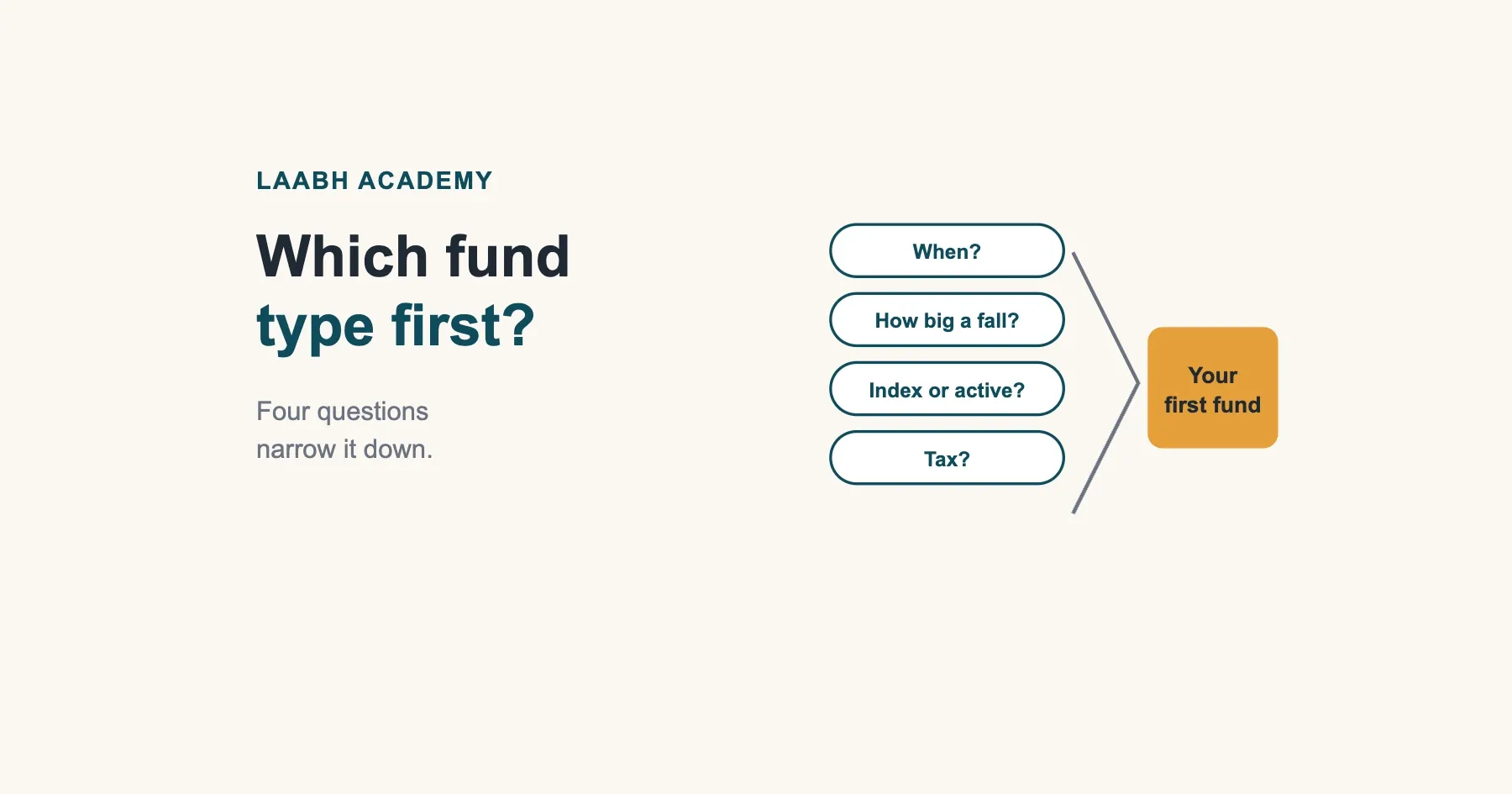
No single fund type suits every beginner. Four questions on goal, horizon and risk help you pick a category, then check its catch before any scheme.
Summarize this article with AI





The short version
- No fund type is best for everyone; goal, horizon and tolerance for falls decide the category.
- Pick the category first, read its catch, then look at schemes.
- Index and flexi cap funds both own a broad market; they differ in cost and in who decides.
- "Large cap" does not mean safe, and "hybrid" spans a wide range of risk. Read the riskometer.
- ELSS gives a deduction only under the old tax regime, and each instalment is locked in for 3 years.
There is no single "best" type of mutual fund for a beginner. The right fund category depends on your goal, how many years until you need the money, and how big a fall you could sit through without stopping. Diversified equity categories spread your money across many companies, hybrid funds mix equity and debt, and in every case you pick the category first and the scheme second.
You have decided to start an SIP (Systematic Investment Plan): investing a fixed amount in a mutual fund scheme at regular intervals, usually monthly. Then every search hands you a list of "top funds": what someone else picked, not how the categories differ. This guide covers the second.
Four questions that narrow it down
A mutual fund category is a SEBI-defined group of schemes that invest in a similar way, such as large-cap, flexi-cap or index funds. The current rules come from SEBI's circular "Categorization and Rationalization of Mutual Fund Schemes", dated 26 February 2026.
1. When do you need the money?
- Within about 3 years: an equity fall may not have time to recover before you withdraw, so equity-heavy categories are generally less suited.
- 3 to 5 years: a middle zone where many investors look at a mix of equity and debt.
- More than 5 years: diversified equity categories are commonly discussed, because there is more time to ride out falls.
These bands are a rule of thumb, not a SEBI rule.
2. How big a fall could you watch without stopping?
Equity funds can fall sharply. Picture ₹50,000 of savings showing as ₹40,000 (a hypothetical 20% fall). If that would make you stop your SIP or sell, an equity-heavy category may not fit you yet, whatever your horizon. To see what a fall does to a running SIP, read What happens to your SIP when the market falls.
3. Simple and low-cost, or a manager making calls?
An index fund is a fund that aims to track a market index rather than pick stocks. In an actively managed fund, a manager chooses the stocks, and you usually pay a higher expense ratio for that work.
4. Do you need a tax deduction, and under which regime?
ELSS (Equity Linked Saving Scheme) is the fund category linked to a tax deduction. As of 28 October 2026, that deduction sits in section 123 of the Income-tax Act, 2025, which replaced the old section 80C. It is capped at ₹1,50,000 a year, shared with items such as provident fund contributions. The new tax regime (section 202) computes income without the Chapter VIII deductions, which include section 123. Under the new regime, ELSS gives no deduction.
The main fund types, explained simply
Every equity-oriented category below can lose value. Each scheme carries a riskometer: a label every mutual fund scheme must show, indicating its risk level from low to very high. AMFI lists six levels: Low, Low to Moderate, Moderate, Moderately High, High and Very High.
Index Funds
- What it is: a fund that aims to track a market index rather than pick stocks. SEBI requires at least 95% of its assets in the securities of that index.
- May suit: someone who wants broad-market exposure at a lower cost without judging a fund manager.
- The catch: it falls when its index falls, by design, and costs plus tracking difference mean it trails the index slightly.
Large Cap Fund
- What it is: at least 80% in large-cap companies. SEBI's Master Circular for Mutual Funds defines which companies count as large, mid and small cap.
- May suit: someone who wants an actively managed portfolio of the biggest listed companies.
- The catch: active-management fees, it can lag its benchmark index, and it is still equity.
Flexi Cap Fund
- What it is: at least 65% in equity, across large, mid and small caps in whatever mix the manager chooses.
- May suit: someone with a long horizon who is comfortable letting a manager shift between company sizes.
- The catch: results depend heavily on the manager's calls, the mix can change, and costs are usually higher than an index fund's.
Hybrid funds
- What it is: funds that combine asset classes. SEBI's sub-categories are Conservative Hybrid (10–25% equity), Balanced Hybrid (40–60% equity, 40–60% debt), Aggressive Hybrid (65–80% equity), Dynamic Asset Allocation, Multi Asset Allocation (at least three asset classes, at least 10% each), Arbitrage Fund and Equity Savings.
- May suit: someone who wants a smoother ride than pure equity, or whose goal is in the medium term.
- The catch: "hybrid" covers very different risk levels. An aggressive hybrid fund behaves mostly like equity, so check the equity range and the riskometer.
ELSS
- What it is: a fund with at least 80% in equity, run in line with the Government's Equity Linked Saving Scheme, 2005.
- May suit: someone filing under the old tax regime who wants the deduction and has a long horizon anyway.
- The catch: a 3-year lock-in that applies to each SIP instalment separately: units from each instalment can be redeemed only 3 years after that instalment's date. Under the new regime you would accept the lock-in with no deduction.
Sectoral and Thematic funds
- What it is: at least 80% in one sector, or one theme (a theme can combine two or more sectors).
- May suit: someone who already has a diversified core and wants a deliberate, small bet on one idea.
- The catch: concentration and timing. When that sector struggles, the whole fund feels it. Several theme-based new fund offers (NFOs) were being marketed in October 2026; a new launch is not, by itself, a reason to start there.
Mid Cap and Small Cap funds
These put at least 65% into mid-sized or smaller companies respectively. The catch: higher volatility, so they need a longer horizon and more tolerance for falls.
The categories side by side
| Category | What it holds (SEBI minimum) | Horizon usually discussed* | Risk | The catch |
|---|---|---|---|---|
| Index Funds | 95% in the tracked index | 5+ years (equity index) | See the riskometer | Falls with the market |
| Large Cap Fund | 80% large caps | 5+ years | See the riskometer | Active fees; can lag its index |
| Flexi Cap Fund | 65% equity, any size mix | 5+ years | See the riskometer | Depends on the manager |
| Hybrid | 10–25% to 65–80% equity, by type | 3+ years, by type | See the riskometer | Risk varies widely |
| ELSS | 80% equity | 5+ years | See the riskometer | 3-year lock-in per instalment; deduction under old regime only |
| Sectoral / Thematic | 80% in one sector or theme | Long; small add-on | See the riskometer | Concentration, timing |
| Mid Cap / Small Cap | 65% mid or small caps | 7+ years | See the riskometer | Higher volatility |
*Horizon bands are an interpretation of common investor-education guidance, not SEBI rules.
Index fund or flexi-cap? A balanced look
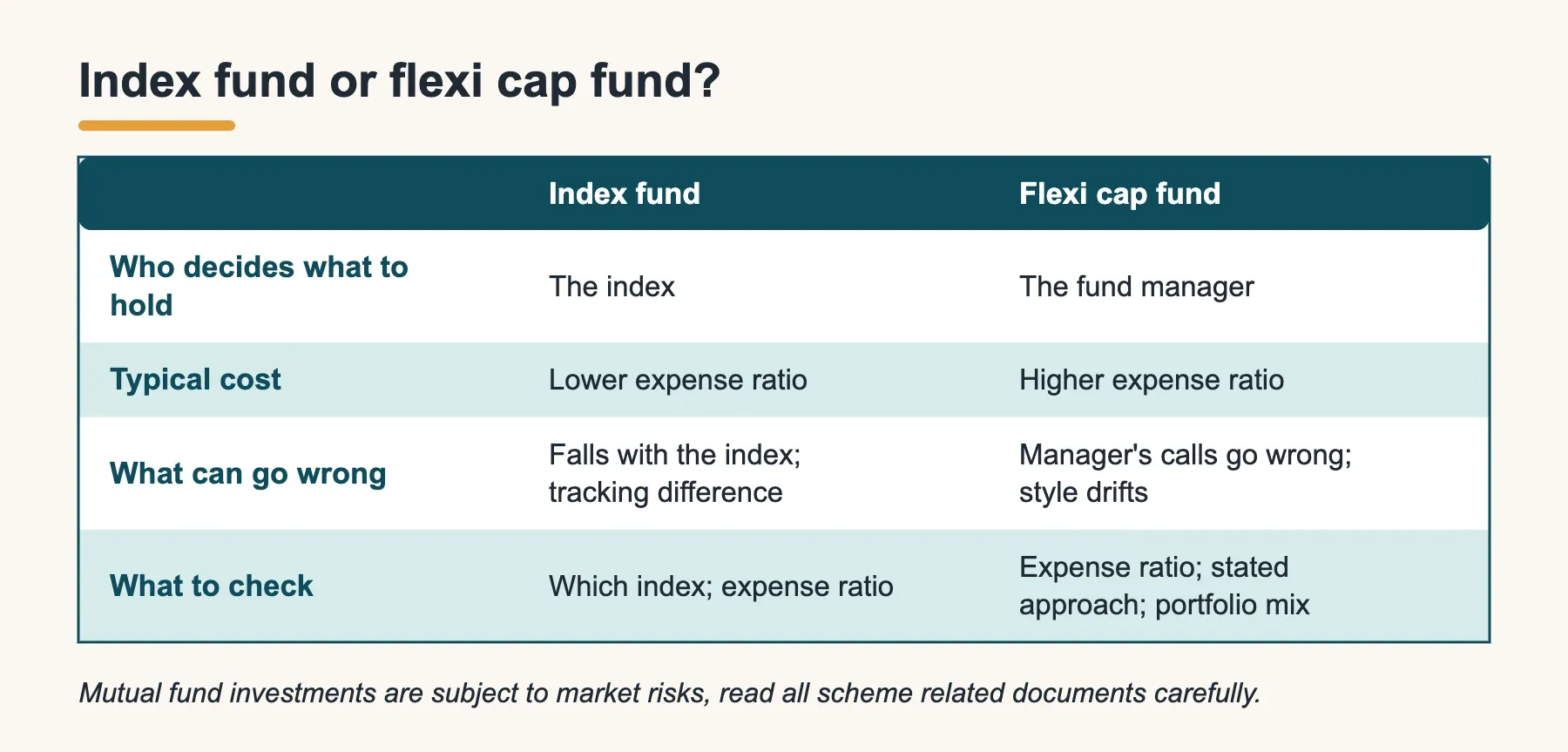
| Index fund | Flexi cap fund | |
|---|---|---|
| Who decides what to hold | The index | The fund manager |
| Typical cost | Lower expense ratio | Higher expense ratio |
| What can go wrong | Falls with the index; tracking difference | Manager's calls go wrong; style drifts |
| What to check | Which index; expense ratio | Expense ratio; stated approach; portfolio mix |
Cost is the easiest gap to see. On ₹1,00,000, an expense ratio of 0.2% costs about ₹200 a year; at 1.0% it costs about ₹1,000. These ratios are hypothetical; a scheme's actual total expense ratio (TER) is in its scheme documents.
An index fund gives up the chance of beating the market for lower cost and simplicity; a flexi cap fund pays for the chance that a manager adds value, which may not happen. Both are valid ways to own a broad market.
Does "large cap" mean safe?
No. Large-company funds are generally less volatile than mid or small cap funds, but they are still equity and can fall for long stretches. The official way to read a scheme's risk is its riskometer, not its category name.
Start with one or two funds
One diversified fund can be enough to begin. More funds of the same type mostly add overlap, not safety: two large-company funds often hold many of the same stocks. Add a second category only when it does a different job, such as a hybrid fund for a nearer goal.
Two first-timers, same SIP, different answers
Neha, 24, Indore: ₹3,000 a month for a two-wheeler in 2 years. With that horizon, an equity fall may not recover in time, so equity-heavy categories are less suited. She compares conservative hybrid or debt-oriented options with a recurring or fixed deposit. And then she checks the catch.
Arvind, 26, Hyderabad: the same ₹3,000 a month, for a goal more than 10 years away. He has already sat through one market fall without stopping. For a goal that far away, diversified equity categories (index, large cap or flexi cap, for example) are among the options worth comparing. And then he checks the catch.
Same amount, different goal, different category.
The catch
This framework narrows the field; it does not choose for you. A category cannot tell you how a scheme will perform, and two schemes in one category can behave quite differently. Your answers will also change with a new job, a marriage or a home loan, so revisit the four questions each year.
Frequently asked questions
Index fund or flexi-cap fund: which is better for a beginner?
Neither is better for everyone. An index fund tracks a market index at a lower cost; a flexi cap fund relies on a manager's choices and usually costs more. The choice comes down to whether you prefer simplicity and lower cost, or are willing to pay for active decisions.
Beginner ke liye kaunsa mutual fund type sahi hai, equity ya hybrid?
Koi ek "sahi" type nahi hai. Agar paisa 3 saal ke andar chahiye, toh equity ko girawat se ubarne ka samay kam milta hai, isliye log aksar hybrid ya debt-oriented options dekhte hain. Agar goal 5 saal se zyada door hai aur aap girawat mein bhi apna pehla SIP chalu rakh sakte hain, toh diversified equity category par vichar kiya ja sakta hai.
Should I start with an ELSS fund to save tax?
Only if the deduction applies to you. As of 28 October 2026, it falls under section 123 of the Income-tax Act, 2025, which is not available under the new tax regime. ELSS also has a 3-year lock-in on each instalment, so it suits money you will not need for at least three years.
How many mutual funds should I start with, one or two?
One diversified fund can be enough to begin. More funds of the same type add overlap rather than safety.
What to do next
Write down your goal and the date you need the money. Answer the four questions, then take the "Before you decide" checklist to any scheme's SID and KIM. For what to expect once your SIP is running, read What happens to your SIP when the market falls.



