Can you withdraw your SIP money anytime? Lock-in, exit load and tax, explained
In most open-ended funds, yes. ELSS locks each instalment for 3 years. See how exit load and tax apply per SIP instalment, with a ₹ example.
Summarize this article with AI





The short version
- In most open-ended funds, you can redeem SIP units whenever you choose, fully or partly.
- ELSS units are locked for 3 years from each instalment's date.
- Exit load is scheme-specific: find the rate and window in the scheme's SID/KIM.
- Each instalment has its own clock for lock-in, exit load and tax.
- Stopping an SIP and redeeming units are separate decisions.
In most open-ended mutual funds, you can redeem (sell back) the units your SIP has bought whenever you choose, fully or partly. The exception is ELSS (tax-saver) funds, where the units from each instalment are locked in for 3 years from that instalment's date. Two costs may apply when you take money out: an exit load, which is scheme-specific and set out in the scheme's documents, and tax on any gain, which depends on how long each instalment has been held.
Karan, 26, works in Indore and has paid a ₹2,000 monthly SIP (Systematic Investment Plan) for a year. His father now needs a ₹10,000 medical test, and Karan's savings are thin. Is the SIP money locked, and what will taking some out cost? If you haven't started an SIP because you worry the money gets stuck, this is your question too.
Is SIP money locked?
For most funds, no. An SIP is a way of buying units every month, and those units can be sold back to the fund house like any other purchase.
- Redemption: Selling your mutual fund units back to the fund at the applicable NAV.
- Lock-in period: A period during which units cannot be redeemed; for ELSS it is 3 years from the date of each investment.
By fund type:
- Open-ended funds (the usual home for an SIP): you can redeem whenever you choose. An exit load may apply if you redeem early.
- ELSS: each instalment's units stay locked for 3 years, and can be redeemed after that.
- Close-ended schemes: these take money only at launch and have their own exit rules, set out in the scheme's Scheme Information Document (SID).
Lock-in, exit load and tax are three different things
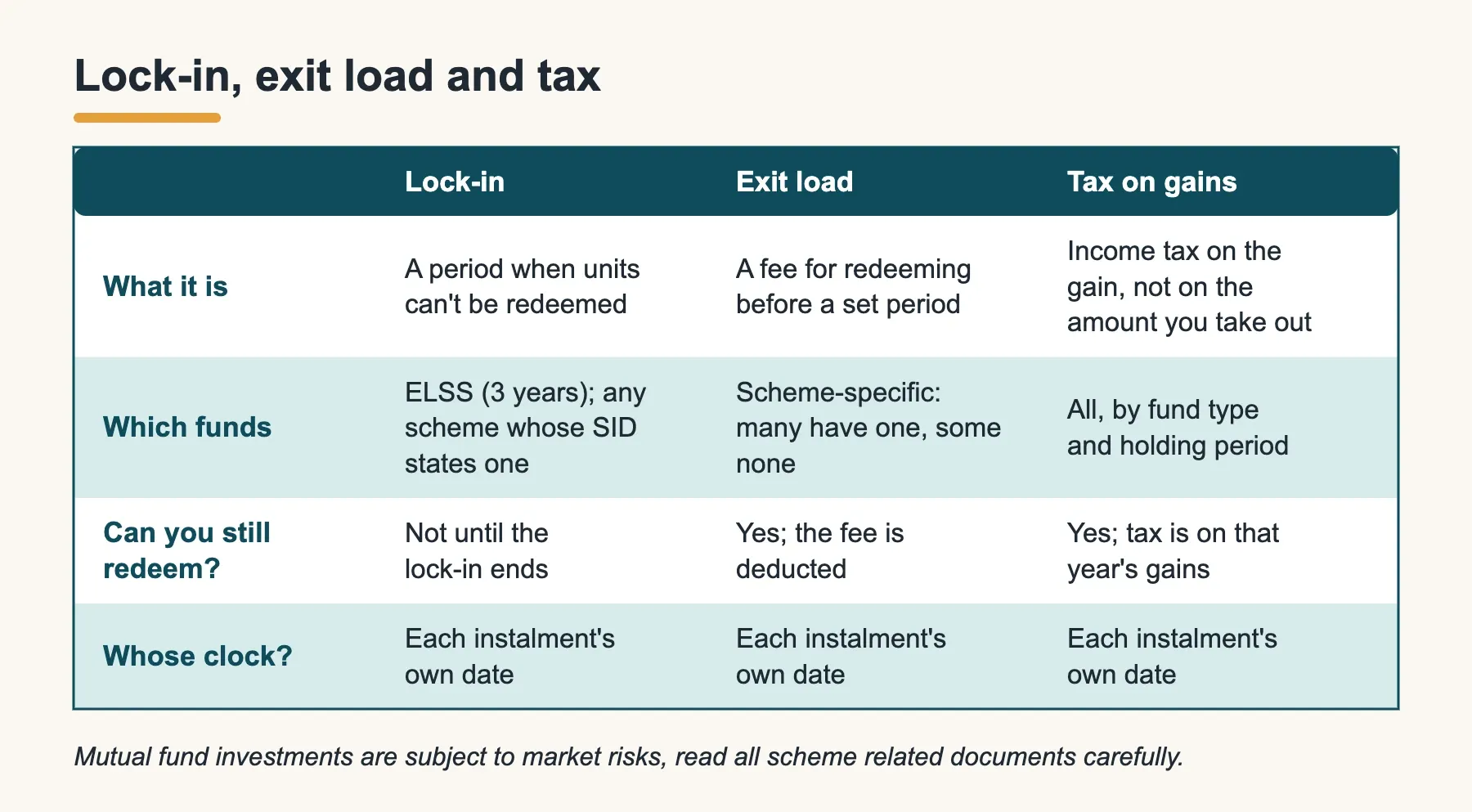
All three get called a "penalty", but they differ.
- Exit load: A fee some schemes charge if you redeem units before a set period; the amount and period are in the scheme's SID.
| Lock-in | Exit load | Tax on gains | |
|---|---|---|---|
| What it is | A period when units can't be redeemed | A fee for redeeming before a set period | Income tax on the gain, not on the amount you take out |
| Which funds | ELSS (3 years); any other scheme whose SID states one | Scheme-specific: many schemes have one, some have none | All, with rules that depend on fund type and holding period |
| Can you still redeem? | Not until the lock-in ends | Yes; the fee is deducted from what you receive | Yes; the tax is worked out on that year's gains |
| Whose clock? | Each instalment's own date | Each instalment's own date | Each instalment's own date |
| Where to check | SID / KIM | SID / KIM | Income Tax Department rules; a tax professional |
Each SIP instalment has its own clock
Every instalment buys a separate batch of units. Lock-in, exit load and tax holding periods are measured from each batch's own date, not from the day your SIP started. When you redeem, units generally go out first in, first out (FIFO): the oldest batch first.
A worked example (hypothetical)
Karan's SIP, simplified:
- ₹2,000 invested on the 5th of every month for 12 months: ₹24,000 in all.
- NAV held at ₹20 throughout, so each instalment buys 100 units (1,200 units in total).
- An illustrative exit load of 1% on units redeemed within 12 months of purchase.
Suppose he redeems everything on the 10th of month 13.
| Instalments | Held for | Value | Exit load (1%) | He receives |
|---|---|---|---|---|
| Month 1 | 12 months, 5 days | ₹2,000 | ₹0 | ₹2,000 |
| Months 2–12 (11 instalments) | From 11 months, 5 days down to 1 month, 5 days | ₹22,000 | ₹220 | ₹21,780 |
| Total | ₹24,000 | ₹220 | ₹23,780 |
Only the oldest instalment is past the 12-month window, so the load applies to ₹22,000 and costs ₹220. Karan receives ₹23,780 before any tax. With the NAV flat there is no gain, so no capital-gains tax: tax applies to gains, not to the amount withdrawn.
If the NAV had risen instead, the gain on month 1's units would count as long-term for an equity-oriented fund, and the gain on months 2–12 as short-term. One redemption, two tax treatments.
Method: hypothetical; NAV assumed constant at ₹20; exit load assumed at 1% on units redeemed within 12 months of purchase; units redeemed first in, first out; other costs and taxes ignored. Real exit loads and windows vary by scheme.
The same idea in an ELSS
In an ELSS SIP, the clock that matters is the lock-in. Had Karan's SIP been in an ELSS from January to December 2026, the January instalment's units could be redeemed from January 2029, the February units from February 2029, and so on until December 2029. The money unlocks in instalments, not all at once.
Can you withdraw only part of it?
Yes. You can redeem a rupee amount or a number of units, and the rest stays invested.
Karan needs ₹10,000. If he redeems units worth ₹10,000, FIFO takes month 1's units (₹2,000, past the window, no load) and then months 2–5 (₹8,000, inside the window, so ₹80 of load). He receives ₹9,920 before tax, and 700 units worth ₹14,000 stay invested.
To get the full ₹10,000 in hand, he would redeem about ₹10,081 worth, since the extra ₹81 also carries the load. Schemes may also set a minimum redemption amount or a minimum balance; the SID states these.
Tax when you redeem early
The Income Tax Department's published rules for resident individuals, as of 28 October 2026:
- You are taxed on the gain: what you receive for the units minus what you paid for them.
- Each instalment has its own holding period, so one redemption can mix short-term and long-term gains.
- Equity-oriented funds (broadly, funds that keep at least 65% in equity shares of listed Indian companies): gains on units held for 12 months or less are short-term and taxed at 20%.
- Gains on equity-oriented units held for more than 12 months are long-term. They are taxed at 12.5% on the part of your total long-term gains from equity shares and equity-oriented funds that exceeds ₹1.25 lakh in a financial year.
- Debt-heavy funds (those that invest more than 65% in debt and money-market instruments): gains on units bought on or after 1 April 2023 are taxed at your income-tax slab rate, however long you hold them.
- Debt-fund units bought before 1 April 2023 follow different, older rules; check with a tax professional.
- Other fund types, such as some hybrid funds and funds of funds, follow different rules.
- Surcharge and cess apply on top of these rates.
Tax rules change; consult a tax professional for your situation.
Stop the SIP, or withdraw the money?
These are two separate actions.
- Stopping or pausing an SIP ends or skips future instalments. The units you already own stay invested.
- Redeeming sells units you already own. It doesn't stop the SIP: the next instalment is still debited unless you stop or pause it.
Redeeming releases cash now; stopping or pausing helps if the instalment itself is hard to pay. Some fund houses and platforms offer a pause; check whether yours does, and for how long. If a market fall is what's making you think about stopping, read What happens to your SIP when the market falls (and should you stop it?).
What withdrawing early does to your goal
Money you take out stops growing toward the goal it was meant for. Karan's goal now rests on ₹14,000 of units instead of ₹24,000, so it may take longer or need a higher SIP later. For a real need, like his father's test, that is a fair trade. For a want, it deserves a second look.
Before you decide to redeem
The catch
Being able to withdraw any time is useful, and it's also what makes it easy to raid a long-term goal. An SIP redeemed every few months starts to behave like a savings account with market risk attached. A separate emergency buffer lets the SIP do its job.
Frequently asked questions
Can I withdraw my SIP before 3 years? Is there a penalty?
In most open-ended funds, yes. Outside ELSS there is no 3-year rule; what you check is the exit load, a scheme-specific fee if you redeem units before a set period, plus tax on any gain. ELSS is different: each instalment's units can be redeemed only 3 years after that instalment's date.
Can I withdraw only part of my SIP money?
Yes. You can redeem a rupee amount or a number of units, and the remaining units stay invested. The oldest units are generally redeemed first, so a partial withdrawal may avoid exit load if those units are past the scheme's exit-load window. A scheme may set a minimum redemption amount; the SID states it.
SIP ka paisa beech mein nikal sakte hain kya? Kitna charge lagta hai?
Zyaadatar open-ended funds mein haan: aap apne units kabhi bhi, poore ya thode, redeem kar sakte hain. ELSS mein har instalment ke units 3 saal ke liye lock rehte hain. Kharcha do tarah ka ho sakta hai: exit load, agar units scheme ki tay avadhi se pehle bechein (rate aur avadhi SID/KIM mein likhe hote hain), aur munafe par tax. Units bechne se aapka SIP band nahin hota; use alag se rokna padta hai.
Do I pay tax if I withdraw my SIP early?
Only on gains, not on the amount you take out. As of 28 October 2026, for equity-oriented funds, gains on units held 12 months or less are taxed at 20%, and gains on units held longer are taxed at 12.5% on total long-term equity gains above ₹1.25 lakh in a financial year. Debt-heavy fund units bought on or after 1 April 2023 are taxed at your slab rate. Tax rules change; consult a tax professional for your situation.
Should I stop my SIP or withdraw the money if I need cash?
They do different things. Redeeming releases cash from units you already own; stopping or pausing only affects future instalments. If you need money now, redeem only what you need, then decide separately whether you can keep paying the SIP.
Your next step
Open your scheme's SID or KIM on the fund house's website, note the exit-load rate and window and any lock-in, and save the "Before you decide" checklist for the day you need it.
Read next: What happens to your SIP when the market falls (and should you stop it?)



