How to check if an adviser or finfluencer is SEBI registered: a 2-minute lookup
Check an adviser, analyst or finfluencer on SEBI's register and a distributor's ARN on AMFI, see what each may do, and where to complain.
Summarize this article with AI





The short version
- Check SEBI's intermediaries list (for advisers and analysts) or AMFI's ARN search (for distributors) before you pay or follow anyone's advice.
- A number that "looks right", a SEBI logo or a certificate image is not proof. The register is.
- RIAs advise for a fee, RAs publish research and recommendations, distributors sell mutual fund schemes for commission.
- SEBI-regulated entities must not associate with unregistered people who give advice or make return claims.
- Check the payee with SEBI Check and never share OTPs or logins; complaints go to SCORES, fraud to cybercrime.gov.in or 1930.
To check if an adviser is SEBI registered, open sebi.gov.in, go to Recognised Intermediaries, choose Investment Advisers or Research Analysts, and search the name or registration number. For mutual fund distributors, search the ARN on AMFI's website. If the person isn't listed, or the details don't match, don't pay or share account access.
The check takes about two minutes. Below are the steps for each lookup, what each registration allows, and where to go if something has already gone wrong. The method works on anyone, so we name no one.
How do I check if my investment adviser is really SEBI registered?
SEBI keeps a public list of every intermediary it has registered, including investment advisers (often called RIAs) and research analysts (RAs). The list is the source of truth. A screenshot, a logo or a certificate image sent on chat is not.
The 2-minute lookup, as of 17 November 2026:
- Get the details in writing. Ask the person for their full registered name (individual or firm) and their SEBI registration number. A registered adviser or analyst is expected to share these openly.
- Open SEBI's own website. Type sebi.gov.in yourself rather than tapping a link someone sent you.
- Find the intermediaries list. Look for "Recognised Intermediaries" (or the intermediaries section) and pick the category: Investment Advisers, or Research Analysts.
- Search by name or number. Check that the name, registration number and category all match what you were told.
- Check the dates and contact details. The entry shows the registration's validity and the registered contact details. If the phone number or email you were given differs from the one on SEBI's list, treat that as a mismatch.
- Check where the money goes. Before paying, compare the payee name with the registered name. SEBI also runs a tool called SEBI Check, where you can enter a UPI ID, or a bank account number with its IFSC, to check an intermediary's payment details before you transfer money.
If any step fails, stop. A "similar" name is not the same firm.
What does a valid SEBI RIA registration number look like?
SEBI registration numbers follow a fixed format: a short letter prefix that shows the category, followed by digits. Investment adviser numbers typically begin with INA, and research analyst numbers with INH. A mutual fund distributor doesn't have a SEBI number at all; it has an ARN (AMFI Registration Number).
The prefix helps you spot an obvious mismatch, for example someone calling themselves an adviser while quoting an analyst's number. But a correctly formatted number proves nothing on its own. Anyone can type "INA" followed by nine digits. What counts is that the exact number appears on SEBI's list against the exact name you are dealing with.
The same goes for a SEBI logo on a poster, profile picture or payment page: it is not evidence of registration. Trust the register, not the branding.
What's the difference between an RIA, a research analyst and a mutual fund distributor with an ARN?
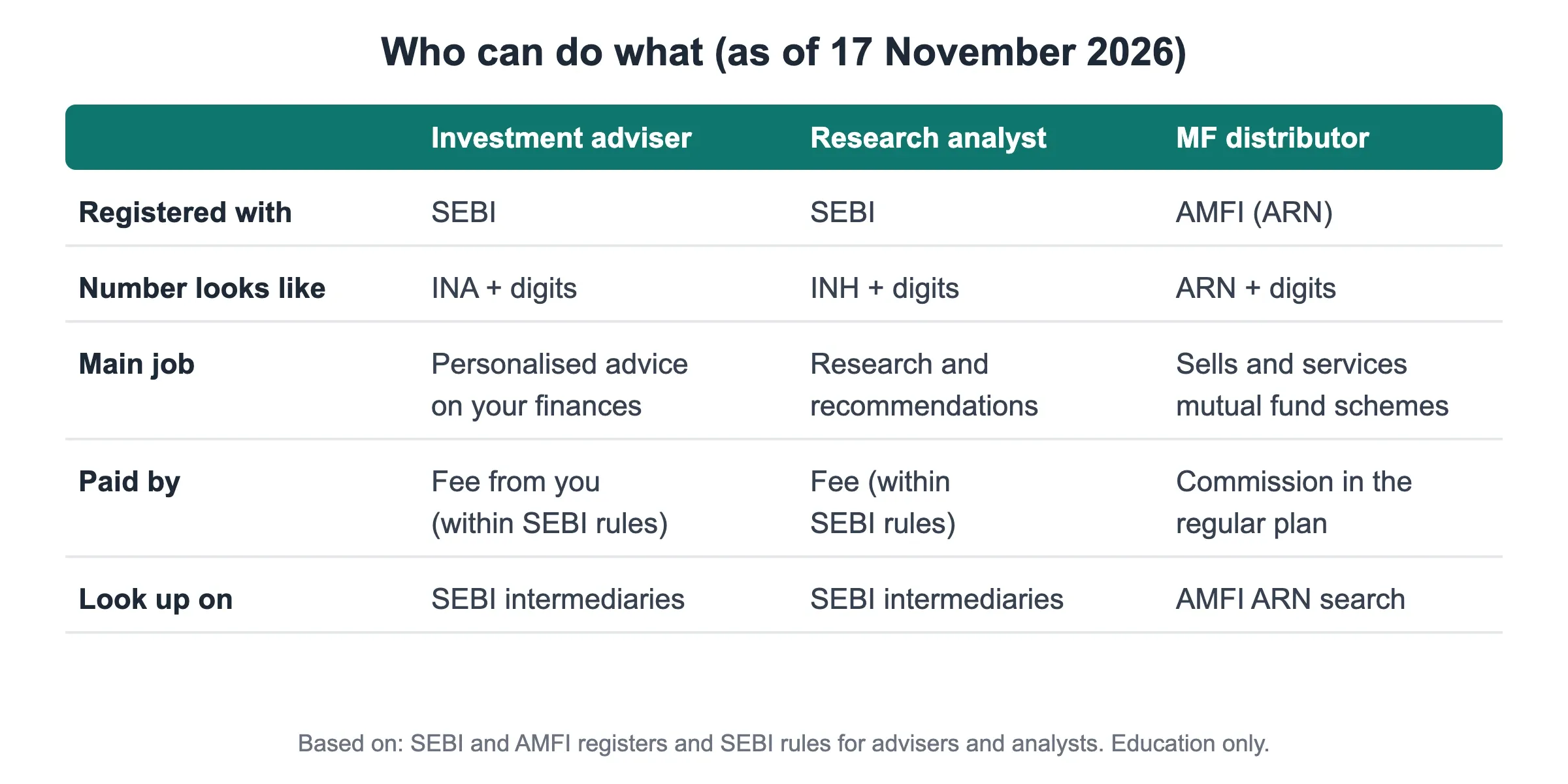
All three may talk to you about investments, but each registration permits a different job. Here is a plain summary of the roles as SEBI and AMFI frame them, as of 17 November 2026:
| Registered investment adviser (RIA) | Research analyst (RA) | Mutual fund distributor (ARN holder) | |
|---|---|---|---|
| Registered with | SEBI | SEBI | AMFI (ARN), under SEBI's mutual fund rules |
| Number looks like | Starts with INA | Starts with INH | ARN followed by digits |
| Main job | Personalised advice on your overall finances and investments | Research reports and recommendations on securities | Selling (distributing) mutual fund schemes and servicing your investments |
| How they are paid | A fee from you, within SEBI's fee rules | A fee from you (or from the firm they publish for), within SEBI's rules | Commission from the fund house, built into the regular plan's expense ratio |
| Where to look them up | SEBI intermediaries list | SEBI intermediaries list | AMFI's distributor (ARN) search |
To check an ARN, go to amfiindia.com, open the distributor search (listed as locating a distributor or searching by ARN), and enter the ARN or name. Check the name, the ARN and that the registration is current. If you invest through a distributor, the ARN also appears in your mutual fund records, which are maintained by registrars such as CAMS and KFintech. Our guide to what CAMS and KFintech are explains where those records live.
The payment line matters. A distributor is paid through the regular plan's commission, which is why the same scheme also has a direct plan with a lower expense ratio. Our guide on direct vs regular plans explains that cost difference.
On fees: SEBI's rules for advisers and analysts set limits on how much they can charge individual clients and how far in advance. Under a SEBI circular dated 2 April 2025, advisers and research analysts may collect fees in advance for up to one year, if the client agrees. A three-month plan is within that period, so the length of a plan on its own isn't a warning sign. What matters is whether the person is registered and whether the money goes to the registered entity.
Can someone give personalised stock advice online without SEBI registration?
Talking about markets is not advising you. Explaining a P/E ratio, an index or how SIPs compound is education. Telling you which stock to buy, at what price, or how to adjust your portfolio, especially for a fee, is advice or a recommendation, and SEBI's framework expects that to come from a registered adviser or research analyst.
SEBI has also tightened the rules from the other side. Amendments notified on 26 August 2024, followed by a SEBI circular dated 22 October 2024, say that SEBI-regulated entities and their agents must not have any direct or indirect association with a person who:
- gives advice or recommendations about securities without being registered with, or permitted by, SEBI; or
- makes express or implied claims of returns or performance, unless SEBI permits it.
People engaged purely in investor education are outside this restriction, as long as they don't give such advice or make such return claims. So the test is not the platform or the follower count; it is what the person does. A creator who explains concepts is educating. One who sells stock calls or "assured" monthly returns without registration is doing something SEBI-regulated entities are now barred from associating with.
None of this makes every online creator suspect. It gives you one question: "Are you telling me what to buy for my money? If so, what is your SEBI registration number?"
A hypothetical scenario: the ₹21,000 "3-month advisory plan"
Hypothetical scenario. No real person or group.
Someone in a chat group offers you a "3-month advisory plan" for ₹21,000, which works out to ₹7,000 a month. If you renewed it every quarter, that would be ₹84,000 over a year. Before paying, run three checks:
- Name and number on SEBI's list. Ask for the registration number and search it on SEBI's Investment Adviser or Research Analyst list. Not listed, or listed under a different name? Don't pay.
- Payee matches the registered entity. The account or UPI ID should belong to the registered person or firm, not a personal account of someone else. Run the payment details through SEBI Check before transferring.
- No guaranteed-return language. Any promise of fixed or assured profits from market investments is a red flag, whoever makes it. Markets don't offer guarantees, and claims of returns are exactly what SEBI's 2024 rules target.
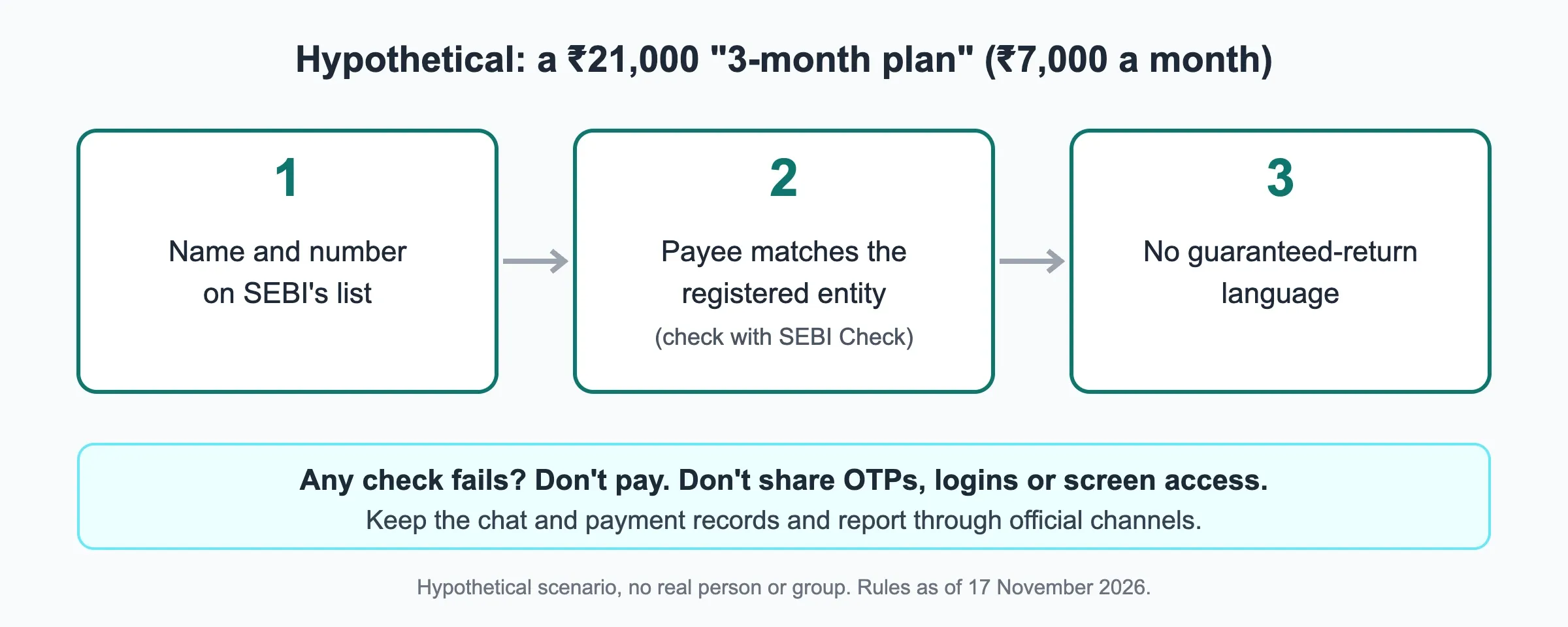
If all three pass, you still decide whether the service is worth ₹21,000 to you. If any one fails, don't pay, don't share your trading login, OTPs or screen access, and report it through the routes below.
Where do I complain if someone unregistered took money for advice?
Which route fits depends on who you dealt with.
- If the person or firm is SEBI registered: raise the complaint with them first, in writing. If it isn't resolved, file it on SCORES, SEBI's online complaint system (scores.sebi.gov.in). SEBI launched the upgraded SCORES 2.0 in April 2024, aimed at faster resolution with set timelines and a review stage if you aren't satisfied. Disputes with registered entities can also go to online dispute resolution through the SMART ODR portal.
- If the person is not registered: SCORES is built for complaints against registered entities, so also alert SEBI through its official contact channels and share screenshots, payment receipts and chat records.
- If money was taken by fraud: report it promptly on the national cyber-crime portal (cybercrime.gov.in) or the 1930 helpline, and inform your bank. Speed matters for any chance of tracing a transfer.
- Watch the official warnings: SEBI and the stock exchanges publish cautions about unregistered entities and impersonation. Check them before you act on a tip.
Keep the chat, the payment proof and the claimed registration number. That record makes a complaint workable.
What to do next
Bookmark SEBI's intermediary search on sebi.gov.in and check before you pay anyone. When you are ready to compare mutual fund schemes yourself, read how to choose a mutual fund. If someone is pitching you derivatives tips, read SEBI's F&O loss study first.
This article is for education only. It is not investment, legal or tax advice, and it does not recommend any adviser, analyst, distributor or product.
— Laabh