NSDL vs CDSL: What a Depository Does, Why Your Broker Picks It, and Where It Shows Up in Your Statements
NSDL vs CDSL explained: both SEBI-regulated depositories, your DP picks one. Tell them apart by account ID and CAS, with dated facts.
Summarize this article with AI





The short version
- NSDL and CDSL both hold securities electronically under the Depositories Act, 1996 and SEBI regulations.
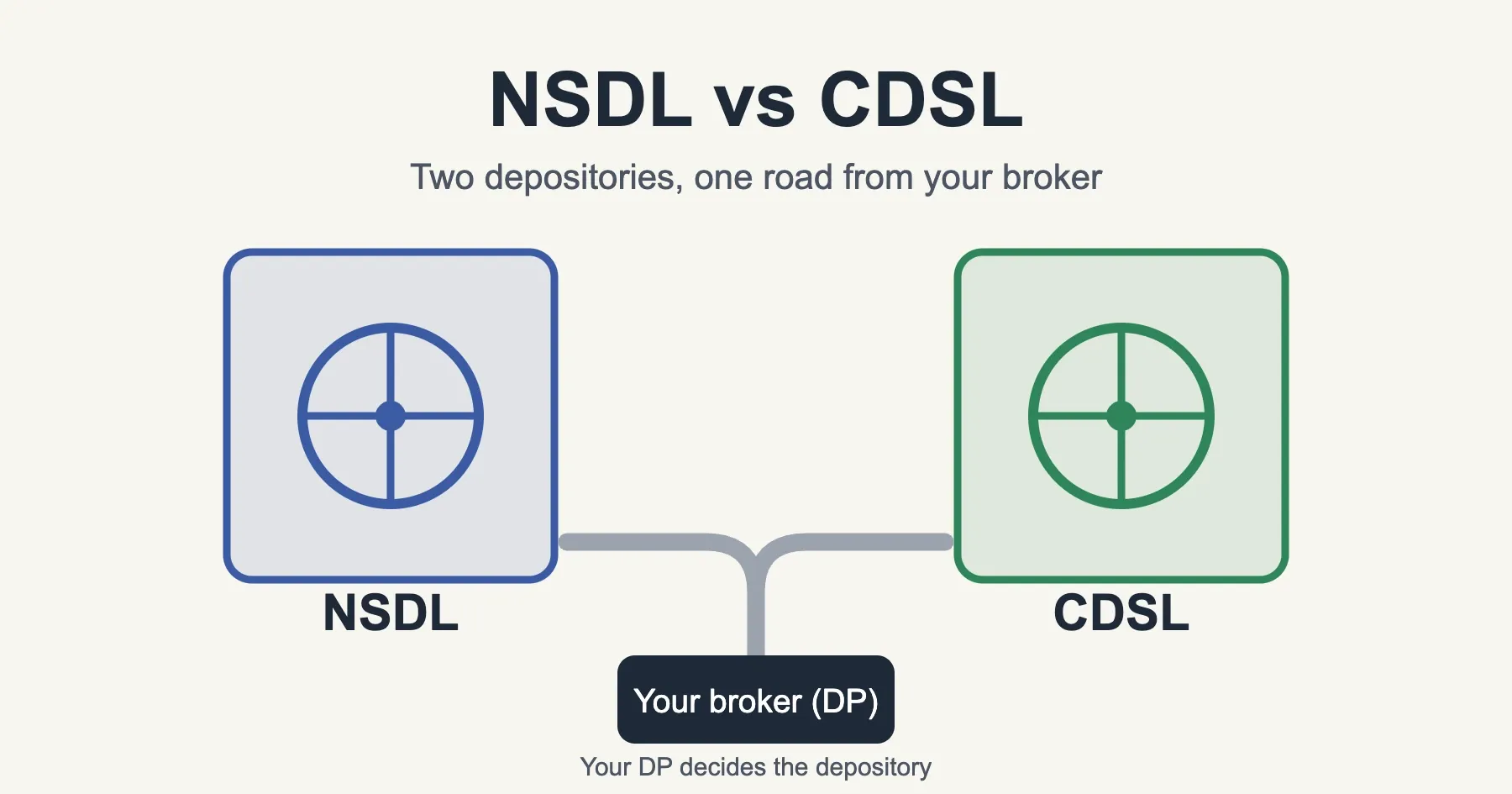
- You choose a DP; the DP decides the depository.
- An NSDL ID starts with "IN"; a CDSL ID is 16 digits, all numeric. Your welcome email and CAS also name the depository.
- With accounts on both, the depository where you opened your account earlier sends your CAS by default, and you can change that through your DP.
- Account counts and custody values differ, and neither makes one depository a better choice for you.
As of 22 November 2026: NSDL and CDSL are India's two depositories, the institutions that hold your shares, ETF units and other securities in electronic form. Both operate under the Depositories Act, 1996 and SEBI's Depositories and Participants Regulations, 2018. You do not pick one directly; the broker or bank you open your demat account with (your depository participant, or DP) is linked to a depository. For an investor, the practical NSDL vs CDSL differences are in account numbers, statements and login screens, not in how safe your holdings are.
Nikita, 27, a product designer in Pune, has two demat accounts. Her welcome emails mention CDSL for one and NSDL for the other, and her monthly statement arrives from only one of them. This page explains why, using her paperwork.
What a depository does, and what a DP does
Think of it as a four-step chain:
- You place an order or hold securities.
- Your DP (the broker or bank that opened your demat account) maintains your account and passes your instructions on.
- The depository (NSDL or CDSL) records which securities sit in your account in electronic form.
- The company or fund keeps its register of holders, updated from the depository's records.
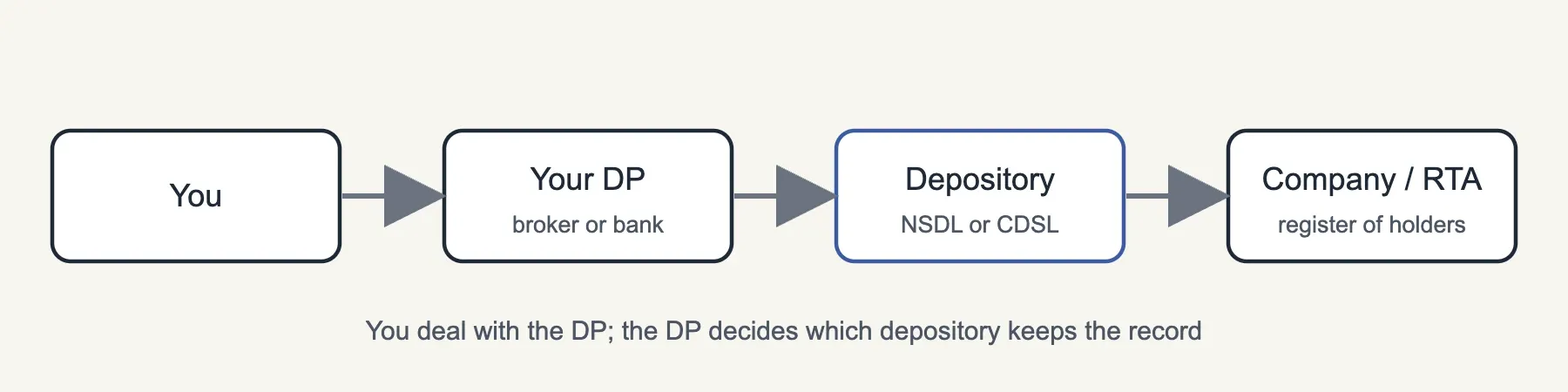
The depository is the record-keeper; the DP is the shop counter where you deal with it. You never open an account directly with NSDL or CDSL. Our guide on what a demat account is covers the account itself, and how the stock market works in India follows one buy order into it.
NSDL vs CDSL: the dated facts
Figures below come from each depository's own website, checked on 22 November 2026. Note the different dates and definitions before comparing them.
| NSDL | CDSL | |
|---|---|---|
| Full name | National Securities Depository Ltd | Central Depository Services (India) Ltd |
| Started | Established August 1996; operations from November 1996 | Founded 1999 |
| Demat accounts | 4,76,91,191 active client accounts (about 4.77 crore), as of 31 October 2026 | 19,34,06,915 investor accounts excluding closed ones (about 19.34 crore), as of 30 September 2026 |
| Value held in custody | ₹542.26 lakh crore, as of 31 October 2026 | About ₹89.04 lakh crore (₹8,90,36,746 million), as of 30 September 2026 |
| Depository participants | 326 | 591 |
| Stock exchange listing | Listed on BSE in August 2025 | Listed on NSE in 2017 |
Two patterns stand out. CDSL has more accounts; NSDL holds far more value. Large institutions and custodians tend to hold big blocks of securities, which can push custody value up without adding many accounts. Neither number says anything about which depository is "better" for you.
Both depositories are listed companies. That fact is mentioned here only for context: this page takes no view on either company's shares.
Which one am I on? Read your account ID
The surest check is your account opening email, your DP's statement or your CAS: each names the depository. The account ID also gives it away:
- NSDL: the ID starts with the letters "IN": an 8-character DP ID ("IN" plus six digits) followed by an 8-digit client ID, for example IN30xxxx xxxxxxxx.
- CDSL: the ID is 16 digits, all numbers, for example 12xxxxxx xxxxxxxx.
Here is Nikita's setup (hypothetical holdings and prices; no securities named):
| Account 1 | Account 2 | |
|---|---|---|
| Opened | 2023, with Broker A | 2026, with Broker B |
| ID (masked) | 12xxxxxx xxxxxxxx | IN30xxxx xxxxxxxx |
| Depository | CDSL (16 digits, all numeric) | NSDL ("IN" prefix) |
| Holdings | 30 ETF units at ₹412.50 = ₹12,375; 12 shares at ₹1,580 = ₹18,960 | 25 shares at ₹96.40 = ₹2,410 |
| Account value | ₹31,335 | ₹2,410 |
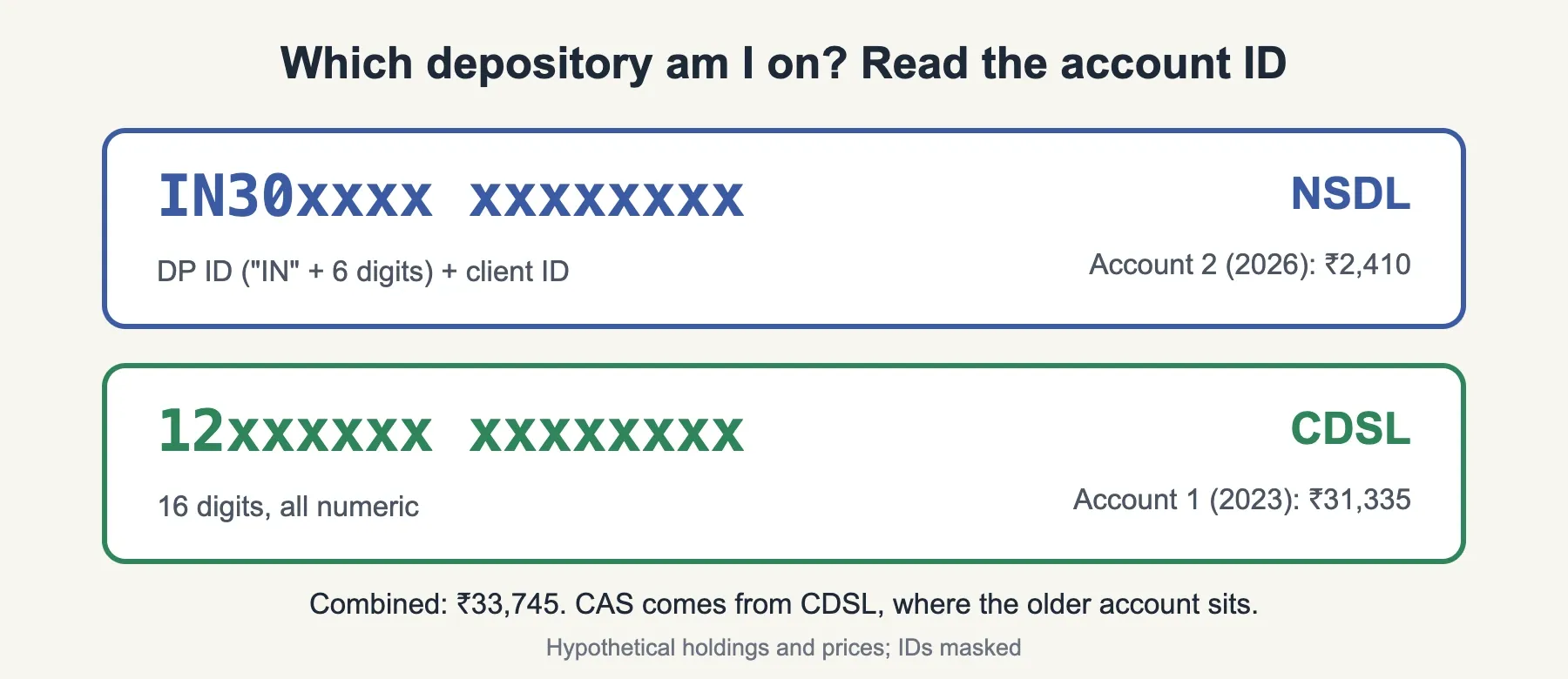
Her combined demat value is ₹31,335 + ₹2,410 = ₹33,745.
Can I choose, and does it matter?
You choose a DP, and the DP decides the depository. If you specifically want an account on the other depository, you would open it with a DP linked to that depository. Many people end up on both without planning it, as Nikita did.
For day-to-day investing, the same SEBI regulations govern both depositories and every DP registered under them. What differs is operational: the ID format, which depository's website or app shows your holdings, which one sends your statement, and how certain authorisations reach you.
Where the depository shows up in your life
Your CAS and the "default depository"
The Consolidated Account Statement (CAS) puts all your demat accounts and mutual fund units held with mutual fund registrars (RTAs) in one statement, matched on your PAN. According to CDSL's CAS FAQ, if you hold demat accounts with both depositories, the one where your account was opened earlier becomes the default depository and sends the CAS. You can ask to change the default depository by informing your DP.
For Nikita, Account 1 (CDSL, 2023) is older, so CDSL sends her CAS. It lists both demat accounts, totalling ₹33,745 in this example, plus any mutual fund folios under her PAN.
The same FAQ says a CAS is sent monthly when there is a transaction in any of your demat accounts or folios in that month, and half-yearly otherwise (holdings as of March and September, sent in April and October). Our CAS walkthrough explains each section, and tracking all your mutual funds with PAN covers what a CAS can miss.
Selling shares: authorising the debit
When you sell, shares leave your demat account, and that debit needs your authorisation. Depending on your DP, this may be a one-time authorisation you give your broker or a prompt (such as a PIN or OTP) that comes from the depository linked to your account. If an authorisation message names NSDL while your broker's app talks about CDSL, check which account the sale is from; the message comes from that account's depository.
Moving shares between accounts on different depositories
If Nikita wants her 25 shares (₹2,410 in the example) in Account 1, the move is an inter-depository transfer: she instructs her NSDL DP (Broker B) to deliver them to her CDSL account. Ask the sending DP about its charges and the details it needs before you start.
Is one safer than the other?
No ranking is possible from public rules: both depositories are market infrastructure institutions set up under the same law and regulated by SEBI, and your DP is SEBI-registered either way. Your holdings are recorded in your name with whichever depository your DP uses.
The risk that matters more is the market itself. Holding shares in a demat account, on either depository, does not protect you from a fall in their price.
Frequently asked questions
What is the difference between NSDL and CDSL?
Both are SEBI-regulated depositories that hold securities in electronic form. Your DP decides which one your account is on. The differences you notice are operational: account ID format, which one sends your statement and where authorisations come from.
Which is better, NSDL or CDSL?
There is no verdict to give. Both work under the same law and SEBI regulations. Choose your DP on service and charges; the depository follows from that choice.
How do I know if my demat account is with NSDL or CDSL?
Check your account opening email, DP statement or CAS. An NSDL account ID starts with "IN"; a CDSL account ID is 16 digits, all numeric.
Why did I get my CAS from CDSL (or NSDL)?
If you have demat accounts on both depositories, the one holding the account you opened earlier is your default depository and sends the CAS. You can ask your DP to change the default.
Can I transfer shares from NSDL to CDSL?
Yes, through an inter-depository transfer. You instruct the DP where the shares currently sit to move them to your account on the other depository. Charges are set by that DP, so ask before you start.
Save this checklist
Before you open or review a demat account, note three things: your account ID and what it says about the depository, which depository sends your CAS, and your DP's charges for transfers. Keep this page handy for the next time "NSDL" or "CDSL" appears in your inbox.