What are CAMS and KFintech? The record-keepers behind your mutual fund emails
CAMS and KFintech are SEBI-registered RTAs that keep your mutual fund records and send your emails. They don't hold your money. Here's who does what.
Summarize this article with AI





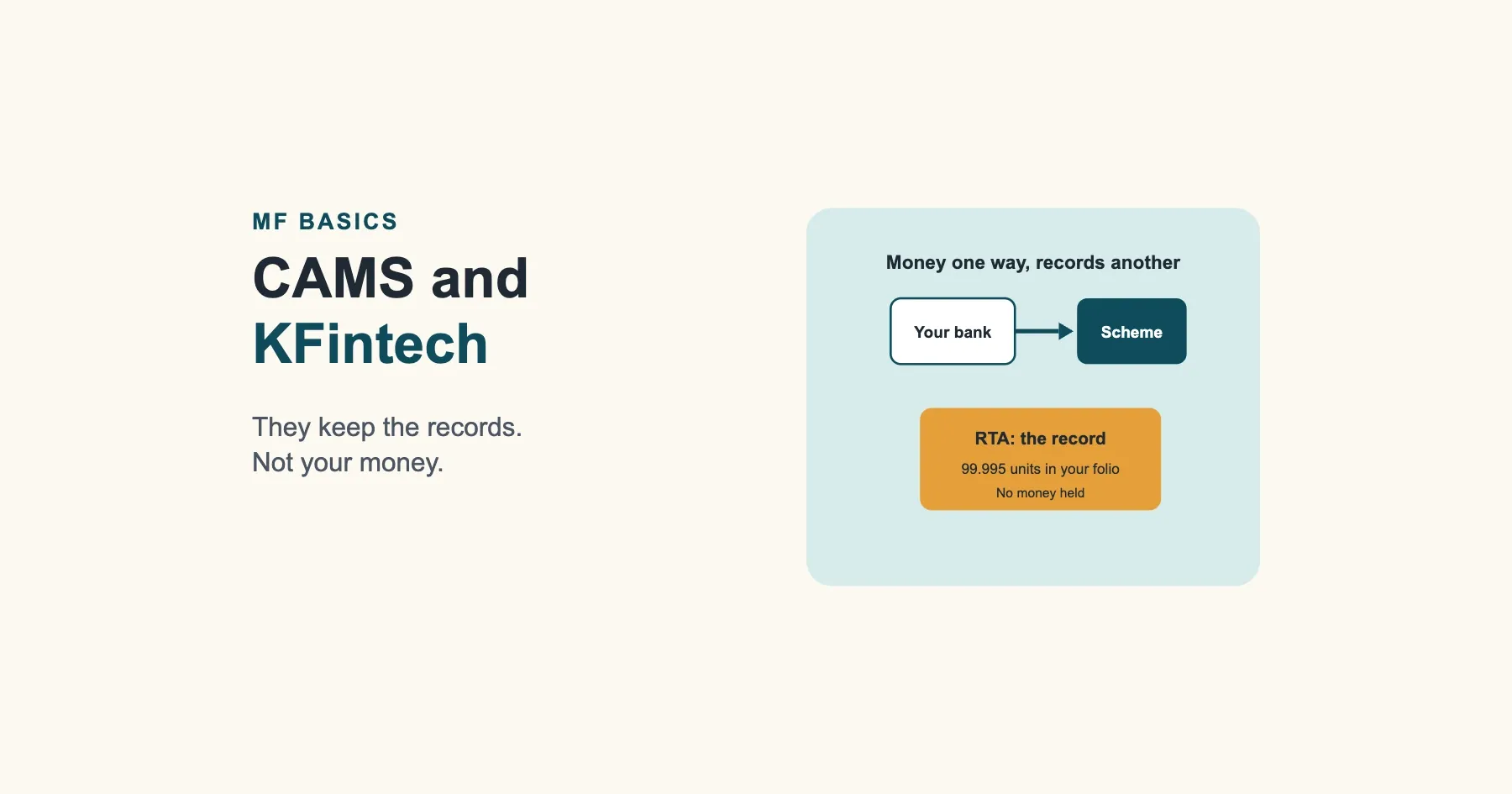
The short version
- CAMS and KFintech are SEBI-registered RTAs that keep mutual fund records for the fund houses that appoint them.
- They allot units, update your folio and send confirmations; they don't hold your money.
- Your fund's assets are held by a custodian, with trustees overseeing the fund house.
- KRA (your KYC) and RTA (your folio) are different roles; MFCentral is a joint service platform of the two RTAs.
- KFintech is the renamed Karvy Fintech.
CAMS and KFintech are registrars and transfer agents (RTAs) registered with SEBI. Fund houses hire them to keep investor records: they process SIP registrations, allot units, update bank and nominee details and send statements. They don't hold your money; the scheme's assets are held by a custodian under the fund's trustees.
Divya, 29, started her first SIP from Dehradun last month. The fund house she picked is one name, yet the confirmation email came from another: an RTA. If you're asking what CAMS and KFintech are, and why they email you about money you gave someone else, this page places each one in your own SIP journey.
Quick disambiguation: five names you'll see
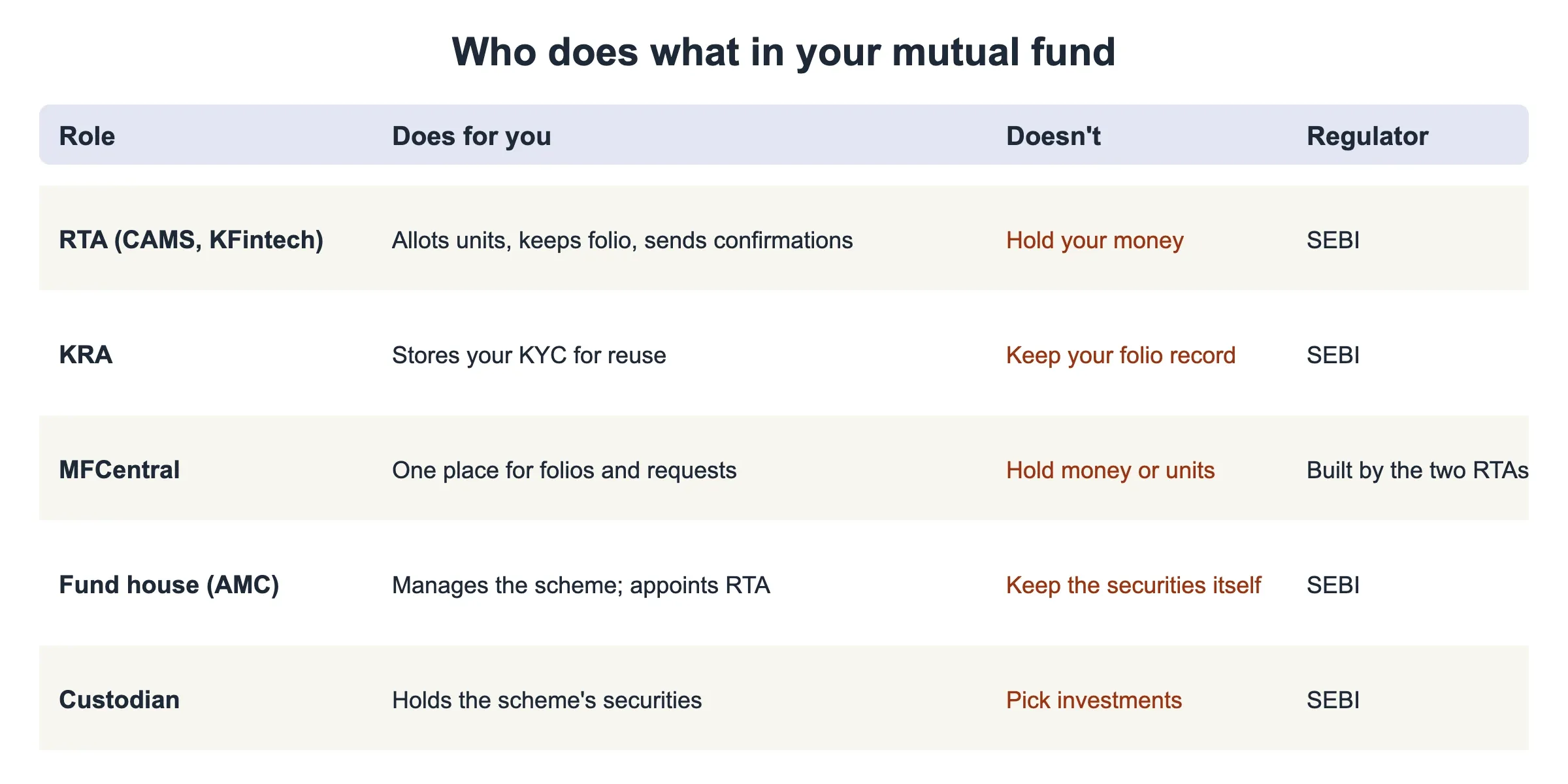
| Name | What it is | What it does for you |
|---|---|---|
| Fund house (AMC) | Manages the scheme's money | Picks investments; appoints the RTA |
| RTA (CAMS or KFintech) | Record-keeper for the fund house | Allots units, updates your folio, sends confirmations |
| KRA | KYC registration agency | Stores your KYC once for use across the market |
| MFCentral | Platform built by CAMS and KFintech | One place to view folios and make service requests |
| Custodian | Holds the scheme's securities | Safekeeping, under the trustees' oversight |
What is CAMS and why does it email me about my mutual fund?
CAMS (Computer Age Management Services) is a registrar and transfer agent. An RTA is the back office a fund house appoints to keep the register of who owns how many units. You don't choose it; the fund house does. That is why two SIPs with two fund houses can bring emails from two different RTAs.
The emails follow your activity. When your SIP is registered, when an instalment buys units, when you redeem, or when you change your address, bank or nominee, the RTA updates your folio (your account number with that fund house) and writes to you. Its other jobs include:
- recording each purchase and redemption at the applicable NAV;
- processing service requests such as bank mandate, nominee and contact changes;
- handling transmission of units to nominees or legal heirs after an investor's death;
- sending account statements for the folios it services.
What does KFintech do, and is it the same as Karvy?
KFintech (KFin Technologies) does the same RTA job for the fund houses that appoint it. It is the company once known as Karvy Fintech. A stock-exchange filing records the name change from Karvy Fintech Private Limited to KFin Technologies Private Limited effective 5 December 2019, and the company now trades as KFin Technologies Limited.
So older pages that say "CAMS and Karvy" mean the same two record-keepers, and "Karvy" on an old statement means today's KFintech.
Are CAMS and KFintech holding my money?
No. The angle to remember: the RTA keeps the records of your units; it doesn't keep your money.
Your SIP instalment moves from your bank to the scheme's own account, not to the RTA. The securities the scheme buys are held by a custodian, and the trustees oversee the fund house on investors' behalf. The RTA's job is to write down that you now own a certain number of units.
For what happens to those assets if a fund house itself closes, read what happens if an AMC shuts down.
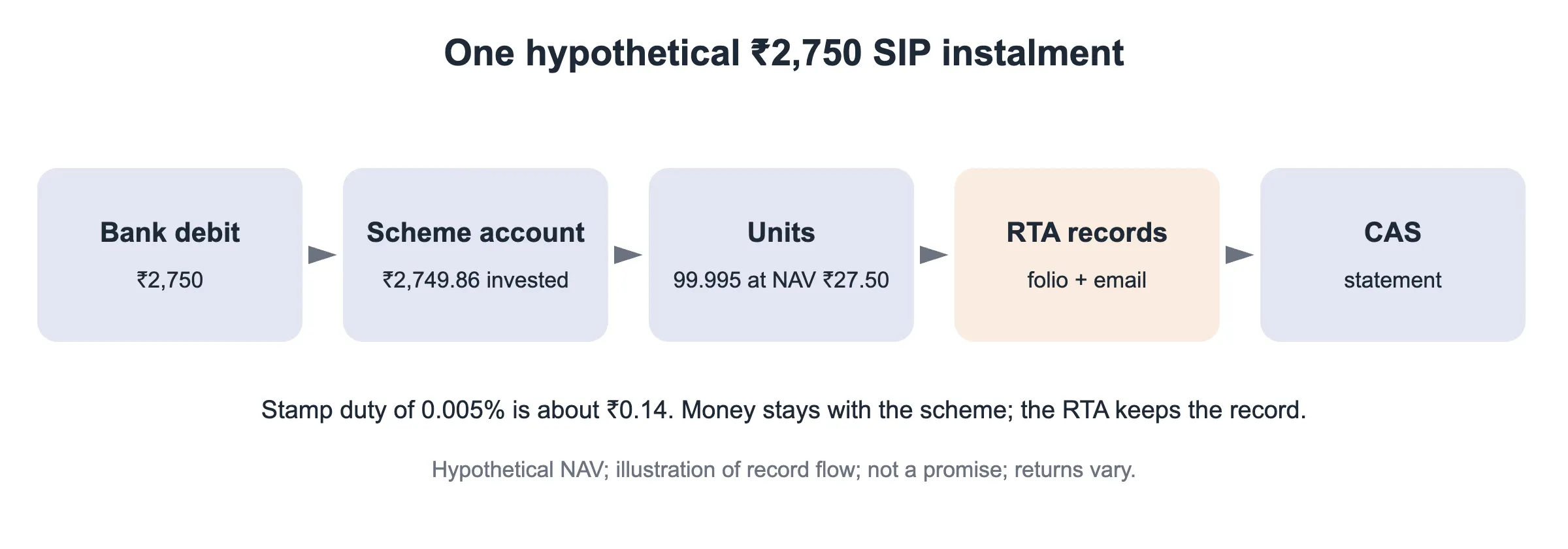
Where the RTA shows up in one SIP instalment
Here is one hypothetical instalment followed from bank to statement. Hypothetical NAV; illustration of record flow; not a promise; returns vary.
- Debit. ₹2,750 leaves your bank account on the SIP date.
- Stamp duty. Stamp duty of 0.005% applies to mutual fund purchases, about ₹0.14 here, so roughly ₹2,749.86 is invested.
- Units. At a NAV of ₹27.50, ₹2,749.86 buys about 99.995 units (2749.86 ÷ 27.50).
- Record. The money sits in the scheme's account. The RTA records 99.995 units in your folio and emails a confirmation.
- Statement. The units then appear in your Consolidated Account Statement (CAS).
Who sends the CAS depends on your PAN. If your PAN is linked to a demat account, the depository (NSDL or CDSL) sends one CAS covering both your demat holdings and your mutual fund folios. If not, the CAS for your folios comes from the mutual fund side, through the RTAs. Under SEBI's 2024 framework the CAS is emailed by default: monthly in a month with a transaction, and half-yearly otherwise.
Is CAMS KRA the same as CAMS the registrar?
No. A KRA (KYC registration agency) is a different role with its own SEBI registration under the KYC Registration Agency Regulations, 2011. When you complete KYC once, a KRA stores the record so every fund house and broker can check it instead of asking you again.
CAMS and KFintech each have a KRA business in their groups, which is why "CAMS KRA" appears on KYC status pages. Your KYC record (the KRA side) and your folio record (the RTA side) are separate. A KYC status of "on hold" is fixed through KYC, not through the RTA that services your folio. Our guide to mutual fund KYC online explains each status: mutual fund KYC online.
What is MFCentral, and how does it relate to CAMS and KFintech?
MFCentral is a common platform that CAMS and KFintech built together after a SEBI push to make servicing easier for investors. Its first phase, for non-financial requests, went live in September 2021; a mobile app and financial transactions followed in 2023. In November 2024 the two RTAs announced they would move it into a separate company with equal ownership.
For you, it means one place to see folios serviced by both RTAs, download statements and raise requests such as contact, bank or nominee changes, instead of going to each fund house. It does not keep your money. It is also where you can lock a folio with a mutual fund debit freeze.
Common mix-ups to avoid
- Thinking a "Karvy" statement is fake. It is the older name for KFintech.
- Sharing an OTP or PIN. Genuine RTA emails confirm what happened; they don't ask you to read out an OTP. Never share an OTP or PIN with anyone. Make changes only through the official websites and apps linked from your fund house's site, and check the sender's domain before you click.
Frequently asked questions
Can I change my bank or nominee through the RTA?
Yes. You can usually request these through the fund house, the RTA's own service channels or MFCentral, with verification such as an OTP that you enter yourself.
Is an RTA email asking for my OTP genuine?
Treat it as suspicious. An OTP is meant for you to type into an official site or app you opened yourself, never to send back by email, phone or chat. Check the sender's domain and, if unsure, contact the fund house directly.
Who sends my CAS?
If your PAN is linked to a demat account, a depository (NSDL or CDSL) sends a combined CAS. Otherwise it comes from the mutual fund side through the RTAs. Both are emailed by default: monthly when there is a transaction, half-yearly otherwise.
Does the RTA handle claims after an investor's death?
Yes. Transmission of units to a nominee or legal heir is processed by the RTA for the fund house, based on the documents submitted.
Is the RTA regulated?
Yes. Registrars and transfer agents are registered with SEBI under its Registrars to an Issue and Share Transfer Agents Regulations, and you can look up registered intermediaries on SEBI's website.
Read next
See where these records show up: our section-by-section guide to reading your CAS explains every line the RTA or depository sends you: how to read your mutual fund CAS.
— Laabh



