How to Open a Demat Account in 2026: Documents, What It Costs to Keep, and the New Nominee Step
How to open a demat account in 2026: documents, steps, BSDA charges and the new nominee or opt-out rule. No minimum balance.
Summarize this article with AI





The short version
- A mutual fund SIP needs no demat; shares, ETFs and IPO allotments do.
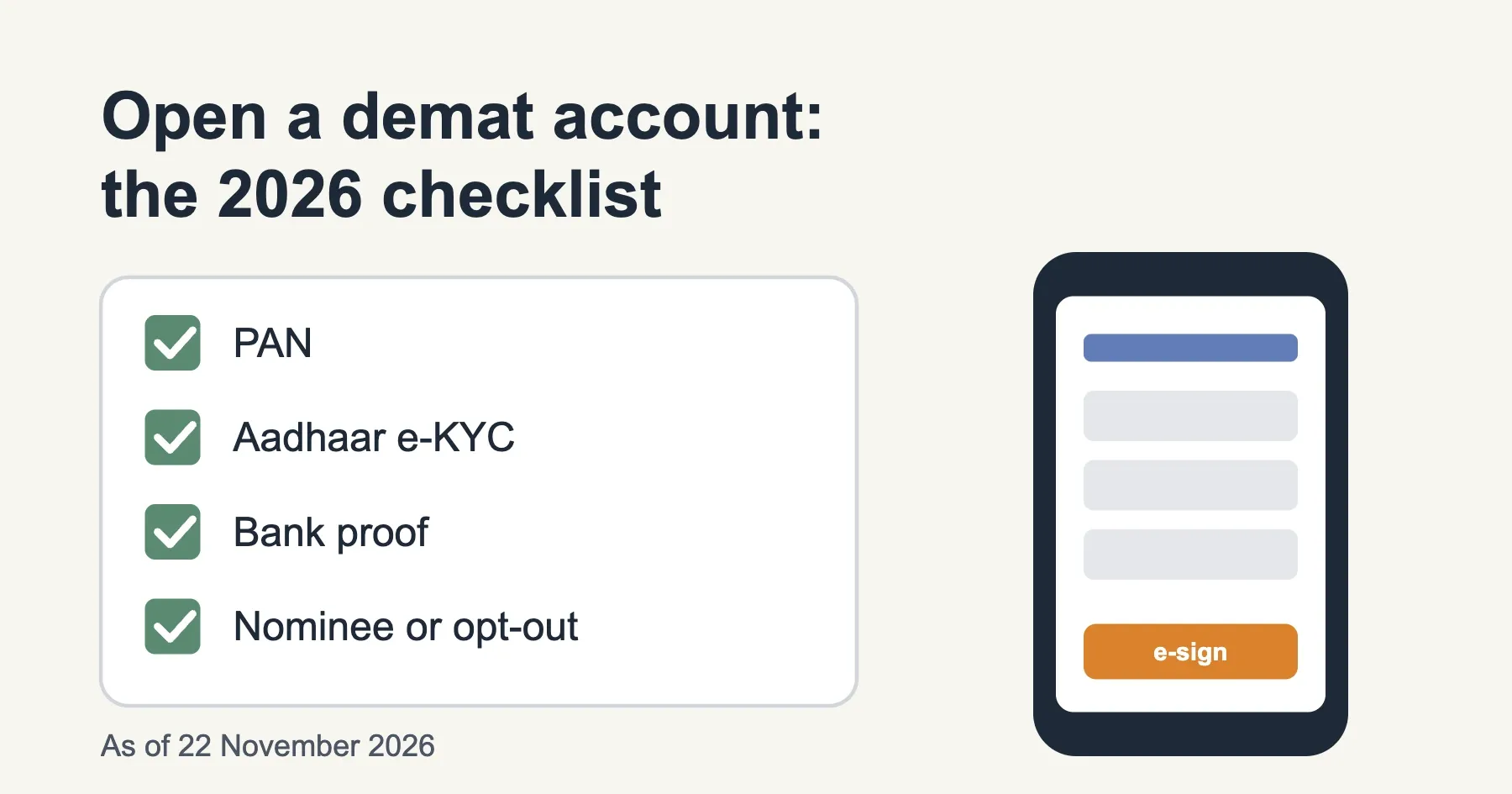
- Keep PAN, Aadhaar, bank proof, photo and signature, mobile and email ready; income proof only for derivatives.
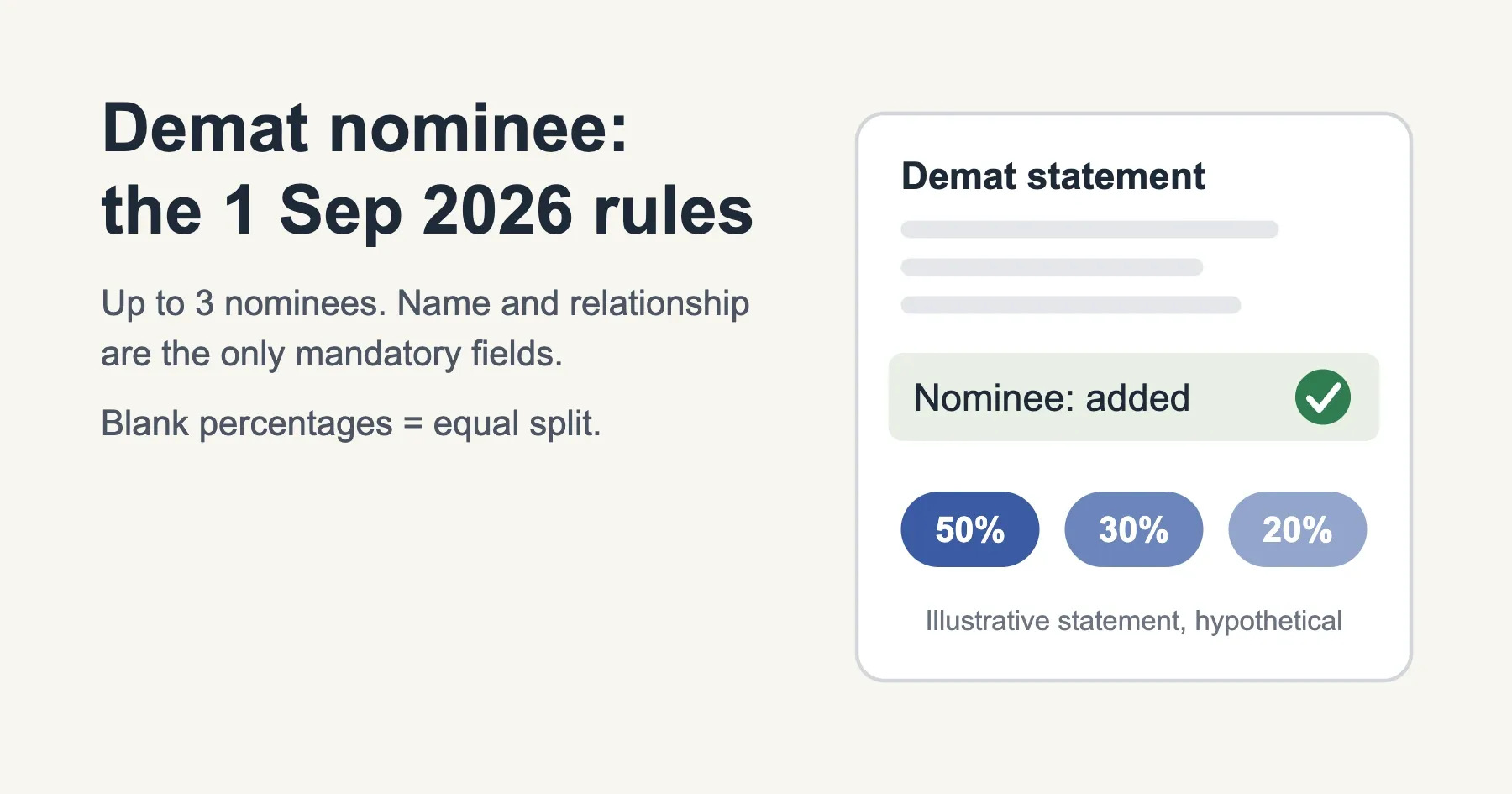
- From 1 September 2026, a single-holder account needs a nominee (up to three) or an opt-out declaration.
- There is no minimum balance; an eligible BSDA pays no AMC up to ₹4 lakh and at most ₹100 a year up to ₹10 lakh.
- Your DP's tariff sheet shows what the account costs.
As of 22 November 2026: to open a demat account online, you pick a SEBI-registered depository participant (DP), complete KYC with your PAN and Aadhaar-based e-KYC, link a bank account, e-sign the forms and, since 1 September 2026, either name up to three nominees or sign an opt-out declaration. A demat account holds securities, not cash, so there is no balance to maintain. What you pay is the DP's charges, and an eligible Basic Services Demat Account (BSDA) pays no annual maintenance charge while holdings stay up to ₹4 lakh.
Pallavi, 24, has a first job in Nagpur and wants to buy her first ETF units. She wants the checklist first: does she need a demat at all, which papers to keep ready, what it costs each year, and what the new nominee step asks.
First: do you need a demat account?
| You want to | Demat needed? | Why |
|---|---|---|
| Start a mutual fund SIP | No | SEBI's FAQ for MF investors says units can be held in a statement of account or in demat form |
| Buy shares on NSE or BSE | Yes | Shares bought on an exchange are credited to your demat account |
| Buy ETF units on an exchange | Yes | ETF units are bought and sold on the exchange like shares |
| Get shares allotted in an IPO | Yes | Allotted shares are credited to your demat account |
Starting with a ₹1,000 monthly SIP? Skip this for now: see mutual funds without a demat. For shares you need a trading account (your broker places orders) linked to a demat account (holds what you own); see what a demat account is.
Who can open a demat account
| Who | Can open? | What to confirm with your DP |
|---|---|---|
| Resident adult | Yes | Your own PAN and KYC |
| Minor | Yes, through a guardian | The guardian's KYC and the minor's proof of age |
| NRI | Yes | The account type, which depends on whether money is repatriable |
| Joint holders | Yes | KYC for every holder; nomination is optional for joint accounts |
Documents required for a demat account
| Item | Needed by | Notes |
|---|---|---|
| PAN | Everyone | Your KYC is tied to it |
| Aadhaar (e-KYC or DigiLocker) or another address proof | Everyone | Verified by OTP online |
| Cancelled cheque or bank statement | Everyone | Name should match PAN |
| Photograph and signature | Everyone | Often captured in the flow |
| Mobile number and email | Everyone | For OTPs and alerts |
| Nominee name and relationship (date of birth if the nominee is a minor), or an opt-out | Single-holder accounts, from 1 September 2026 | Up to three nominees |
| Income proof (salary slip, ITR or bank statement) | Only for derivatives | Not needed for shares or ETFs |
Done KYC for a mutual fund? Check its status with our KYC status guide.
How to open a demat account online, step by step
1. Pick a SEBI-registered depository participant
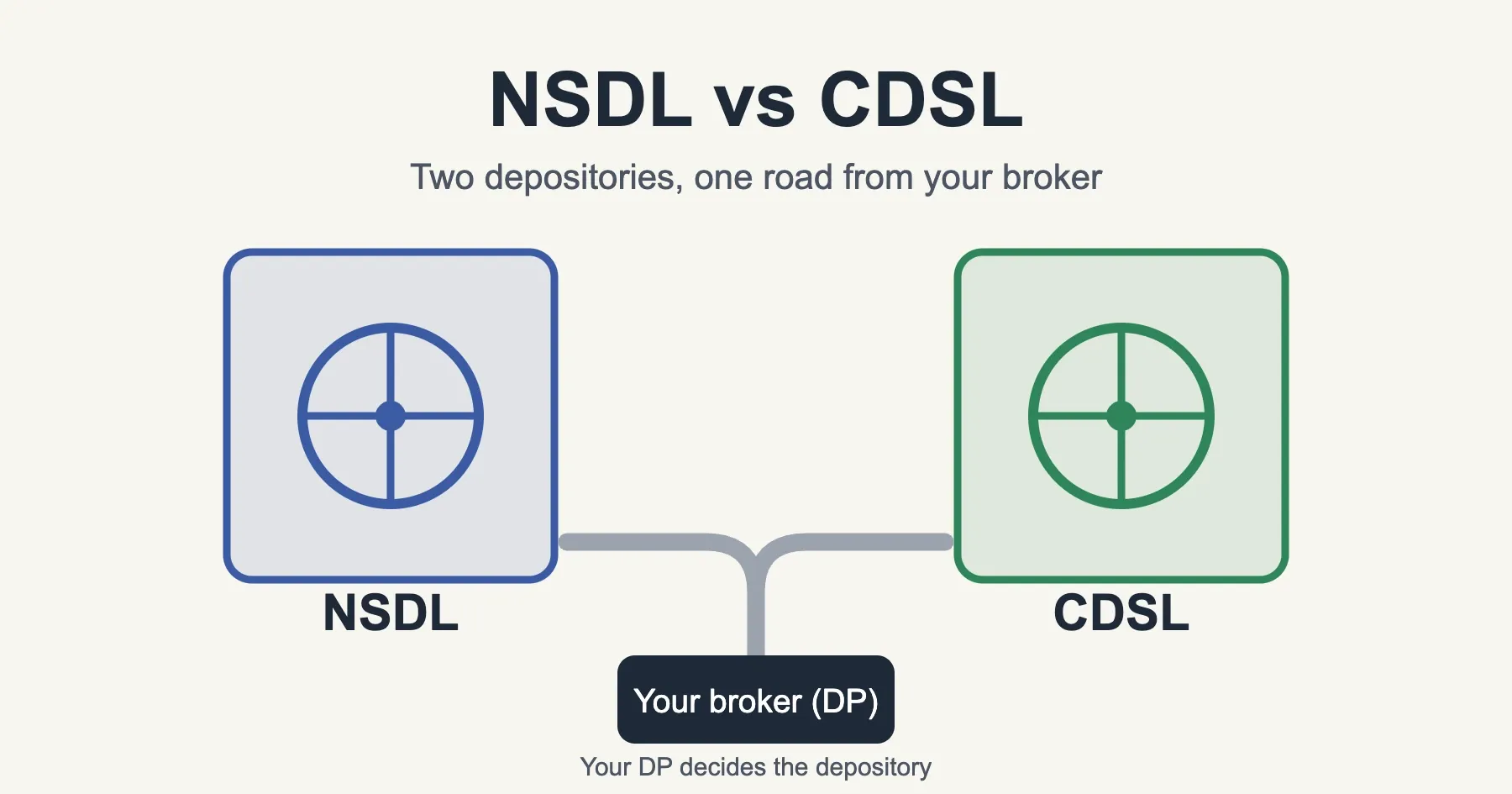
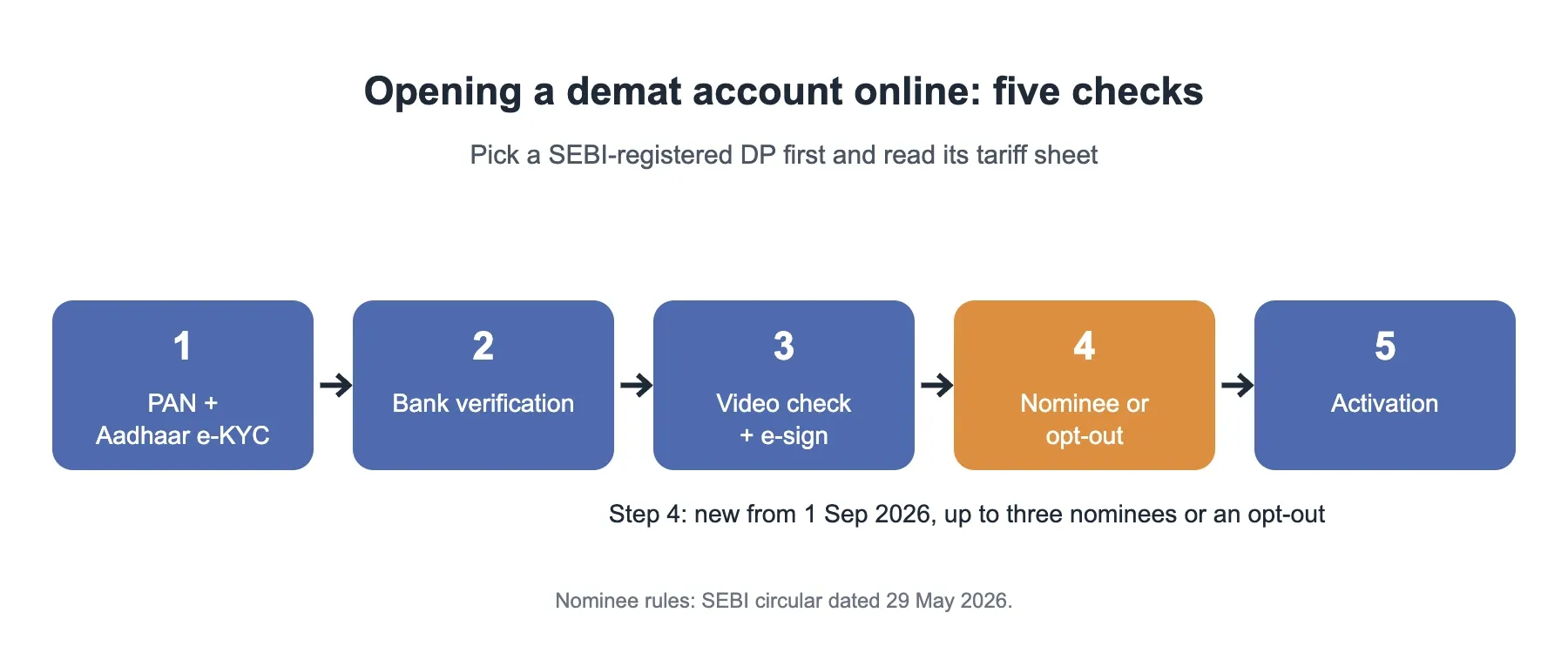
A DP is the agent of a depository (NSDL or CDSL), often the same firm as your broker; see NSDL vs CDSL. CDSL's account-opening FAQ suggests choosing one based on convenience and charges. Check the DP is on SEBI's list of registered depository participants and download its tariff sheet.
2. PAN and Aadhaar e-KYC or DigiLocker
You enter your PAN and the DP checks for existing KYC; Aadhaar e-KYC or DigiLocker fills in identity and address. A name or date-of-birth mismatch across PAN, Aadhaar and bank is the usual reason an application stalls.
3. Bank account verification
You link a bank account in your own name; many DPs verify it by crediting a token amount and matching the name.
4. Video or in-person verification and e-sign
Online applications usually include a short in-person verification, often by video, then an Aadhaar OTP e-sign.
5. Nominee or opt-out (new from 1 September 2026)
SEBI's circular SEBI/HO/OIAE/OIAE_IAD-3/P/CIR/2026/12676 dated 29 May 2026 says the investor "shall mandatorily provide nomination, unless declaration form for 'opt-out' is submitted", for accounts in a single name. Effective 1 September 2026:
- Up to three nominees; only name and relationship are mandatory, plus date of birth for a minor nominee.
- Contact details, percentage shares and guardian details are optional; unspecified shares are split equally.
- Online, you confirm by e-sign, digital signature or an OTP; you can change it any number of times.
- Joint accounts: nomination is optional, but all holders must consent to any change.
6. Segments, DDPI and what you're signing
Turn on only the segments you will use; equity cash covers shares and ETFs. A Demat Debit and Pledge Instruction (DDPI) lets the broker debit securities to settle your sales. It is optional: without it, you authorise each sale with the depository, usually by OTP.
7. Activation
When checks clear, you receive your DP ID and client ID. The regulator sources we checked set no fixed number of days.
Minimum amount and charges
- Minimum balance: none. The account holds securities, not cash.
- Opening fee: CDSL's account-opening FAQ says no account opening charges apply besides statutory charges.
- Annual maintenance charge (AMC): set by your DP; a BSDA follows the SEBI slabs below.
- Other charges and GST: such as a fee when you sell; see the tariff sheet.
| Value of holdings in a BSDA | Annual maintenance charge |
|---|---|
| Up to ₹4 lakh | Nil |
| Above ₹4 lakh and up to ₹10 lakh | Up to ₹100 a year |
| Above ₹10 lakh | No longer a BSDA; regular AMC may apply |
Debt and other securities count together, and you must be an individual who is first or sole holder of only one demat account.
Worked example: three-year upkeep at three holding sizes
Hypothetical, not a recommendation. Pallavi has one demat; holdings stay at the same value for three years (real prices move and can change the slab). BSDA at the SEBI cap; regular AMC a hypothetical ₹500 a year; GST and transaction charges left out.
| Holdings | BSDA eligible? | BSDA AMC a year | BSDA, 3 years | Regular AMC a year (hypothetical) | Regular, 3 years |
|---|---|---|---|---|---|
| ₹60,000 | Yes | ₹0 | ₹0 | ₹500 | ₹1,500 |
| ₹6 lakh | Yes | Up to ₹100 | Up to ₹300 | ₹500 | ₹1,500 |
| ₹12 lakh | No | Not applicable | Not applicable | ₹500 | ₹1,500 |
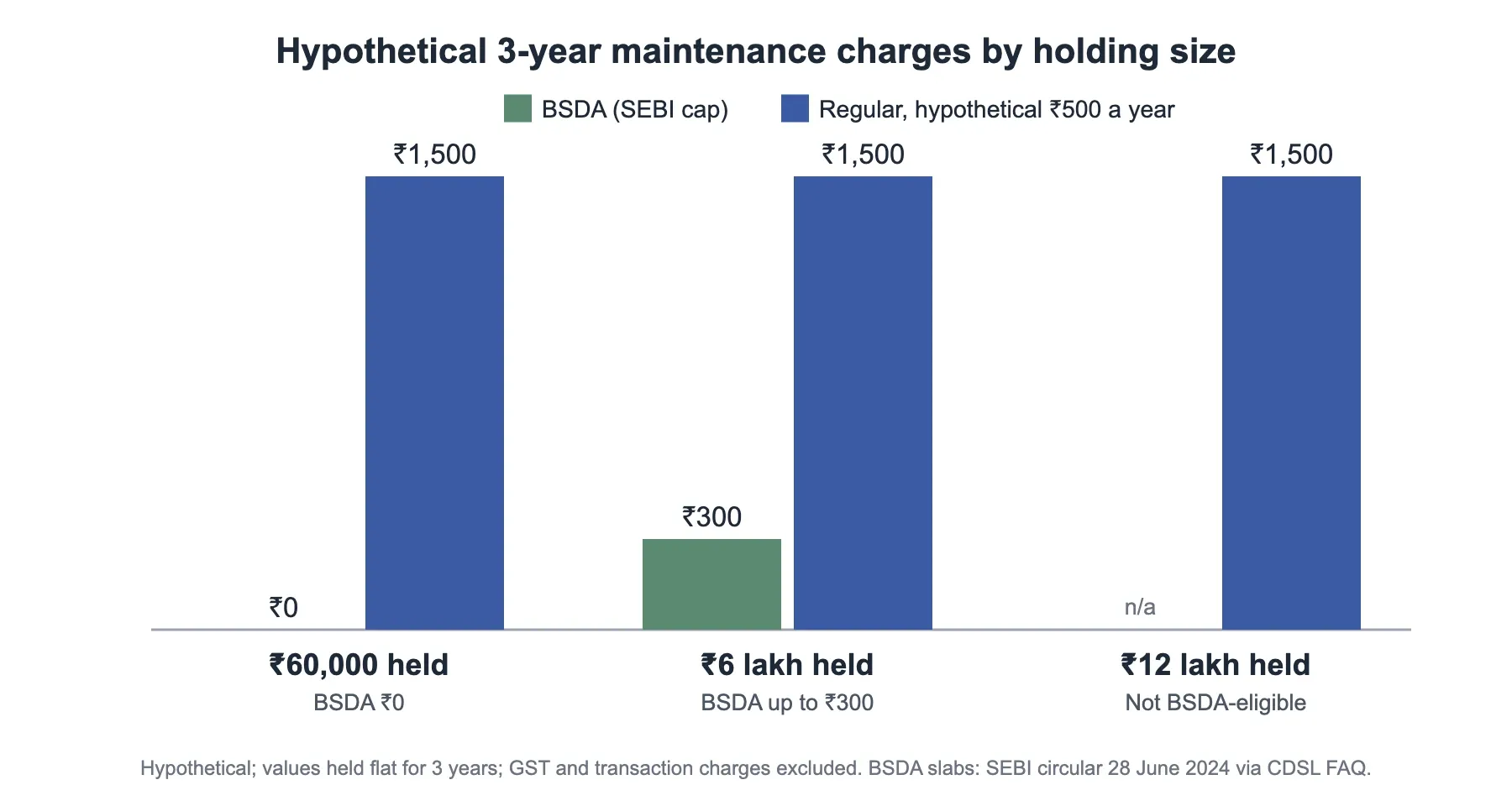
Over three years the BSDA costs ₹1,500 less at ₹60,000 and at least ₹1,200 less at ₹6 lakh; at ₹12 lakh the regular tariff applies.
Pallavi needs no opening balance; her first purchase costs one share or ETF unit plus charges. By contrast, a ₹1,000 monthly SIP for three years puts in ₹36,000 with no demat and no AMC.
Mistakes to avoid
- Several accounts: a second demat as first holder ends BSDA eligibility, and each carries its own AMC.
- Every segment ticked: derivatives carry higher risk; switch them on only if you understand them.
- DDPI unread: it is optional; know what it allows.
- Careless nominee details: review nominees after marriage or a birth.
- Skipping the tariff sheet: it shows your actual charges.
For what happens after you buy, follow one order through the system in how the stock market works.
Frequently asked questions
What documents are required to open a demat account in India?
As of 22 November 2026: PAN, Aadhaar for e-KYC (or another address proof), bank proof, photo and signature, and a mobile number and email. Single holders also give nominee details or an opt-out. Income proof is usually needed only for derivatives.
Is there a minimum amount to open a demat account?
No. A demat holds securities, not cash, so there is no balance to keep. You pay charges: an eligible BSDA pays no annual maintenance charge up to ₹4 lakh of holdings and at most ₹100 a year up to ₹10 lakh.
Do I need a demat account to invest in mutual funds?
No. SEBI's FAQ says mutual fund units can be held in a statement of account or in demat form. You need a demat for shares, ETF units and IPO allotments.
Is adding a nominee compulsory when opening a demat account?
From 1 September 2026, a single-holder demat account needs a nominee (up to three) or an opt-out declaration (SEBI circular, 29 May 2026). For joint accounts it is optional.
How long does it take to open a demat account online?
The regulator sources we checked set no timeline. It depends on how fast KYC, bank verification, video verification and e-sign clear; matching names and dates of birth across PAN, Aadhaar and bank avoids common delays.
Save this checklist
Save this checklist and tick off each item before you apply. Starting with a mutual fund? You don't need a demat.