Share Buyback Tax in 2026: How Your Tendered Shares Are Taxed Now, and How the Rules Changed Since 2024
From 1 April 2026, buyback proceeds are taxed as capital gains, not dividend. The three-regime timeline, with one ₹ example run through each.
Summarize this article with AI





The short version
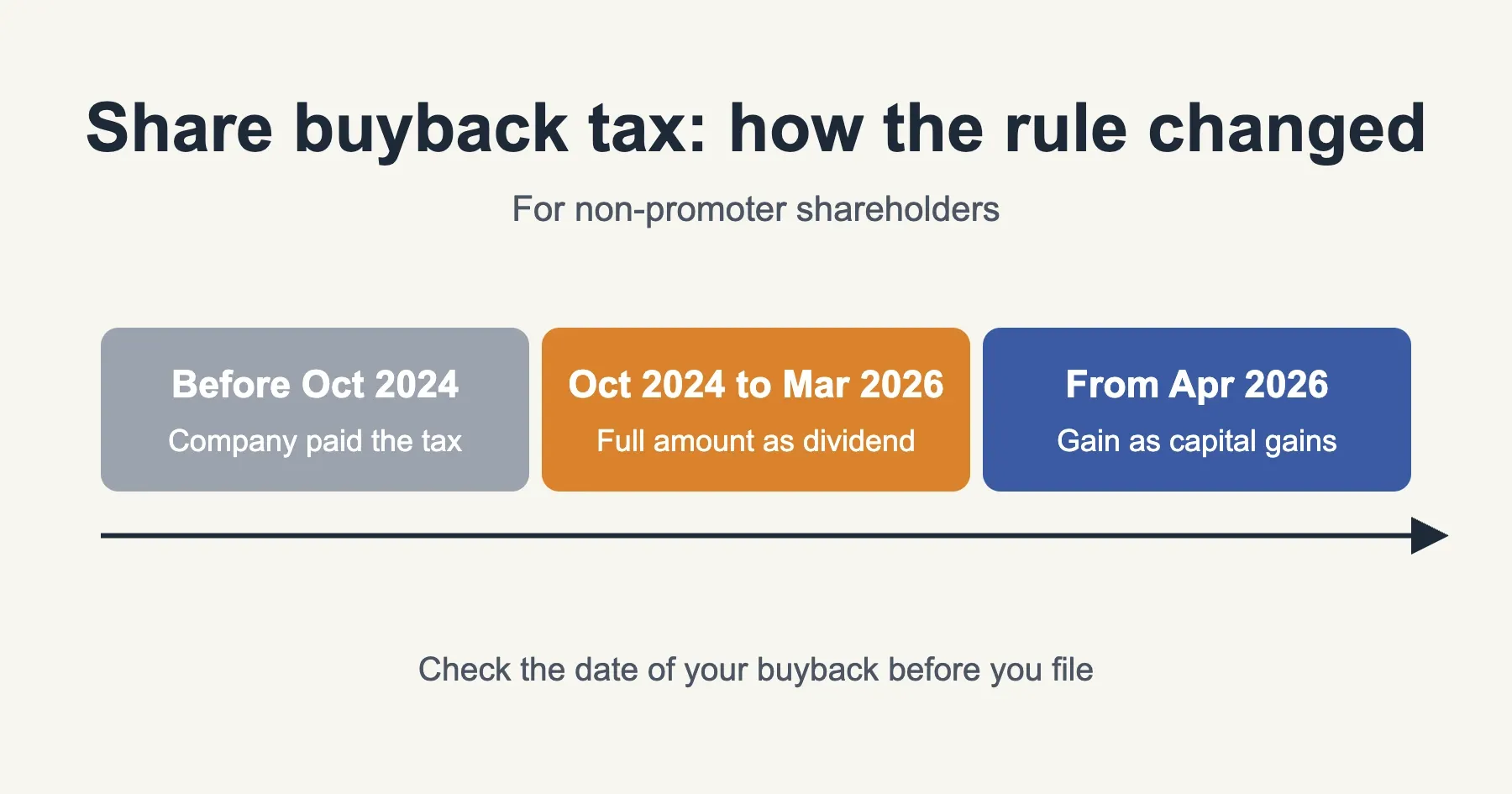
- From 1 April 2026, non-promoter shareholders pay capital gains tax on buyback proceeds minus cost, not dividend tax on the full amount.
- From 1 October 2024 to 31 March 2026, the full proceeds were taxed as dividend and the cost became a capital loss.
- Before 1 October 2024, the company paid the buyback tax and the shareholder did not.
- The acceptance ratio decides how many of your tendered shares are bought; the rest return to your demat account.
- Check your buyback date against the timeline before you file.
If you are not a promoter, the money you receive when a company buys back your shares is now taxed as capital gains: the buyback price minus what you paid, at the short-term or long-term rate for listed shares. This rule applies to buybacks on or after 1 April 2026, after the Finance Act 2026 amended the Income-tax Act, 2025. For a buyback before that date, an older rule applied, so the date of your buyback decides which one you use.
Kavya, 29, in Kochi, saw a banner in her broker app: "Buyback offer open." Every article she found said the whole amount would be taxed as dividend. That was true from 1 October 2024 to 31 March 2026, and is no longer the rule. Below, the three regimes sit on one dated timeline, with one example run through each.
What a buyback is and how a tender offer works
A buyback is a company purchasing its own shares from existing shareholders. In a tender offer, it offers a fixed price to everyone who held shares on a set day, under the SEBI (Buy-back of Securities) Regulations, 2018. New to how shares sit in your account? See what a demat account holds. The usual sequence:
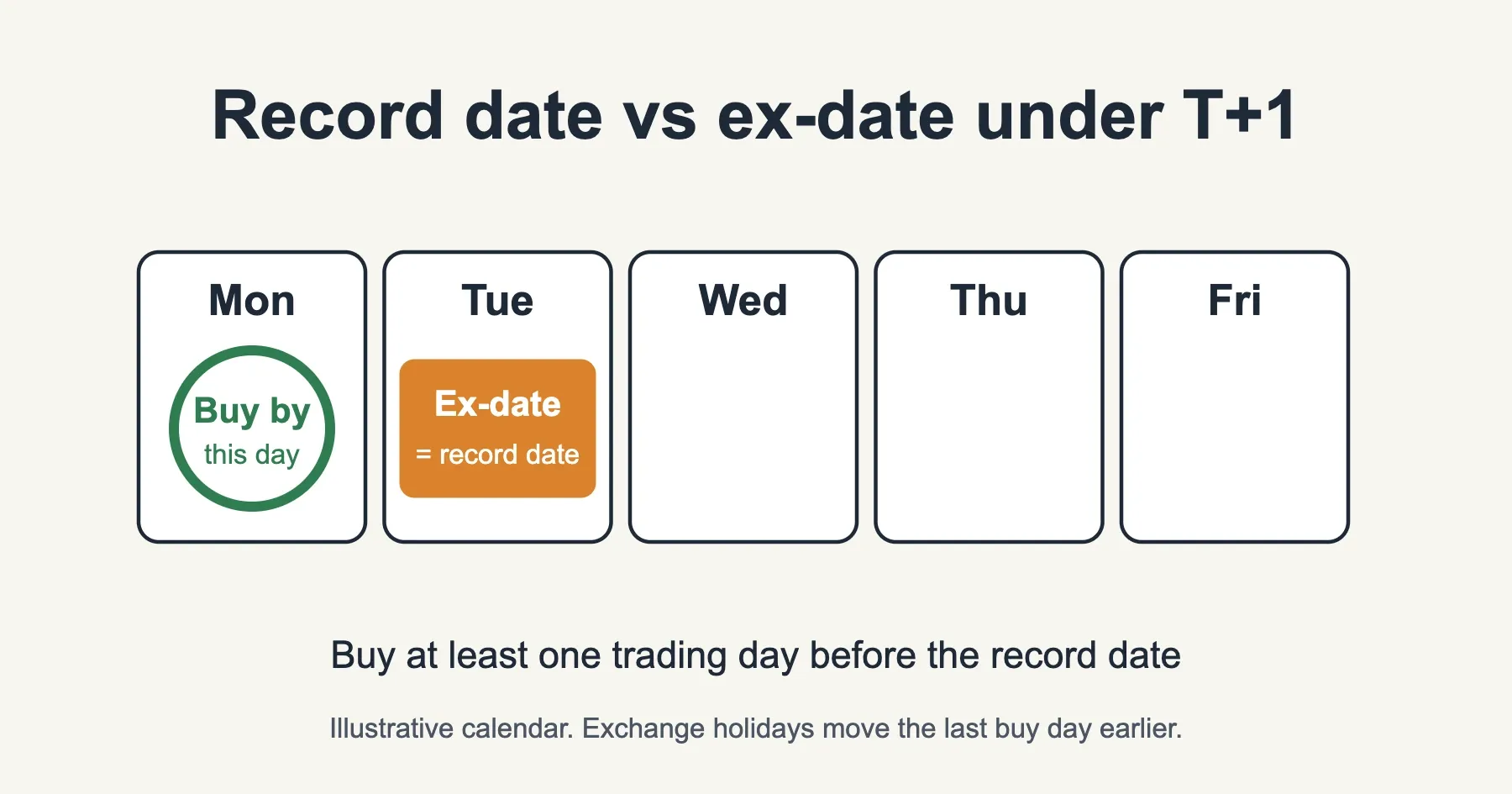
- Record date. You must hold the shares in your demat account on this date to take part.
- Entitlement. The offer letter tells you how many shares you are entitled to tender, based on your holding.
- Tender window. You place a tender request through your broker during the offer period. You may offer more than your entitlement or fewer.
- Acceptance. If more shares are offered than the company wants to buy, only part of each tender is accepted. The share of your tendered shares that is actually bought is the acceptance ratio.
- Settlement. Money for accepted shares reaches your bank account; unaccepted shares are returned to your demat account.
Hypothetically, tender 120 shares with 40 accepted and the acceptance ratio is 40 / 120 = 33.33%; the other 80 shares come back to you.
How buybacks are taxed now (from 1 April 2026)
The Finance Act 2026 removed buyback money from the definition of "dividend" in section 2(40) of the Income-tax Act, 2025, and taxes it under section 69 as capital gains, with effect from 1 April 2026 for tax year 2026-27 onwards, per the Income Tax Department's Notes on Clauses. In plain terms, your taxable amount is:
Buyback price received minus your cost of acquisition = capital gain (or loss).
Short-term vs long-term: holding period and rates
For listed equity shares, the rates are 20% on short-term gains (held 12 months or less; section 196 of the Income-tax Act, 2025) and 12.5% on long-term gains (held more than 12 months), with long-term gains on listed equity exempt up to ₹1.25 lakh in a year (section 198). Surcharge and cess may apply. Check the rate and exemption in your filing utility, as Budgets change them.
Promoters are taxed differently
Promoters pay an additional income tax on top of normal capital gains tax, for an effective rate reported as 22% for a domestic company promoter and 30% for other promoters. The rest of this page assumes you are not a promoter.
The three regimes on one timeline
| Buyback date | How a tendering shareholder is taxed | Who pays the tax |
|---|---|---|
| Before 1 October 2024 | Proceeds not taxed in your hands; the company paid a separate buyback tax | Company |
| 1 October 2024 to 31 March 2026 | Full proceeds taxed as dividend at your slab rate; your cost of the shares becomes a capital loss | You |
| From 1 April 2026 | Proceeds minus cost taxed as capital gains (short-term or long-term) | You |
The sources read for this page say the new rule applies to buybacks "on or after 1st April, 2026" but do not say whether the record, acceptance or payment date decides a buyback that straddles it. If yours was near 31 March 2026, confirm with a tax professional.
Worked example run through all three regimes
Hypothetical: you bought 120 shares at ₹400 each (cost ₹48,000) 20 months ago. The company offers ₹520 a share in a tender buyback. You tender all 120 and, at an assumed acceptance ratio of 33.33%, 40 are accepted.
- Proceeds for accepted shares: 40 × ₹520 = ₹20,800
- Cost of those 40 shares: 40 × ₹400 = ₹16,000
- Gain: ₹20,800 − ₹16,000 = ₹4,800
- Holding: 20 months, so long-term
| Regime | What is taxable in your hands | Tax on it (hypothetical) |
|---|---|---|
| Before October 2024 | ₹0 (company paid its own tax) | ₹0 for you |
| October 2024 to March 2026 | ₹20,800 as dividend; ₹16,000 capital loss | ₹4,160 at an assumed 20% slab rate |
| From April 2026 | ₹4,800 long-term capital gain | ₹0 if within the yearly exemption; ₹600 at 12.5% if the exemption is already used |
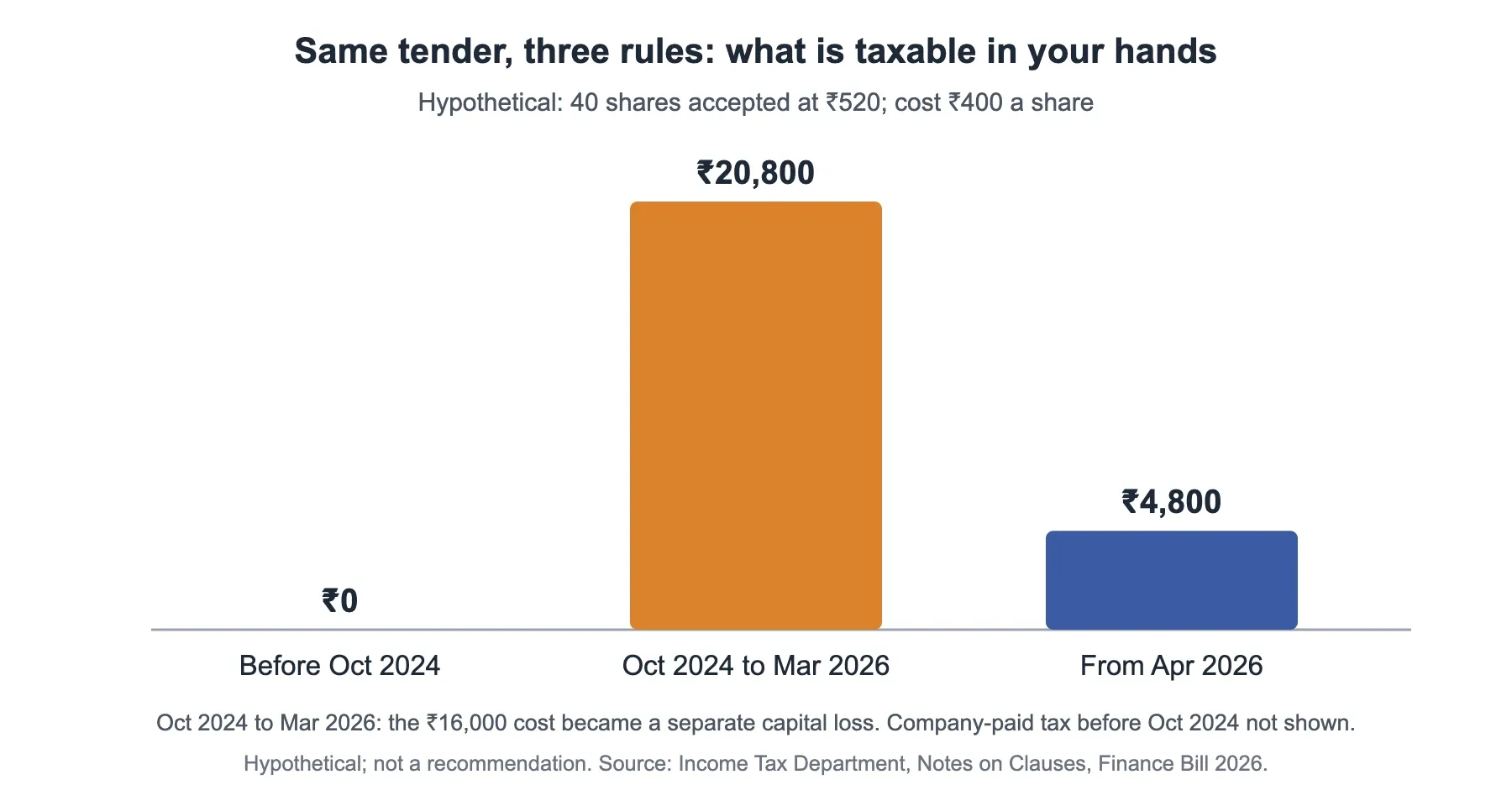
The middle row explains the confusion. Under the 2024 rule, you were taxed on ₹20,800 though your real profit was ₹4,800; the ₹16,000 capital loss helped only if you had capital gains to set it against, now or later under the carry-forward rules. Under the current rule, the taxable figure matches the actual profit.
The 80 unaccepted shares (cost ₹32,000) are not taxed at this point. They are taxed only when you sell them later, like any other shares.
Tender or sell in the market? Factors, not a recommendation
This page takes no view on any buyback. Factors people weigh:
- Acceptance ratio. Only part of what you tender may be bought, and the final ratio is known only after the offer closes.
- Unaccepted shares come back. They return to your demat account at whatever the market price is then, which can be lower than before the offer.
- Tax. From 1 April 2026, both routes are taxed as capital gains, so tax is less of a deciding factor than it was. Hypothetically, selling 40 shares in the market at ₹500 gives proceeds of ₹20,000 and a gain of ₹4,000, against ₹4,800 from the tender; both are long-term here.
- Costs. Brokerage and charges on either route depend on your broker.
If the mechanics of a market sale are unfamiliar, see how the stock market works in India.
How it shows in your capital-gains statement and ITR
Your broker's capital-gains statement should list accepted shares as a sale, with the buyback price as sale value and your purchase price as cost. A buyback from 1 April 2026 goes in the capital gains schedule of your return, as short-term or long-term, like any listed share sale. For a buyback between 1 October 2024 and 31 March 2026, the proceeds were dividend income (under "income from other sources") and the cost was a capital loss.
Schedule names can change with the new Act's forms, so verify with the current ITR form before filing. For another listed-share example, see tax on IPO listing gains.
Frequently asked questions
How is a share buyback taxed for retail shareholders in 2026?
For buybacks on or after 1 April 2026, non-promoter shareholders are taxed on the gain (buyback price minus cost) as short-term or long-term capital gains. This follows the Finance Act 2026 amendment to section 69 of the Income-tax Act, 2025.
Is buyback money still taxed as dividend?
Not for buybacks from 1 April 2026. It was, for buybacks from 1 October 2024 to 31 March 2026, when the full amount counted as dividend and the cost became a capital loss. If your buyback was close to 31 March 2026, confirm which rule applies with a tax professional.
Should I tender my shares in a buyback or sell in the market?
That depends on the acceptance ratio, the gap between the buyback and market price, what happens to unaccepted shares, and your costs. From April 2026, both routes are taxed as capital gains, so tax matters less to the choice than before. This page does not recommend either route.
What is the acceptance ratio in a buyback?
It is the share of your tendered shares that the company actually buys. If you tender 120 shares and 40 are accepted, the ratio is 33.33%, and the remaining 80 shares are returned to your demat account.
How do I show buyback income in my ITR?
For a buyback from 1 April 2026, report it in the capital gains schedule as a sale of listed shares, using your broker's capital-gains statement. Form and schedule names can change, so verify with the current ITR form before filing.
Save this timeline
Save the three-regime table and check it against your offer letter's dates before you file.