IPO Lot Size and Minimum Investment: How Many Shares You Must Apply For, and the Most a Retail Investor Can Bid
IPO lot size explained: one lot costs ₹10,000-15,000 on the mainboard, retail bids go up to ₹2 lakh, and SME IPOs need more.
Summarize this article with AI





The short version
- A lot is the smallest bundle of shares you can bid for; bids go in whole multiples of it.
- Mainboard minimum application value is ₹10,000 to ₹15,000 (ICDR Reg. 47(2)); work it out at the upper end of the price band.
- A retail individual investor bids for not more than ₹2 lakh; maximum lots = ₹2,00,000 ÷ one-lot value, rounded down.
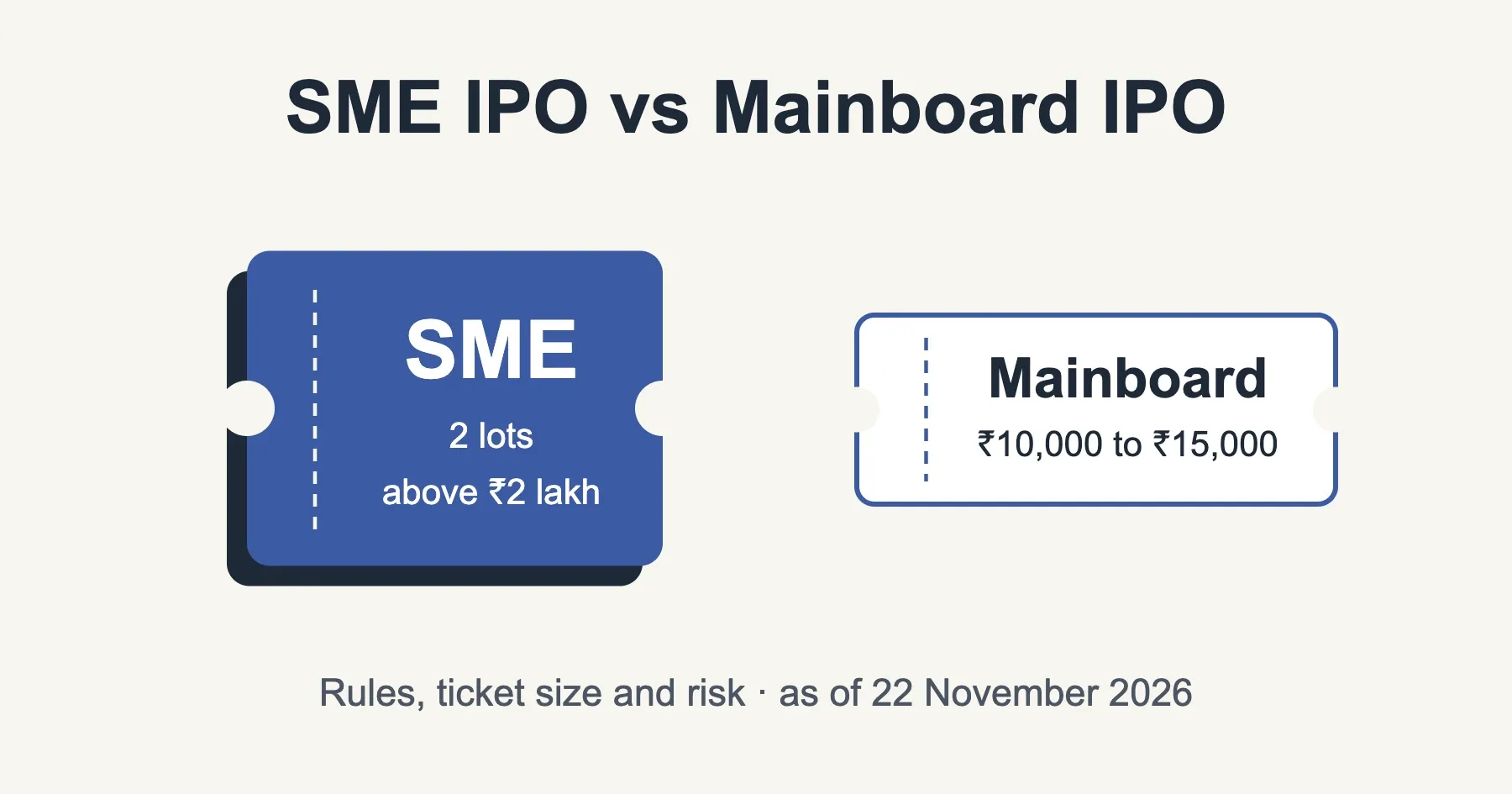
- SME IPOs currently need two lots above ₹2 lakh; SEBI's October 2026 proposal of ₹1 lakh is not yet a rule.
- More lots in an oversubscribed retail book do not raise your chance of getting one lot.
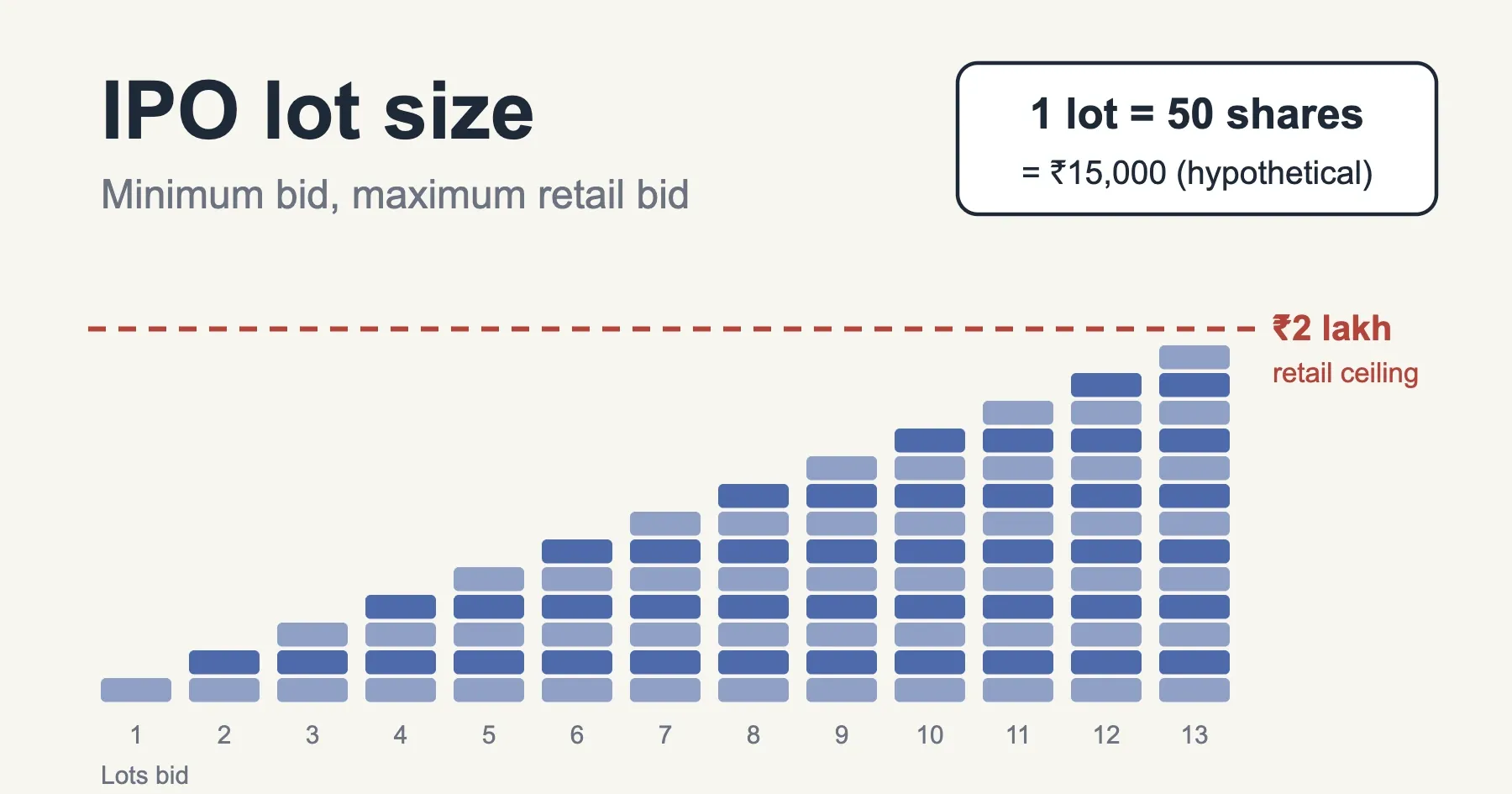
As of 25 November 2026: an IPO lot size is the minimum number of shares you must bid for, and every bid has to be a whole multiple of that lot. On a mainboard IPO, SEBI's rules keep the minimum application value between ₹10,000 and ₹15,000, and a retail individual investor can bid for up to ₹2 lakh. SME IPOs currently ask for a minimum of two lots worth more than ₹2 lakh, and a SEBI proposal from October 2026 to lower that is not yet a rule.
Ishita, 27, in Nagpur, has a new demat account, a UPI-linked bank account and ₹40,000 set aside for her first IPO application. An issue page shows "Price band ₹285 to ₹300, lot size 50." She wants to know what one lot costs, how many lots she may bid for, and why an SME issue needed more than ₹2 lakh. Every price band here is hypothetical; no real issue is named.
What a lot size is and why IPOs use one
The lot size (also called the minimum bid lot or market lot) is the smallest bundle of shares an IPO accepts in one bid. With a 50-share lot you can bid for 50, 100 or 150 shares, not 37. SEBI's Issue of Capital and Disclosure Requirements (ICDR) Regulations, 2018 require applications to be made in multiples of the minimum application value (Regulation 47(3)).
A fixed bundle gives the issue a clean unit to allot: SEBI's allotment rule for retail applicants is written in terms of "the minimum bid lot".
How the lot size is set
Regulation 47(2) of the ICDR Regulations (as amended up to 21 March 2026) says the minimum application size on a mainboard IPO must fall within a minimum application value of ₹10,000 to ₹15,000. The issuer and its lead managers announce the price band and choose a lot that lands in that range. Two hypothetical issues, sized near ₹15,000 at the upper end:
| IPO A (hypothetical) | IPO B (hypothetical) | |
|---|---|---|
| Price band | ₹285 to ₹300 | ₹1,120 to ₹1,180 |
| Lot size | 50 shares | 12 shares |
| One lot at the upper price | ₹15,000 | ₹14,160 |
| One lot at the lower price | ₹14,250 | ₹13,440 |
A costlier share means fewer shares in a lot, not a bigger minimum. At ₹300, any lot from 34 to 50 shares would sit inside the ₹10,000 to ₹15,000 range; IPO A's issuer picked 50.
Minimum investment: one lot at the upper price band
Formula 1: Minimum bid = 1 lot × lot size × upper end of the price band
- IPO A: 1 × 50 × ₹300 = ₹15,000
- IPO B: 1 × 12 × ₹1,180 = ₹14,160
Why the upper end? If you bid at the cut-off price (explained below), the amount kept aside in your bank account is worked out at the top of the band, and you only learn the final price after bidding closes.
Maximum for a retail investor: the ₹2 lakh ceiling
The ICDR Regulations define a retail individual investor (RII) as "an individual investor who applies or bids for specified securities for a value of not more than two lakhs rupees" (Regulation 2(1)(vv)). In a book-built mainboard issue, not less than 35% of the net offer is set aside for RIIs (Regulation 32(1)(a)).
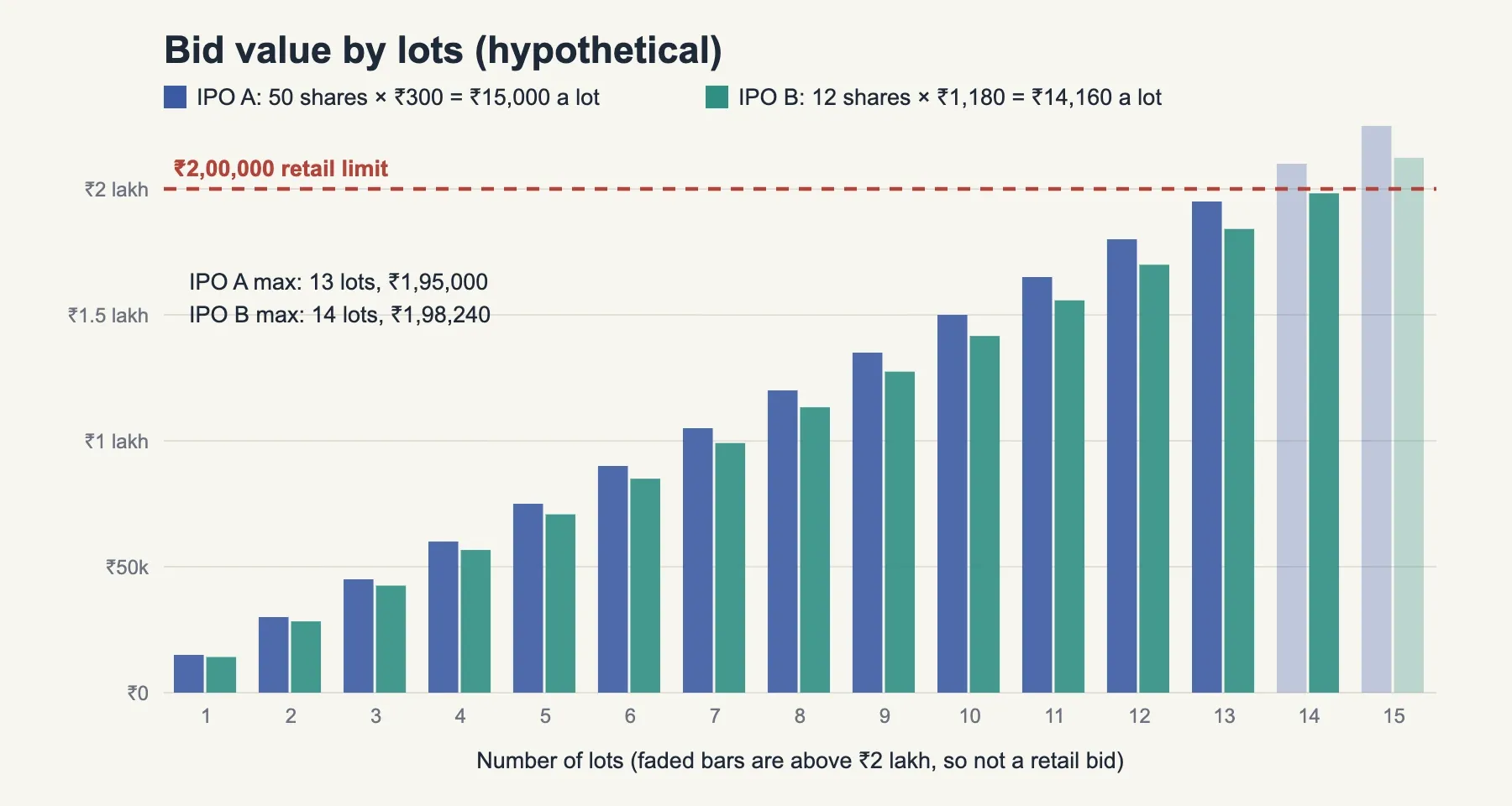
Formula 2: Maximum retail lots = ₹2,00,000 ÷ value of one lot at the upper price, rounded down to a whole number
| IPO A (hypothetical) | IPO B (hypothetical) | |
|---|---|---|
| One lot at the upper price | ₹15,000 | ₹14,160 |
| ₹2,00,000 ÷ one lot | 13.33 | 14.12 |
| Maximum retail lots | 13 lots (650 shares) | 14 lots (168 shares) |
| Maximum retail bid | ₹1,95,000 | ₹1,98,240 |
| One more lot would be | ₹2,10,000 | ₹2,12,400 |
Ishita's ₹40,000 fits two lots of either issue (₹30,000 or ₹28,320). Her budget, not the ₹2 lakh ceiling, binds first.
Cut-off price: what is blocked and what is released
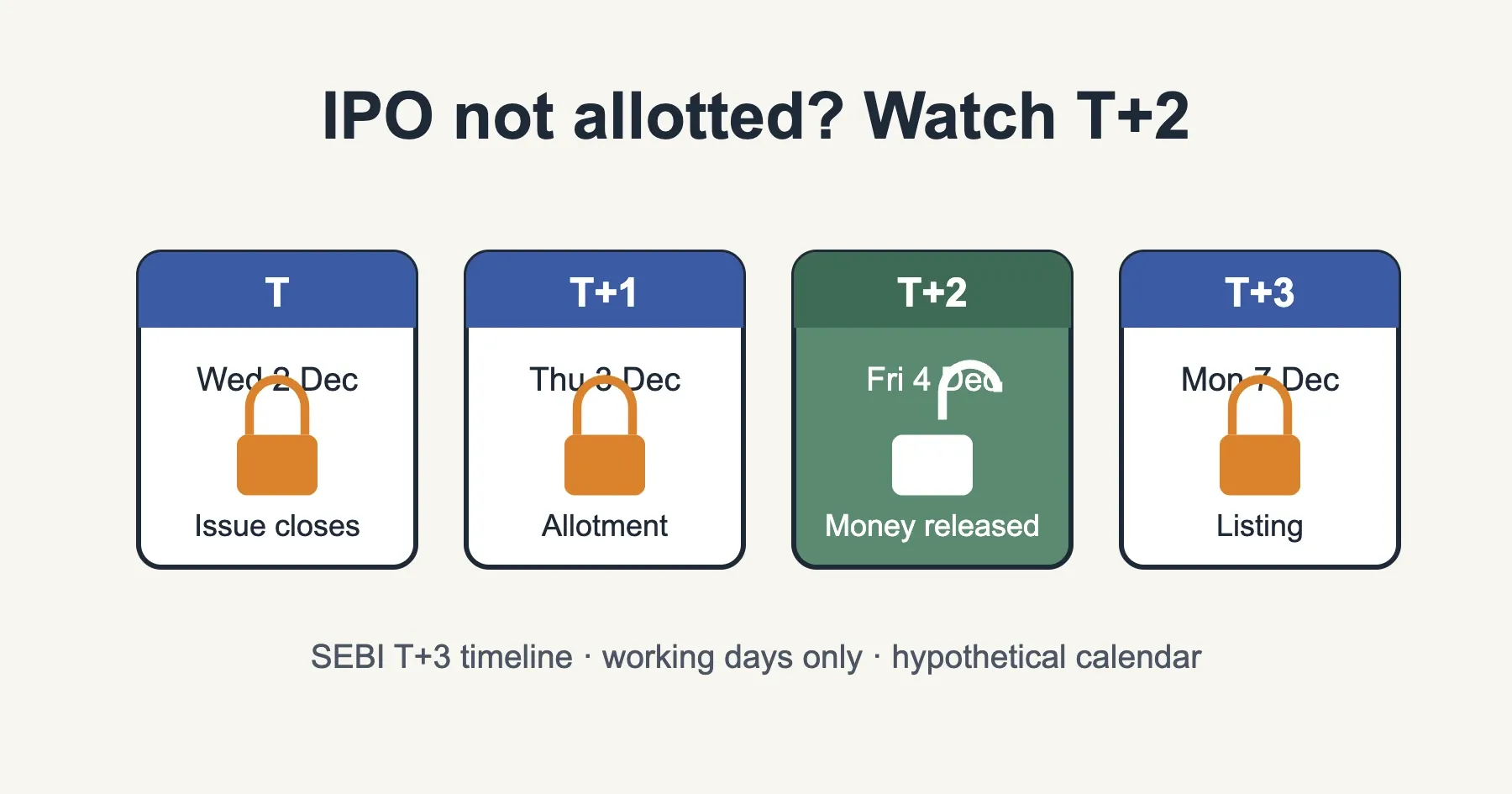
On a mainboard IPO, a retail applicant can tick "cut-off", agreeing to buy at whatever final price is fixed within the band. When you apply through UPI, you approve a mandate and your bank blocks the bid amount at the upper end of the band. The money stays in your account but cannot be spent until allotment. You then pay only for shares you receive, at the final price, and the rest is unblocked. The step-by-step flow is in our guide to applying for an IPO through UPI.
Hypothetical outcome, with the final issue price assumed at ₹290 for IPO A:
| Bid at cut-off | Blocked at ₹300 | If allotted 1 lot | If allotted every lot bid for |
|---|---|---|---|
| Ishita: 2 lots | ₹30,000 | Pays ₹14,500; ₹15,500 released | Pays ₹29,000; ₹1,000 released |
| Full retail bid: 13 lots | ₹1,95,000 | Pays ₹14,500; ₹1,80,500 released | Pays ₹1,88,500; ₹6,500 released |
The ₹6,500 in the last cell is only the price difference: 13 lots × 50 shares × ₹10.
Mainboard vs SME IPO minimums
SME IPOs follow a separate chapter of the ICDR Regulations, with a far larger ticket size:
| As of 25 November 2026 | Mainboard IPO | SME IPO: current rule | SME IPO: SEBI proposal |
|---|---|---|---|
| Minimum application | ₹10,000 to ₹15,000 (Reg. 47(2)) | Two lots, and above ₹2 lakh (Reg. 267(2)) | Four lots of at least ₹25,000 each, so ₹1 lakh |
| Cut-off bidding | Available to retail applicants | Not allowed (NSE circular, applies to SME IPOs opening from 1 July 2025) | Not covered here |
| Trading lot after listing | Single shares | Same as the IPO lot (SEBI circular of 21 February 2012) | One share |
| Status | In force | In force (ICDR amendment notified 4 March 2025) | Consultation paper of 14 October 2026; comments closed 4 November 2026 |
We have not seen a final SEBI decision on the proposal, so check sebi.gov.in before relying on it. Under either version, Ishita's ₹40,000 cannot make an SME application. For wider differences in eligibility and risk, see our SME IPO vs mainboard IPO guide.
Does applying for more lots improve your chances?
Not in the way many first-time applicants expect. Regulation 49(4) says the allotment to each retail individual investor shall not be less than the minimum bid lot, subject to availability, with any balance allotted proportionately. When the retail portion is heavily oversubscribed, there are not enough lots for every applicant, and a 13-lot bid is still one application. A bigger bid then mostly means more money blocked for the same shot at one lot. Our guide to how IPO allotment works walks through the basis of allotment. No bid size assures an allotment.
After listing: selling what you are allotted
On the main board, shares trade singly, so 50 allotted shares of IPO A can be sold 1, 20 or all 50 at a time. The listing price can be above or below the issue price.
SME shares still trade in bundles equal to the IPO lot (SEBI circular of 21 February 2012). The October 2026 proposal would move them to one share; until SEBI decides, the bundle rule applies.
Frequently asked questions
What is lot size in an IPO?
The minimum number of shares you must bid for; every bid is a whole multiple of it. With a hypothetical ₹300 upper price and a 50-share lot, one lot costs ₹15,000.
What is the minimum amount needed to apply for an IPO in India?
One lot, which ICDR Reg. 47(2) places within ₹10,000 to ₹15,000 on a mainboard IPO; plan with the upper end of the band. SME IPOs need two lots above ₹2 lakh.
How many lots can a retail investor apply for in an IPO?
As many as keep the bid at or below ₹2 lakh: divide ₹2,00,000 by one lot's value at the upper price and round down. A hypothetical ₹15,000 lot allows 13 lots; a ₹14,160 lot allows 14.
Does applying for more lots increase IPO allotment chances?
Not when the retail portion is heavily oversubscribed: SEBI's rule centres on the minimum bid lot per applicant, subject to availability, so a larger bid is still one application.
What is the minimum investment in an SME IPO?
Two lots worth more than ₹2 lakh (ICDR Reg. 267(2)). SEBI's 14 October 2026 consultation paper proposes ₹1 lakh (four lots of at least ₹25,000); it is not a rule yet.
Save this for your first application
Save the two formulas, then read how IPO allotment works to see what happens between blocking and allotment.