IPO Not Allotted? The Day Your Blocked Money Should Be Released, and What to Do If It Isn't
IPO not allotted? Under SEBI's T+3 rule, blocked money is due back on T+2. See a dated tracker, three ₹ refund cases and who to contact if it's late.
Summarize this article with AI





The short version
- Under SEBI's T+3 timeline, money for shares you did not get should be released on T+2: the working day after the basis of allotment.
- Only working days count, so weekends and holidays move the dates.
- Released amount = amount blocked − (shares allotted × final price). A lower final price on a cut-off bid adds to the release.
- If the money is still on hold after T+2, start with your bank, then the broker, then the registrar, then SEBI SCORES.
- SEBI's compensation rate for delayed unblocking is ₹100 a day or 15% a year of the application amount, whichever is higher, paid by intermediaries.
As of 22 November 2026: if you applied for an IPO through UPI or ASBA and did not get shares, SEBI's T+3 timeline says the blocked money should be released on T+2, the working day after the basis of allotment is finalised. "T" is the day the issue closes, and only working days count. Check your bank account or UPI app for the release, not your broker app.
Tanvir, 27, works in Bhubaneswar and applied for his first IPO from a broker app. The allotment result says "not allotted", yet his bank app still shows the amount on hold. Here is the date he should watch, and what to do if it passes.
Blocked, not debited: what happened to your money
When you approve the UPI mandate for an IPO bid, your bank puts a hold on the bid amount. The money stays in your savings account, but you cannot spend that portion. NPCI's IPO FAQ puts it plainly: the amount stays blocked until allotment is finalised, and if you get no shares, it is unblocked.
How the application and mandate work, step by step, is covered in our guide to applying for an IPO through UPI. This page starts where that one ends: after the issue closes.
The T+3 timeline, day by day
SEBI's circular of 9 August 2023 (SEBI/HO/CFD/TPD1/CIR/P/2023/140) cut the time from issue close to listing from T+6 to T+3 working days. It was optional for issues opening from 1 September 2023 and mandatory from 1 December 2023. The circular's timetable puts basis of allotment on T+1 and the instructions to debit and unblock on T+2, with unblocking to be completed that afternoon.
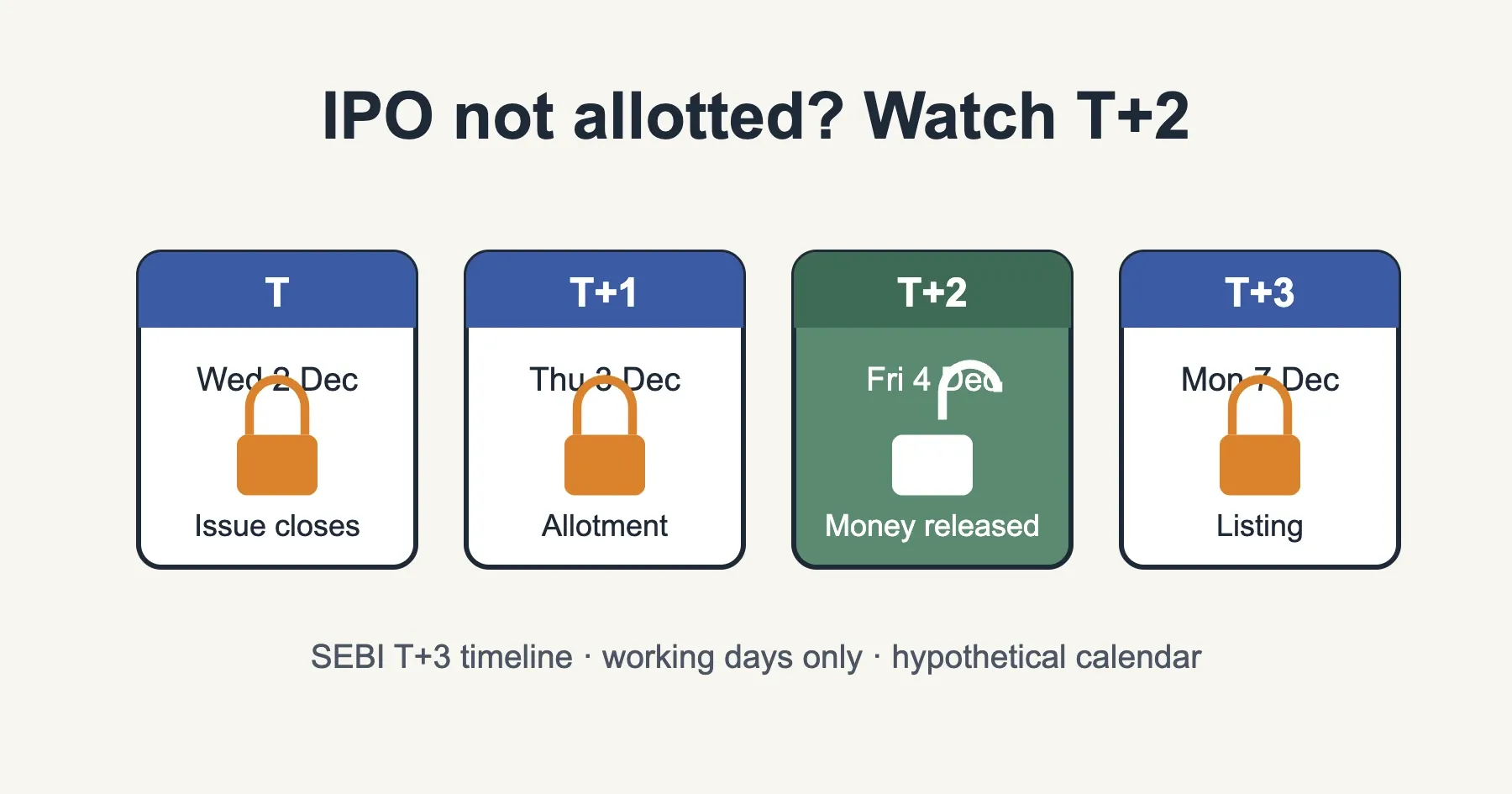
Here is how that looks on a hypothetical issue that closes on Wednesday 2 December 2026, assuming no exchange holiday that week:
| Day | Date (hypothetical) | What happens |
|---|---|---|
| T | Wednesday 2 December 2026 | Issue closes; final bids and mandates are collected |
| T+1 | Thursday 3 December 2026 | Basis of allotment is finalised; allotment status can be checked with the registrar |
| T+2 | Friday 4 December 2026 | Allotted amount debited, unallotted amount unblocked; shares credited to demat accounts |
| (weekend) | 5 and 6 December 2026 | Not working days; the clock pauses |
| T+3 | Monday 7 December 2026 | Shares listed and trading begins |
A holiday between T and T+2 moves every later step by a working day. For how the allotment itself is decided when an issue is oversubscribed, see how IPO allotment works.
Three release cases, with one ₹ example
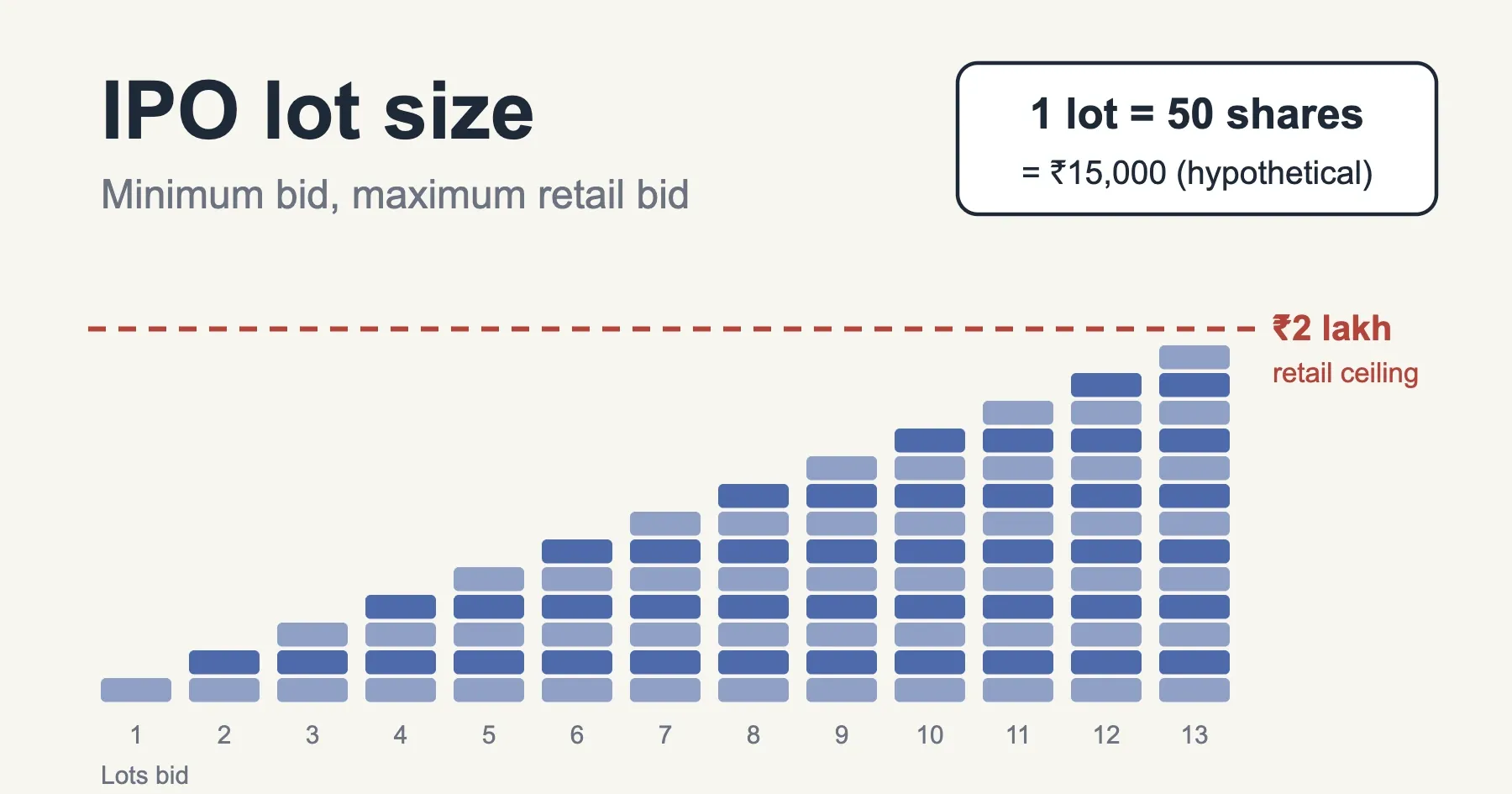
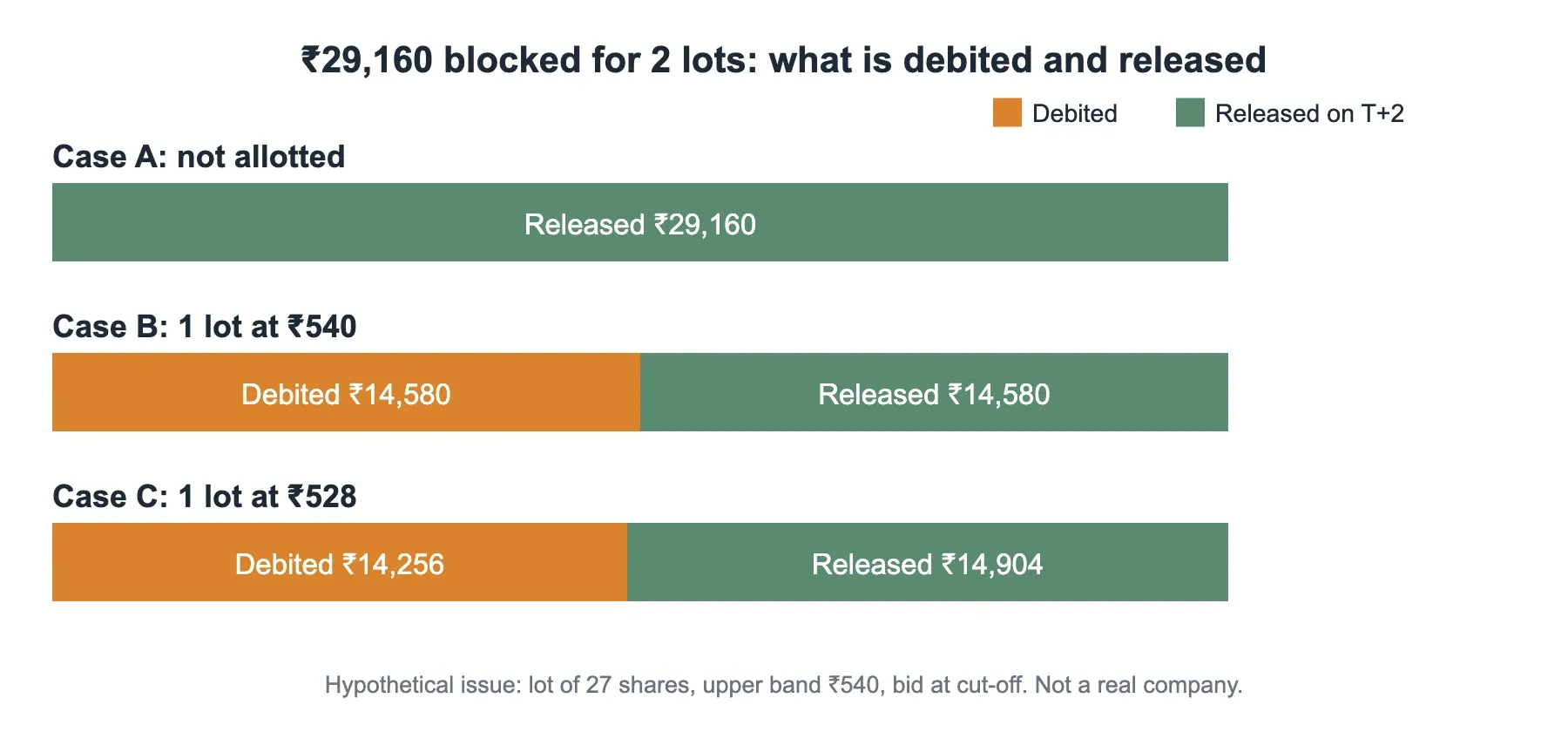
Assume Tanvir bid for 2 lots of a hypothetical issue at the cut-off price. The upper end of the price band is ₹540 and one lot is 27 shares, so his bank blocked 2 × 27 × ₹540 = ₹29,160. For how lots are sized, see IPO lot size and minimum investment.
| Case | Shares allotted | Final price | Debited | Released on T+2 |
|---|---|---|---|---|
| A: not allotted | 0 | not applicable | ₹0 | ₹29,160 |
| B: 1 of 2 lots | 27 | ₹540 | ₹14,580 | ₹14,580 |
| C: 1 lot, price fixed lower | 27 | ₹528 | ₹14,256 | ₹14,904 |
Not allotted at all: the full amount is released
In Case A, all ₹29,160 should be usable again by the end of T+2 (Friday 4 December here).
Partly allotted: only the unallotted part is released
In Case B, Tanvir gets 1 lot. The bank debits 27 × ₹540 = ₹14,580 and releases the other ₹14,580. NPCI's FAQ describes this: on part allocation, money is debited for the allocation value and the rest returns to your account. The formula is simple: amount released = amount blocked − (shares allotted × final issue price).
Bid at cut-off and the final price came in lower: the difference is released
A cut-off bid blocks money at the upper end of the band. If the company fixes the final price lower, at a hypothetical ₹528, Tanvir pays 27 × ₹528 = ₹14,256 for his 1 lot. The release is ₹29,160 − ₹14,256 = ₹14,904: the unallotted lot plus ₹12 a share saved on the lot he got.
Still showing as blocked? A five-point checklist
If T+2 has ended, check these first:
- Read the bank statement, not just the balance. Some banks show the hold separately from the available balance. Look for a release entry, or a debit and a release, dated T+2.
- Check the mandate status in your UPI app. NPCI says active requests are visible in the app's Mandate section. A mandate still shown as active after T+2 is worth noting with a screenshot.
- Note the mandate validity date. Some apps show a validity date later than T+2. That date is the outer limit of the mandate, not SEBI's unblocking date, so it is not a reason to wait quietly beyond T+2.
- Confirm your allotment status with the registrar. The registrar to the issue publishes allotment status. Make sure you are in Case A, B or C before counting what should come back.
- Check the calendar for a holiday. A bank or exchange holiday between T and T+2 pushes the deadline by a working day.
Who to contact, in what order
- Your bank (the SCSB). NPCI's FAQ says that for blocking and unblocking complaints, the investor may approach the bank. SEBI's April 2022 circular also records that the bank is responsible for grievances about blocking and unblocking of application amounts. Quote the application number, amount and T+2 date.
- The broker or app you applied through. NPCI also points investors to the intermediary where the application was submitted. You cannot revoke an IPO block from the UPI app yourself after the issue closes; NPCI says a mandate can be revoked only until the issue closes.
- The registrar to the issue. Useful when the dispute is about how many shares you were allotted, which decides how much should be released.
- SEBI's SCORES portal (scores.sebi.gov.in). If the bank or intermediary does not resolve it, you can complain to SEBI online. Keep screenshots and the bank's reply.
SEBI's compensation for late unblocking
SEBI's circulars (16 March 2021, as followed up on 20 April 2022) set compensation for delays, including "delayed unblocking for non-allotted/partially allotted applications". The rate is "Rs.100/- per day or 15% per annum of the application amount, whichever is higher", and the obligation sits with the intermediaries: the SCSB, and in some cases the issue's lead manager, not you. The T+3 circular, now carried into SEBI's ICDR master circular (last updated 9 February 2026), says compensation for delayed unblocking is computed from T+3 day.
On Tanvir's ₹29,160, 15% a year works out to about ₹12 a day, so the ₹100-a-day figure is the higher of the two. The days counted and how it is paid depend on the circular in force and your bank's records, so ask the bank for its calculation in writing.
Does a blocked amount still earn interest?
The money stays in your savings account while it is blocked; only your ability to spend it is paused. Banks generally work out savings interest on the daily balance, so the blocked amount usually keeps earning your normal savings rate. Confirm the treatment of a held amount with your bank.
Hypothetical illustration: at an assumed 3% a year savings rate, ₹29,160 held for 5 days (Monday 30 November to Friday 4 December) accrues about ₹12 of interest. The rate is an assumption, not a promise; your bank's rate decides the real figure.
Frequently asked questions
When will my money be unblocked if I don't get an IPO allotment?
By the end of T+2, where T is the day the issue closed and only working days count. That is one working day after the basis of allotment, under SEBI's circular of 9 August 2023, mandatory since 1 December 2023.
Why is my IPO amount still blocked after allotment?
Common reasons are a bank delay, a holiday in between, a mandate still active in your UPI app, or a partial allotment where part was debited. Check your bank statement first, then mandate and allotment status.
How much money is released if I get a partial IPO allotment?
The amount blocked minus the shares allotted multiplied by the final price. In the hypothetical example, ₹29,160 blocked for 2 lots, 1 lot allotted at ₹540, releases ₹14,580; at a final price of ₹528 it releases ₹14,904.
Do I get compensation if my IPO money is unblocked late?
SEBI's circulars set compensation of ₹100 a day or 15% a year of the application amount, whichever is higher, for delayed unblocking, payable by the intermediaries. The T+3 circular says it is computed from T+3 day. Raise it with your bank first and keep a record of the dates.
Does blocked IPO money earn interest?
The money stays in your savings account while blocked, and banks generally calculate savings interest on the daily balance, so it usually keeps earning your normal rate. Confirm with your bank how it treats a held amount.
Save this checklist
Save the checklist and contact order for your next allotment result.