Tax on IPO listing gains: how a listing-day sale is taxed, with a ₹ example
Sold IPO shares on listing day? It's usually short-term capital gain, taxed at 20% plus cess in FY 2026-27. Worked ₹ example, set-off rules, ITR form.
Summarize this article with AI





The short version
- A listing-day sale of allotted IPO shares is a short-term capital gain on listed equity.
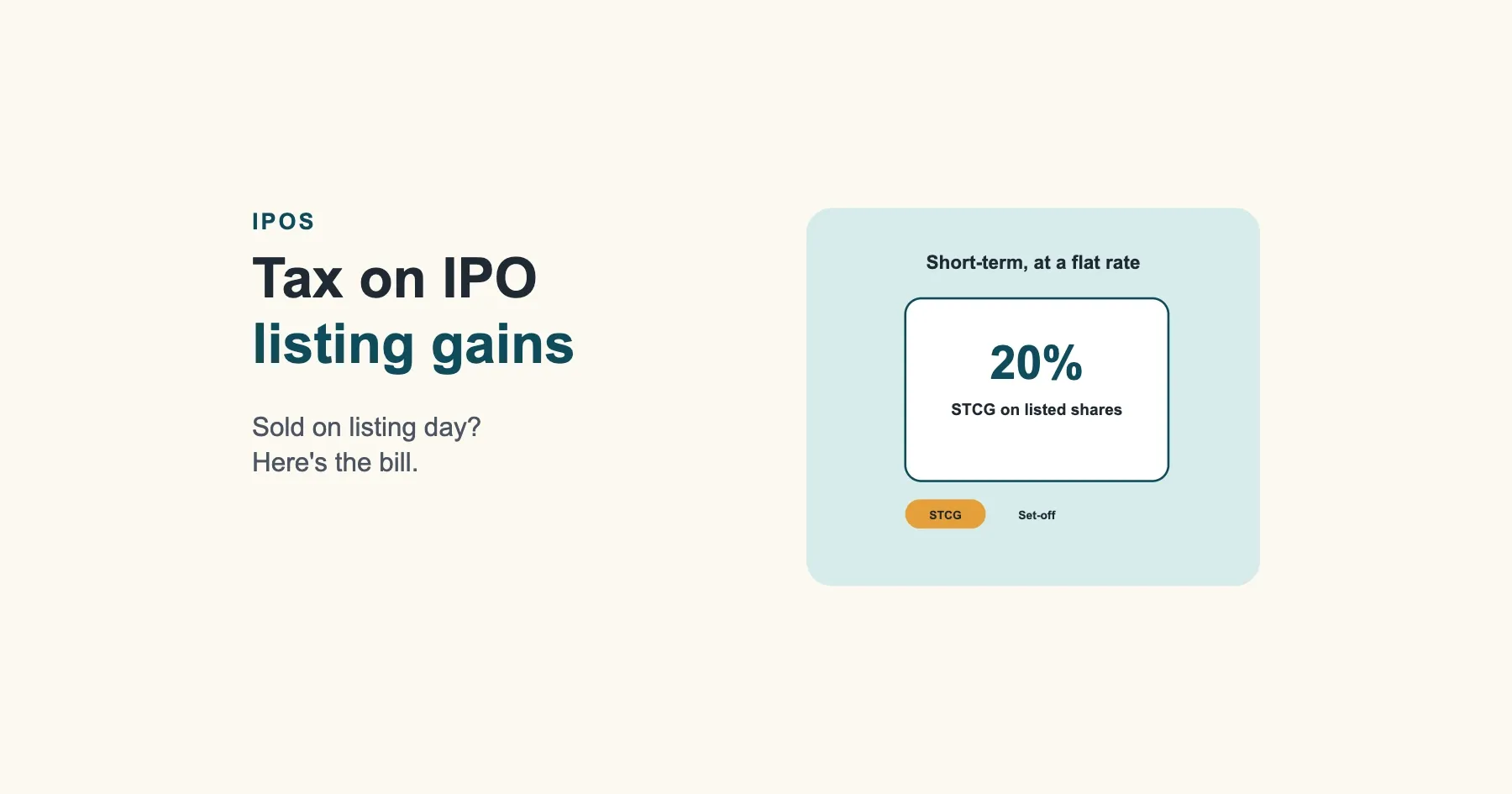
- As of FY 2026-27, under the Income-tax Act, 2025 (section 196), it is taxed at 20% plus 4% cess, whatever your slab.
- In the hypothetical example, a ₹2,280 gain means ₹474.24 in tax; a ₹600 loss on another sale cuts it to ₹349.44.
- Short-term capital losses can be set off against any capital gains and carried forward for eight years, if you file on time.
- Frequent, large-volume IPO selling can be treated as business income, which changes the rate and the ITR form.
If you sell IPO shares on listing day, the profit is a short-term capital gain on listed equity, because you held the shares for less than 12 months. As of FY 2026-27, under the Income-tax Act, 2025, it is taxed at 20% plus cess. A listing-day loss can be set off against capital gains.
Sanjana, 27, works in Tirunelveli. She was allotted 40 shares in her first IPO and sold them on listing day. How much tax does she owe, and where does she show it?
How is profit from selling IPO shares on listing day taxed?
Shares held as an investment are a capital asset. When you sell, the difference between the sale value and your cost is a capital gain (or loss). The tax then depends on how long you held the shares and whether securities transaction tax (STT) applied to the sale.
A listing-day sale lands in the same place for almost everyone:
- Holding period: days, well under the 12 months that separate short-term from long-term for listed shares.
- STT: shares sold on a recognised stock exchange in India carry STT on the trade.
So the gain falls under the special provision for short-term gains on equity shares sold with STT: section 196 of the Income-tax Act, 2025, which took over the role of section 111A of the 1961 Act. The trigger is the sale, not the allotment or the listing.
Is a listing-day sale short-term capital gain, and at what rate now?
Yes. As of FY 2026-27, under the Income-tax Act, 2025, short-term gains on equity shares sold with STT are taxed at 20%, plus 4% health and education cess on the tax. Surcharge can apply at higher incomes; this example leaves it out.
The 20% rate came in with the Finance (No. 2) Act, 2024, for transfers on or after 23 July 2024; before that it was 15%.
Two details matter for a small gain:
- The rate is flat. It does not depend on your slab.
- The basic exemption limit can absorb part of it. Under section 196, if a resident individual's other income is below the amount not chargeable to tax, the shortfall reduces the gain before the 20% applies.
Worked example: 40 shares, sold on listing day
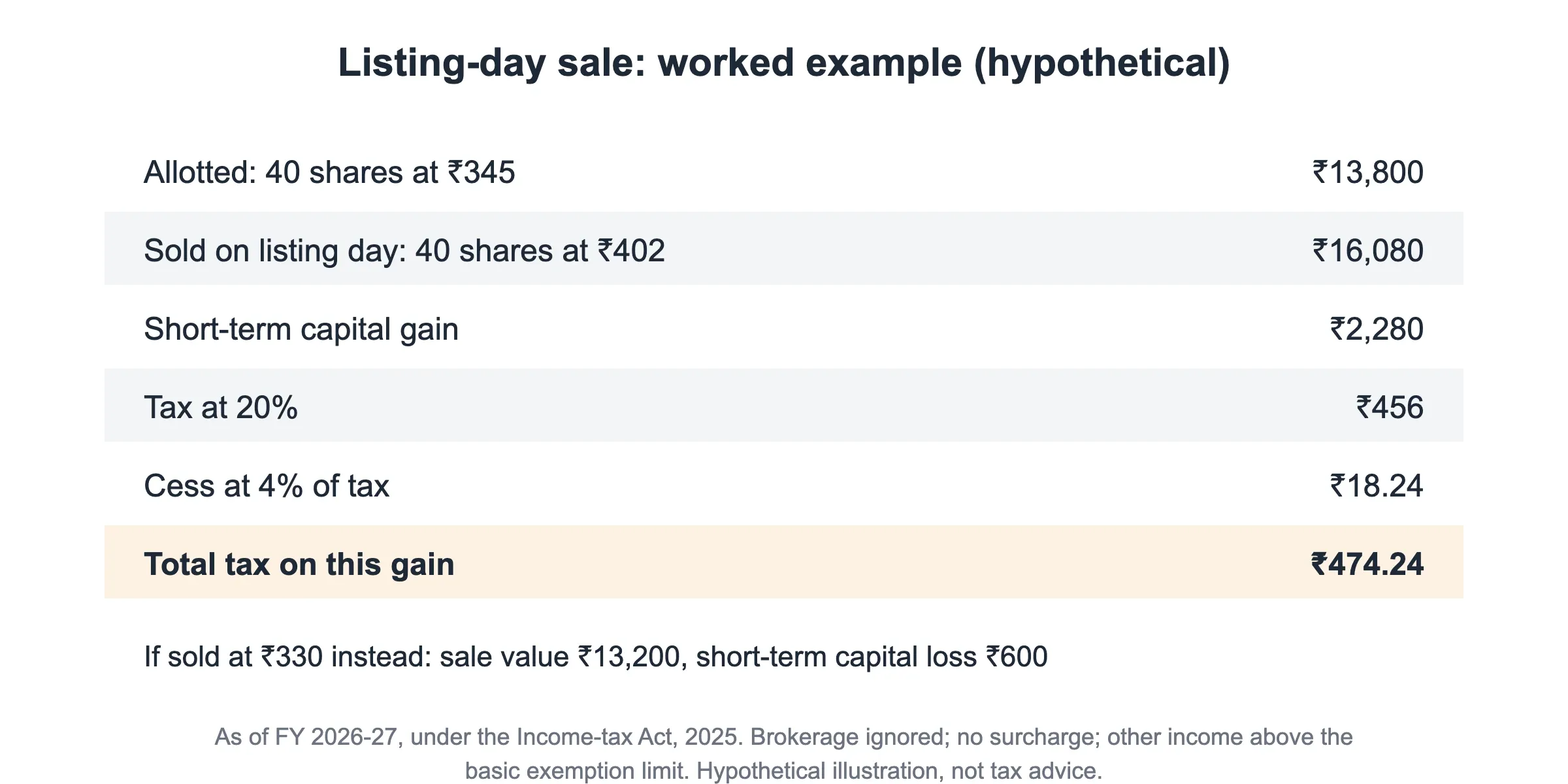
All figures are hypothetical. Rate and cess as of FY 2026-27, under the Income-tax Act, 2025. Brokerage ignored, STT not deducted from the gain, no surcharge, and other income already above the basic exemption limit. Not tax advice.
| Step | Amount |
|---|---|
| Allotted: 40 shares at ₹345 | ₹13,800 |
| Sold on listing day: 40 shares at ₹402 | ₹16,080 |
| Short-term capital gain | ₹2,280 |
| Tax at 20% | ₹456 |
| Cess at 4% of tax | ₹18.24 |
| Total tax on this gain | ₹474.24 |
Had Sanjana kept the shares, there would be no tax yet: an unsold gain is not taxed.
Why isn't STT deducted? The law does not allow STT as a deduction when you compute capital gains. Brokerage on the sale is generally treated as an expense on transfer.
Is a listing-day sale speculative or business income?
Allotted shares sit in your demat account and move out when you sell, so a listing-day sale is delivery-based. Speculative income covers trades settled without delivery, such as intraday trades. A listing-day sale of allotted shares is therefore not speculative.
Capital gain or business income depends on the facts. For someone who applies to an occasional IPO, the gain is usually treated as a capital gain. If you apply and sell frequently, in large volumes, with borrowed money or as a regular activity, the pattern may be treated as business income, taxed at your slab rate instead of 20%. CBDT has issued guidance on when shares are a capital asset and when they are stock-in-trade; a tax professional can apply it to your trades.
Can I set off a loss from an IPO that listed below issue price?
Yes. Suppose the same 40 shares listed weak and Sanjana sold at ₹330:
- Sale value: 40 × ₹330 = ₹13,200
- Cost: ₹13,800
- Short-term capital loss: ₹600
Under the Income Tax Department's rules, a short-term capital loss can be set off against both short-term and long-term capital gains. A long-term capital loss can only be set off against long-term gains. Neither can be set off against salary.
With one ₹2,280 gain and this ₹600 loss in the same year, the net short-term gain is ₹1,680 (hypothetical). At 20% plus 4% cess, the tax is ₹349.44 instead of ₹474.24, ₹124.80 less.
Any unadjusted capital loss can be carried forward for eight years, but only if you file the return for the loss year on or before the due date.
What if I hold the shares for more than 12 months?
The gain becomes long-term. For listed equity sold with STT, long-term gains are taxed at 12.5% on the amount above ₹1.25 lakh a year (the rates for transfers on or after 23 July 2024, carried into the current law). The same hypothetical ₹2,280 gain, with no other long-term equity gains that year, would sit inside the ₹1.25 lakh exemption.
| Situation | Type | Tax (as of FY 2026-27, under the Income-tax Act, 2025) |
|---|---|---|
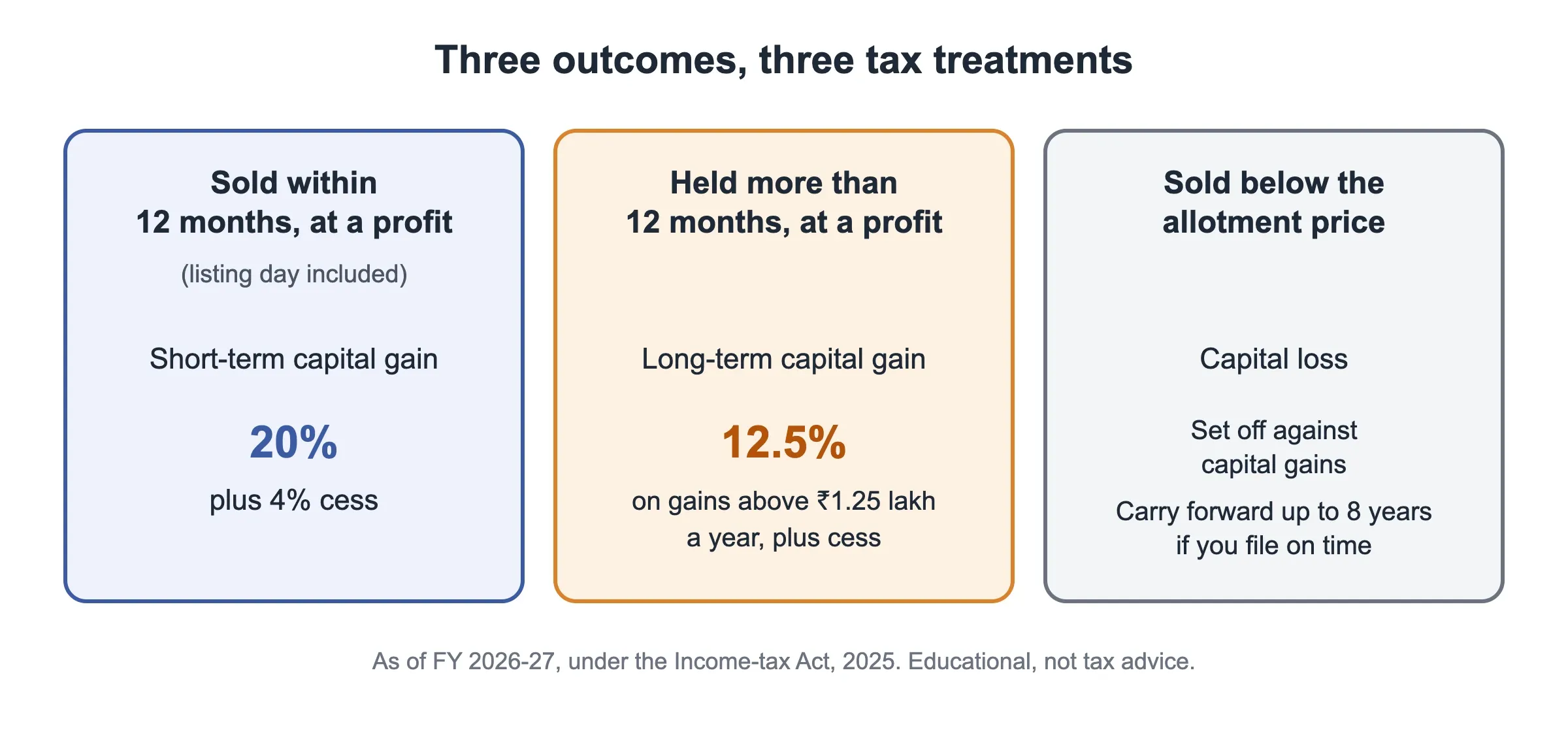
| Sold within 12 months at a profit (listing day included) | Short-term capital gain | 20% plus 4% cess |
| Held more than 12 months, sold at a profit | Long-term capital gain | 12.5% on gains above ₹1.25 lakh a year, plus cess |
| Sold below the allotment price | Capital loss | Set off against capital gains; carry forward up to eight years if you file on time |
Prices can move either way in a year, so let your plan set the holding period, not the tax table.
Which ITR form do I use if I sold IPO shares this year?
A sale in FY 2026-27 goes in the return you file in 2027; check the forms notified for that year. Going by recent years' forms:
- ITR-2: capital gains with no business or professional income. Most salaried sellers fall here.
- ITR-3: business or professional income, including share trading treated as a business.
- ITR-1 has not covered short-term capital gains.
Report each sale with dates, sale value and cost, and match them with your broker's capital gains statement.
Frequently asked questions
Is IPO listing gain short-term?
Yes, in almost every case. Listed shares must be held for more than 12 months to be long-term, and a listing-day sale happens within days of allotment. As of FY 2026-27, under the Income-tax Act, 2025, the gain is taxed at 20% plus cess.
Does the new-regime rebate cover STCG on shares?
No. The new-regime rebate for lower incomes does not reduce tax on special-rate gains such as short-term gains on listed shares. If your other income is below the basic exemption limit, though, the shortfall can reduce the taxable gain.
What if I held the shares for more than 12 months?
The gain becomes long-term. As of FY 2026-27, long-term gains on listed equity sold with STT are taxed at 12.5% on the amount above ₹1.25 lakh a year, plus cess.
Do I pay tax if the shares listed below the issue price?
Not on that sale. A sale below cost is a short-term capital loss. Set it off against capital gains in the same year and carry any balance forward for eight years, provided you file by the due date.
Read next
Understand how allotment works before you apply: how IPO allotment works
- How UPI blocks and releases money in an IPO application: applying for an IPO through UPI
- Where your allotted shares sit: what a demat account is
- Choosing your tax regime this year: old vs new tax regime for salaried employees
— Laabh