NPS withdrawal rules in 2026: lump sum, annuity and early exit
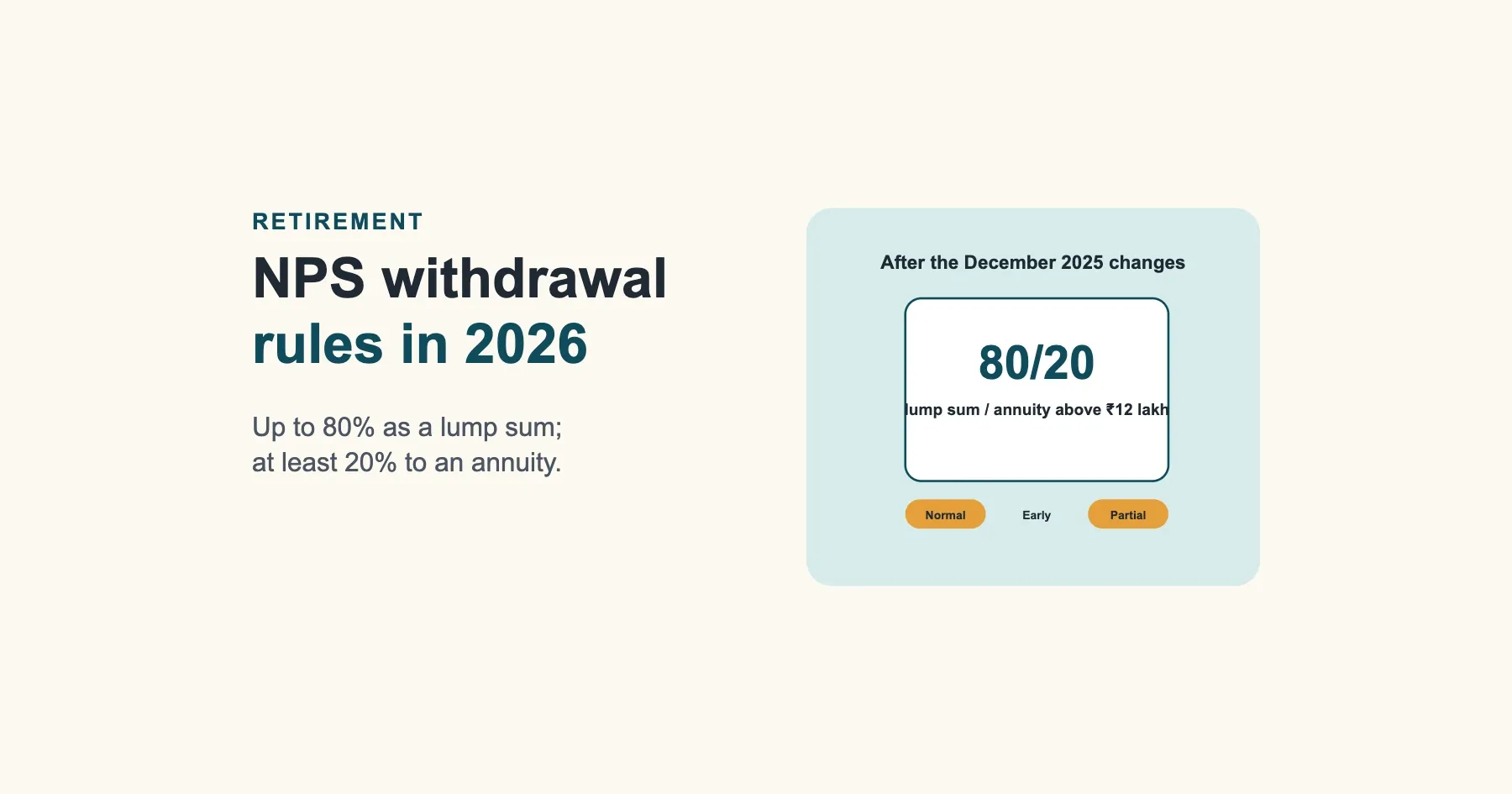
Non-government NPS subscribers can take up to 80% as a lump sum at normal exit, 20% to an annuity. Early exit, partial withdrawals and tax, explained.
Summarize this article with AI





The short version
- Non-government subscribers can take up to 80% as a lump sum at normal exit, with at least 20% buying an annuity, when the corpus is above ₹12 lakh.
- Early exit keeps the reverse split: up to 20% lump sum, at least 80% annuity, with full withdrawal allowed up to ₹5 lakh.
- Partial withdrawals: up to four before 60, four years apart, for specified purposes.
- For the hypothetical ₹38,00,000 corpus: up to ₹30,40,000 lump sum and at least ₹7,60,000 annuity at normal exit.
Under PFRDA's exit rules as amended in December 2025, non-government NPS subscribers can take up to 80% of the corpus as a lump sum at normal exit and must use at least 20% to buy an annuity, when the corpus is above ₹12 lakh. Premature exit and small-corpus rules differ.
Scope: this page covers non-government subscribers (the All Citizen and Corporate models). Government-sector rules differ. Rules as of 17 November 2026.
Say you are 32 and contribute to NPS through your employer. One headline says you can now take 80% of your NPS as cash; another asks whether you really can. Both can be true, because the 80% has conditions. Below, the NPS withdrawal rules 2026 are laid out event by event.
Where do these rules come from?
NPS exits are governed by the PFRDA (Exits and Withdrawals under the National Pension System) Regulations, 2015. PFRDA's website lists a consolidated copy marked "last amended on 16 December 2025", and PFRDA summarised the changes in a press release dated 19 December 2025. The figures below follow that release.
How much of my NPS corpus can I take as a lump sum at 60 under the 2026 rules?
A non-government subscriber exiting normally (at 60, at superannuation, or after 15 years in NPS in the All Citizen model, whichever applies) can take up to 80% of the corpus as a lump sum and must use at least 20% to buy an annuity. Before the amendment, the minimum annuity share was 40%.
The 80/20 split applies when the corpus is above ₹12 lakh. Smaller corpuses have their own rules:
- ₹8 lakh or less: the whole amount can be withdrawn; no annuity is required.
- Above ₹8 lakh and up to ₹12 lakh: up to ₹6 lakh can be taken upfront. The balance goes to an annuity, or is paid out through systematic unit redemption (SUR) over at least six years, or a mix.
- Above ₹12 lakh: up to 80% lump sum, at least 20% annuity.
A worked example in ₹ (hypothetical)
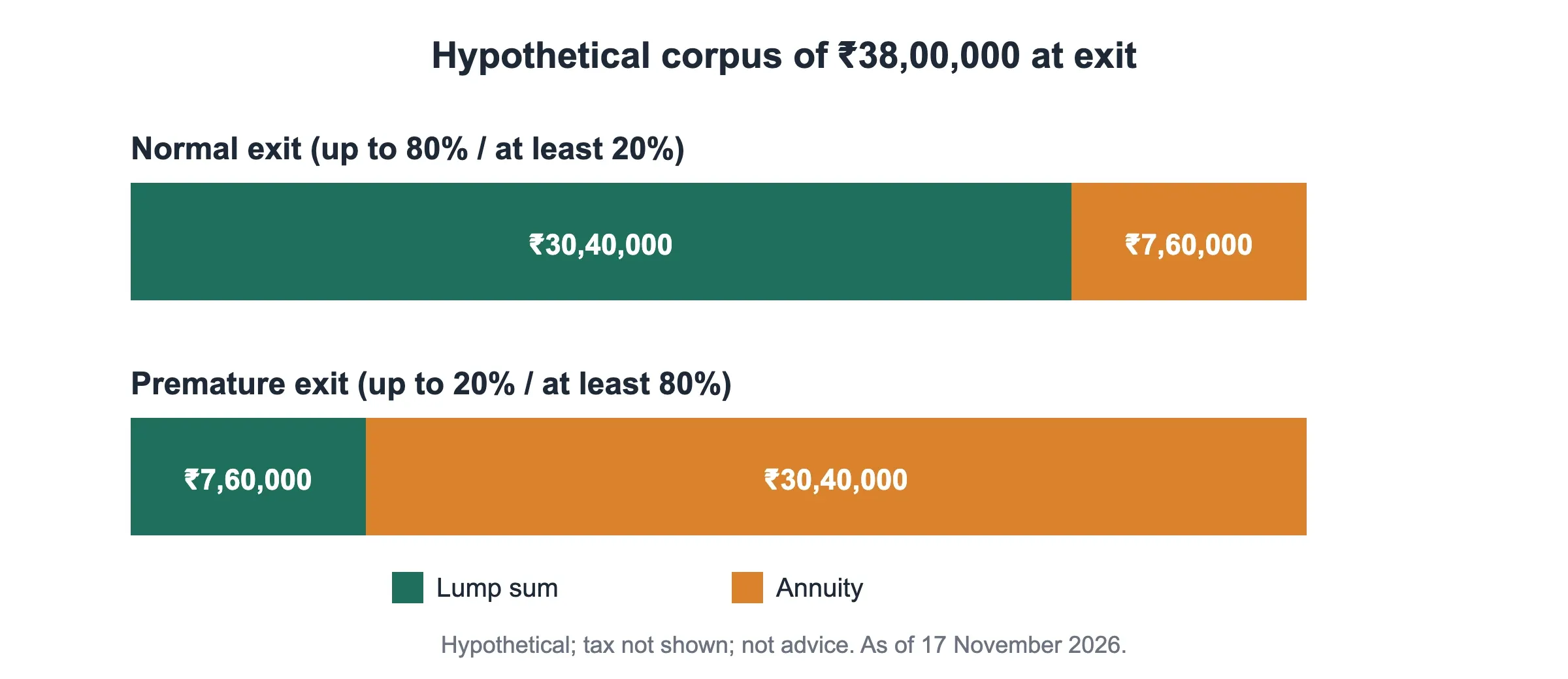
Take a hypothetical non-government subscriber with a corpus of ₹38,00,000 at 60. That is above ₹12 lakh, so the 80/20 rule applies:
| Amount | |
|---|---|
| Corpus at 60 | ₹38,00,000 |
| Up to 80% as lump sum | ₹30,40,000 |
| At least 20% to buy an annuity | ₹7,60,000 |
| Total | ₹38,00,000 |
Hypothetical; tax not shown; not advice. The corpus is a fixed illustrative figure, and no growth rate is assumed. Not a promise; returns vary.
"Up to" matters: the 20% annuity share is a floor, not a target.
Can I exit NPS before 60, and how much must go into an annuity then?
Yes, but the split reverses. A non-government subscriber who exits before normal exit can take up to 20% as a lump sum and must use at least 80% to buy an annuity. This split did not change in the amendment.
What did change:
- Small-corpus threshold: if the corpus is ₹5 lakh or less, the full amount can be withdrawn. The earlier limit was ₹2.5 lakh.
- Minimum period: the five-year minimum subscription before premature exit in the All Citizen model has been removed.
With the same hypothetical ₹38,00,000 corpus, an early exit would allow up to ₹7,60,000 as a lump sum, with at least ₹30,40,000 going to an annuity.
Is the NPS lump sum tax-free, and is the annuity income taxed?
Tax rules as of FY 2026-27, under the Income-tax Act, 2025. Check the current position with the Income Tax Department before you act.
- Lump sum at exit: under the earlier law, 60% of the corpus withdrawn on closure was exempt. Protean's explainer says that only 60% is explicitly tax-free and that the extra 20% now allowed may be taxable at slab rates unless the government clarifies otherwise. Check whether this has since been addressed before you withdraw.
- Amount used to buy an annuity: not taxed when it buys the annuity, under the earlier law.
- Annuity income: the pension you receive from the annuity is generally taxed as income in the year you receive it.
- Partial withdrawals: under the earlier law, a partial withdrawal within the permitted limit was exempt; check the current position.
Deductions on NPS contributions depend on the tax regime you choose; see NPS vs SIP for retirement. Tax rules change; consult a tax professional for your situation.
Is buying an annuity still compulsory in NPS for private-sector subscribers?
Yes, with exceptions:
- At normal exit, at least 20% of a corpus above ₹12 lakh must buy an annuity.
- At premature exit, at least 80% of a corpus above ₹5 lakh must buy an annuity.
- Below the small-corpus thresholds, no annuity is required.
Deferment: the maximum exit age is now 85 (it was 75), so subscribers can stay invested, and defer the lump sum or the annuity purchase, for longer. The earlier 15-day advance notice to continue or defer has been removed. Check the current process with your CRA.
An annuity is bought from an annuity service provider empanelled under NPS; this page names none.
Can I make a partial withdrawal from NPS for a house, children's education or illness?
Yes, for specified purposes. The amendment changed the count and spacing:
- How many: up to four partial withdrawals before 60 (previously three).
- Gap: four years between withdrawals before 60 or superannuation; three years after.
- Purposes: specified purposes such as children's education or marriage, buying or building a house, and medical treatment. Confirm the current list with your CRA.
- Limit: up to 25% of your own contributions.
The amendment also lets a regulated lender place a lien on up to 25% of your own contributions as security for a loan, within the partial-withdrawal limits.
NPS withdrawal rules 2026: the rules table
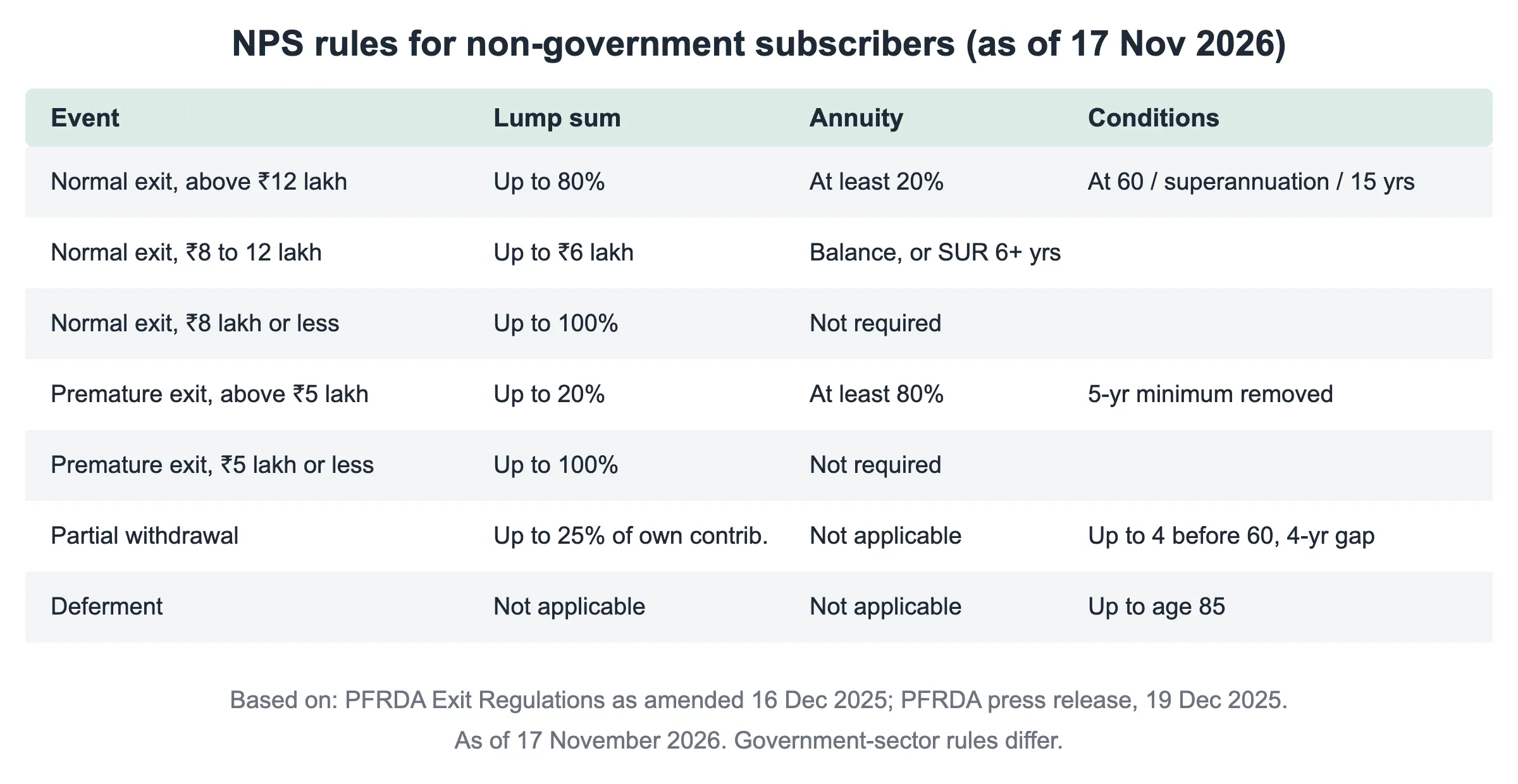
As of 17 November 2026, under the Exit Regulations as amended in December 2025.
| Event | Lump sum | Annuity | Conditions |
|---|---|---|---|
| Normal exit, above ₹12 lakh | Up to 80% | At least 20% | At 60, superannuation or 15 years |
| Normal exit, ₹8 to 12 lakh | Up to ₹6 lakh | Balance, or SUR over 6+ years | |
| Normal exit, ₹8 lakh or less | Up to 100% | Not required | |
| Premature exit, above ₹5 lakh | Up to 20% | At least 80% | Five-year minimum removed |
| Premature exit, ₹5 lakh or less | Up to 100% | Not required | |
| Partial withdrawal | Up to 25% of own contributions | Not applicable | Up to 4 before 60, 4-year gap |
| Deferment | Not applicable | Not applicable | Up to age 85 |
Frequently asked questions
Does the 80% rule apply to government employees?
No. Government-sector subscribers keep a minimum 40% annuity at normal exit, so their lump sum stays at up to 60%.
Can I defer withdrawal beyond 60?
Yes. The maximum exit age is now 85, so you can defer the lump sum or annuity purchase until then.
How do I apply through the CRA?
Log in to your CRA with your PRAN and follow its withdrawal steps; corporate subscribers may need nodal office authorisation.
Is the whole 80% lump sum tax-free?
Not confirmed. A CRA explainer says only 60% is explicitly exempt and the extra 20% may be taxable unless clarified (as of FY 2026-27, under the Income-tax Act, 2025). Tax rules change; consult a tax professional for your situation.
Read next
See how NPS and an SIP differ on lock-in and control in NPS vs SIP for retirement.
— Laabh