NPS vs SIP for retirement: lock-in, annuity, tax and control compared
NPS is a PFRDA pension account with exit and annuity rules; an SIP invests in a mutual fund you can usually redeem anytime. Rules as of 13 Nov 2026.
Summarize this article with AI





The short version
- As of 13 November 2026, at least 20% of a non-government NPS corpus above ₹12 lakh must buy an annuity at normal exit; premature exit needs at least 80%.
- An SIP usually has no lock-in (ELSS aside), and the whole value stays yours to redeem.
- NPS offers specific tax deductions, most of them only under the old regime; confirm current rules.
- Split by purpose: money locked for retirement, and money you may need sooner.
NPS (National Pension System) is a PFRDA-regulated retirement account: access before 60 is restricted, and at normal exit at least 20% of a corpus above ₹12 lakh must buy an annuity. An SIP invests regularly in a SEBI-regulated mutual fund and usually has no lock-in. NPS also has specific tax deductions; check the current rules.
Say Karan, 30, works in Kolkata and has ₹6,000 a month he wants to keep for retirement. HR has asked whether he wants NPS; a friend says an SIP is simpler. The NPS vs SIP question looks like a returns contest, but the real differences are who decides when he can touch the money, how it is paid out, and how it is taxed.
NPS vs SIP: which is better for retirement?
They do different jobs. NPS is a retirement account with its own rules on access and payout. An SIP puts money into a mutual fund in fixed instalments; the fund decides the risk, and you decide when to sell.
| NPS (Tier I) | Mutual fund SIP | |
|---|---|---|
| Regulator | PFRDA | SEBI |
| Purpose | Pension income in retirement | Any goal you set, including retirement |
| Access before 60 | Restricted: partial withdrawals for listed purposes, or premature exit with at least 80% to an annuity | Usually any time; ELSS has a three-year lock-in; exit load may apply |
| Payout at exit | Above ₹12 lakh, at least 20% must buy an annuity; smaller corpora have more choice (see below) | Whole value is yours to redeem, when you choose |
| Tax | Specific deductions on contributions (see below) | Capital gains tax when you redeem |
| Who sets the mix | You (active choice) or an age-based auto choice | You, by choosing the fund |
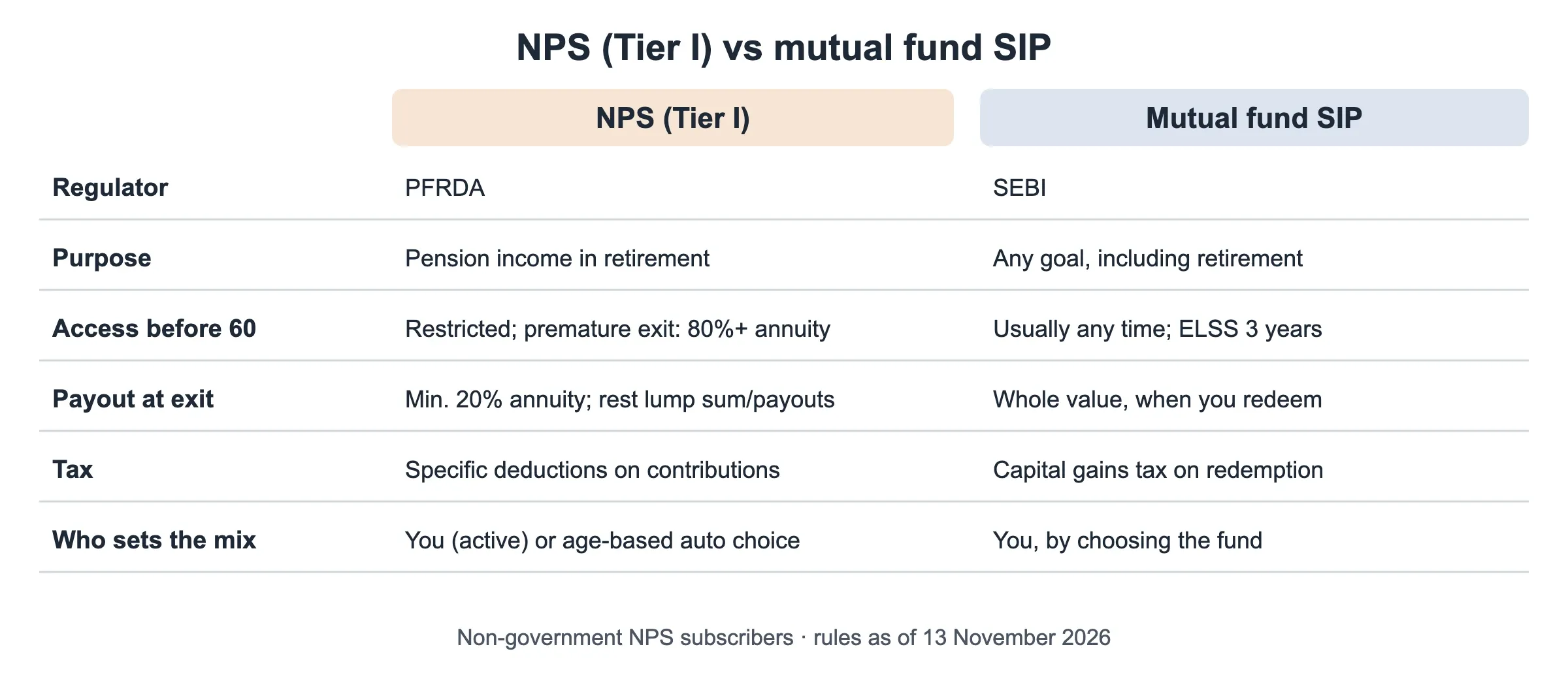
NPS fits if you want money that is hard to touch until retirement, value a pension-style payout, and can use the tax deductions. An SIP fits if you want to decide the timing yourself, or the money may be needed for something before 60. Check whether your employer contributes to NPS, because that changes the maths.
Can I withdraw NPS money before 60 like an SIP?
Not in the same way. An SIP in an open-ended fund can usually be redeemed any business day at the applicable NAV, less any exit load. NPS Tier I has three routes before normal exit:
- Partial withdrawal. Regulation 8 allows withdrawals of up to 25% of your own contributions, for listed purposes such as children's higher education or marriage, buying or building a house, and medical treatment. Since the December 2025 amendment, you can make up to four partial withdrawals before 60, at least four years apart.
- Premature exit. You can leave before 60, but at least 80% of the corpus must buy an annuity. Only if the corpus is ₹5 lakh or less can you take all of it out. The earlier five-year minimum for the All Citizen Model has been removed.
- Normal exit after 15 years. For the All Citizen Model, the amended rules allow normal exit at 60 or after 15 years of subscription, whichever comes first.
Tier II is an optional account linked to Tier I. It is more flexible on withdrawals, but it does not carry Tier I's tax deductions, and it is closed when you exit Tier I.
How much of NPS must go into an annuity at retirement now?
At least 20%, for non-government subscribers exiting at 60 or under the normal exit rule. This was cut from 40% in the December 2025 amendment, and the lump sum limit rose from 60% to 80%. Smaller corpora have more choice:
- Up to ₹8 lakh: you can withdraw it all.
- Above ₹8 lakh up to ₹12 lakh: up to ₹6 lakh as lump sum, with the rest taken as periodic payouts over at least six years or used for an annuity.
- Above ₹12 lakh: up to 80% lump sum, and at least 20% buys an annuity.
Karan's ₹6,000 a month, both ways
Hypothetical, not a promise; returns vary. Karan puts ₹6,000 a month in for 25 years, which is ₹18.00 lakh contributed. Assume returns of 8% and 10% a year, compounded monthly, with each instalment invested at the start of the month. Both are market-linked.
| Assumed return | Corpus after 25 years | NPS: minimum 20% to annuity | NPS: up to 80% lump sum | SIP: value you control |
|---|---|---|---|---|
| 8% a year | ₹57.44 lakh | ₹11.49 lakh | ₹45.95 lakh | ₹57.44 lakh |
| 10% a year | ₹80.27 lakh | ₹16.05 lakh | ₹64.22 lakh | ₹80.27 lakh |
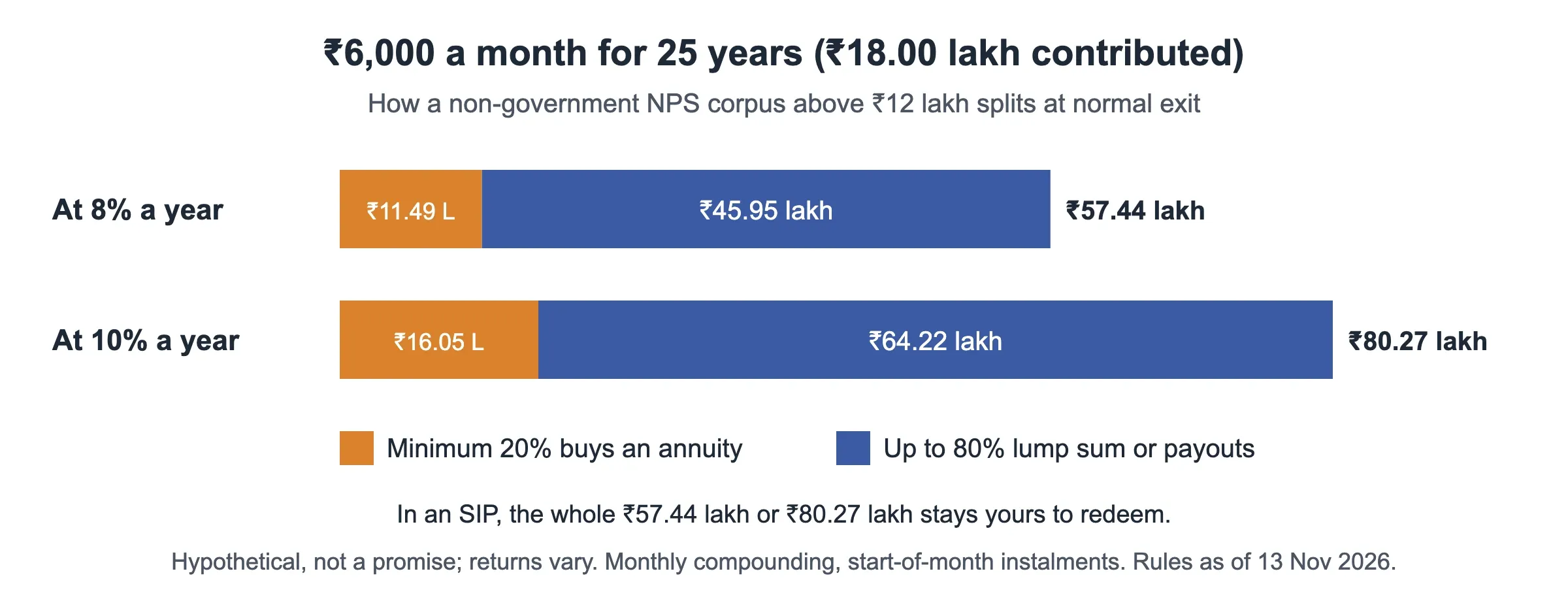
The same rate is used for both, so only the rules differ. In NPS, at least ₹11.49 lakh (at 8%) or ₹16.05 lakh (at 10%) would buy an annuity, which pays a regular, taxable income. In an SIP, the whole value stays accessible, and you pay capital gains tax only on what you redeem, in the year you redeem it. In real life the two won't earn the same return.
What extra tax benefit does NPS give that an SIP doesn't?
Tax rules as of 13 November 2026. The Income Tax Department's return guide for salaried individuals (AY 2026-27) lists these NPS deductions:
- Old tax regime: your own contributions count within the overall Section 80C, 80CCC and 80CCD(1) limit, and Section 80CCD(1B) allows a further deduction of up to ₹50,000. Employer contributions under 80CCD(2) are deductible up to 10% of salary (14% for central or state government employers).
- New tax regime: only the employer's contribution under 80CCD(2) is deductible, up to 14% of salary for all employers.
A regular SIP gives no deduction on what you put in; ELSS is the old-regime exception, with its three-year lock-in. On the way out, an SIP's gains are taxed as capital gains, at rates that depend on the fund type and how long you held the units. NPS annuity income is taxed in the year you receive it.
The Income-tax Act, 2025, applying from 1 April 2026, renumbers these provisions; confirm current sections, limits and NPS lump-sum treatment before you file. Tax rules change; consult a tax professional for your situation.
Who decides the asset mix, and what does it cost?
In NPS, you choose a pension fund and then either set your own split across asset classes (active choice, within PFRDA's limits) or pick an auto choice that cuts equity as you age. You choose from a regulated menu, not individual stocks.
With an SIP, you pick the mutual fund, so the category (equity, debt, hybrid, index) sets the mix. A fund's costs sit inside its NAV as the expense ratio; NPS costs follow PFRDA's fee structure for pension funds and intermediaries. Read the current charges before you start.
Should I invest in both NPS and a mutual fund SIP?
You can hold both. The cleaner way to decide is to ask what each rupee is for, the framing our PPF vs SIP comparison uses.
- Rupees that should stay untouched until retirement suit an account with access rules. NPS fits here, especially if your employer contributes.
- Rupees you may need before 60, or want to move as your plans change, suit an SIP. Our guide on how long to continue your SIP helps match the horizon to the goal.
- Check your salary structure first. If NPS is part of your CTC, check how it shows up in your take-home pay.
New to SIPs? Start with what an SIP is.
Frequently asked questions
Who regulates NPS?
The Pension Fund Regulatory and Development Authority (PFRDA) regulates NPS. Mutual funds, and so SIPs, are regulated by SEBI.
Is employer NPS part of CTC?
An employer's NPS contribution is usually shown as part of CTC rather than in-hand pay. Check your offer letter or salary slip.
Can I take all my NPS money out at 60?
Only if the corpus is ₹8 lakh or less. Above that, rules as of 13 November 2026 require at least part of it to go to an annuity or periodic payouts, with at least 20% buying an annuity above ₹12 lakh.
Does an SIP have a lock-in?
Most SIPs in open-ended funds have no lock-in, though an exit load may apply on early redemption. ELSS funds lock in each investment for three years.
Can I stay in NPS after 60?
Yes. Since the December 2025 amendments, the maximum exit age is 85.
Read next
Weighing another long lock-in? Compare PPF and SIP side by side. For the exit rules in detail, read NPS withdrawal rules in 2026.
— Laabh