What is a benchmark in a mutual fund? Why TRI is the fair test
A benchmark is the index a fund is compared with. SEBI requires the Total Return Index (TRI), which adds dividends back. See how to read it on a factsheet.
Summarize this article with AI





The short version
- A benchmark is the index a fund's returns are compared with, named in the SID and shown on the factsheet.
- SEBI has required benchmarking to the Total Return Index since 1 February 2018; a TRI adds dividends back, a price index leaves them out.
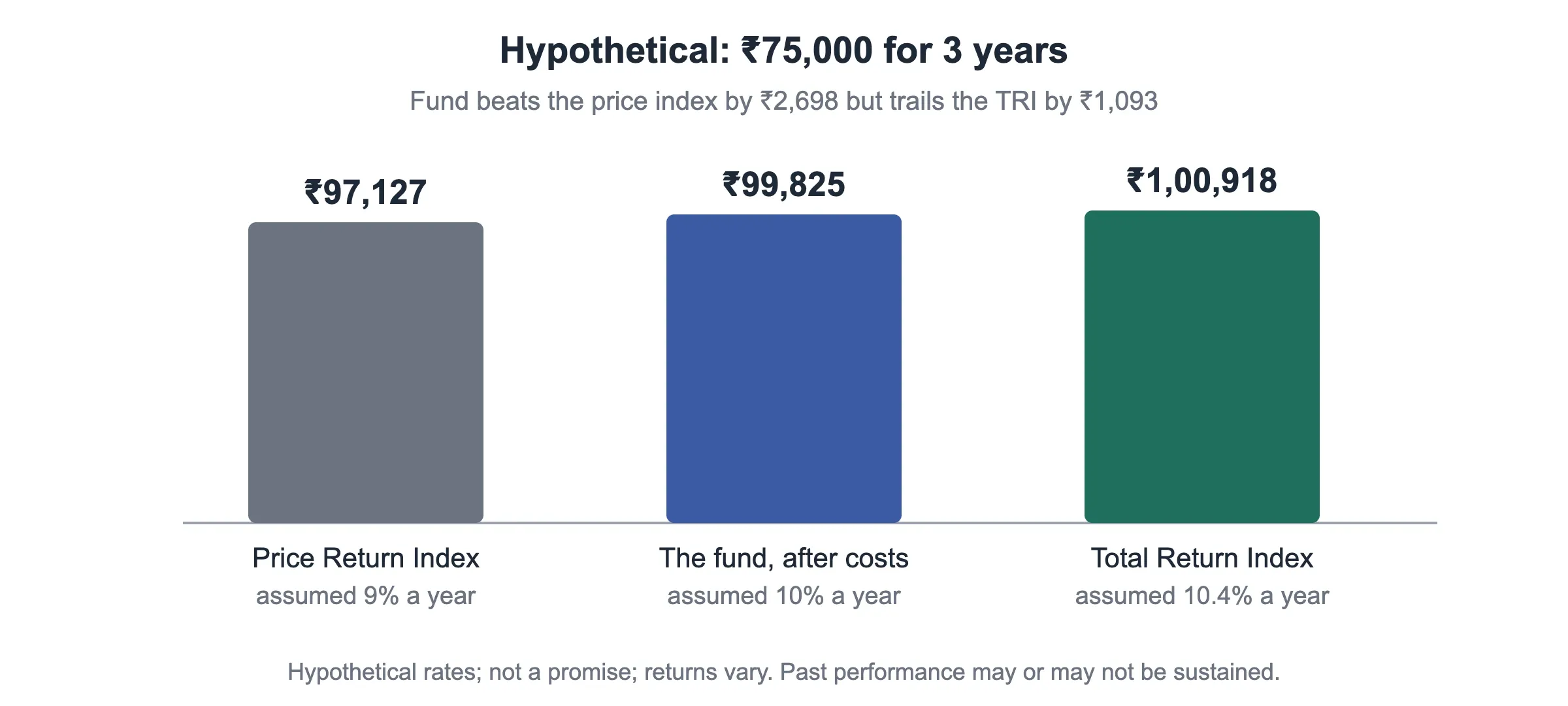
- In our hypothetical ₹75,000 example, the fund beats the price index by ₹2,698 but trails the TRI by ₹1,093.
- Compare the same plan and the same periods, across several periods.
- Trailing the TRI in one period is context, not a verdict.
A benchmark is the index a mutual fund's returns are compared with. SEBI requires funds to benchmark performance to the Total Return Index (TRI), which adds dividends back into the index, unlike a price index. To judge a fund, compare its returns with the TRI over the same periods, not one good year.
Picture Farhan, 27, in Lucknow, reading his first fund factsheet. One row shows the scheme's return; the row below shows the benchmark's. If that benchmark left out dividends, the fund would look better than it was. Here is what a benchmark in a mutual fund is, and how to read the two rows yourself.
What is a benchmark in a mutual fund?
A benchmark is a market index that represents what the fund is trying to invest in. A large cap fund is compared with a large cap index; a short-duration debt fund with a debt index of similar duration. The scheme names its benchmark in its Scheme Information Document (SID), and the factsheet shows the scheme's returns beside it.
Under SEBI's October 2021 circular on uniform benchmarks, schemes follow a two-tier structure. In SEBI's words, "The first tier benchmark shall be reflective of the category of the scheme", and "The second tier Benchmark is optional and shall be decided by the AMCs". The circular adds: "All the benchmarks followed should necessarily be Total Return Indices." Index funds and ETFs have a single benchmark, the index they replicate.
What is TRI (Total Return Index), and how is it different from a price index?
A Price Return Index (PRI) moves only with the prices of the shares in it. When a company pays a dividend, its share price typically drops on the ex-date, and a price index records the drop but not the cash. NSE's index provider puts it plainly: a price index "does not consider the returns arising from dividend receipts".
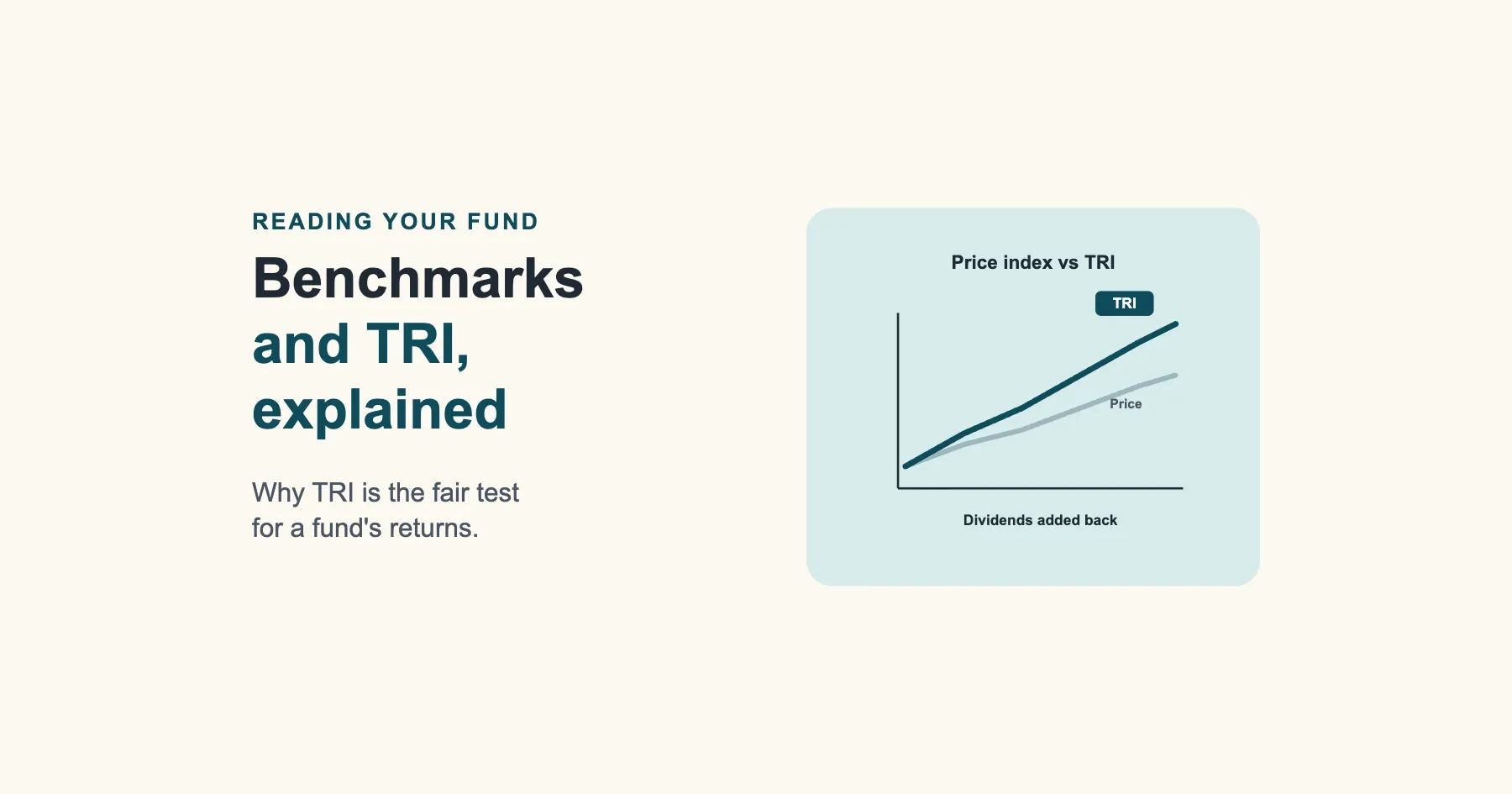
A Total Return Index adds that income back. On the NSE indices' explanation, "Dividend payouts as they occur are indexed on ex-date" and reinvested in the index. The TRI and the price index start from the same base, so over time the TRI sits above the price index by roughly the dividends it has added.
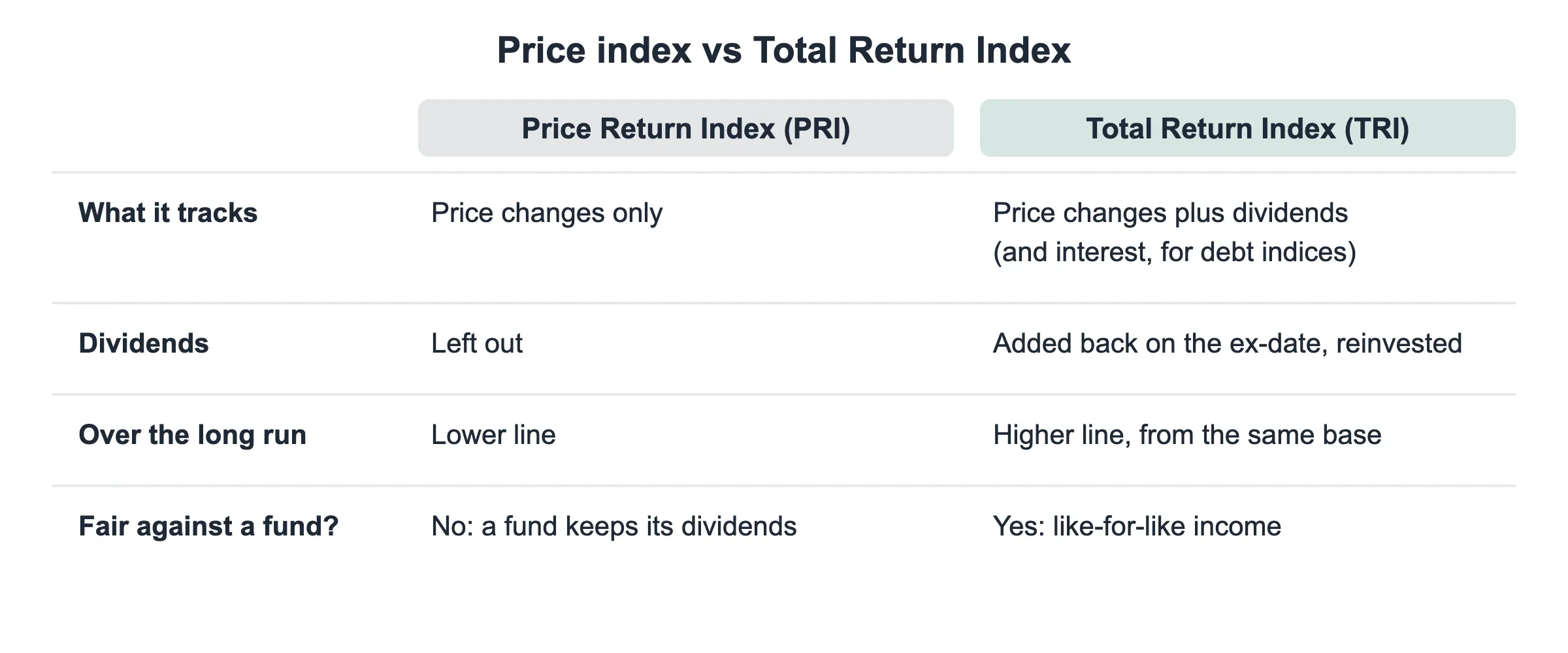
| Price Return Index (PRI) | Total Return Index (TRI) | |
|---|---|---|
| What it tracks | Price changes only | Price changes plus dividends (and interest, for debt indices) |
| Dividends | Left out | Added back on the ex-date and reinvested |
| Over the long run | Lower line | Higher line, from the same base |
| Fair against a fund? | No: a fund keeps the dividends it receives | Yes: like-for-like income |
Why do mutual funds compare returns with TRI?
A fund that holds shares receives their dividends, and that income lifts its NAV. Comparing that NAV with a price index would set the fund against a yardstick that throws its dividends away. SEBI's circular of 4 January 2018 (SEBI/HO/IMD/DF3/CIR/P/2018/04) noted that "TRI is more appropriate as a benchmark to compare the performance of mutual fund schemes" and directed in para 3(b) that performance "shall be benchmarked to the Total Return variant of the Index". It applied to all schemes from 1 February 2018.
If you see a comparison outside the factsheet, check which variant it uses.
A worked example: beating the price index is the easy test
Take a hypothetical ₹75,000 lump sum invested for 3 years. All three rates below are hypothetical assumptions, chosen only to show the arithmetic (not a promise; returns vary):
- Price index: 9% a year
- Total Return Index: 10.4% a year (the price move plus about 1.4% a year of dividends)
- The fund, after its costs: 10% a year
| Hypothetical, ₹75,000 for 3 years | Assumed yearly return | Ending value | Gain |
|---|---|---|---|
| Price Return Index | 9% | ₹97,127 | ₹22,127 |
| The fund (after costs) | 10% | ₹99,825 | ₹24,825 |
| Total Return Index | 10.4% | ₹1,00,918 | ₹25,918 |
Against the price index, the fund looks ahead by ₹2,698. Against the TRI, it trails by ₹1,093. Same fund, same three years, opposite conclusions. That is why the TRI is the fair test. (Each value is ₹75,000 × (1 + rate)³, rounded to the nearest rupee.)
Real returns vary and can be negative, and past performance may or may not be sustained.
How do I check if my fund beat its benchmark on a factsheet?
- Find the performance table. Factsheets usually show the scheme's returns beside its benchmark's for the same periods, for example 1, 3 and 5 years and since launch.
- Confirm the benchmark is a TRI. Look for "TRI" or "Total Return" in its name.
- Match the plan. Direct and regular plans of a scheme have different expense ratios, so their returns differ. Read the row for the plan you hold or are considering.
- Compare like with like. Compare one period with the same period, and annualised (CAGR) returns with annualised returns.
- Look across several periods. Behind over 1 year but ahead over 5 is a different story from behind over every period.
What does it mean if a fund underperforms its benchmark?
It means that over that period an investor in the fund earned less than the index did. Some of the gap is structural: an index has no costs, while a fund's reported returns are after its expense ratio, so even a fund that matched the market before costs would trail its TRI slightly.
One period behind is context, not a sell signal. Ask instead: is the gap consistent across 3 and 5 years? Is it larger than the cost difference alone would explain? Has the fund's category or mandate changed? Risk level and costs belong in the same check.
Benchmarks for index funds: tracking difference
For an index fund, the benchmark is the index it copies, so the question changes from "did it beat the index?" to "how closely did it follow it?" The gap between the fund's return and its TRI over a period is the tracking difference. It is usually negative because of costs; a smaller gap means closer tracking. Our guide to comparing two index funds covers this in detail.
Frequently asked questions
Can two funds in one category use different benchmarks?
Yes. SEBI's 2021 framework allows one broad market index per index provider for each category, so two funds in the same category may use comparable indices from different providers. An AMC may also add an optional second-tier benchmark.
Does the expense ratio affect the comparison?
Yes. Reported fund returns are after the expense ratio, while an index carries no costs. That is one reason a fund that tracks its market closely still shows returns slightly below its TRI.
Where do I find a fund's benchmark?
In the Scheme Information Document, the Key Information Memorandum and the monthly factsheet. The factsheet also shows the scheme's and the benchmark's returns side by side.
Read next
A benchmark is one filter of six. Check where it fits in the full checklist in our guide on how to choose a mutual fund without chasing last year's returns.
— Laabh



