What is an SIP in mutual funds? A plain-English guide for your first one
An SIP invests a fixed amount in a mutual fund scheme at regular intervals. See how ₹2,500 a month becomes units, and why value can still fall.
Summarize this article with AI





The short version
- An SIP is a way to invest a fixed amount in a mutual fund scheme at regular intervals. It is not a fund and not a fixed return.
- Each instalment buys units at the applicable NAV; your value is units × the current NAV.
- Rupee cost averaging can lower your average cost per unit, but it does not remove risk.
- Minimums, costs and stop rules are set per scheme or fund house. Read the SID and KIM.
- AMFI says missed instalments carry no fund-house penalty, but three consecutive misses cancel the SIP.
An SIP (Systematic Investment Plan) is a way to invest a fixed amount in a mutual fund scheme you choose, at regular intervals such as every month. Each instalment buys units of that scheme at the applicable NAV (net asset value) for that day, so the number of units you get changes as the NAV changes. Because the scheme's investments are market-linked, the value of what you have built up can fall as well as rise.
An SIP is a habit, not a product: the fund does the investing, and the SIP sets the rhythm. Below, we follow one instalment into your folio, run a three-month example that can end either way, and point each follow-up question to a deeper guide.
SIP is / SIP is not
| An SIP is | An SIP is not |
|---|---|
| A way to invest in a mutual fund scheme | A type of fund or a separate product |
| A fixed amount on a fixed date | A fixed return |
| A discipline that spreads your buying over time | Protection against a fall in value |
| Something you can stop later, on the scheme's terms | A contract you must keep paying |
AMFI's investor-education site, Mutual Funds Sahi Hai, puts the last row plainly: "SIP is just a convenient mode of investing and not a contractual obligation".
How does an SIP work, step by step?
- Choose a scheme and an amount. You pick the mutual fund scheme, the amount, the frequency and a date.
- Set up a bank mandate. You authorise the fund house (AMC) or the platform you use to debit your bank account on that date. Registration can take some days; your fund house's form states how long.
- The debit happens. On the SIP date, the amount leaves your bank account.
- Units are allotted at the applicable NAV. Your money buys units at the NAV that applies to that instalment, after any applicable charges such as stamp duty. Our guide to what NAV is explains how units are priced, and NAV cut-off time for an SIP explains which day's NAV you get.
- Units add up in your folio. Each month's units join the earlier ones. Your holding is worth the total units × the current NAV.
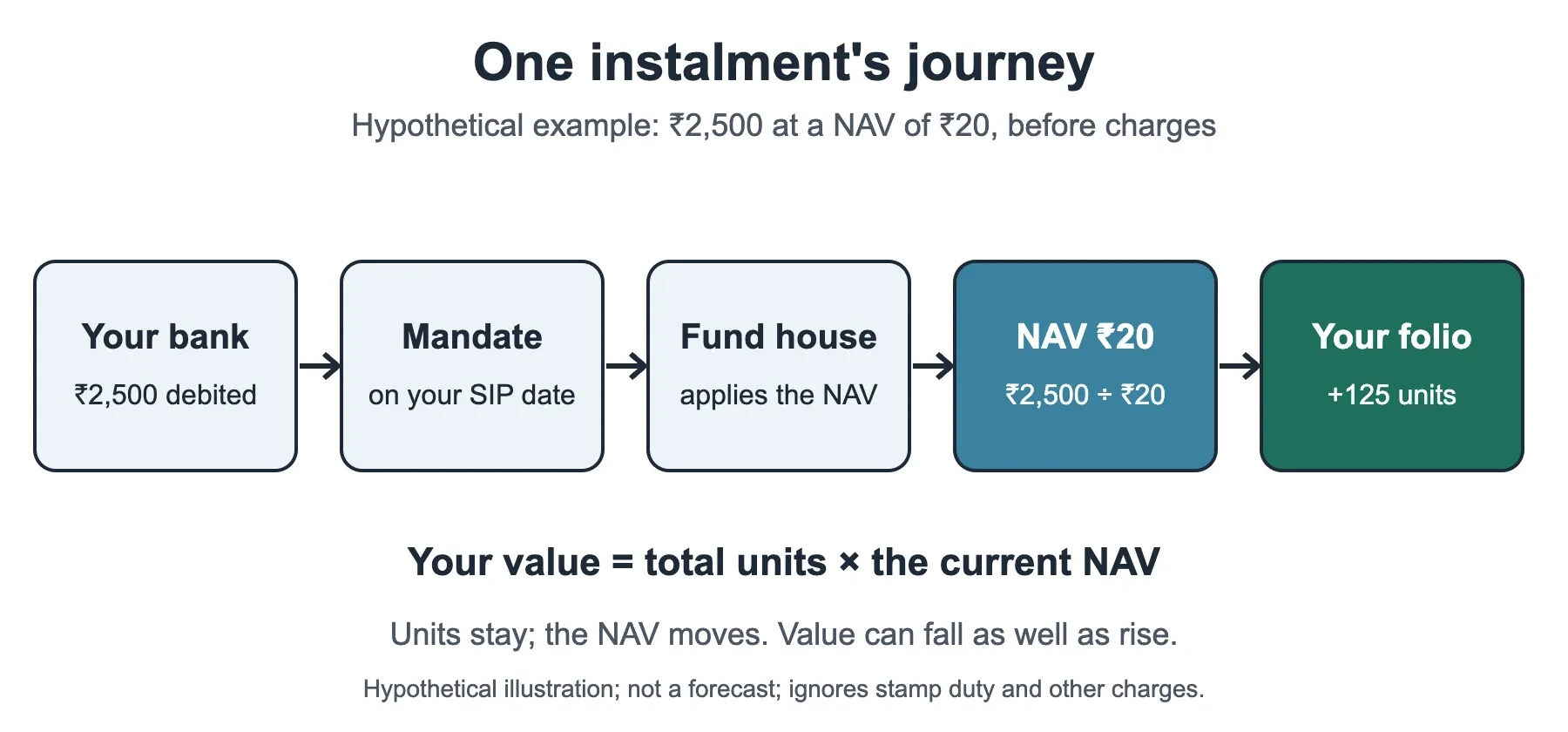
One instalment's journey: the ₹2,500 example
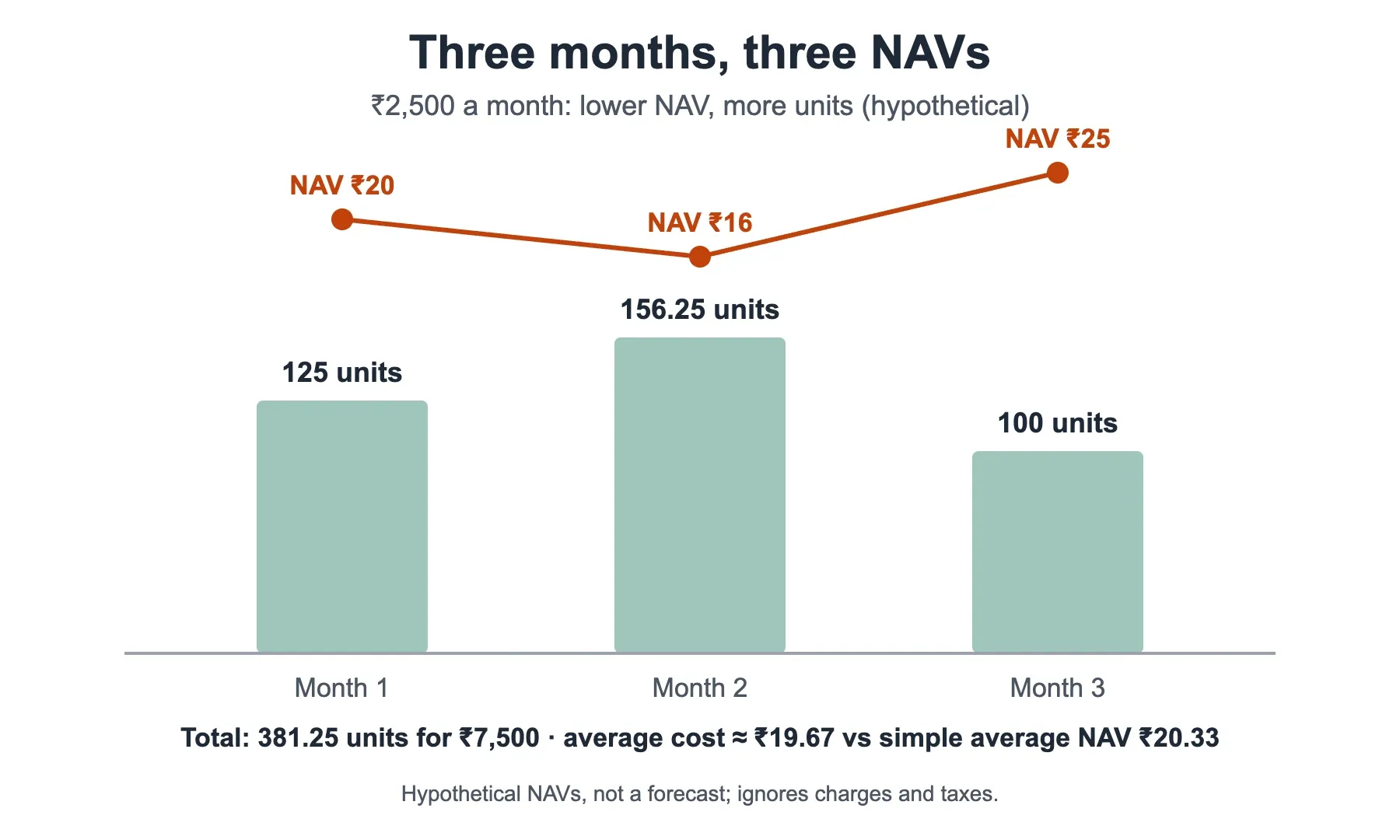
Say you invest ₹2,500 a month for three months. The NAVs below are made up to show the mechanics.
| Month | Hypothetical NAV | Units bought with ₹2,500 (before charges) |
|---|---|---|
| 1 | ₹20 | 125.000 |
| 2 | ₹16 | 156.250 |
| 3 | ₹25 | 100.000 |
| Total | Simple average NAV: ₹20.33 | 381.250 units for ₹7,500 |
Hypothetical NAVs, not a forecast; ignores charges and taxes.
Your average cost is ₹7,500 ÷ 381.25 units = about ₹19.67 per unit, a little below the simple average of the three NAVs (₹20.33). That happened because the same ₹2,500 bought more units in the month the NAV was low and fewer when it was high.
This effect is called rupee cost averaging. AMFI's investor site describes it as "averaging out the price at which you purchase units of a mutual fund". But it does not remove risk, and it does not guarantee a lower cost than investing a lump sum on a particular day. It only means a fixed amount buys more units when prices are lower.
Now two possible endings, both hypothetical:
- If the NAV is ₹22 after month 3: 381.25 × ₹22 = ₹8,387.50, which is ₹887.50 more than the ₹7,500 you put in.
- If the NAV is ₹17 after month 3: 381.25 × ₹17 = ₹6,481.25, which is ₹1,018.75 less than you put in.
Same SIP, opposite outcomes: averaging can still leave you below what you invested.
Is an SIP safe, or can you lose money?
An SIP is only the route into a scheme. The risk sits in the scheme itself: an equity fund, a debt fund and a gold fund behave very differently, whichever way you pay in. Scheme documents carry a riskometer label, and what the riskometer levels mean shows you how to read it.
So yes, you can lose money through an SIP. An SIP doesn't guarantee profit or protect against loss. When the NAV falls, the value of every unit you already hold falls with it. That is a real fall in value, even before you redeem, and no one can promise when or whether it will recover.
What an SIP changes is behaviour: you are not deciding each month whether "now" is a good time. If markets fall after you start, read what happens to your SIP when markets fall before you change anything.
SIP vs lump sum: what's the difference?
| SIP | Lump sum | |
|---|---|---|
| How money goes in | A fixed amount at regular intervals | One larger amount at once |
| Timing exposure | Spread across many purchase dates | Tied to one purchase date |
| Discipline | Built in by the schedule | Depends on you deciding to invest |
| Usually described as fitting | Regular income, such as a monthly salary | A sum already in hand, such as a bonus |
There is no general winner: the result depends on how the NAV moves afterwards, which no one knows in advance. For a bonus, lump sum or SIP for a bonus compares the options.
How much do you need to start?
There is no single industry-wide minimum. Each scheme sets its own minimum amounts in its SID (scheme information document) and KIM (key information memorandum). As one example, the KIM of one gold fund of fund dated 21 November 2025 lists a minimum purchase of "Rs.100/- and any amount thereafter". Other schemes set other figures, and SIP minimums can differ from one-time minimums.
Some schemes allow very small instalments; see small-ticket SIPs of ₹250.
What an SIP costs you
An SIP has no separate "SIP fee" of its own. You bear the same costs as any investor in that scheme:
- Expense ratio (TER): the scheme's annual running costs, charged to the scheme and reflected in its NAV. See expense ratio in mutual funds.
- Exit load: a charge some schemes apply if you redeem within a set period. It is stated in the scheme's KIM.
- Other charges: any stamp duty that applies to purchases, and any charges your bank or platform levies.
Stop, pause, miss, withdraw: what you can change later
- Missed an instalment? AMFI's Mutual Funds Sahi Hai says "Mutual Fund companies don't penalize for non-payment of SIP instalments", and that "your SIP will automatically be cancelled if you fail to make the payments for three consecutive months." The same page warns that your bank will penalise you if the auto-debit is dishonoured. See what happens when you miss an SIP instalment.
- Want to take money out? You can usually redeem units already bought, subject to any exit load or lock-in. See withdrawing your SIP money.
- Wondering how long to keep going? That depends on your goal's date. See how long to continue an SIP.
- Want to invest more as you earn more? See how much to step up an SIP.
AMFI's page also advises sending a stop request at least 30 days in advance if you foresee a cash crunch. How you stop or pause, and the notice your fund house or platform needs, varies, so check their terms.
Compounding, in one paragraph
Returns that stay invested can earn returns of their own, which is why the later years of a long SIP can matter more than the early ones. It works in reverse in falling years, and nothing about it is guaranteed. See how SIP compounding works.
Before your first SIP: a short checklist
- Emergency fund first. Keep money you may need in a hurry where you can reach it without selling at a bad moment; see how much emergency fund to keep.
- A goal and a year. Write down what the money is for and roughly when you will need it.
- A fund type that matches the timeline. Which type of mutual fund a beginner should start with walks through the categories.
- KYC done. KYC (know your customer) must be completed before any mutual fund investment; see mutual fund KYC online.
- Growth or IDCW option. Decide whether you want returns reinvested or paid out; see growth vs IDCW.
Frequently asked questions
What is an SIP in mutual funds, in simple words?
An SIP (Systematic Investment Plan) is a way to invest a fixed amount in a mutual fund scheme at regular intervals, such as monthly. Each instalment buys units at the applicable NAV, and the value of those units rises and falls with the scheme's investments.
How does an SIP work each month?
On your chosen date, the amount is debited through your bank mandate. The fund house allots units at the applicable NAV, after any charges, and adds them to your folio.
Is an SIP safe, or can I lose money?
The risk depends on the scheme, not the SIP. If the NAV falls below your average cost, your holding is worth less than you invested. An SIP doesn't guarantee profit or protect against loss.
What is the difference between an SIP and a lump sum?
An SIP spreads fixed amounts over many purchase dates; a lump sum invests one amount at once, so the result depends more on that single date. Which works out better depends on how the NAV moves afterwards.
What is the minimum amount to start an SIP?
There is no single industry minimum. Each scheme sets its own minimum in its SID and KIM, so check the scheme you are considering.
Can I stop or pause my SIP anytime?
AMFI's investor site calls an SIP "a convenient mode of investing and not a contractual obligation", so you can stop it. How you stop or pause it, and how much notice is needed, depends on the fund house or platform. Units you already hold stay invested until you redeem them.
Related reading
- how to start an SIP, step by step
- starting an SIP with your first salary
- SIP vs FD vs RD
- XIRR in an SIP
- mutual funds without a demat account
- comparing two index funds
- an SIP in a child's name
- how to read your CAS
- PPF vs SIP
- the 50/30/20 budget
Your next step
Before choosing any fund, write down one goal, the amount and the year you'll need it. That note will decide more than any SIP calculator.
— Laabh



