How to claim mutual funds after a death: the transmission steps for each family situation
Nominee, joint holder or legal heir? The documents each needs to claim mutual funds after a death, SEBI's 2026 limits, the 21-day timeline and tax.
Summarize this article with AI





The short version
- Transmission moves units, not cash, into the claimant's own folio; find every folio first.
- Each folio has its own situation: nominee, surviving joint holder or legal heir.
- With no nominee, the documents depend on value per fund house: up to ₹10,000, up to ₹10 lakh, or above.
- No tax on transmission; on later redemption, the previous owner's cost and holding period carry over.
- Processing is due within 21 calendar days of a complete set of documents.
To claim mutual funds after an investor's death, the nominee, surviving joint holder or legal heir submits a transmission request with the death certificate, the claimant's KYC and bank proof to the fund house or its registrar (CAMS or KFintech). The units move into the claimant's own folio. Tax arises only when they are later redeemed.
If you are reading this after losing a parent, a spouse or another relative, take it one step at a time. The units stay invested in the folio while you gather the papers, and nothing here has to be finished in the first week. This guide asks one question first: which of three family situations is yours? It then gives the document list for that situation, based on SEBI's rules as of 17 November 2026.
My parent passed away and had mutual funds: how do we claim them?
The process is called transmission: moving mutual fund units from a deceased investor to the person entitled to them. Units move, not cash. Once they sit in the claimant's own folio, the claimant can keep them or redeem them later, like any other investment.
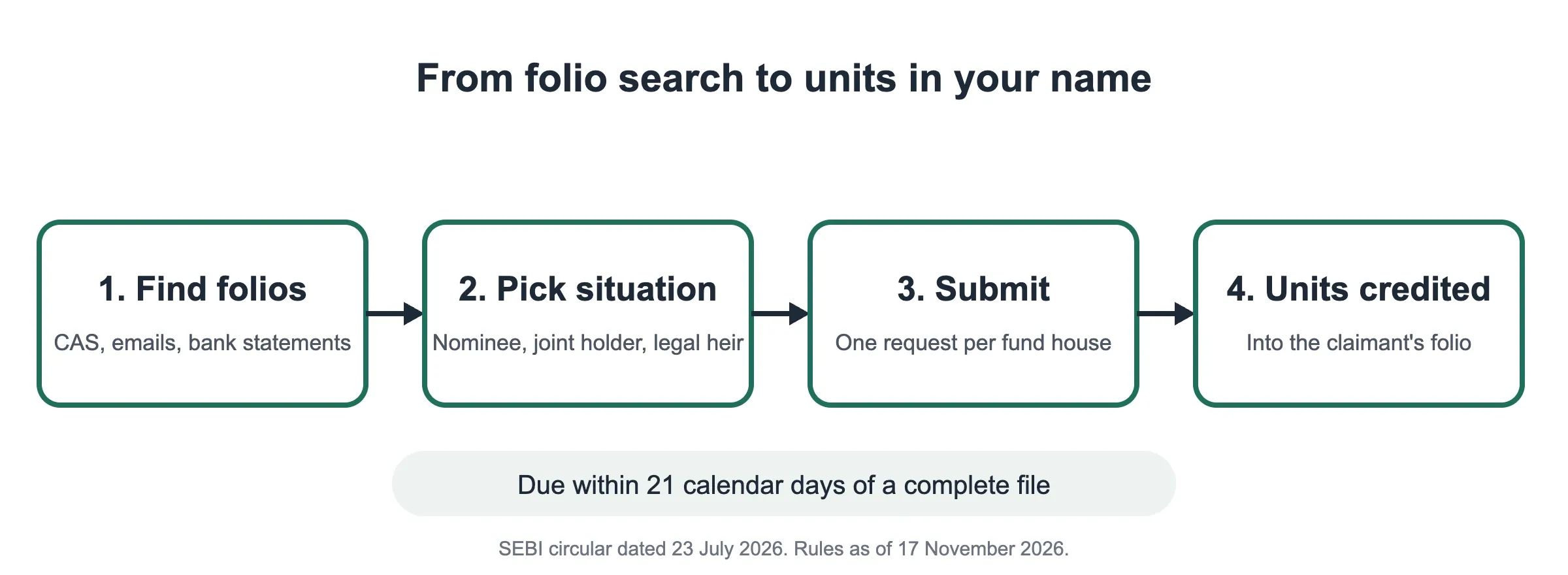
Work through these steps in order:
- Collect copies of the death certificate. You will need one for each fund house, and the 2026 SEBI framework asks for a verifiable death certificate.
- Find every folio. A folio is the account number a fund house gives an investor, and one person can have several. A Consolidated Account Statement (CAS) lists folios across fund houses for one PAN; our guide on how to read your CAS walks through it. Also check the deceased's email for monthly statements and their bank statements for SIP debits or redemption credits.
- Note the situation for each folio. Was a nominee registered? Was the folio held jointly? The answer can differ from one folio to the next.
- Get the claimant's KYC in order. If the claimant has never invested, they complete KYC before the units can come to them.
- Submit one request per fund house with the documents for your situation (table below).
- Check the new statement. Once transmission is done, the units appear in the claimant's folio and a statement follows.
Tell each fund house about the death early, even before every document is ready. That lets them stop further instructions on the folio. Also tell the bank, since any SIP mandate runs on the deceased person's bank account.
What documents are needed for mutual fund transmission?
SEBI simplified and standardised transmission in a circular dated 23 July 2026, which applies to units issued by asset management companies and came into force 30 days after issue. The table covers units held in a fund house's account statement (not in a demat account). Value is worked out by the claimant at the last available NAV, per fund house.
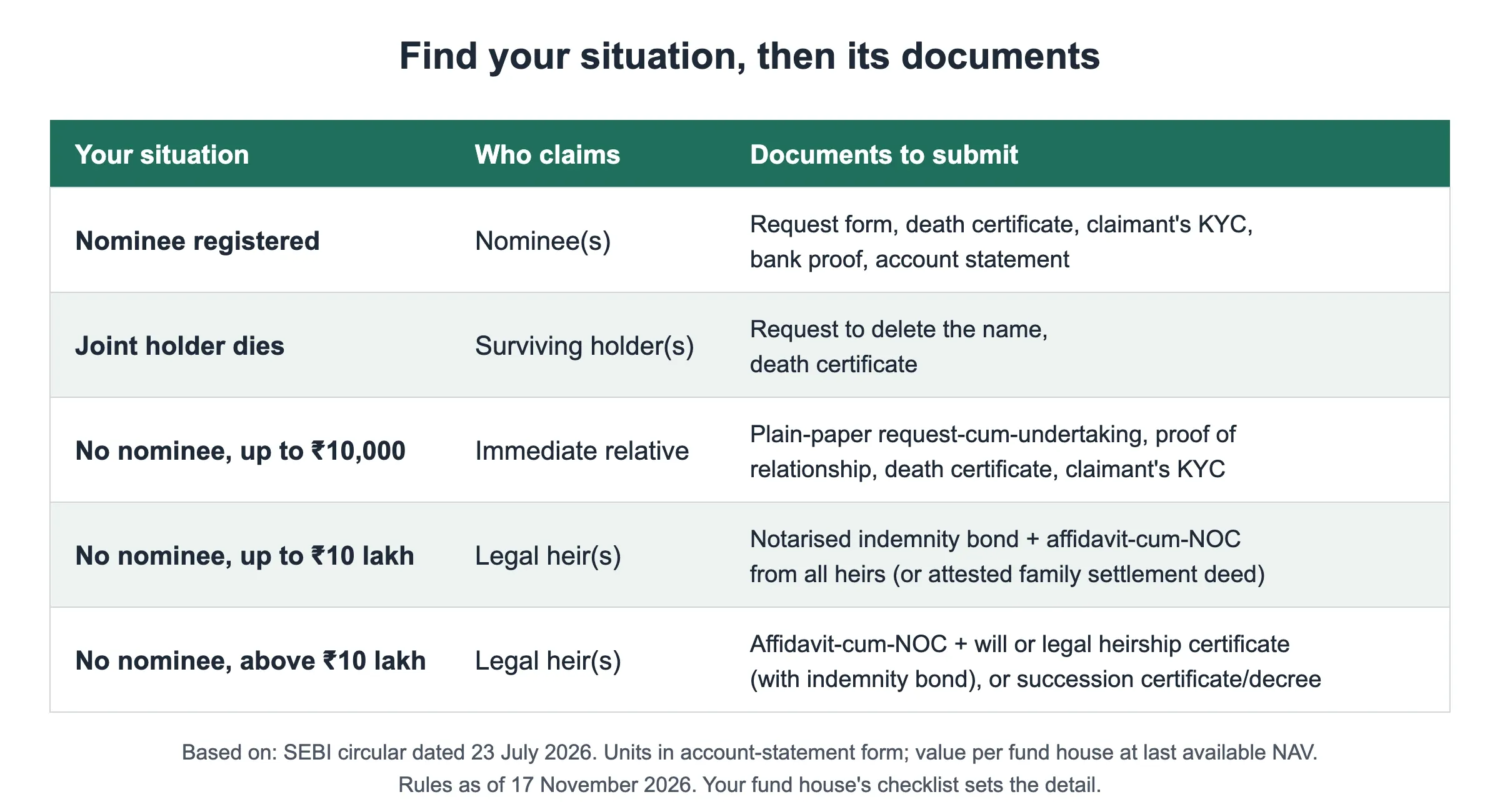
| Your situation | Who claims | Documents to submit |
|---|---|---|
| A nominee is registered | The nominee(s) | Transmission request form, death certificate, the claimant's KYC, bank proof, latest account statement |
| Held jointly, one holder dies | Surviving joint holder(s) | Request to delete the deceased holder's name, with the death certificate |
| No nominee, value up to ₹10,000 | An immediate relative: parent, spouse, child or parent-in-law | Plain-paper request-cum-undertaking, proof of relationship, death certificate, the claimant's KYC |
| No nominee, value up to ₹10 lakh | Legal heir(s) | Notarised indemnity bond and an affidavit-cum-NOC from all legal heirs, or an attested family settlement deed |
| No nominee, value above ₹10 lakh | Legal heir(s) | Affidavit-cum-NOC from all legal heirs, plus one of: a will with an indemnity bond; a legal heirship certificate from a revenue officer not below tehsildar rank, with an indemnity bond; or a succession certificate, letter of administration or court decree |
A few points sit behind the table:
- Probate is no longer mandatory under the July 2026 framework.
- Units held in demat follow higher limits: ₹30,000 for the low-value route and ₹30 lakh for simplified documents, counted per beneficial owner.
- Standard formats (the request form, indemnity bond and affidavit-cum-NOC) are annexed to the circular, and fund houses are expected to offer them on their websites.
- Your fund house's checklist decides the detail, such as how many copies are needed or whether an original must be shown in person.
What if there was no nominee on the folio?
Then the units go to the legal heirs, and the paperwork depends on the value held with that fund house. For small holdings, up to ₹10,000, an immediate relative can use a short plain-paper route. Up to ₹10 lakh, the legal heirs sign an indemnity bond and a joint affidavit-cum-NOC, so no court papers are needed. Above ₹10 lakh, you add a will, a legal heirship certificate or a court-issued document such as a succession certificate.
Two situations need extra care:
- When heirs disagree. The simplified framework does not apply where there is a dispute or competing claims. That is the point to speak with a lawyer, who can advise on the court route.
- When all joint holders die together. The July 2026 framework covers the death of a sole holder or of all joint holders. Ask the fund house which documents it needs, because that depends on whether nominees were registered.
A nominee also isn't automatically the final owner. SEBI's July 2026 framework says the nominee receives the units as a trustee on behalf of the legal heirs. The fund house's job ends once it transmits to the nominee; who finally keeps the money is decided by the will or succession law. If that question matters in your family, a lawyer can explain how it applies to you.
Do we pay tax when units are transferred to us?
Not on the transmission itself. This section reflects the rules as of 17 November 2026 (FY 2026-27, under the Income-tax Act, 2025). Receiving units by inheritance or as a nominee is not treated as a sale, so no capital gains tax arises when they move into your folio. Tax comes later, when you redeem. At that point, the previous owner's purchase cost becomes your cost, and their holding period counts towards yours.
A hypothetical example. A father bought equity fund units for ₹2,10,000. He held them for more than 12 months. At his death they are worth ₹3,60,000, and his son is the registered nominee.
- Trigger 1, transmission: units move to the son's folio. Tax: nil.
- Trigger 2, redemption: the son later redeems everything at ₹3,60,000. Gain: ₹3,60,000 minus ₹2,10,000 = ₹1,50,000. Because the father's holding period counts, the gain is long-term.
- With no other equity long-term gains that year, the first ₹1,25,000 is exempt. Taxable gain: ₹25,000. Tax at 12.5%: ₹3,125. Cess at 4%: ₹125. Total: ₹3,250.
These values are hypothetical and assumed for illustration; they are not a promise, and returns vary. The tax figures are as of FY 2026-27, under the Income-tax Act, 2025, and are not tax or legal advice. Tax rules change; consult a tax professional for your situation.
How long does transmission take, and where do we apply?
Under the July 2026 framework, the fund house or registrar must process a claim within 21 calendar days of receiving all the required documents. If a claim is delayed or rejected, it has to give reasons in writing.
Where to apply:
- The fund house, at its branch or through its service channels.
- Its registrar, CAMS or KFintech, which keeps the folio records and processes transmission for the fund house. Our explainer on what CAMS and KFintech are shows which one serves which fund house.
- Online, where offered. The circular lets entities offer an online facility as an option. Whether you can file through a registrar's website or MFCentral depends on what each currently accepts, and originals may still need to be shown.
If you hold folios with five fund houses, expect five requests. Keep a simple list: fund house, folio number, situation, date sent and acknowledgement number.
Frequently asked questions
Must the nominee redeem the units?
No. Transmission moves the units into the nominee's folio, where they stay invested. The nominee can hold or redeem them later. Tax applies only on redemption.
Is the claimant's KYC needed?
Yes. The claimant's KYC must be in place for the units to be credited. If the claimant is a minor, the guardian's KYC is used.
Does an SIP stop automatically?
Inform the fund house and the bank as soon as you can. The fund house can stop instructions on the folio once it knows of the death, and the bank can cancel the mandate on the deceased's account.
Is the nominee the final owner?
Not necessarily. SEBI's rules say the nominee receives the units as a trustee on behalf of the legal heirs. Who finally keeps them follows the will or succession law. For a disagreement, speak with a lawyer.
Check your own folios have a nominee
A registered nominee makes the process shorter for the people you leave behind. Read next: how to add a nominee to your folio.
— Laabh



