How to read your mutual fund CAS: a section-by-section walkthrough
Who sends your mutual fund CAS, how often it arrives, and what each section means, with a fictional annotated sample. Rules checked 12 Nov 2026.
Summarize this article with AI





The short version
- The CAS is one statement of all your mutual fund folios under your PAN, plus demat holdings if you have demat.
- Demat holders get it from NSDL or CDSL; MF-only investors get it from the mutual funds through their RTAs.
- It comes monthly after a month with a transaction, and in April and October if there was none.
- Market value minus cost value gives a simple gain or loss; XIRR is the fairer measure for an SIP over time.
It turns up in your inbox as a PDF with a long name, a password and several pages of tables. That file is your Consolidated Account Statement (CAS): one statement that lists your mutual fund transactions and holdings across fund houses, and your demat holdings too if you have a demat account. Who sends it depends on whether you hold a demat account, and it arrives monthly when you have transacted and every six months when you haven't.
Think of it as your mutual fund passbook. Here is how to read it in about ten minutes, using a fictional sample.
Statement rules as checked on 12 November 2026.
What is a CAS, and why did I get one?
A CAS pulls your mutual fund folios into one statement. A folio is your account number with one fund house, so three fund houses usually means at least three folios.
A CAS usually arrives for one of two reasons:
- You transacted last month. An SIP instalment, a purchase or a redemption counts. The CAS for that month follows.
- It is April or October. If your folios saw no transactions in the half-year, AMFI's investor page says "the CAS is sent once in six months in October / April", showing your holdings at the end of the previous month.
So a CAS in a month when you didn't invest is most likely the half-yearly holdings statement, not a mistake.
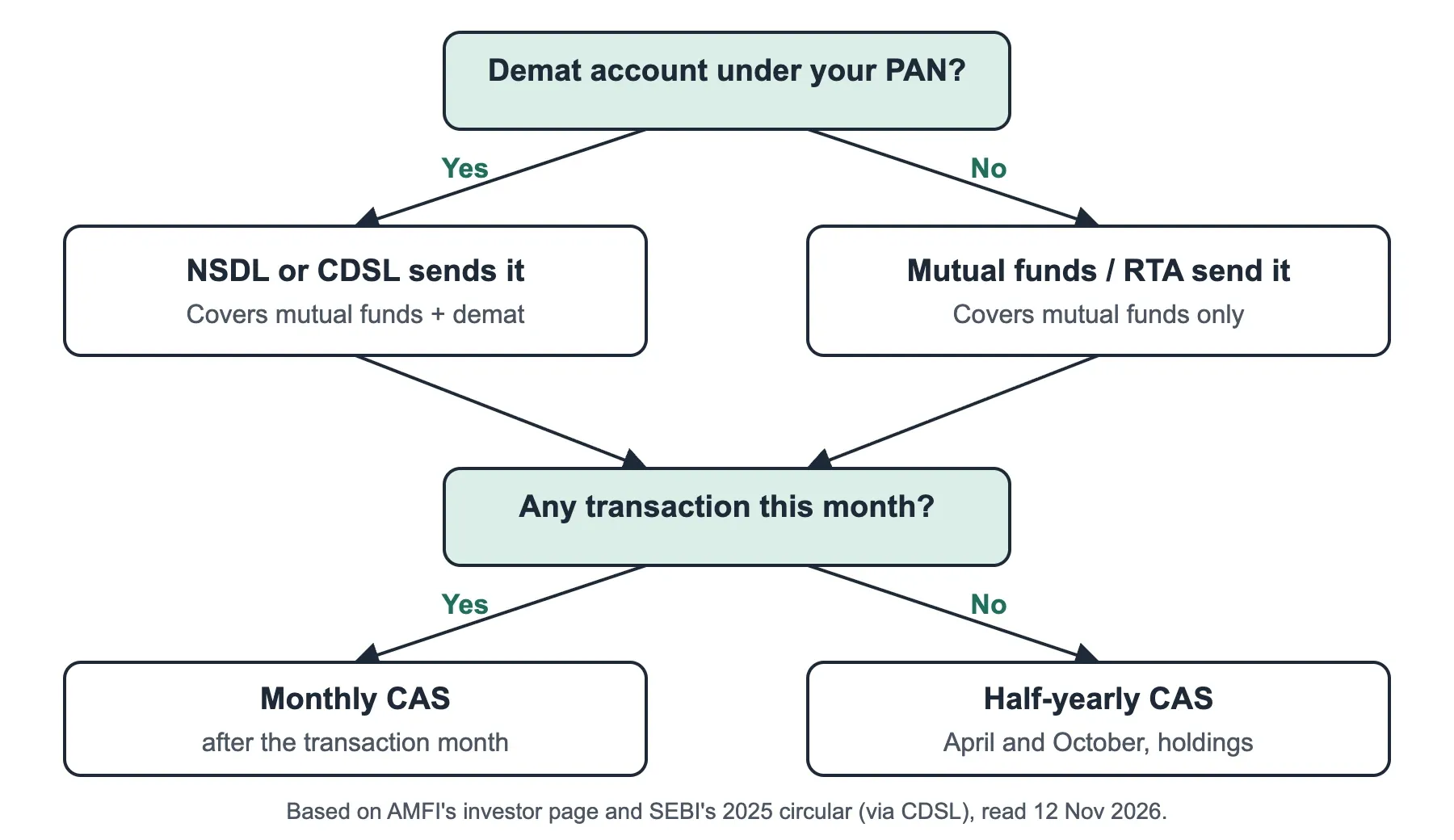
Who sends your CAS: depository or mutual fund/RTA?
| Your situation | Who sends the CAS | What it covers |
|---|---|---|
| You have a demat account under the same PAN as your folios | The depository, NSDL or CDSL | Mutual fund folios and your demat account holdings |
| You invest only through mutual fund folios (no demat) | The mutual funds, through their registrar and transfer agents (RTAs) | Mutual fund transactions only |
For demat holders, AMFI's investor page puts it this way: "The Depositories - NSDL or CDSL – as the case may be - shall issue the CAS, containing transaction/holding details of both mutual fund folios and depository accounts to the demat account holders."
For investors without a common demat link, the same page says "the CAS is sent by Mutual Funds containing only the mutual fund transactions". The registrars named on that page, CAMS and KFintech, provide e-CAS "electronically via e-CAS through a mail-back service." These RTAs keep investor records for fund houses; which one handles your folio depends on the fund house. AMFI's page ties the split to your PAN: the depository CAS covers PANs "that are common across the RTAs AND the Depositories".
How often it arrives, and the timeline rules
The pattern is simple: monthly after a month with a transaction, half-yearly (April and October) with your holdings if there were none. The exact deadlines come from two different sources, and they don't say the same thing, so we give them separately.
For demat holders (depository CAS). SEBI's circular of 14 February 2025, as forwarded by CDSL to its participants, revised the timelines from 14 May 2025. Fund houses and RTAs share data with the depositories "within five (5) days from the month end". The depositories then send the e-CAS "within twelve (12) days from the month end" and a physical CAS "within fifteen (15) days from the month end". For the half-yearly statement, the e-CAS goes "on or before the eighteenth (18th) day of April and October". One small oddity: the CDSL communiqué prints the circular number differently from SEBI's reference, so cite it by date if you need to.
For the mutual fund CAS (AMFI's investor page). AMFI's page says "CAS for financial transactions done during each month is sent by 10th of the following month." That page is undated, and its monthly timeline differs from SEBI's 2025 depository timeline. We have not merged the two into one rule.
If your statement seems late against either timeline, check with the RTA or fund house that services your folio before assuming something is wrong.
Reading it section by section
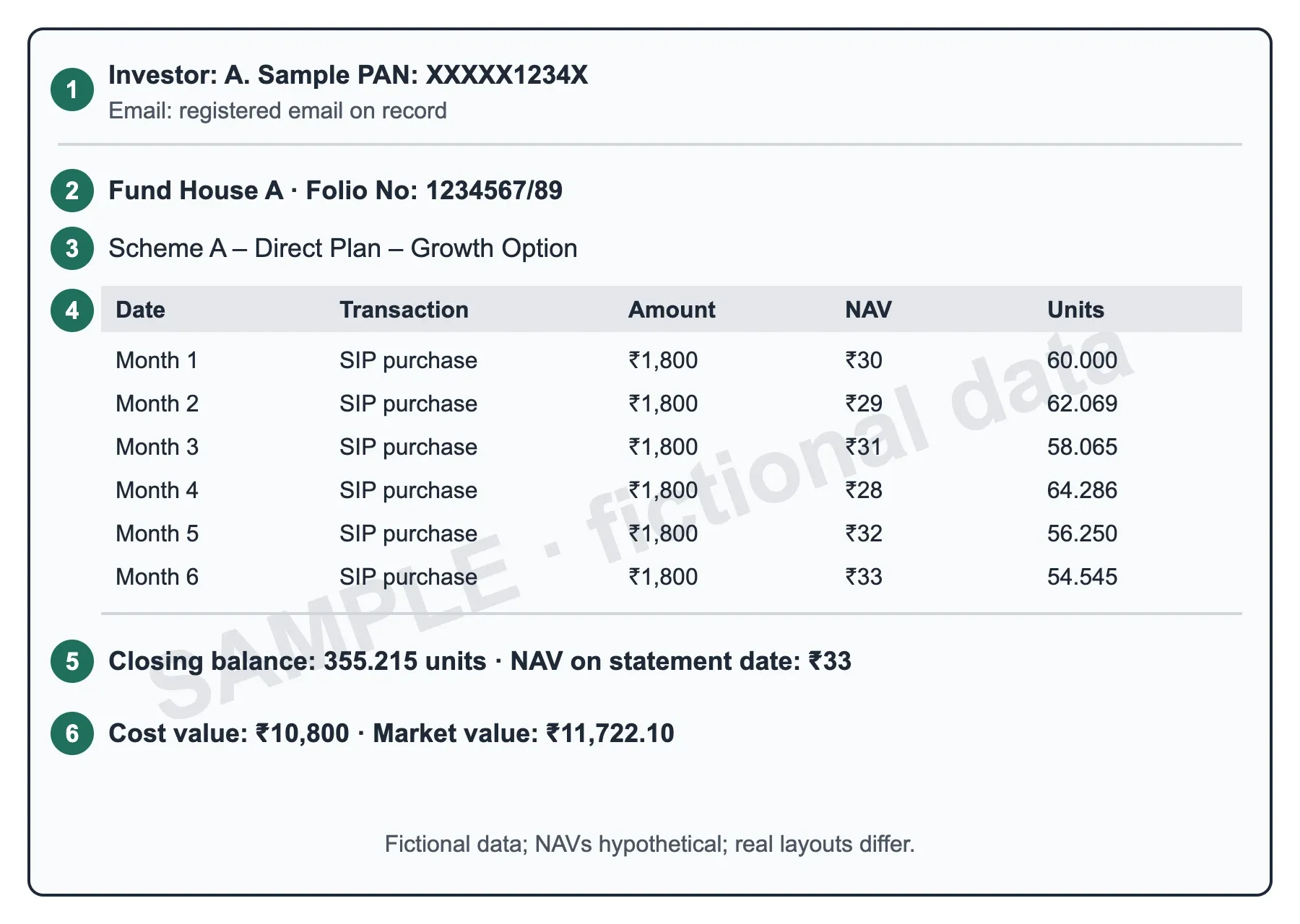
Your CAS may lay these out differently, with other labels or in another order. The fictional sample below shows six parts most statements contain.
Sample statement with fictional data; NAVs hypothetical; real layouts differ.
1. Investor details and PAN
The top block shows your name, email and a partly masked PAN, such as XXXXX1234X. If the PAN or name looks wrong, raise it with the fund house first.
2. Folio number for each fund house
Each fund house section starts with a folio number. Note it down; it is the reference every fund house or RTA will ask for.
3. Scheme name, plan and option
Under each folio you'll see the scheme name followed by the plan (direct or regular) and the option, such as growth or IDCW. Confirm this matches what you meant to buy. Our guide to growth or IDCW explains the option.
4. The transaction table
Each row shows a date, the transaction type, the amount, the NAV applied and the units allotted. Our sample is a ₹1,800 monthly SIP over six months:
| Month | Amount | NAV (hypothetical) | Units |
|---|---|---|---|
| 1 | ₹1,800 | ₹30 | 60.000 |
| 2 | ₹1,800 | ₹29 | 62.069 |
| 3 | ₹1,800 | ₹31 | 58.065 |
| 4 | ₹1,800 | ₹28 | 64.286 |
| 5 | ₹1,800 | ₹32 | 56.250 |
| 6 | ₹1,800 | ₹33 | 54.545 |
Units are the amount divided by the NAV. In month 2, ₹1,800 ÷ ₹29 = 62.069 units. Real statements may reflect small deductions, such as stamp duty, so your units may be slightly fewer than this simple division suggests. If NAV is new to you, start with what NAV is.
5. Closing units and NAV
At the end of each scheme you'll find the closing unit balance and the NAV on the statement date. In the sample, the six instalments add up to 355.215 units, and the last NAV is ₹33.
6. Cost value and market value
Cost value is what you paid: 6 × ₹1,800 = ₹10,800. Market value is units × NAV: 355.215 × ₹33 = ₹11,722.10. The gap, ₹922.10 in this example, is your unrealised gain on paper. With different NAVs it could just as easily be a loss.
Does the CAS show your returns?
It shows enough to work out an absolute gain or loss: market value minus cost value. In the sample, that is ₹922.10 on ₹10,800 invested.
It ignores when each rupee went in. For an SIP, XIRR weighs each instalment by how long it has been invested, so it is the fairer measure over time. Some statements may show additional return figures; check the legend on yours to see what any figure means before relying on it. See what XIRR is.
If the market value is below your cost, that is normal at times for a market-linked investment. Here is how an SIP behaves when markets fall: what happens to your SIP when the market falls.
Something's missing or wrong: what to check
If a fund or SIP you expected isn't in your CAS, run through these in order:
- Your email. The CAS goes to the email registered with the fund house, RTA or depository. AMFI's page also notes that investors who have not registered an email "will get only the monthly CAS".
- PAN and KYC. A folio opened with a different PAN, or one with incomplete KYC, may not be grouped with the rest. See KYC on hold.
- Timing. A new SIP's first instalment may not have been processed before the statement period closed. Wait for the next one.
- The demat question. If you hold units through a demat account, look in the depository CAS rather than an RTA statement. See mutual funds without a demat account.
If none of these explains it, contact the fund house or its RTA with your folio number and PAN.
The password
Your CAS PDF is password-protected. The email that carries your CAS usually explains how the password is formed. If it doesn't, check with the registrar (RTA), fund house or depository that sent it. We don't state a password format here because we couldn't confirm one from an official source.
Need an older statement?
AMFI's page says "A duplicate CAS will not be available in physical statement form for the past months." If your email is registered, you can request a duplicate e-CAS through the mail-back services of the registrars.
Frequently asked questions
What is a CAS (Consolidated Account Statement) in mutual funds?
It is a single statement that lists your mutual fund transactions and holdings across fund houses, grouped by folio. If you have a demat account, it also covers your demat holdings.
Who sends the CAS: CAMS, KFintech, NSDL or CDSL?
If you have a demat account under the same PAN, the depository (NSDL or CDSL) issues it. If you invest only through mutual fund folios, the mutual funds send it, and the registrars CAMS and KFintech offer e-CAS through mail-back services.
Why did I get a CAS in April or October when I didn't invest?
That is the half-yearly holdings statement. AMFI's page says that when there are no transactions, the CAS is sent once in six months, in October and April, showing your holdings at the end of the previous month.
Where do I find my folio number on the CAS?
Each fund house section begins with a folio number, usually near the fund house name. Keep a note of each one, because fund houses and RTAs ask for it in every request.
Does the CAS show my returns or XIRR?
It shows cost value and market value, which give an absolute gain or loss. Some statements may show additional return figures; check the legend on yours. For an SIP, XIRR is a fairer measure over time.
Why is a fund or SIP missing from my CAS?
Common reasons are a different registered email, a PAN or KYC mismatch, a first instalment not yet processed, or units held in demat appearing on the depository CAS instead. If none applies, contact the fund house or RTA.
One thing to do this week
Search your inbox for your latest CAS and note your folio numbers in one place. That list makes every future question to a fund house faster.
— Laabh



