Co-payment in health insurance: one hospital bill, three ways you might pay
Co-pay is your percentage share of an admissible claim. See one ₹2.2 lakh bill under 20% co-pay, a deductible and a room-rent cap, with IRDAI definitions.
Summarize this article with AI





The short version
- Co-pay is a percentage of the admissible claim; a deductible is a fixed rupee amount you pay first.
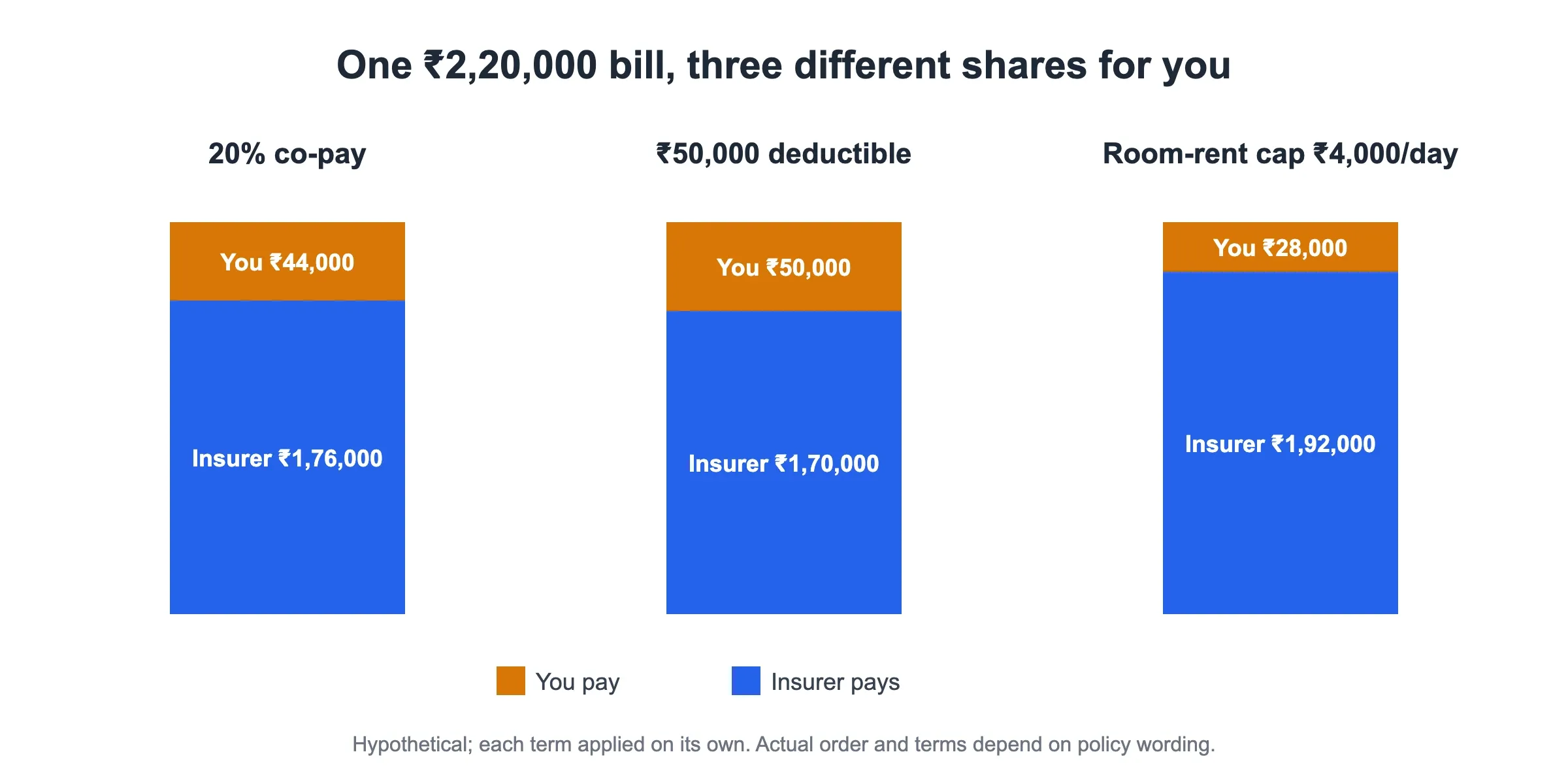
- On a hypothetical ₹2,20,000 bill: 20% co-pay leaves you ₹44,000, a ₹50,000 deductible leaves you ₹50,000, and a room-rent proportionate deduction leaves you ₹28,000.
- Co-pay grows with the bill, so check your share on a large claim, not a small one.
- Terms, including age-based co-pay and the order of deductions, are policy-specific. Read the CIS and policy wording.
- Disputes go to the insurer's grievance cell first, then Bima Bharosa or the Insurance Ombudsman.
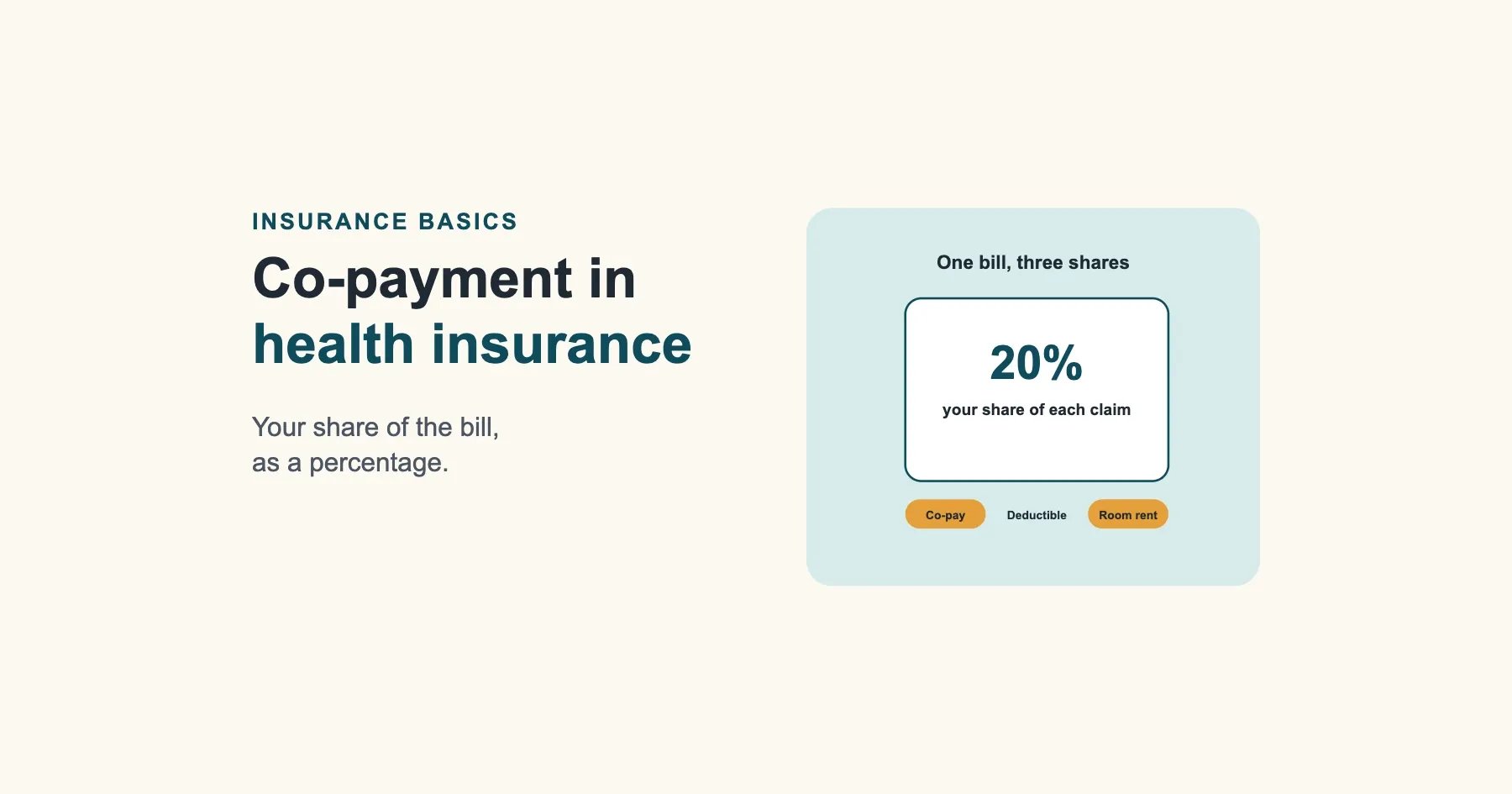
Co-payment is the percentage share of an admissible claim that you pay yourself, such as 20%, while the insurer pays the rest. On a ₹2,20,000 admissible bill with 20% co-pay, you pay ₹44,000 (hypothetical). A deductible is different: it is a fixed amount you pay before cover starts.
That is the co-payment in health insurance meaning in one line. The trouble is that co-pay rarely shows up alone. A deductible or a room-rent limit can also leave you with part of the bill, and each one works differently. Below, one hypothetical bill is run through all three so you can see what each term does before you sign a proposal form.
What does co-payment mean in health insurance, in simple words?
Co-payment, or co-pay, is a set percentage of every admissible claim that you pay yourself. If your policy has a 20% co-pay, you pay 20% of the admissible amount and the insurer pays 80%, up to the sum insured.
IRDAI's Guidelines on Standardization in Health Insurance (2013) define it this way:
The same guidelines define a deductible as "a cost-sharing requirement under a health insurance policy that provides that the Insurer will not be liable for a specified rupee amount of the covered expenses, which will apply before any benefits are payable by the insurer. A deductible does not reduce the sum insured."
Two words in those definitions do a lot of work:
- Percentage vs rupee amount. Co-pay grows with the bill. A deductible stays the same whatever the bill.
- Admissible. Co-pay is worked out on the amount the insurer accepts under the policy, not on the hospital's full invoice. Items the policy doesn't pay for are already yours before co-pay is applied.
Co-pay terms are policy-specific. The percentage, which treatments it covers, and whether it changes with age or city all sit in your policy wording and Customer Information Sheet (CIS).
If my hospital bill is ₹2,20,000 and co-pay is 20%, how much do I pay?
You pay ₹44,000 and the insurer pays ₹1,76,000, if the whole ₹2,20,000 is admissible.
Here is the full hypothetical example used in this article:
- Admissible hospital bill: ₹2,20,000
- Sum insured: ₹5,00,000
- Co-pay: 20% of the admissible amount
- Your share: 20% × ₹2,20,000 = ₹44,000
- Insurer's share: ₹2,20,000 − ₹44,000 = ₹1,76,000
Hypothetical; actual order and terms depend on policy wording. Figures are illustrations, not quotes from any policy.
Notice what co-pay does at higher bills. A 20% co-pay on a ₹5,00,000 claim (the full sum insured in this example) would be ₹1,00,000 from your pocket. The bigger the hospitalisation, the bigger your share.
Is co-pay the same as a deductible or a room-rent limit?
No. All three leave you paying part of the bill, but they are triggered differently. Here is the same ₹2,20,000 bill under each one, applied on its own.
| 20% co-pay | ₹50,000 deductible | Room-rent cap ₹4,000/day | |
|---|---|---|---|
| How it works | You pay a percentage of every admissible claim | You pay a fixed amount first; cover starts after | If your room costs more than the cap, linked charges are paid in proportion |
| What triggers it | Every claim | Every claim (or yearly total, per wording) | Choosing a room above the eligible limit |
| You pay | ₹44,000 | ₹50,000 | ₹28,000 |
| Insurer pays | ₹1,76,000 | ₹1,70,000 | ₹1,92,000 |
Hypothetical; actual order and terms depend on policy wording.
How the room-rent number is worked out
Say your policy caps room rent at ₹4,000 a day and you take a room at ₹5,000 a day. The eligible share is ₹4,000 ÷ ₹5,000 = 80%. Many policies then pay only 80% of the charges linked to that room category, not just 80% of the rent. This is called a proportionate deduction.
If ₹1,40,000 of the bill is room-linked charges, the deduction is 20% × ₹1,40,000 = ₹28,000, and that is yours to pay.
Under IRDAI's 2020 product-filing guidelines, insurers were asked not to apply proportionate deduction to pharmacy, implants, medical devices and diagnostics, or to ICU charges, and not to apply it in hospitals that don't follow differential billing by room category. Your policy wording lists which charges count as "associated medical expenses".
When a policy has more than one
Some policies combine terms. In one possible order, the insurer first removes the ₹28,000 proportionate deduction, leaving ₹1,92,000 admissible. A 20% co-pay on that is ₹38,400. Your total would be ₹28,000 + ₹38,400 = ₹66,400, and the insurer would pay ₹1,53,600.
Hypothetical; actual order and terms depend on policy wording. The order in which co-pay, deductible and proportionate deduction apply is set by your policy, so the claims section of the wording is the place to check.
Do all senior citizen health policies have compulsory co-pay?
No single answer covers every policy. IRDAI's definition of co-payment does not tie it to any age. Many policies designed for older buyers do include a co-pay, and some policies add one after a stated age, but the terms differ from product to product.
If you're buying for parents, ask three things:
- Is there a co-pay, and from what age does it start?
- Does it apply to every claim or only to certain treatments?
- Is there an option to remove it for a higher premium?
The answers sit in the CIS and policy wording, not in a brochure headline.
Should I take a policy with co-pay just to get a lower premium?
That is a trade-off only you can weigh, but you can frame it clearly. A co-pay usually lowers the premium because you agree to carry part of each claim. The saving is certain and yearly. The cost is uncertain and arrives when you are in hospital.
Questions to ask before you accept a co-pay:
- What would my share be on a large claim? At 20%, a ₹5,00,000 claim leaves ₹1,00,000 with you (hypothetical).
- Do I have savings set aside for that share? An emergency fund is the usual source.
- Does the co-pay apply to all claims, or only some? For example, only to certain illnesses, or only above a certain age.
- Is there other cover? An employer group policy or a super top-up can change what you need from this policy, depending on how each one is worded.
This article does not recommend any insurer, plan or co-pay level. Read the wording of the specific policy and, if needed, speak to a licensed insurance adviser.
Where do I find co-pay in my policy?
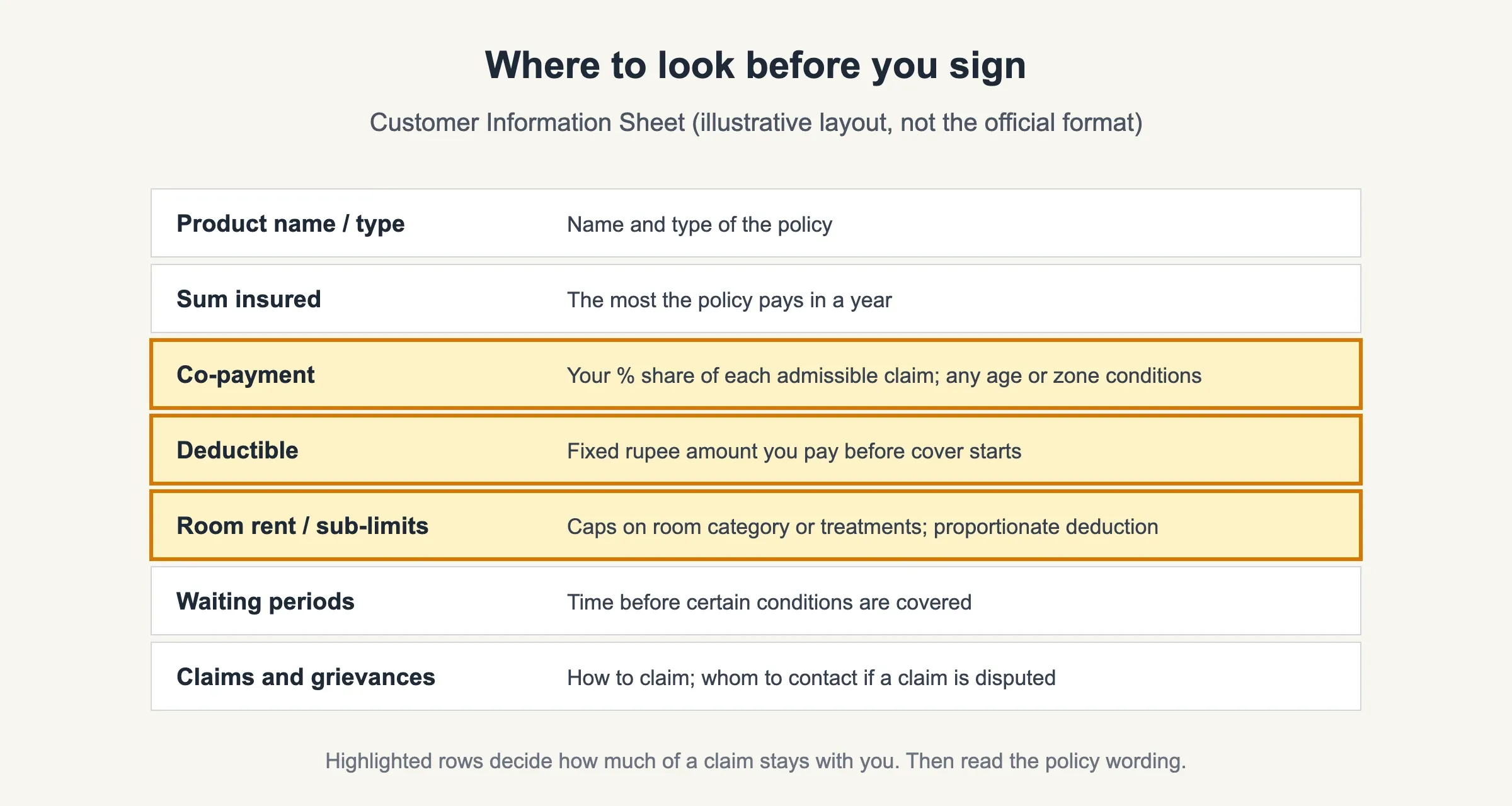
Start with the Customer Information Sheet. IRDAI's Master Circular on Health Insurance Business (29 May 2024) requires insurers to give a CIS with every policy in a set format and to take the policyholder's acknowledgement. Then read the policy wording, especially the sections on cost sharing, room-rent limits and claim settlement.
Read next
Check what your employer cover leaves out: whether employer health insurance is enough
How a super top-up's deductible works: how a super top-up deductible works
Setting money aside for your share of a claim: how much emergency fund to keep
— Laabh